 American Acorns
Regulations under the Act of June 7, 1832, printed page 3 (interrogatories to applicants)
Image · dated 1833 · source: U.S. National Archives, Revolutionary War Pension and Bounty-Land Warrant Application Files, S.18534 (Nathaniel Oak, Chelsea, Vt., later Exeter, Me.), image 4161439_00137; image supplied by the owner on 29 Sep 2026 from a library-discovery download of federal records; the exact record URL was not supplied
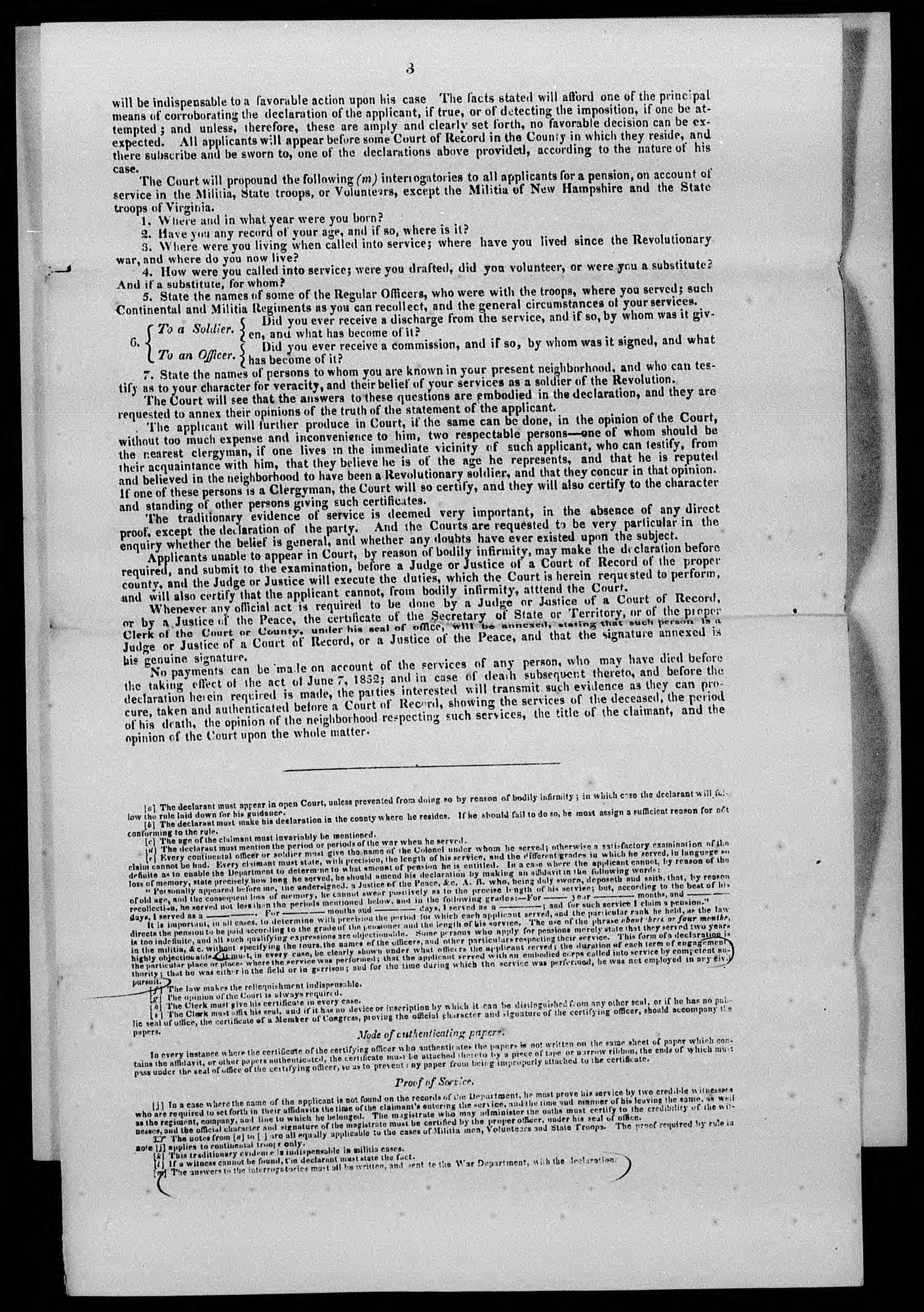
Transcription
Word-for-word transcription (spellings kept; uncertain letters in brackets).
3
[Continuation from page 2]
will be indispensable to a favorable action upon his case. The facts stated will afford one of the principal means of corroborating the declaration of the applicant, if true, or of detecting the imposition, if one be attempted; and unless, therefore, these are amply and clearly set forth, no favorable decision can be expected. All applicants will appear before some Court of Record in the County in which they reside, and there subscribe and be sworn to, one of the declarations above provided, according to the nature of his case.
The Court will propound the following (m) interrogatories to all applicants for a pension, on account of service in the Militia, State troops, or Volunteers, except the Militia of New Hampshire and the State troops of Virginia.
1. Where and in what year were you born?
2. Have you any record of your age, and if so, where is it?
3. Where were you living when called into service; where have you lived since the Revolutionary war, and where do you now live?
4. How were you called into service; were you drafted, did you volunteer, or were you a substitute? And if a substitute, for whom?
5. State the names of some of the Regular Officers, who were with the troops, where you served; such Continental and Militia Regiments as you can recollect, and the general circumstances of your services.
6. To a Soldier. Did you ever receive a discharge from the service, and if so, by whom was it given, and what has become of it?
To an Officer. Did you ever receive a commission, and if so, by whom was it signed, and what has become of it?
7. State the names of persons to whom you are known in your present neighborhood, and who can testify as to your character for veracity, and their belief of your services as a soldier of the Revolution.
The Court will see that the answers to these questions are embodied in the declaration, and they are requested to annex their opinions of the truth of the statement of the applicant.
The applicant will further produce in Court, if the same can be done, in the opinion of the Court, without too much expense and inconvenience to him, two respectable persons—one of whom should be the nearest clergyman, if one lives in the immediate vicinity of such applicant, who can testify, from their acquaintance with him, that they believe he is of the age he represents, and that he is reputed and believed in the neighborhood to have been a Revolutionary soldier, and that they concur in that opinion. If one of these persons is a Clergyman, the Court will so certify, and they will also certify to the character and standing of other persons giving such certificates.
The traditionary evidence of service is deemed very important, in the absence of any direct proof, except the declaration of the party. And the Courts are requested to be very particular in the enquiry whether the belief is general, and whether any doubts have ever existed upon the subject.
Applicants unable to appear in Court, by reason of bodily infirmity, may make the declaration before required, and submit to the examination, before a Judge or Justice of a Court of Record of the proper county, and the Judge or Justice will execute the duties, which the Court is herein requested to perform, and will also certify that the applicant cannot, from bodily infirmity, attend the Court.
Whenever any official act is required to be done by a Judge or Justice of a Court of Record, or by a Justice of the Peace, the certificate of the Secretary of State or Territory, or of the proper Clerk of the Court or County, under his seal of office, will be annexed, stating that such person is a Judge or Justice of a Court of Record, or a Justice of the Peace, and that the signature annexed is his genuine signature.
No payments can be made on account of the services of any person, who may have died before the taking effect of the act of June 7, 1832; and in case of death subsequent thereto, and before the declaration herein required is made, the parties interested will transmit such evidence as they can procure, taken and authenticated before a Court of Record, showing the services of the deceased, the period of his death, the opinion of the neighborhood respecting such services, the title of the claimant, and the opinion of the Court upon the whole matter.
[a] The declarant must appear in open Court, unless prevented from doing so by reason of bodily infirmity; in which case the declarant will follow the rule laid down for his guidance.
[b] The declarant must make his declaration in the county where he resides. If he should fail to do so, he must assign a sufficient reason for not conforming to the rule.
[c] The age of the claimant must invariably be mentioned.
[d] The declarant must mention the period or periods of the war when he served.
[e] Every continental officer or soldier must give the name of the Colonel under whom he served; otherwise a satisfactory examination of the claim cannot be had. Every claimant must state, with precision, the length of his service, and the different grades in which he served, in language so definite as to enable the Department to determine to what amount of pension he is entitled. In a case where the applicant cannot, by reason of the loss of memory, state precisely how long he served, he should amend his declaration by making an affidavit in the following words:
“Personally appeared before me, the undersigned, a Justice of the Peace, &c. A. B. who, being duly sworn, deposeth and saith, that, by reason of old age, and the consequent loss of memory, he cannot swear positively as to the precise length of his service; but, according to the best of his recollection, he served not less than the periods mentioned below: and in the following grades:—For [blank] year [blank] months, and [blank] days, I served as a [blank]. For [blank] months and [blank] days, I served as a [blank]; and for such service I claim a pension.”
It is important, in all cases, to determine with precision the period for which each applicant served, and the particular rank he held, as the law directs the pension to be paid according to the grade of the pensioner and the length of his service. The use of the phrase about three or four months, is too indefinite, and all such qualifying expressions are objectionable. Some persons who apply for pensions merely state that they served two years in the militia, &c. without specifying the tours, the names of the officers, and other particulars respecting their service. This form of a declaration is highly objectionable. It must, in every case, be clearly shown under what officers the applicant served; the duration of each term of engagement; the particular place or places where the service was performed; that the applicant served with an embodied corps called into service by competent authority; that he was either in the field or in garrison; and for the time during which the service was performed, he was not employed in any civil pursuit.
[f] The law makes the relinquishment indispensable.
[g] The opinion of the Court is always required.
[h] The Clerk must give his certificate in every case.
[i] The Clerk must affix his seal, and if it has no device or inscription by which it can be distinguished from any other seal, or if he has no public seal of office, the certificate of a Member of Congress, proving the official character and signature of the certifying officer, should accompany the papers.
Mode of authenticating papers.
In every instance where the certificate of the certifying officer who authenticates the papers is not written on the same sheet of paper which contains the affidavit, or other papers authenticated, the certificate must be attached thereto by a piece of tape or narrow ribbon, the ends of which must pass under the seal of office of the certifying officer, so as to prevent any paper from being improperly attached to the certificate.
Proof of Service.
[j] In a case where the name of the applicant is not found on the records of the Department, he must prove his service by two credible witnesses who are required to set forth in their affidavits the time of the claimant’s entering the service, and the time and manner of his leaving the same, as well as the regiment, company, and line to which he belonged. The magistrate who may administer the oaths must certify to the credibility of the witnesses, and the official character and signature of the magistrate must be certified by the proper officer, under his seal of office.
The notes from [a] to [i] are all equally applicable to the cases of Militia men, Volunteers and State Troops. The proof required by rule in note [j] applies to continental troops only.
[k] This traditionary evidence is indispensable in militia cases.
[l] If a witness cannot be found, the declarant must state the fact.
[m] The answers to the interrogatories must all be written, and sent to the War Department, with the declaration.
How it is shown: Complete image as supplied; no crop, no retouch, no search highlight.
Keep in mind: Part of pension file S.18534 (Chelsea, Vt.; later Maine). The file is a Confirmed record of the Chelsea pensioner; his identification with Nathaniel Oak born 1751 (parents John and Susanna) is the existing reviewed account and stays qualified. Do not merge this file with the Athens pension W.25398. Printed regulations; continuation of scan 00136.