 American Acorns
Sources and evidence key
Evidence labels
Each fact, and each parent-child or partner relationship, carries one of three labels. A label rates that one statement, never a whole person, family or source.
- Confirmed Evidence directly supports this specific statement, the person or relationship is confidently identified, and no material contradiction remains.
- Likely The evidence makes a coherent case, but the identification or the relationship is indirect, or a material gap remains.
- Unconfirmed There is not enough evidence for the statement, or records conflict too much for a stronger label. Unconfirmed does not mean disproved.
Open a label for the reason, linked records and review date. The note states whether the evidence was read as an image, index, transcription, printed copy, memorial or family account. Earlier assessments remain available when a conclusion changes.
Entries from the family tree that nobody has reviewed yet are Unconfirmed. Their explanation says "not yet reviewed" and lists any records the tree attaches to them.
Family tradition marks a story handed down in the family. It says where a statement comes from, not how sure it is: that a tradition was printed in 1906 can be Confirmed while the events it describes stay Unconfirmed.
Family recollection identifies an account remembered by a family member. Each factual claim keeps its evidence label. Contributions are credited according to the contributor's permission.
Rejected candidates, such as parents that online trees copy without a source, are left out of the family tree and its charts. The person's page says what was rejected and why.
In the tree charts
Each line in a chart joins a parent and a child: a solid line is a Confirmed link, a dashed line a Likely one and a dotted line an Unconfirmed one. Downloaded images and PDFs carry the same key. A line describes the link, not the people in the boxes.
Find a Grave memorials
When a person is confidently matched to an existing Find a Grave memorial, their page links to it beside the burial and under Sources. A memorial is a volunteer-contributed page: its dates, inscription transcription and family links are the contributor's. The link is a place to look, not proof of every detail on the page, and each fact keeps its evidence label.
Printed Massachusetts town vital records are copies of the original town books; the original books were not viewed. A modern family keepsake, such as the challenge coin, is a symbol and not a source. Claims that trees online repeat without a source are not used.
The Oak line
- H. L. Oak, Oak-Oaks-Oakes: Family Register: Nathaniel Oak of Marlborough, Mass., and Three Generations of His Descendants (Los Angeles: Out West Co., 1906), especially pp. 7-8. Public domain; read the whole book: PDF, from the copy at the Internet Archive (also on the Downloads page)
- Vital Records of Marlborough, Massachusetts, to the End of the Year 1849 (printed), p. 142. Cited without a link.
- Vital Records of Westborough, Massachusetts, to the End of the Year 1849 (printed), p. 81. Cited without a link.
- Revolutionary War pension file S.18534, Nathaniel Oak, National Archives microfilm M804, roll 1836. Cited without a link.
- Middlesex County, Mass., probate cases 16185 and 16186 (1722): Index to the Probate Records of the County of Middlesex, Massachusetts, First Series (Cambridge, 1914), p. 352, archive.org/details/indextoprobatere1870fols (page image on the Downloads page). Worcester County, Mass., probate case 44119 (1752), index; cited without a link.
- Maine death record of Samuel Oak, 1900, Maine State Archives. Cited without a link.
- Oak family monument, Crowell Cemetery, Exeter, Maine, and the Piscataquis Observer, 6 October 1859. Cited without a link.
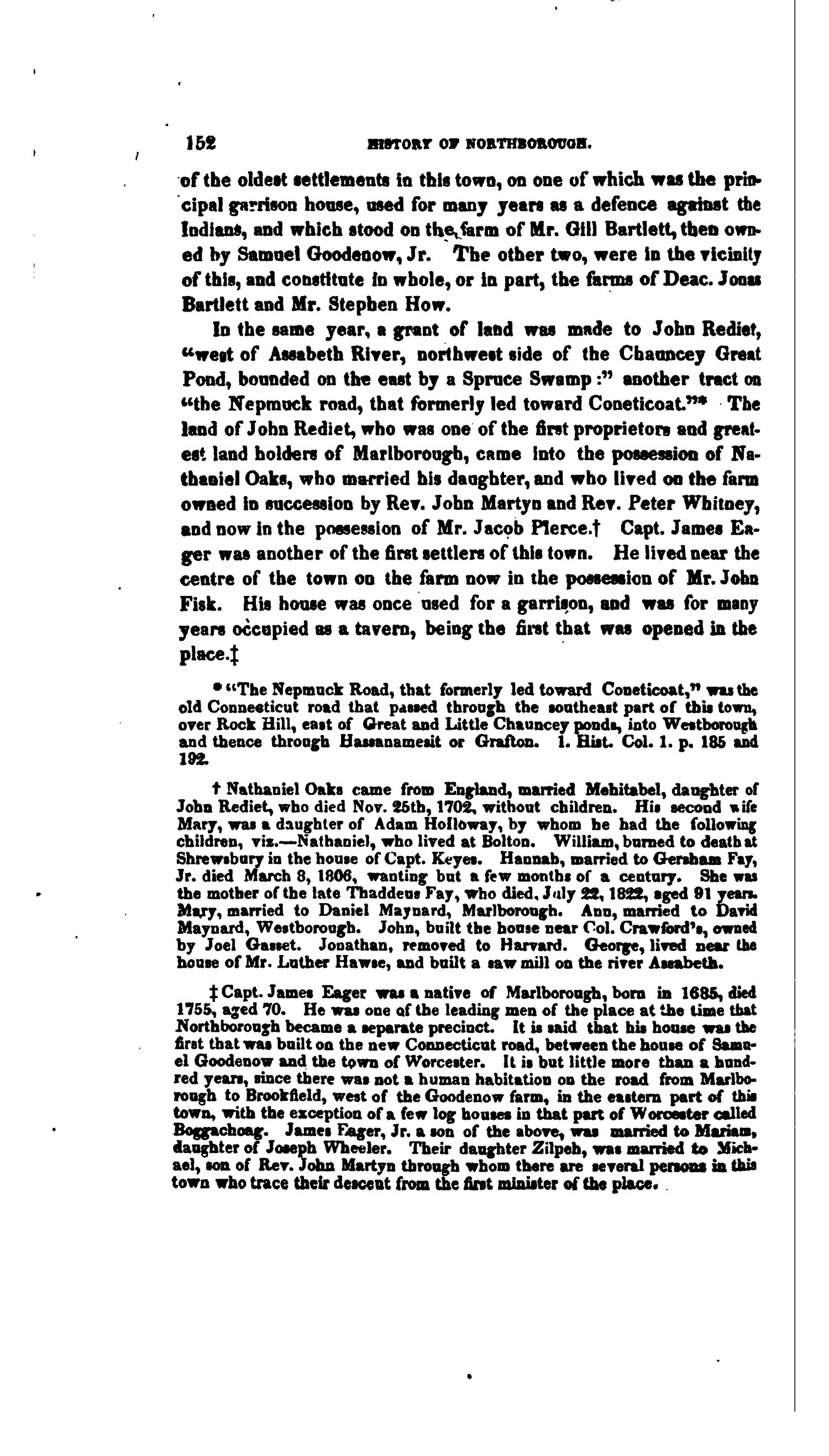
- Worcester Magazine, vol. 2 (1826), p. 152. archive.org/details/worcestermagazi00unkngoog
- Charles Hudson, History of the Town of Marlborough (Boston, 1862), p. 426. archive.org/details/historyoftownofm00huds
The Clarkson family of Liverpool
- St Paul's Church, Liverpool, marriage register, 6 July 1854.
- All Saints Church, Liverpool, baptism register, 22 June 1858, entry 989.
- St Chad's, Poulton-le-Fylde, marriage of Thomas Clarkson and Nancy Banton, 1 February 1827 (transcription).
- General Register Office death index, Toxteth Park, December quarter 1910.
- Allerton cemetery burial, 13 February 1915 (transcription).
- Houston Daily Post, 29 May 1901 (Chronicling America, Library of Congress): chroniclingamerica.loc.gov/lccn/sn86071197/1901-05-29/ed-1/
The registers are cited without links; no public page for them is recorded.
William Banton Clarkson's life in Texas, from 1884 to 1933, rests on his 1921 passport application, his death certificate, English and U.S. censuses and San Antonio and Houston newspapers from 1888 to 1933. His profile lists each one, with links to the newspaper pages on the Portal to Texas History and the Library of Congress. Newspaper reports of lawsuits and bankruptcy petitions are cited as reports: they are not findings about the outcome.
Research incorporated in September 2026
Reviewed additions appear on individual person pages with their sources and evidence labels. Records & photos includes the source catalogue. The family-tree snapshot and research updates are dated separately.
Research findings and evidence (PDF)
Two dated reports collect the earlier findings, source images, citations and unresolved points: Oak findings O01–O80 and Clarkson findings C01–C60. Newer person pages may contain later evidence.
To suggest a correction, include the person, finding ID if available, proposed change and source citation, with a page or image number. Explain how the record identifies the person. Use the research request form; signed-in family members can also share a memory or document.
Living people and recent generations
Public pages contain family material released for this history. Additional family contributions are available after sign-in.
Images
- Pages 7 and 8 of the 1906 register: from the Internet Archive scan of a book published in 1906.
- The Oak family challenge coin: a modern family keepsake, shown with the family's permission.