 American Acorns
About this project
A bronze coin, a family keepsake, carries the Oak family's oldest story in miniature: a young man with a pine knot over his shoulder, a wildcat above him on a rock, two sheep grazing below, waves meeting New England pines, and three spellings of the family name, Oak, Oaks and Oakes, around a Latin motto, Ex glande quercus magna crescit — "From the acorn the mighty oak grows." The coin's reverse gives a date, "Est. 1660." The coin's pictures and the family account behind them are on Nathaniel Oak and the cabin-boy story.
That date raised the question behind much of the research on this site: where does "1660" come from, and does the evidence support it?
A new crest, and a different date
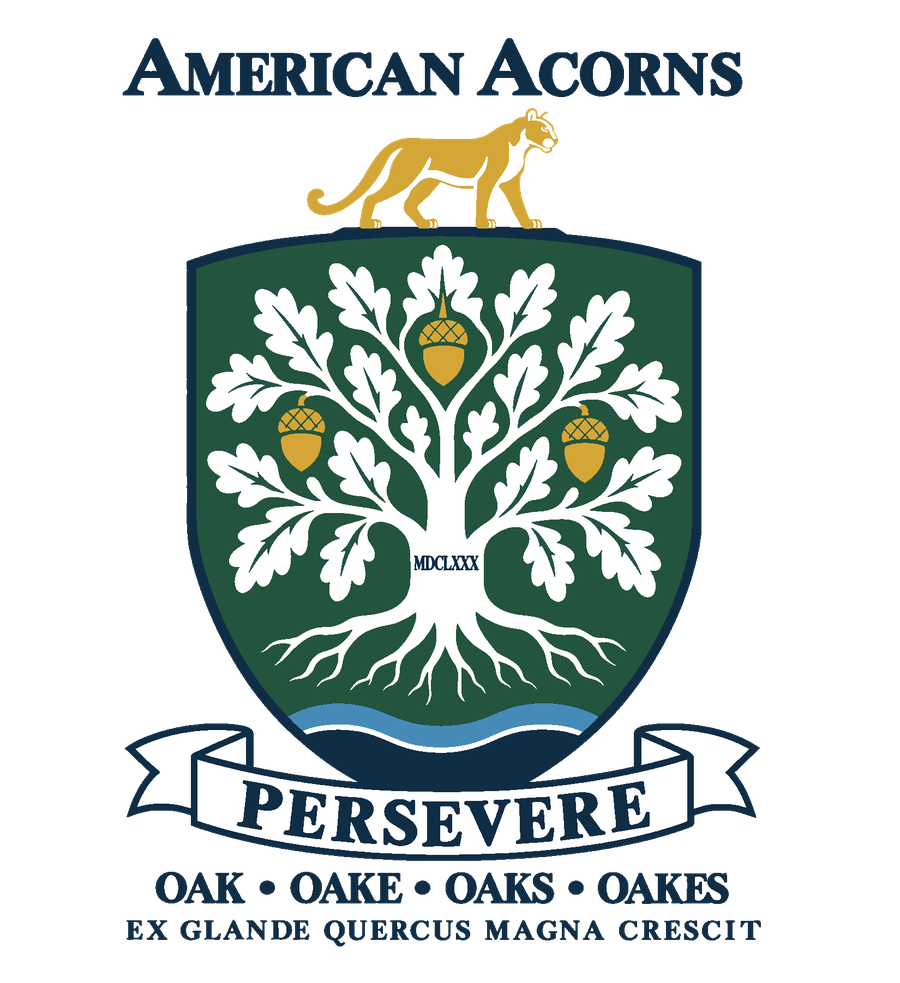
The site's mark is a new crest, not the coin: a green shield with a white oak and three gold acorns, a gold cougar standing above it, a wave below, and a ribbon reading "Persevere." It carries a fourth spelling the coin does not, Oake, alongside Oak, Oaks and Oakes. On the trunk of the oak is a different date, in Roman numerals: MDCLXXX, 1680.
The coin and the crest give two different dates for the same uncertain fact. The coin's "1660" is an estimate printed in two books, of 1905 and 1906; it is not a record of an arrival, only a number written down nearly two and a half centuries after the fact. No record of an arrival year has been found. The tax list of 1688 and the garrison list of 1692 place Nathaniel Oak at Marlborough, Massachusetts by those dates; neither says when he arrived, and an earlier 1686 marriage is also separately recorded, though only as a Likely identification. A Lewiston newspaper of 1899, the earliest printed telling of the shipwreck story found so far, says he "appeared in Marlboro about 1680." That describes his presence at Marlborough, not an arrival from overseas, so as an arrival year it is Unconfirmed.
So "1680" on the crest is the family's adopted working estimate, not a documented year of arrival, chosen while reconsidering the coin's older "1660." No record points to 1680 in particular, and none rules out a later arrival by someone born about 1645. The reasoning, and its assumptions, are set out on Nathaniel Oak and the cabin-boy story; the date stays Unconfirmed.
One database, many sources
American Acorns builds on an export of the family's Family Tree Maker file, built up over years from records and hints from Ancestry.com and others. The site reads that export, and its media, without changing them, and adds reviewed research as a separate collection: FamilySearch, Newspapers.com, Fold3, the Internet Archive, and the catalogs and reading rooms of libraries and archives all feed into it, alongside released family photographs and memories. None of this changes the family historian's FTM file; a correction reaches it only when he enters it there.
AI assistants do much of the legwork behind a story like this one: reading page images and transcribing them, searching newspapers, pension files, probate records and census pages for a name, and drafting the narrative from what those searches turn up. They do not work unchecked. New stories are meant to be read by an independent reviewer before they are published, who compares the draft against the page images as far as they are available, and the published story says so when a particular image could not be checked. Not every older page has had that review yet; they are checked as they are revised.
The site uses three confidence labels: Confirmed, where the evidence directly supports that specific statement, the person or relationship is confidently identified, and no material contradiction remains; Likely, where the evidence makes a coherent case but the identification is indirect or a material gap remains; and Unconfirmed, where there is not enough evidence, or the records conflict too much for a stronger label. A fourth marker, Family tradition, is different in kind: it says where a statement comes from, not how sure it is. A tradition printed in a 1906 book can itself be Confirmed as print, while the events it describes stay Unconfirmed. A record can be read correctly and still be about someone else, so the site labels what a record says separately from whether the person it names belongs to this family. The standard on this site is that every citation has a saved image of its source, not a transcription alone; bringing older citations up to that standard is ongoing work.
Mistakes get found this way, and corrected openly rather than quietly patched. On the story of the family's branch at Chelsea, Vermont, Susannah Oak's death card was first read and published with its day of death given as the 7th; a closer, independent reading found the handwritten digit illegible. The story now says so and labels the day Unconfirmed. It stands that way today on Captain Nathaniel Oak of Chelsea, Vermont.
Reading the site, and helping with it
Most of the site is public: the stories, each person's profile page, the sources and evidence key, the family tree itself at whatever depth a reader wants to follow it, and released family photographs and memories. Some additional material requires family sign-in: some photographs and memories are kept there rather than released publicly, for reasons specific to each item. A memory or photograph someone submits is not released automatically either way; it is saved privately in an editorial inbox for the family historian to review before it reaches either a public page or the family area.
If something on the site looks wrong, or a reader has a source, a lead or a correction to offer, the research request form takes it without any sign-in. It is saved privately for the family historian to review; submitting it does not publish anything or set research in motion on its own. Family members with something more personal to add, such as a memory, a photograph, or help saying who is in one, can share it after signing in.
The AI assistants that help build this site do not contact anyone outside it: no email, no phone calls, no outreach to an archive, a relative or a stranger on the family's behalf. The family historian handles any contact that needs to happen.
Sources
- The challenge coin, its imagery and "Est. 1660," the 1905 book's "about 1660" and the 1906 register's "about 1660 to 1665": Nathaniel Oak and the cabin-boy story.
- The 1686 marriage, the 1688 Marlborough tax list, the 1692 garrison list and the 1899 Lewiston newspaper's "about 1680": the same story, where each is cited with its own source.
- The new crest: /assets/img/crest-full.png and /assets/img/crest.svg, held on this site.
- The Chelsea death-card correction: Captain Nathaniel Oak of Chelsea, Vermont.