 American Acorns
Col. Calvin Sanger Douty: Dover's sheriff and the First Maine Cavalry
Calvin Sanger Douty was sheriff of Piscataquis County, Maine, when the Civil War began. He was nearly fifty, with a wife and young children, and he could have stayed home. Instead he resigned his office, became major of the First Maine Cavalry in October 1861, and in March 1863 was made its colonel. He was killed leading the regiment's charge at Aldie, Virginia, on June 17, 1863. He was a grandson of Captain Jonathan Oak, the son of the immigrant Nathaniel, and he appears with the other Oak-line soldiers in Oak-line military service.
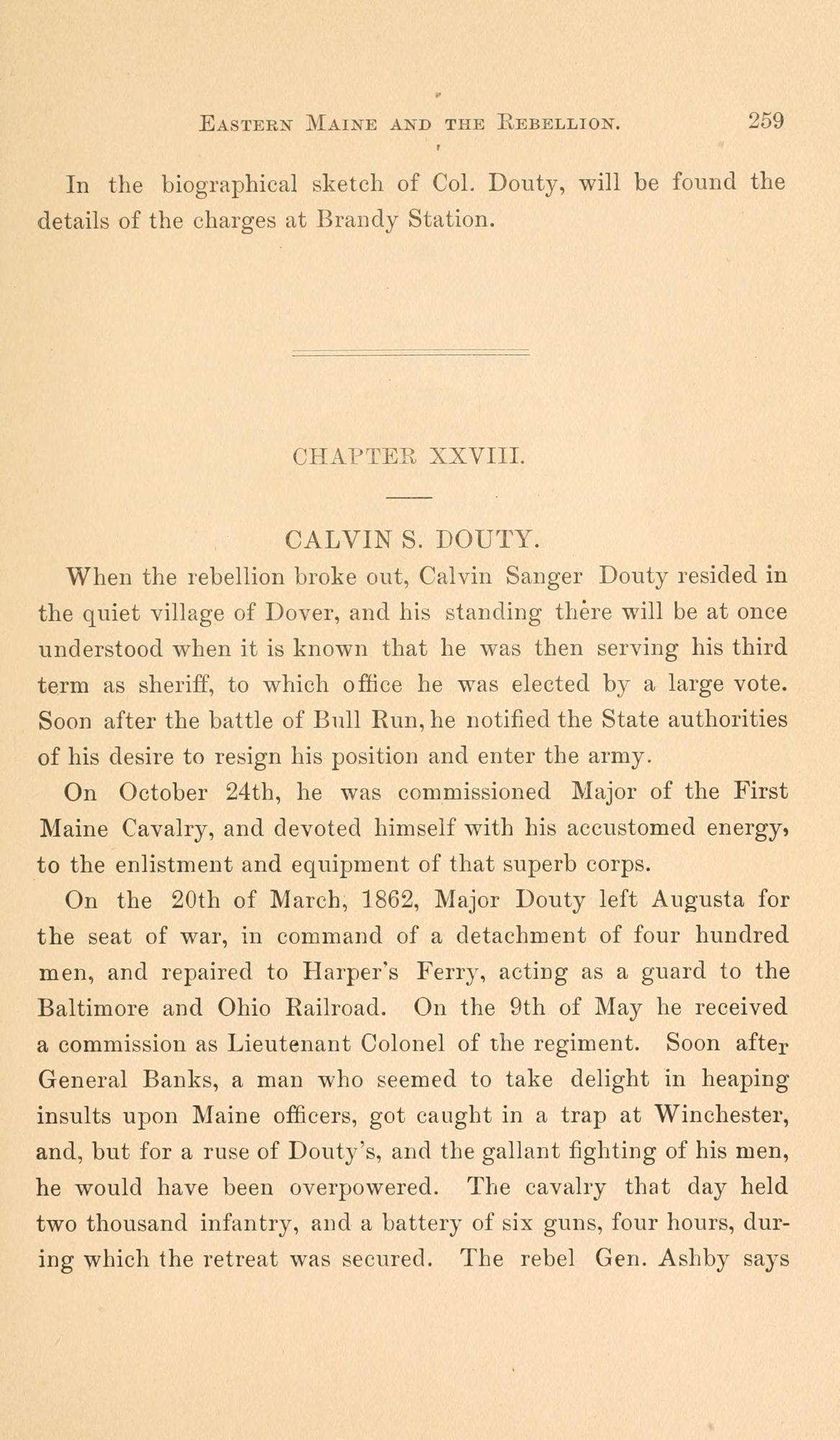
Two books printed in 1887 tell most of his story, and their pages are shown below: Edward P. Tobie's History of the First Maine Cavalry, written for the regiment's veterans, and Ruel H. Stanley and George O. Hall's Eastern Maine and the Rebellion, which gives him a chapter.
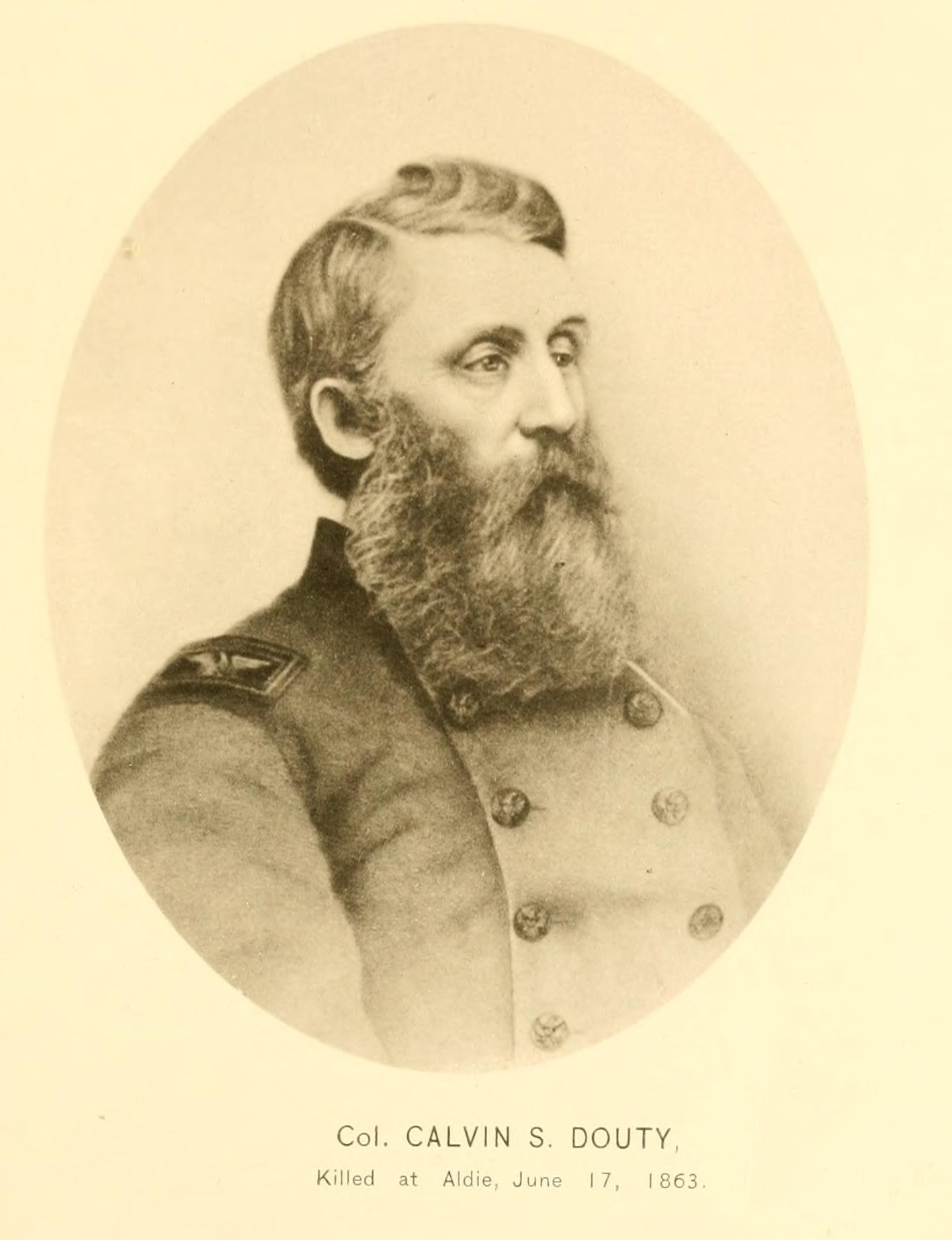
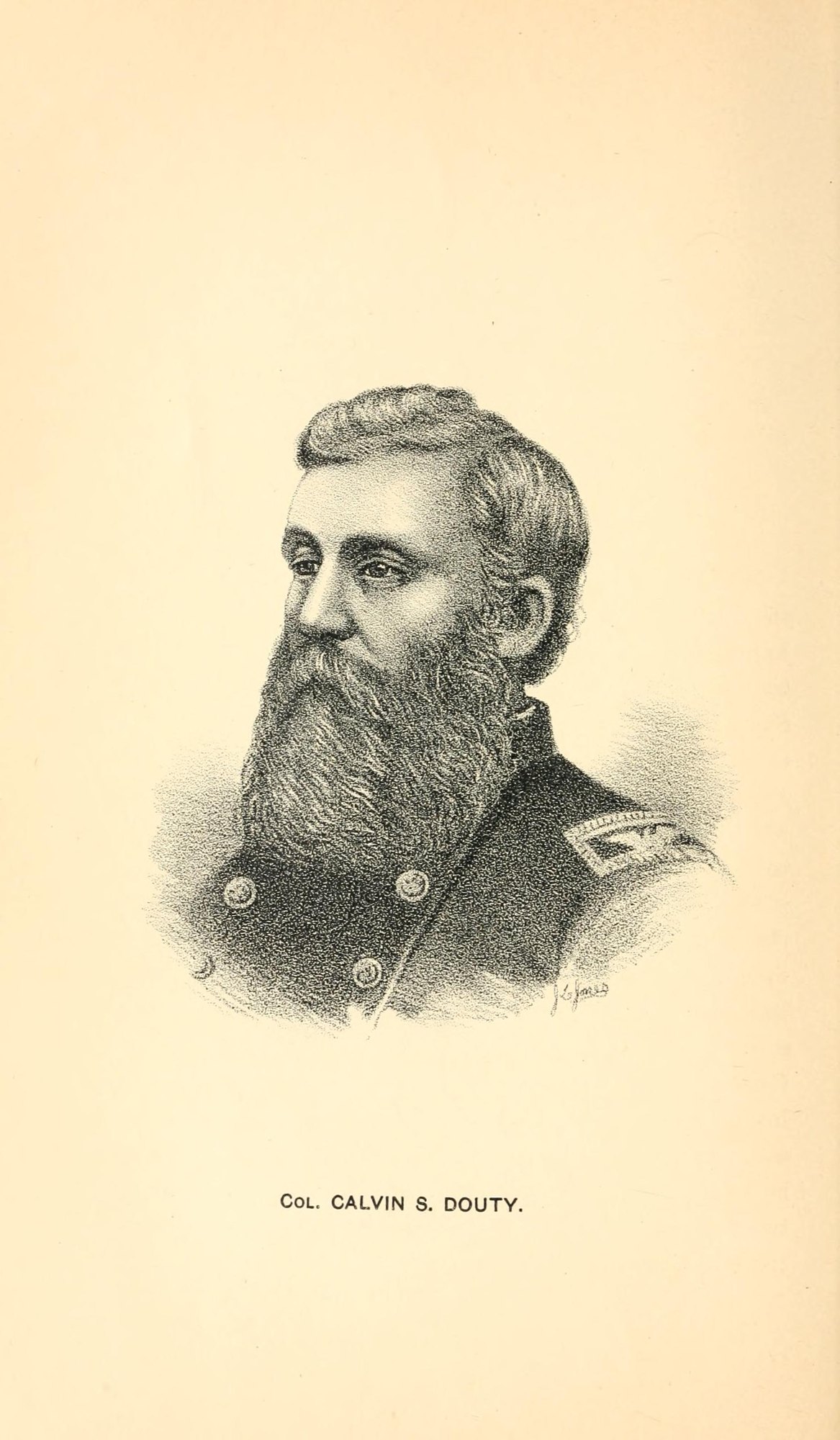
Source: Ruel H. Stanley and George O. Hall, Eastern Maine and the Rebellion, 1887 (Internet Archive)
Image details
Sangerville and Dover
The 1906 family register gives his life in a few lines (no. 181, pp. 52-53; the family heading, "Children of David and Lucy Oaks," is on p. 52). He was the son of David Douty and Lucy Oaks, the daughter of Captain Jonathan, and was born at Sangerville on December 10, 1811. He was a "farmer and surveyor," married on June 15, 1845, moved to Guilford that year and to Dover in 1853, and was "Deputy Sheriff and twice Sheriff of Piscataquis county." His wife was "Emily Cummings Bailey, of 'Mayflower' stock," who died in 1892; they had "1 child, and 6 who died young." The surviving son was Frank S. Douty of San Francisco. One of his sister Abigail's sons was Gen. D. D. Colton of San Francisco, who, the register says, was "associated with Huntington, Hopkins, Stanford and Crocker in building the Central Pacific railroad."
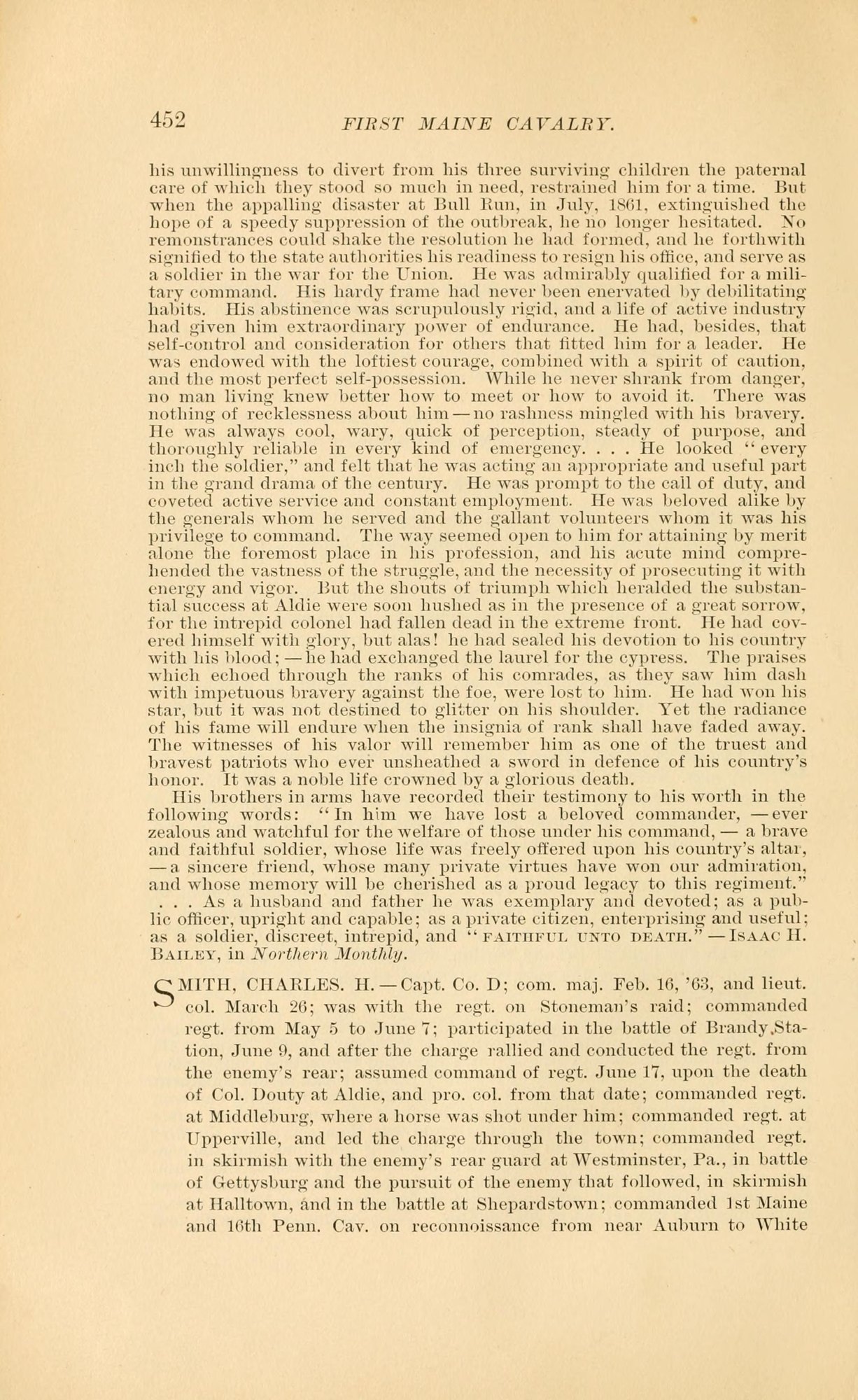
Tobie's regimental history, quoting a sketch by Isaac H. Bailey in the Northern Monthly, says Douty "had thrice been elected sheriff of his native county, and was then serving in the first year of his third term" when the war began (pp. 451-452). Stanley and Hall agree that he was "then serving his third term as sheriff, to which office he was elected by a large vote" (p. 259). The sources differ on his age: the register's birth date would make him 51 at his death, his monument says 50, and Tobie's roster gives his age as 48 when he was commissioned in 1861.
Enlisting, 1861
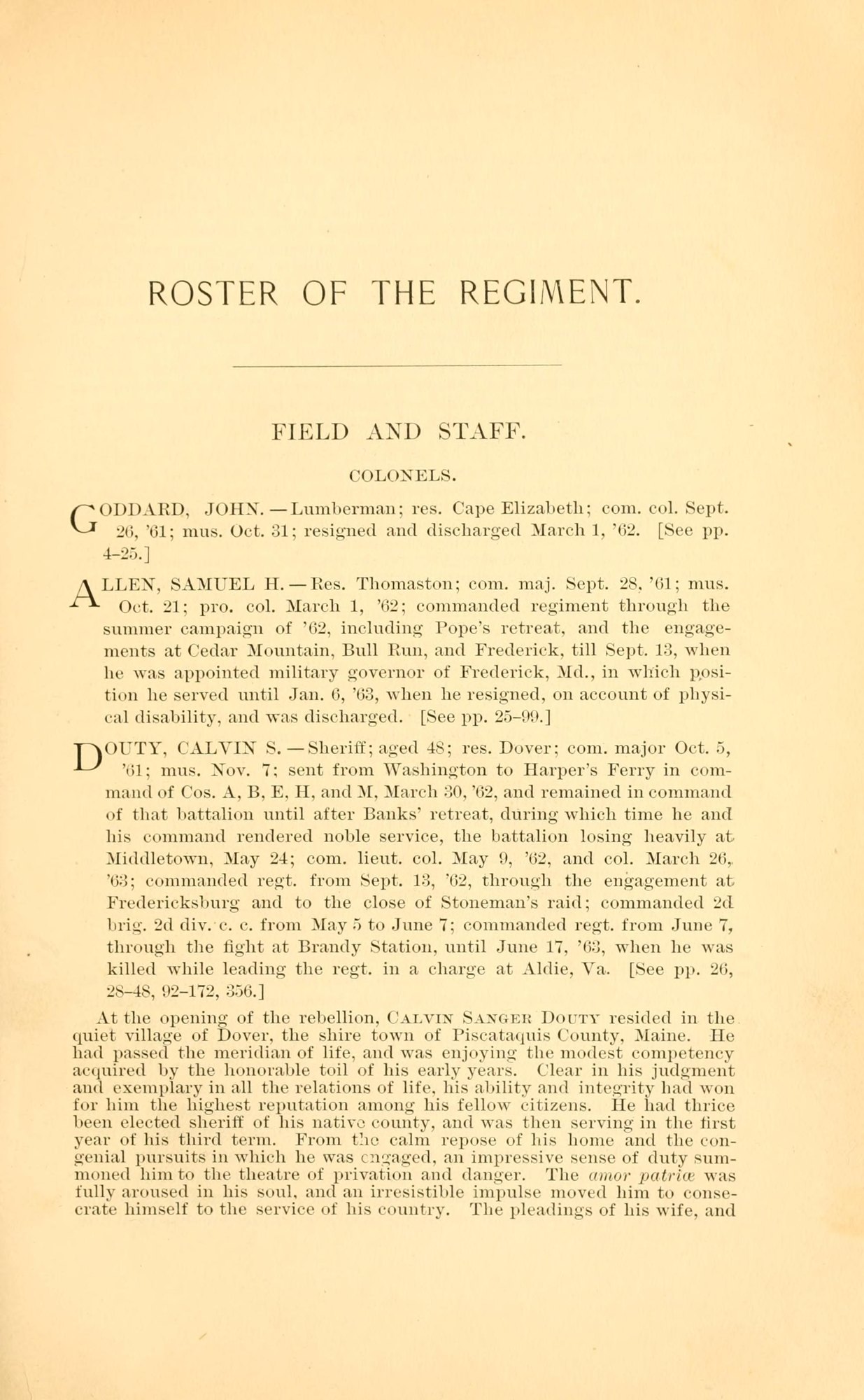
According to Bailey's sketch, "the pleadings of his wife, and his unwillingness to divert from his three surviving children the paternal care of which they stood so much in need, restrained him for a time. But when the appalling disaster at Bull Run, in July, 1861, extinguished the hope of a speedy suppression of the outbreak, he no longer hesitated." He offered the state his resignation as sheriff. Tobie's roster dates his commission as major October 5, 1861, and his muster November 7; Stanley and Hall date the commission October 24 (Tobie, p. 451; Stanley and Hall, p. 259). He was commissioned lieutenant colonel on May 9, 1862, and colonel on March 26, 1863.
Source: Edward P. Tobie, History of the First Maine Cavalry, 1861-1865, 1887 (Internet Archive)
Image details
Source: Edward P. Tobie, History of the First Maine Cavalry, 1861-1865, 1887 (Internet Archive)
Image details
Middletown, May 24, 1862
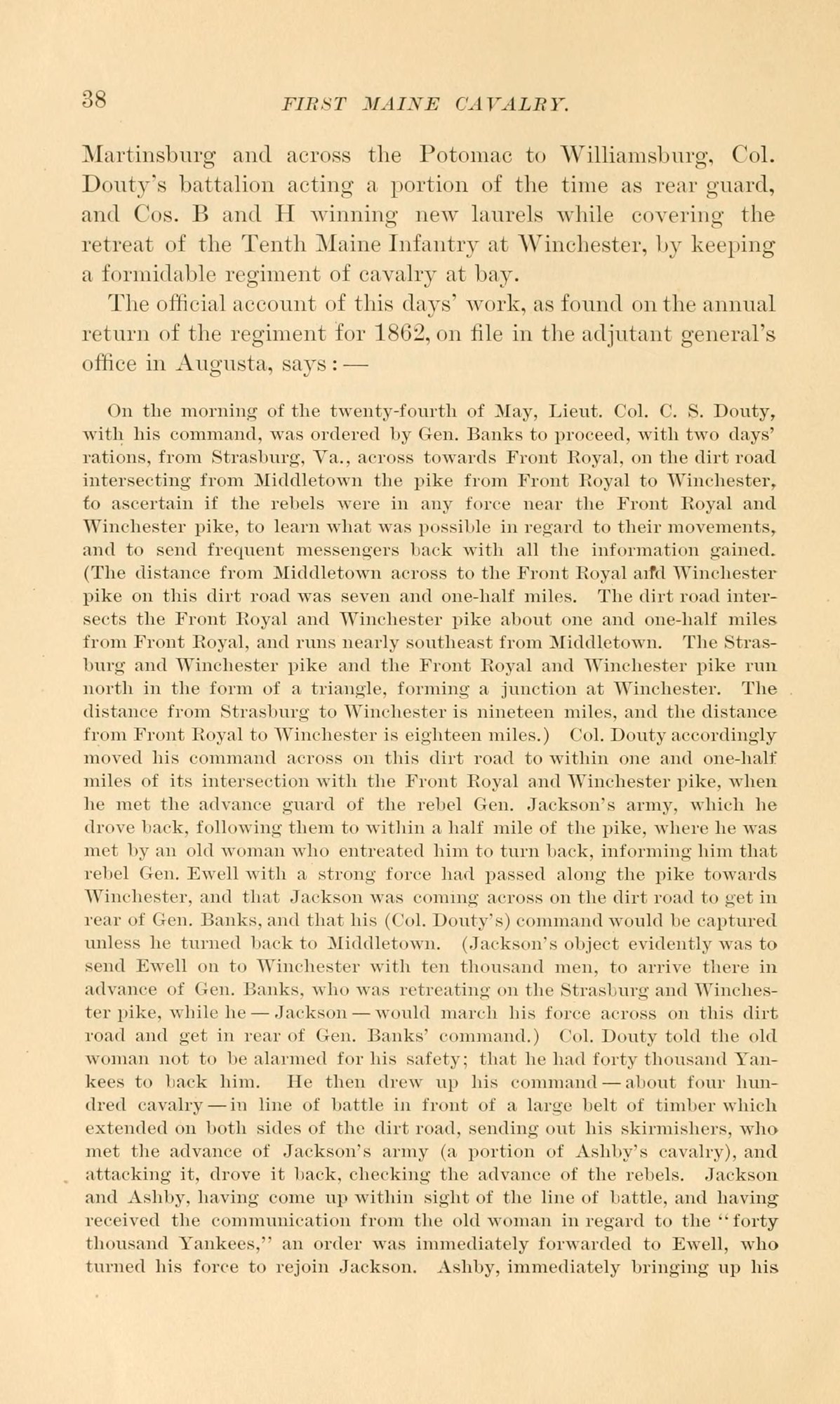
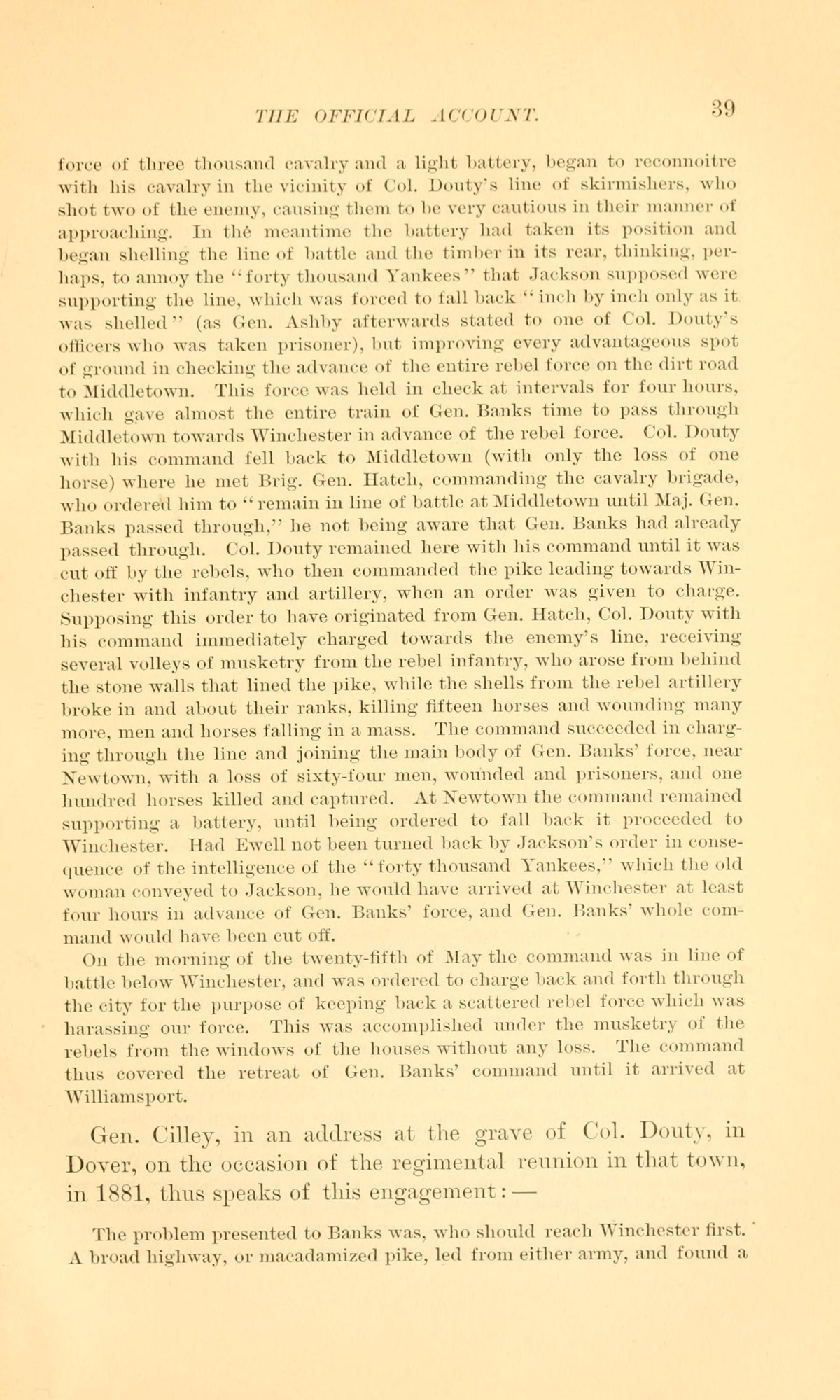
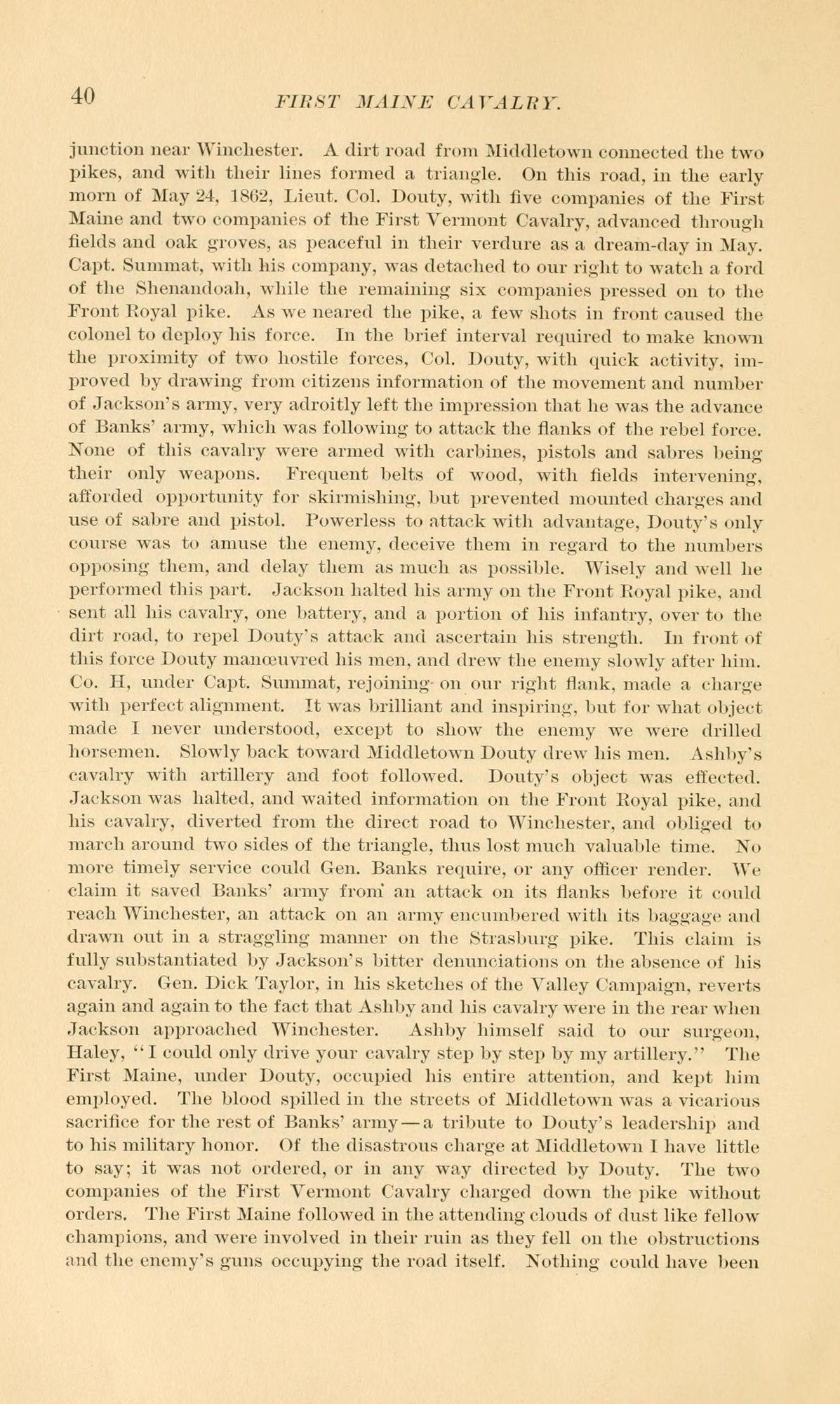
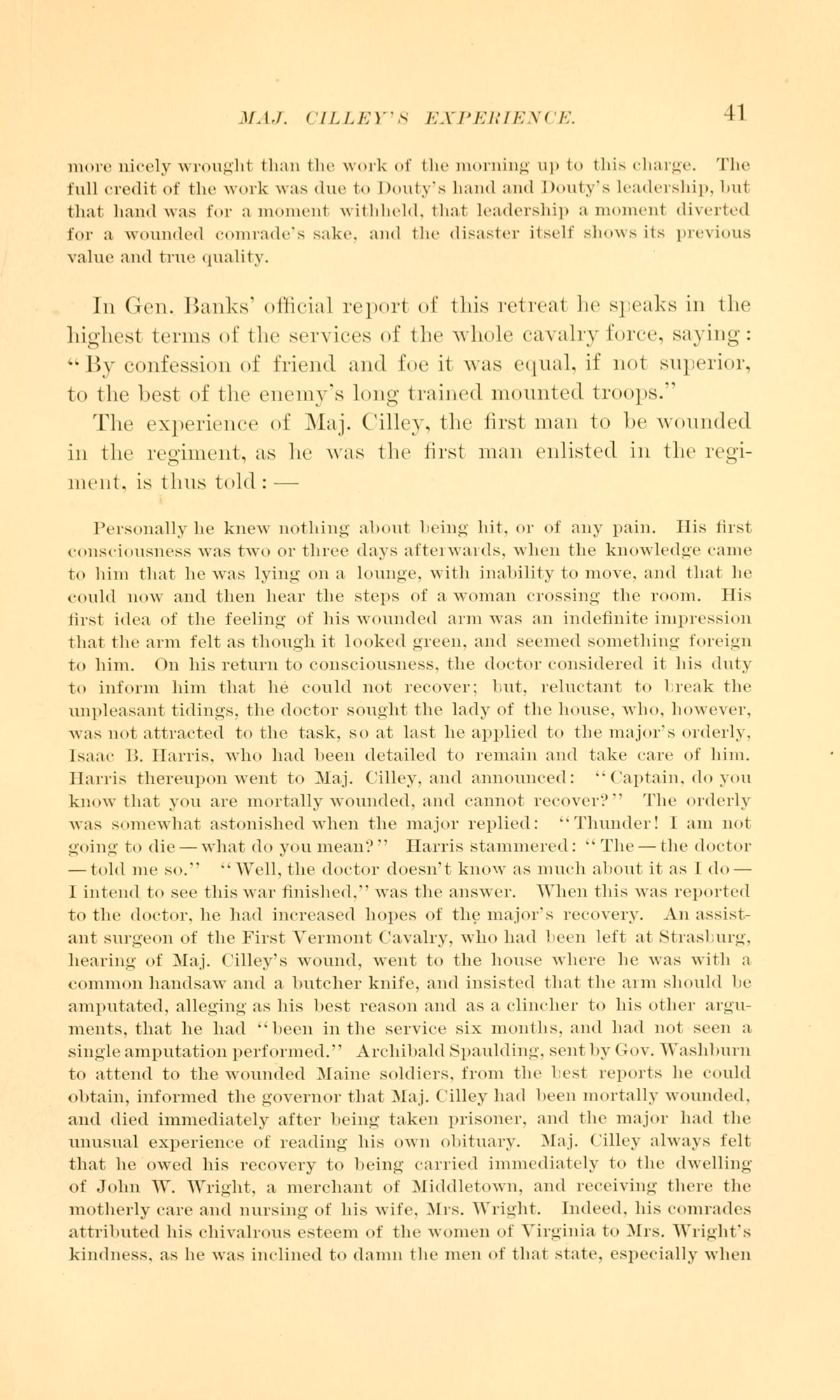
In March 1862 Douty took five companies of the regiment from Washington to Harper's Ferry. On May 24, near Middletown in the Shenandoah Valley, Stonewall Jackson was racing General Nathaniel Banks's army for Winchester, and Douty's battalion, with two companies of Vermont cavalry, was sent down a dirt road toward the Front Royal pike to find the enemy and hold him. Tobie says they met Turner Ashby's force, "some three thousand cavalry and a battery," and held it "for some hours," falling back slowly to Middletown; Ashby, "as he afterwards said," found them "stubborn as mules" and thought there must be more troops behind them (pp. 34-35). Stanley and Hall put it as two thousand infantry and a battery of six guns held for four hours, and write that "the rebel Gen. Ashby says that Col. Douty's cavalry saved Bank's army" (pp. 259-260).
The day ended badly. Ordered on toward Winchester, the column came suddenly on a Confederate battery in a narrow road, and "the consequences were frightful": men and horses were piled up in the road (pp. 36-37). The battalion then served at times as rear guard on the retreat through Winchester and Martinsburg to the Potomac (p. 38). Tobie prints the official account of the day from the regiment's annual return for 1862, and the address Gen. Cilley gave at Douty's grave in Dover at the regiment's 1881 reunion. Cilley said the charge of the two Vermont companies down the pike "was not ordered, or in any way directed by Douty," and that "the full credit of the work was due to Douty's hand and Douty's leadership, but that hand was for a moment withheld, that leadership a moment diverted for a wounded comrade's sake" (pp. 38-41).
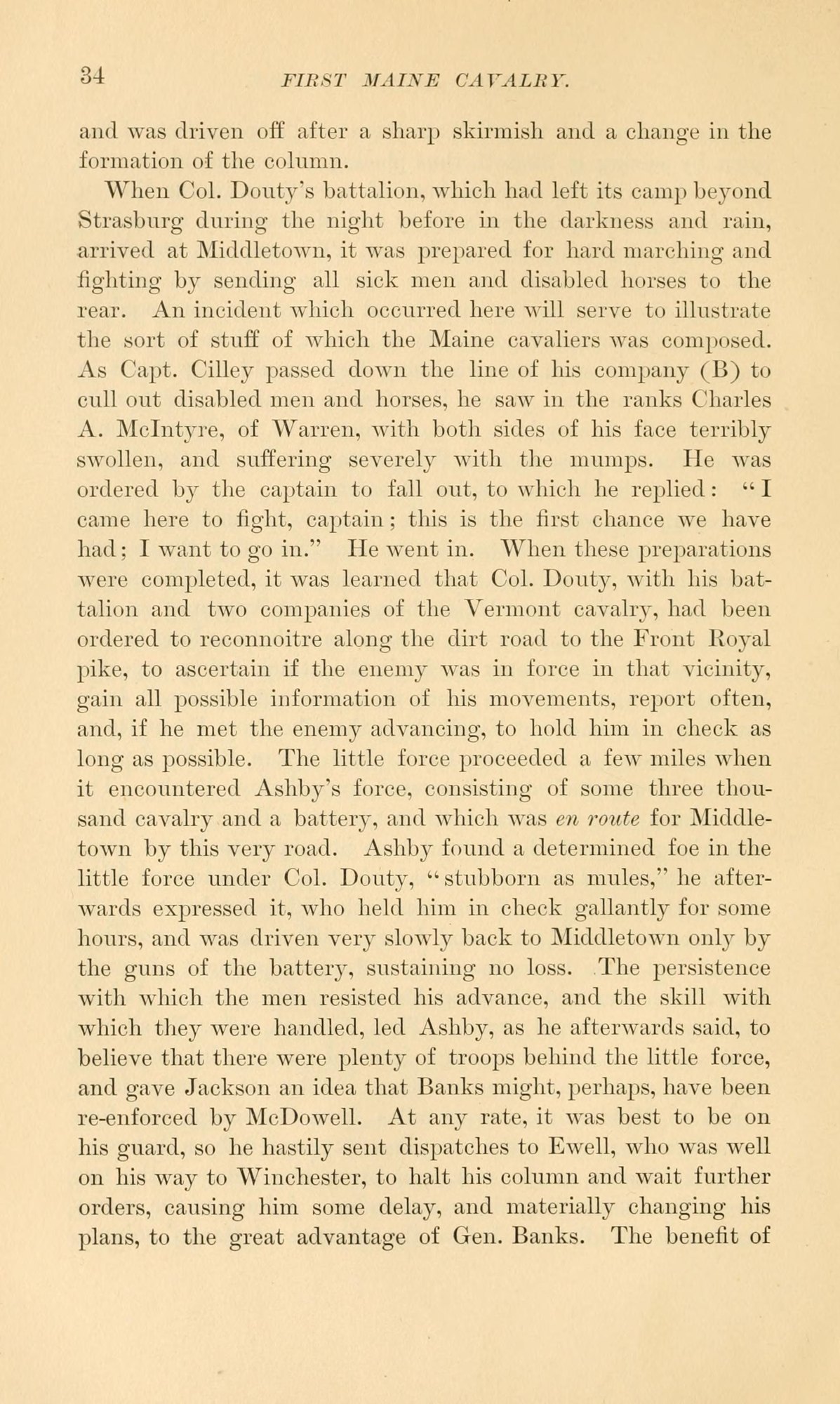
Source: Edward P. Tobie, History of the First Maine Cavalry, 1861-1865, 1887 (Internet Archive)
Image details
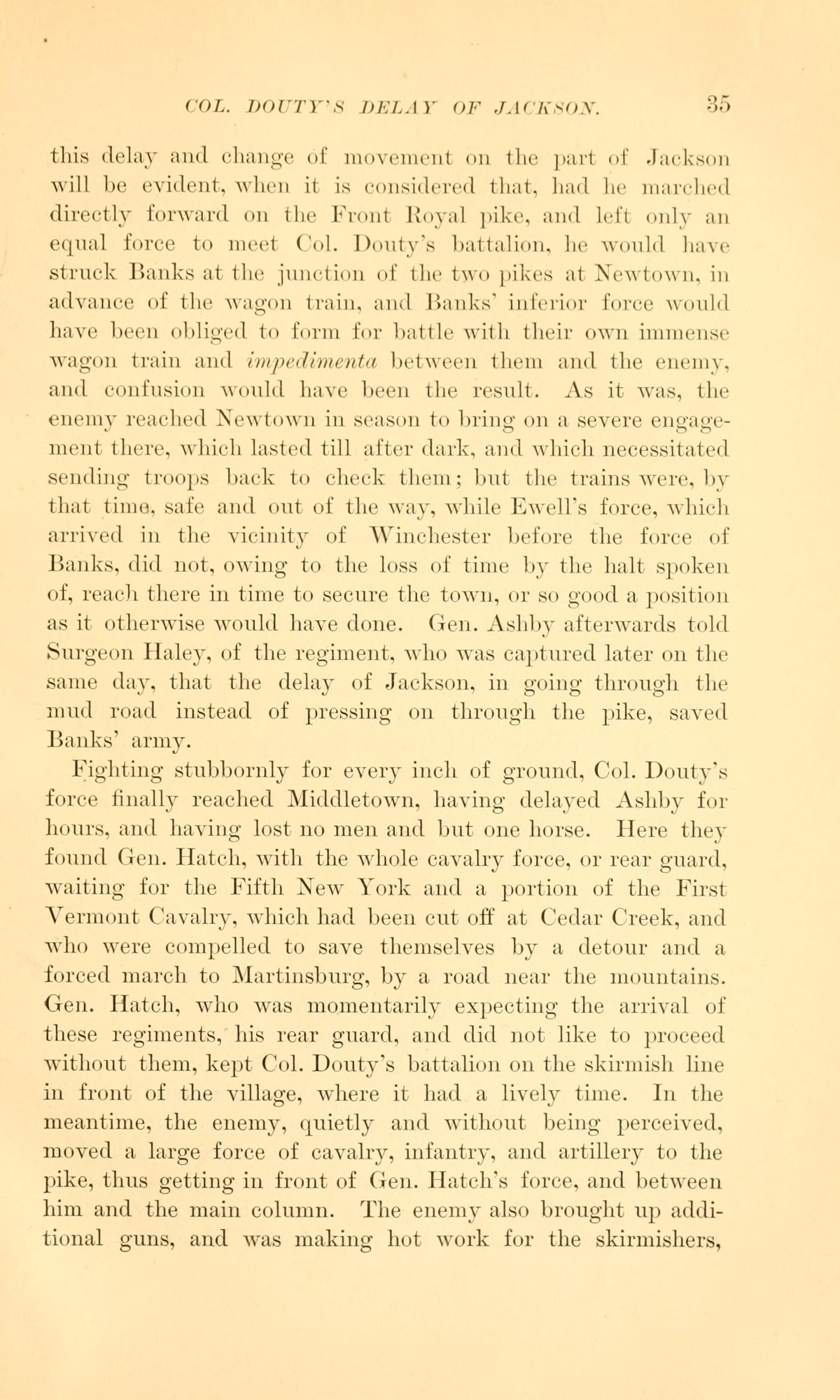
Source: Edward P. Tobie, History of the First Maine Cavalry, 1861-1865, 1887 (Internet Archive)
Image details
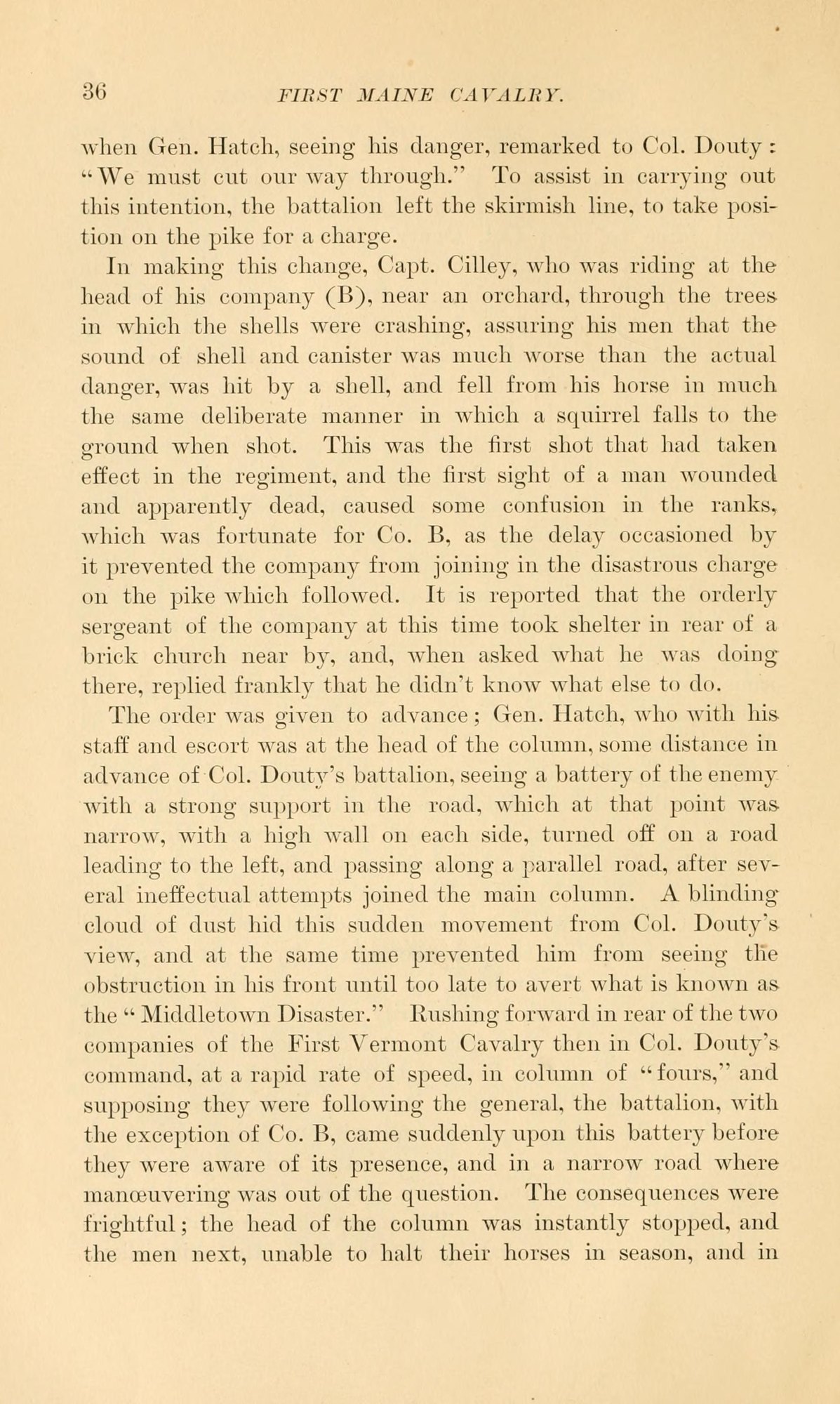
Source: Edward P. Tobie, History of the First Maine Cavalry, 1861-1865, 1887 (Internet Archive)
Image details
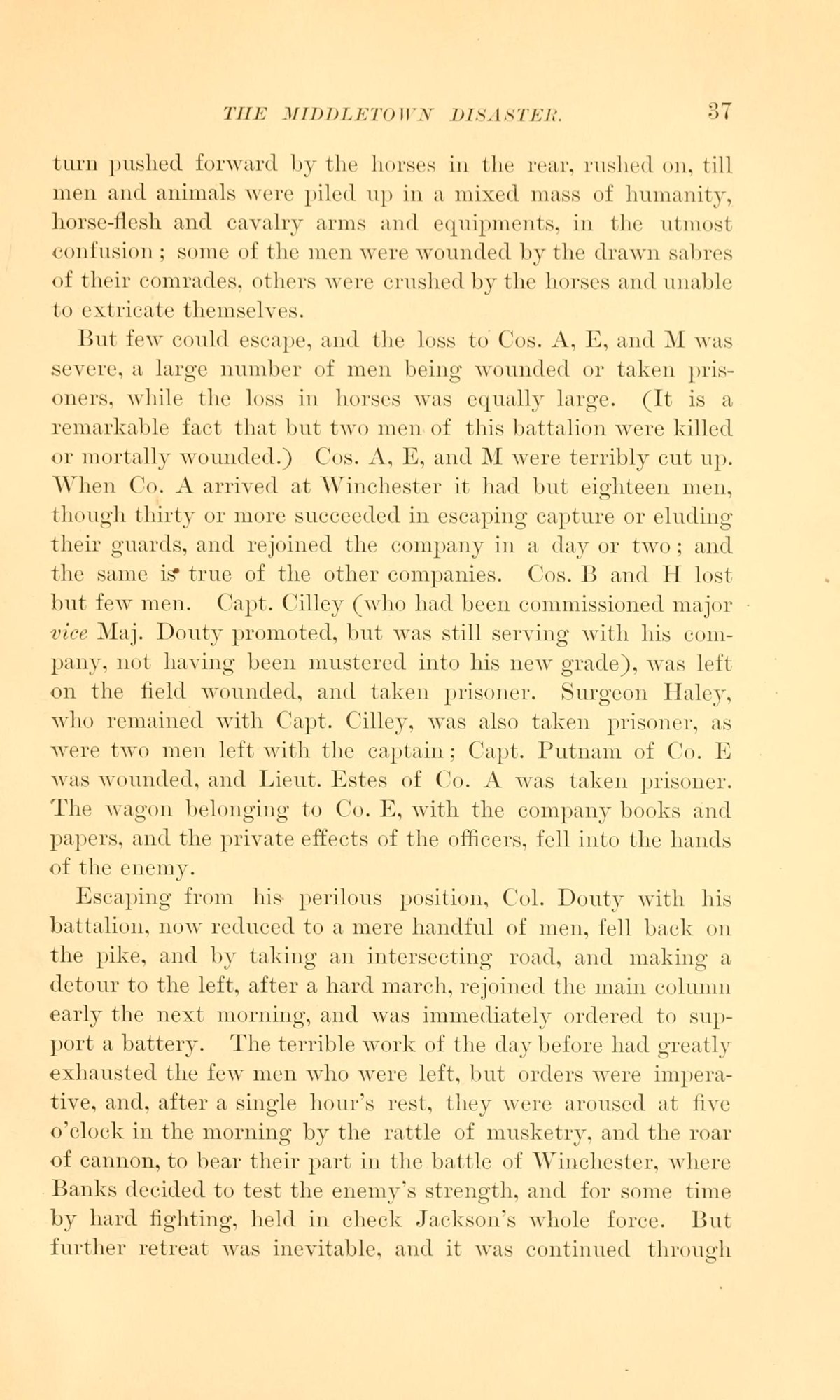
Source: Edward P. Tobie, History of the First Maine Cavalry, 1861-1865, 1887 (Internet Archive)
Image details
Source: Edward P. Tobie, History of the First Maine Cavalry, 1861-1865, 1887 (Internet Archive)
Image details
Source: Edward P. Tobie, History of the First Maine Cavalry, 1861-1865, 1887 (Internet Archive)
Image details
Source: Edward P. Tobie, History of the First Maine Cavalry, 1861-1865, 1887 (Internet Archive)
Image details
Source: Edward P. Tobie, History of the First Maine Cavalry, 1861-1865, 1887 (Internet Archive)
Image details
Banks's report and the letter to Stanton
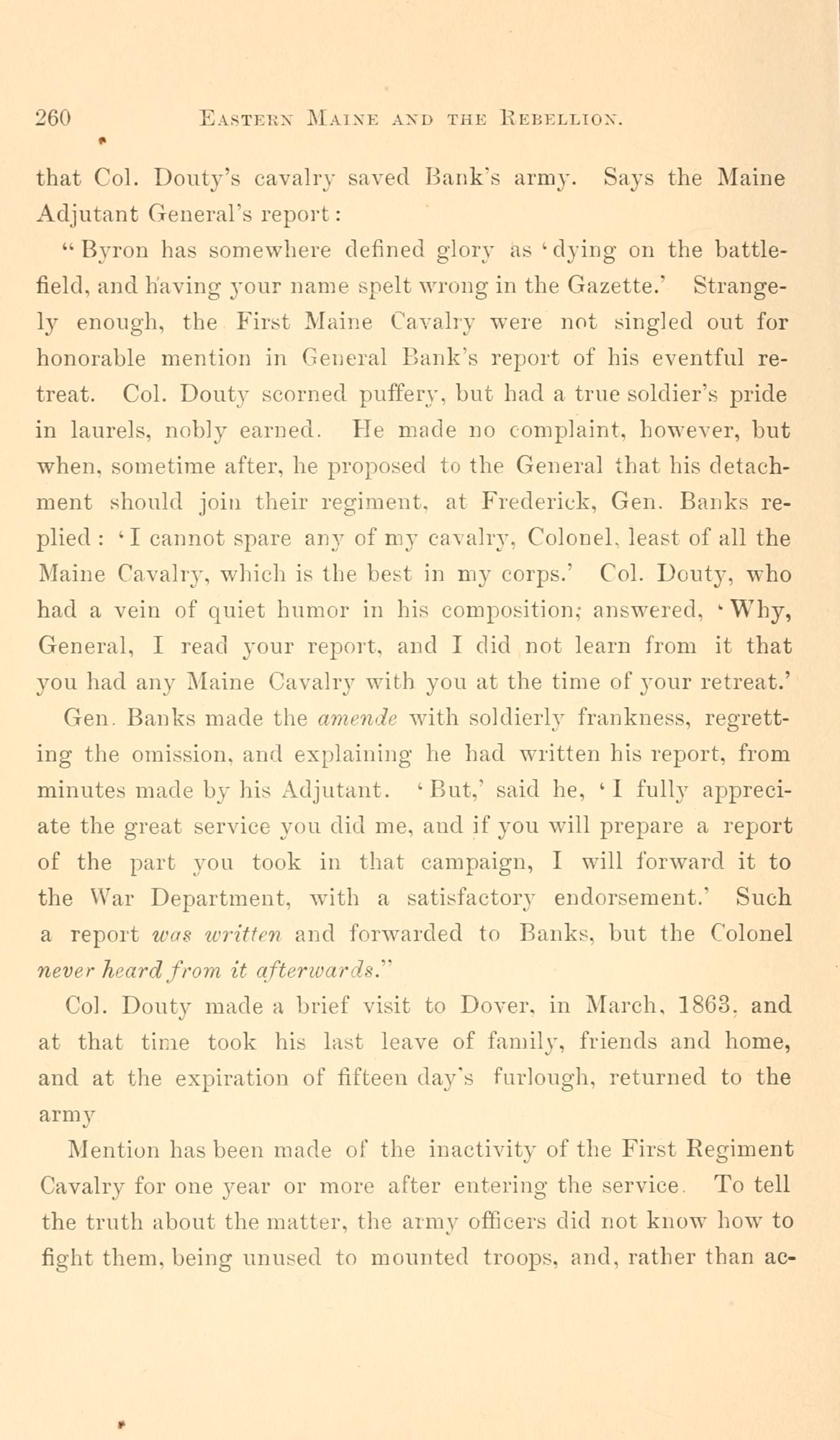
Stanley and Hall quote the Maine Adjutant General's report on what followed. Banks's report of the retreat did not mention the Maine cavalry. When Douty later asked to rejoin the rest of the regiment, Banks refused: "I cannot spare any of my cavalry, Colonel, least of all the Maine Cavalry, which is the best in my corps." Douty, "who had a vein of quiet humor in his composition," answered that he had read the general's report "and I did not learn from it that you had any Maine Cavalry with you at the time of your retreat" (p. 260).
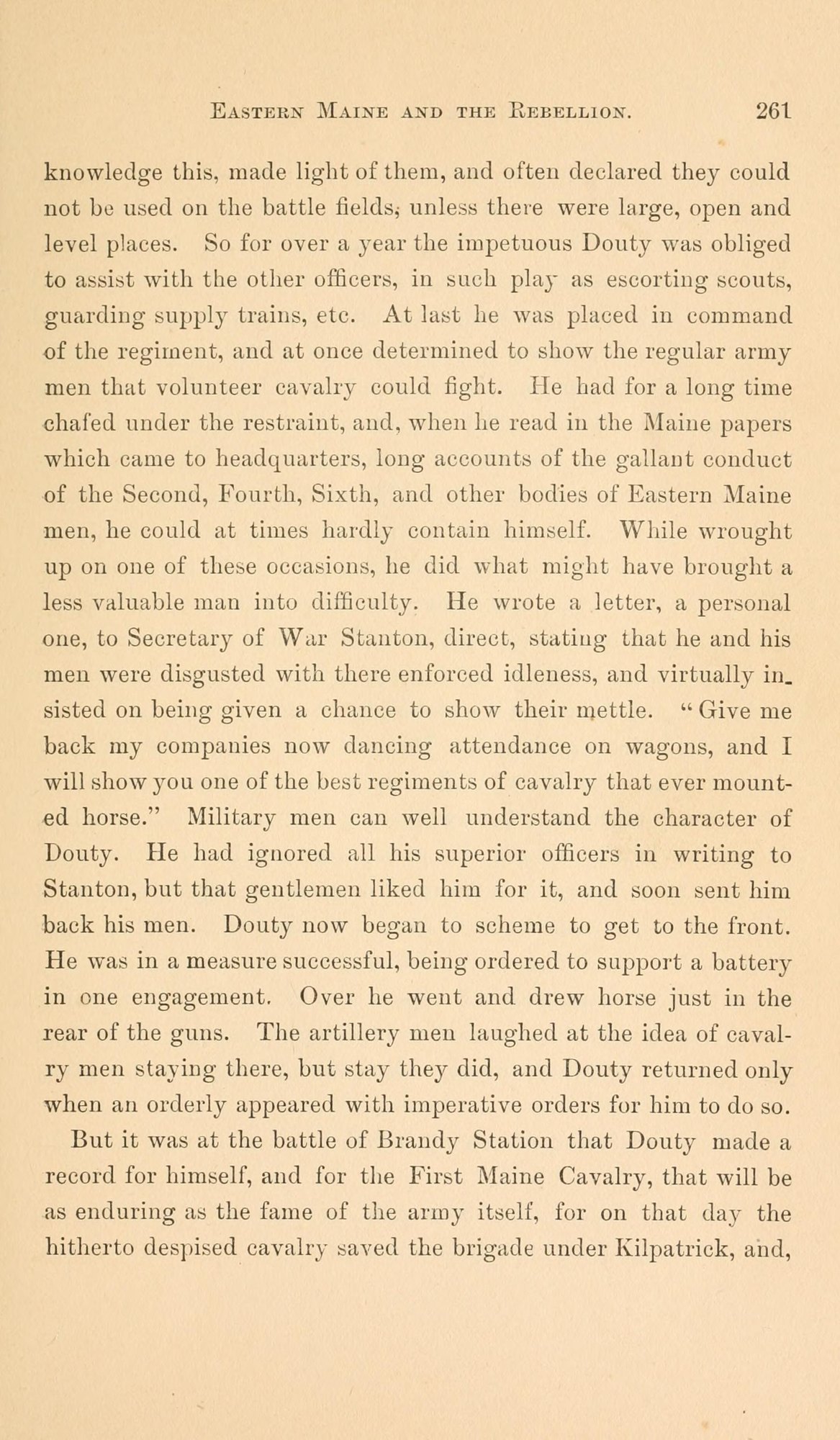
For a year the regiment was used in small pieces, escorting scouts and guarding wagon trains. According to Stanley and Hall, Douty wrote over the heads of his superiors directly to Secretary of War Stanton: "Give me back my companies now dancing attendance on wagons, and I will show you one of the best regiments of cavalry that ever mounted horse." Stanton, they say, "liked him for it, and soon sent him back his men" (p. 261). He made a last visit home to Dover in March 1863, on a fifteen-day furlough (p. 260).
Source: Ruel H. Stanley and George O. Hall, Eastern Maine and the Rebellion, 1887 (Internet Archive)
Image details
Source: Ruel H. Stanley and George O. Hall, Eastern Maine and the Rebellion, 1887 (Internet Archive)
Image details
Source: Ruel H. Stanley and George O. Hall, Eastern Maine and the Rebellion, 1887 (Internet Archive)
Image details
Brandy Station, June 9, 1863
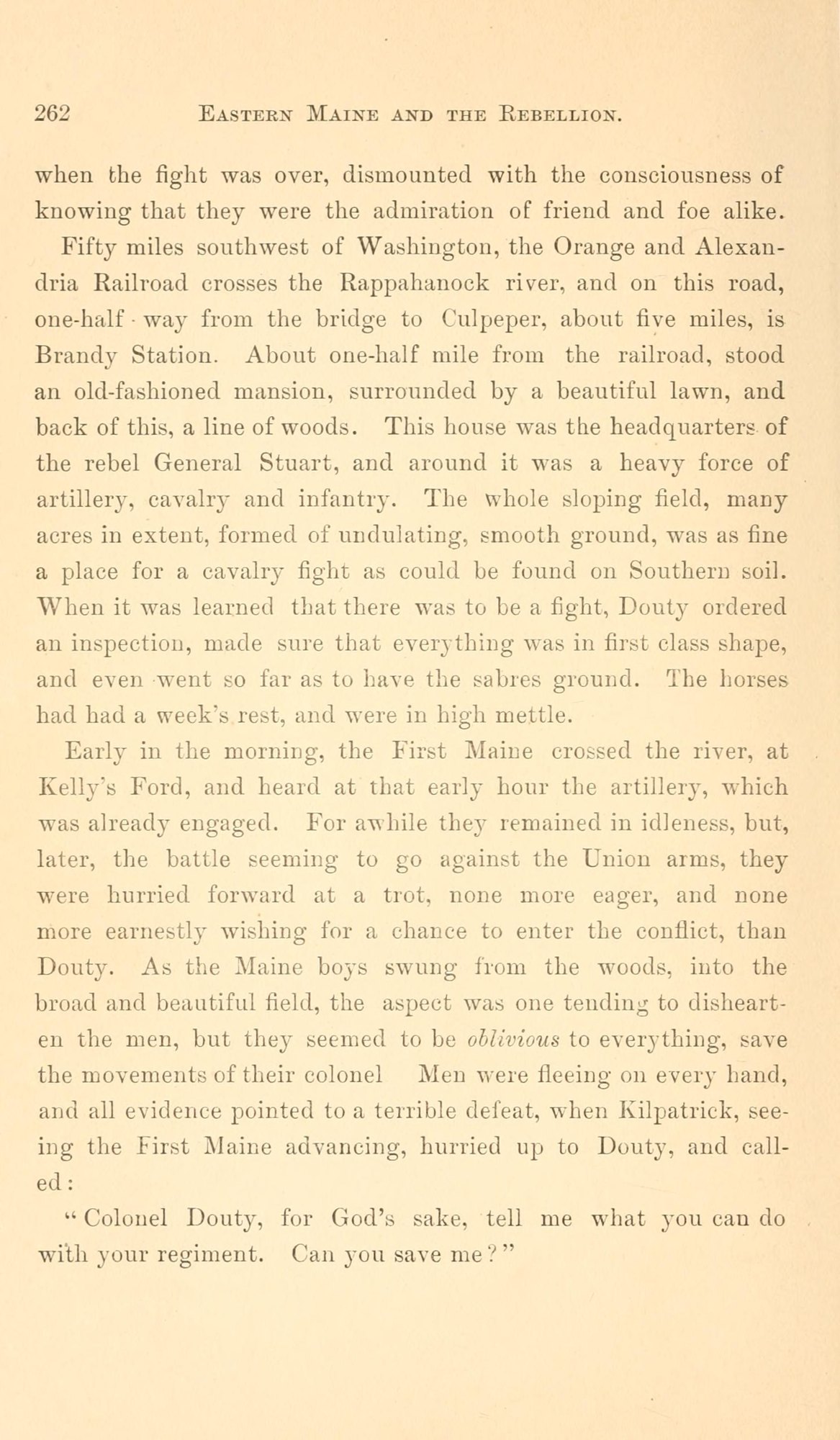
Douty commanded the regiment from September 1862, through Fredericksburg and Stoneman's raid, and for a month that spring commanded the brigade (Tobie, p. 451). At Brandy Station, Stanley and Hall tell how the Union line was breaking when Gen. Judson Kilpatrick rode up: "Colonel Douty, for God's sake, tell me what you can do with your regiment. Can you save me?" Douty, "glancing proudly back to the six hundred grim and silent horsemen," answered, "I can drive those fellows to hell" (pp. 262-263). The regiment charged a battery three times and was for a time cut off before it fought its way out (pp. 263-265).
Source: Ruel H. Stanley and George O. Hall, Eastern Maine and the Rebellion, 1887 (Internet Archive)
Image details
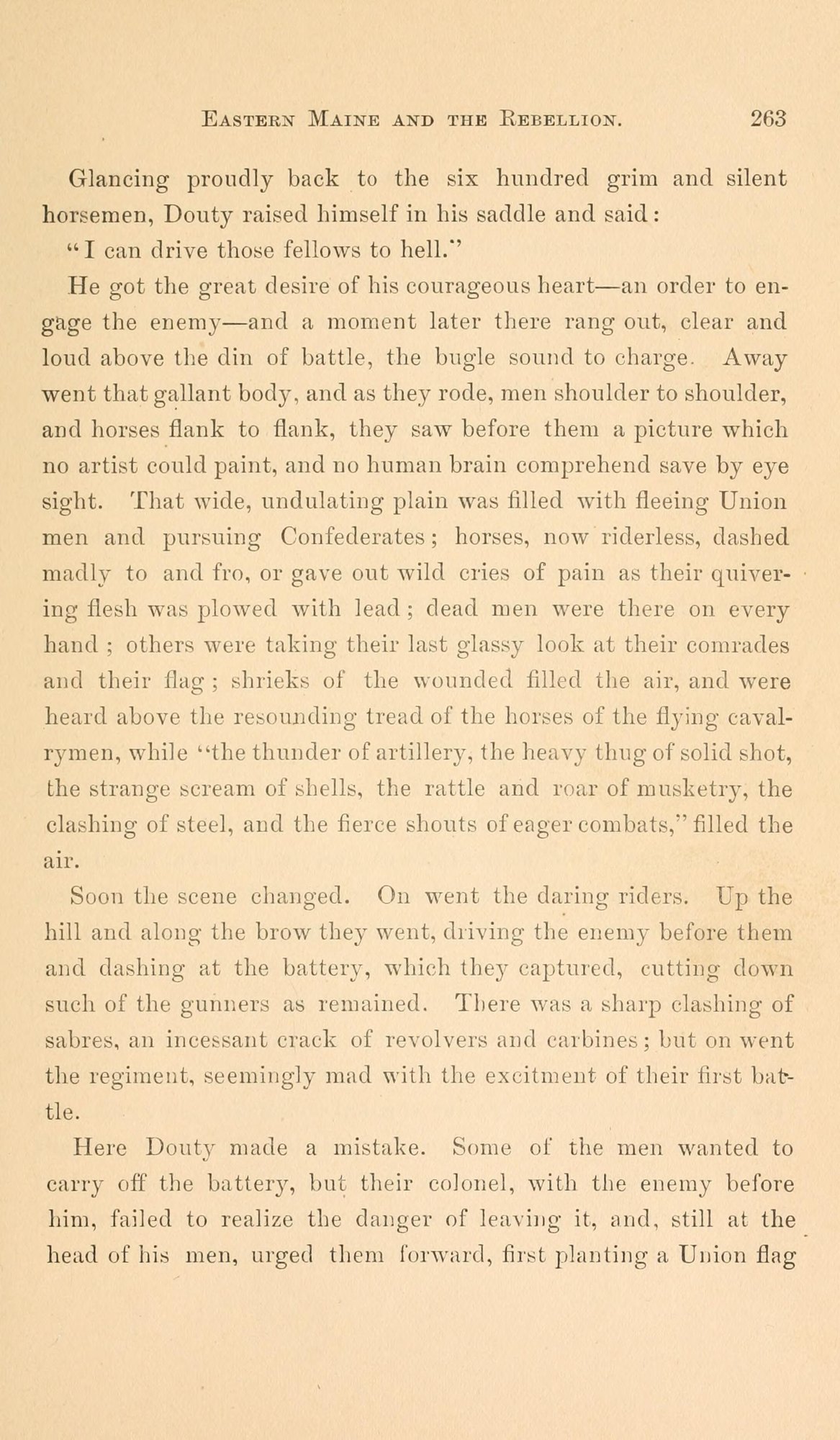
Source: Ruel H. Stanley and George O. Hall, Eastern Maine and the Rebellion, 1887 (Internet Archive)
Image details
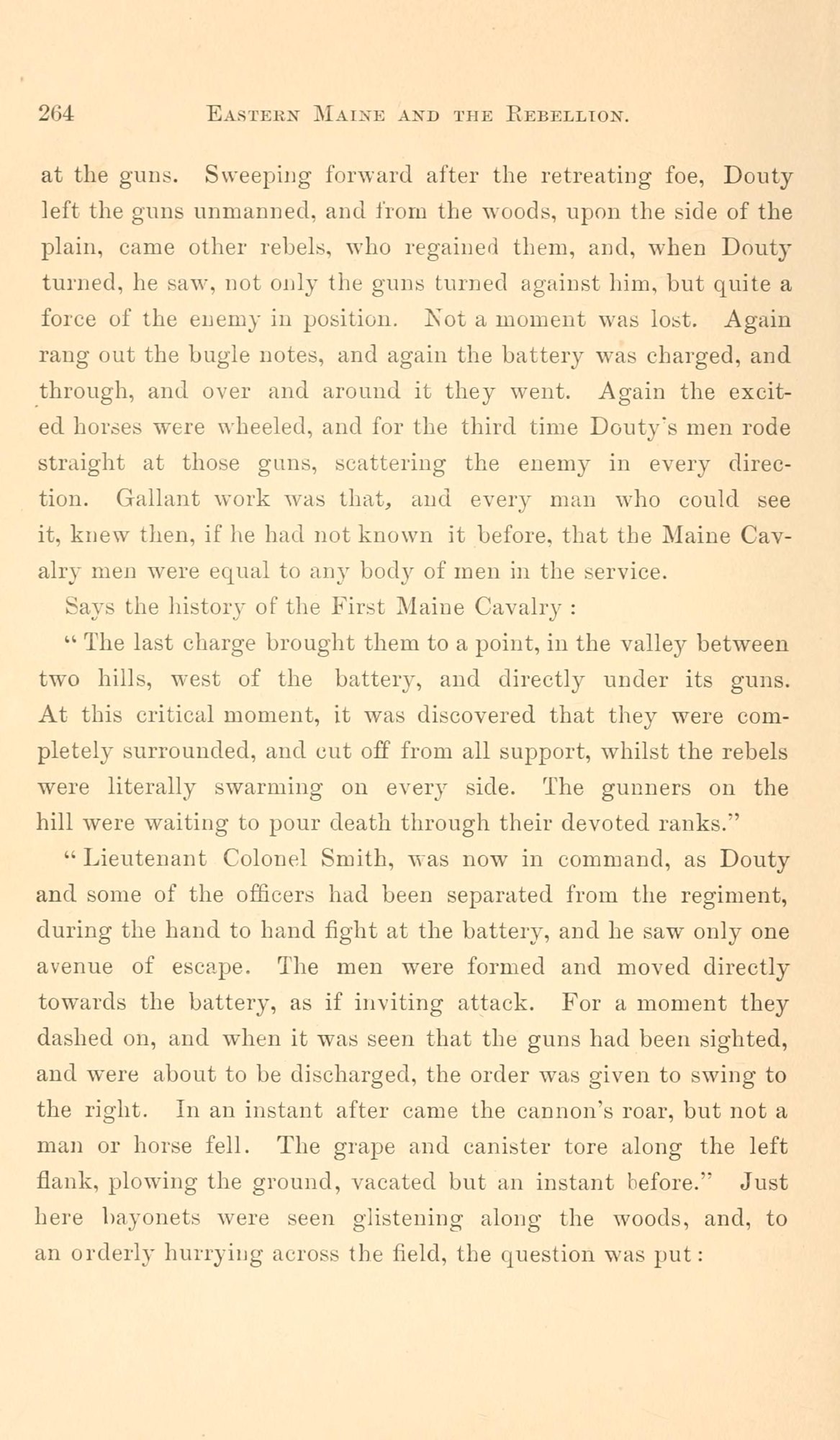
Source: Ruel H. Stanley and George O. Hall, Eastern Maine and the Rebellion, 1887 (Internet Archive)
Image details
Aldie, June 17, 1863
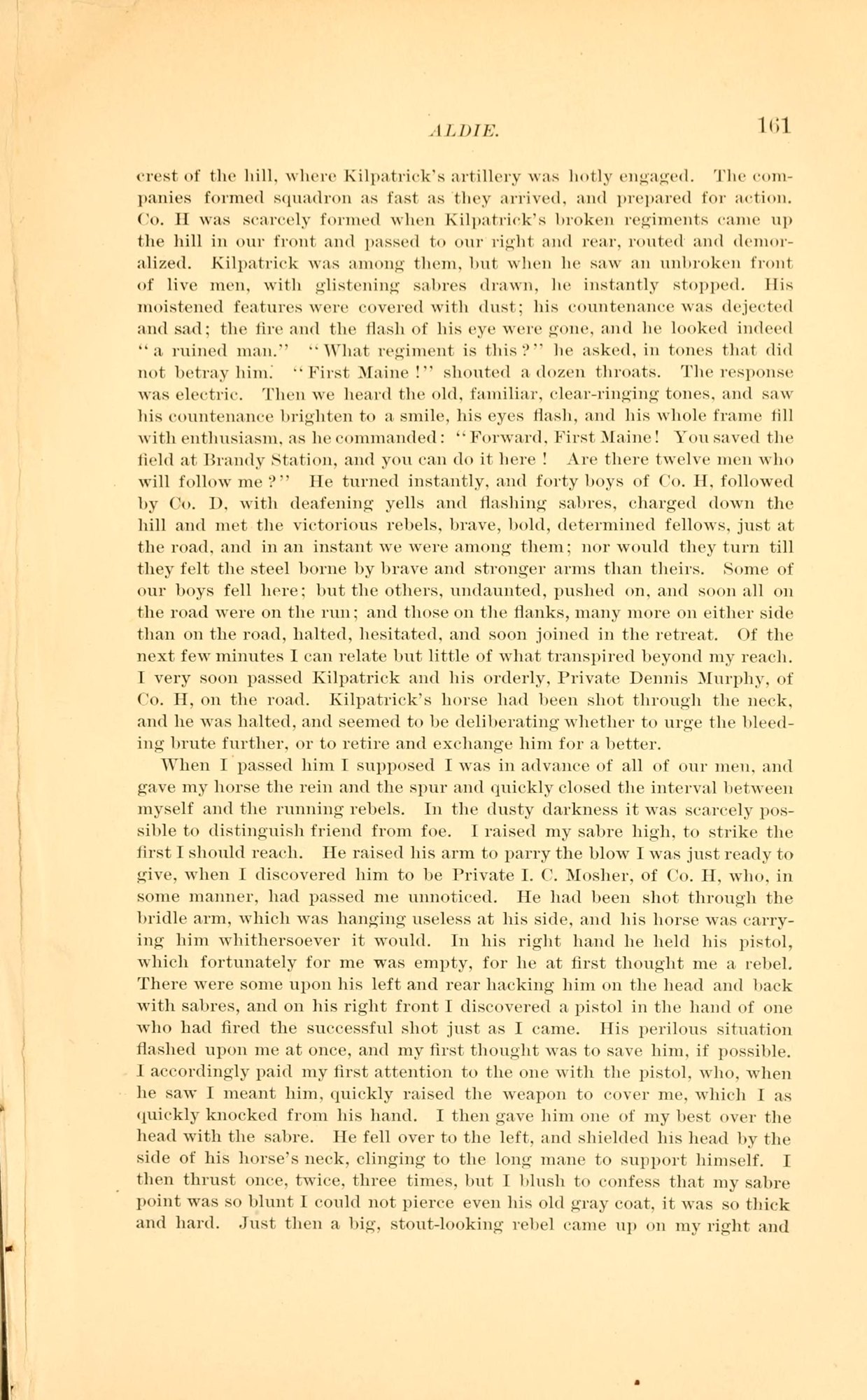
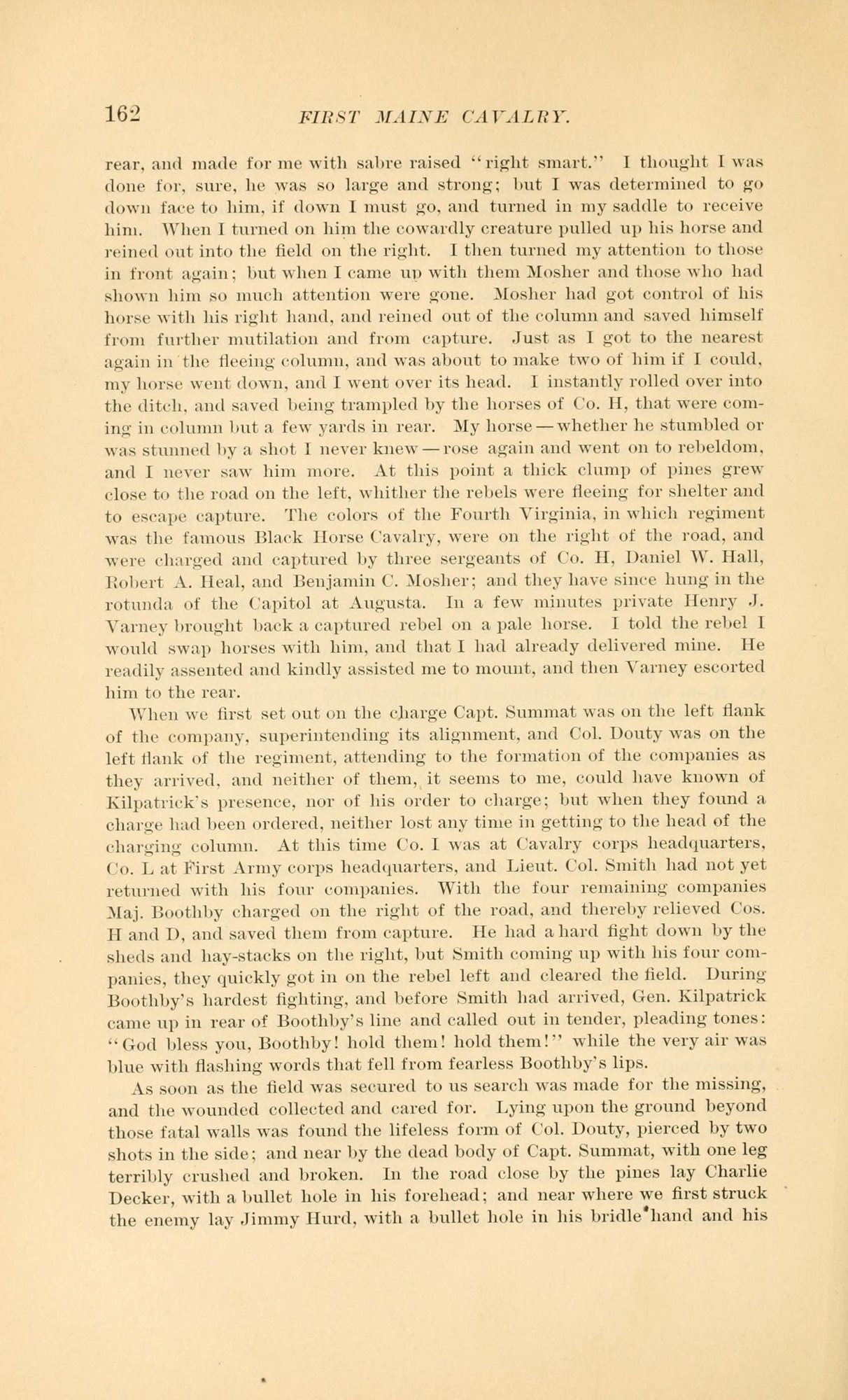
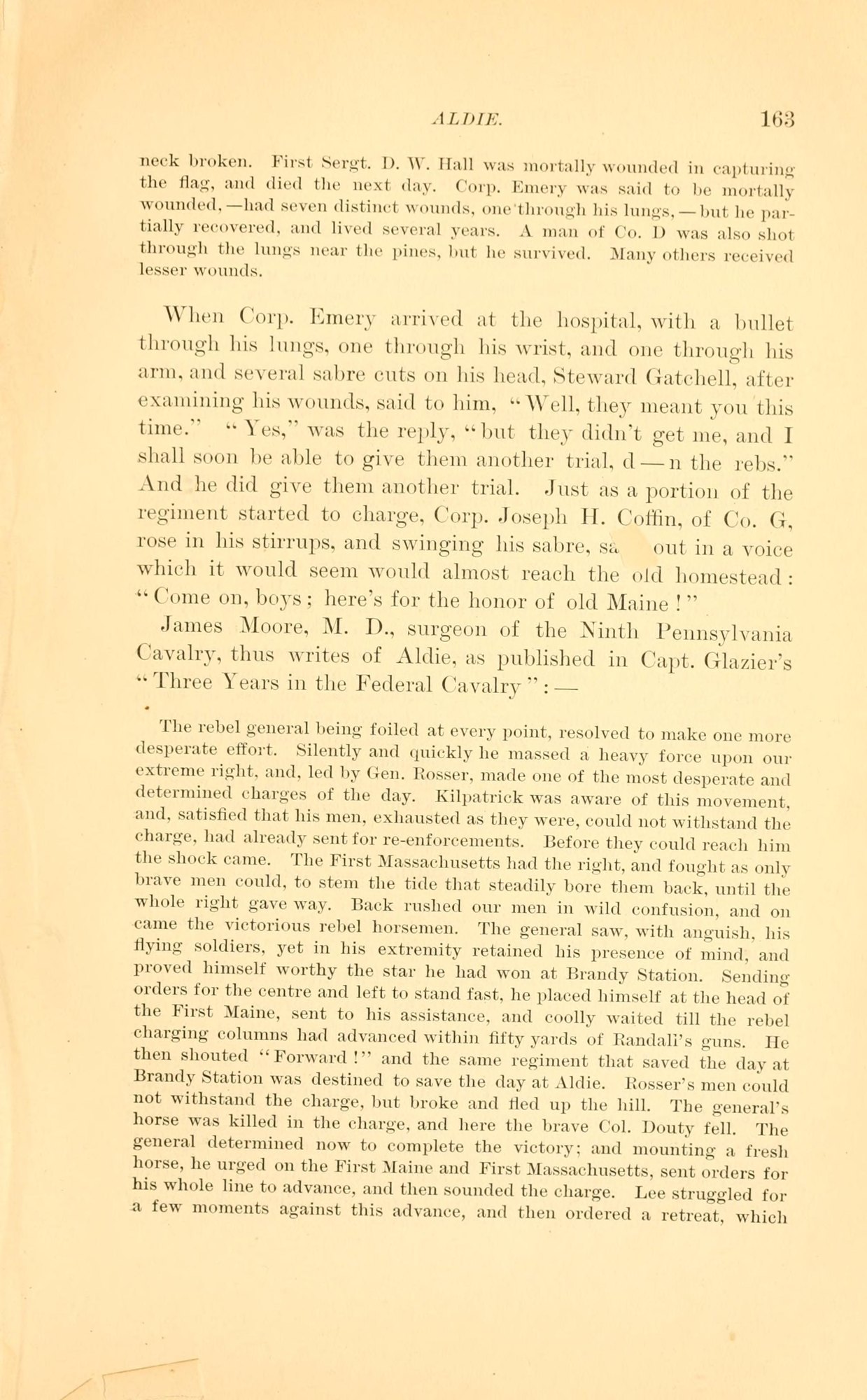
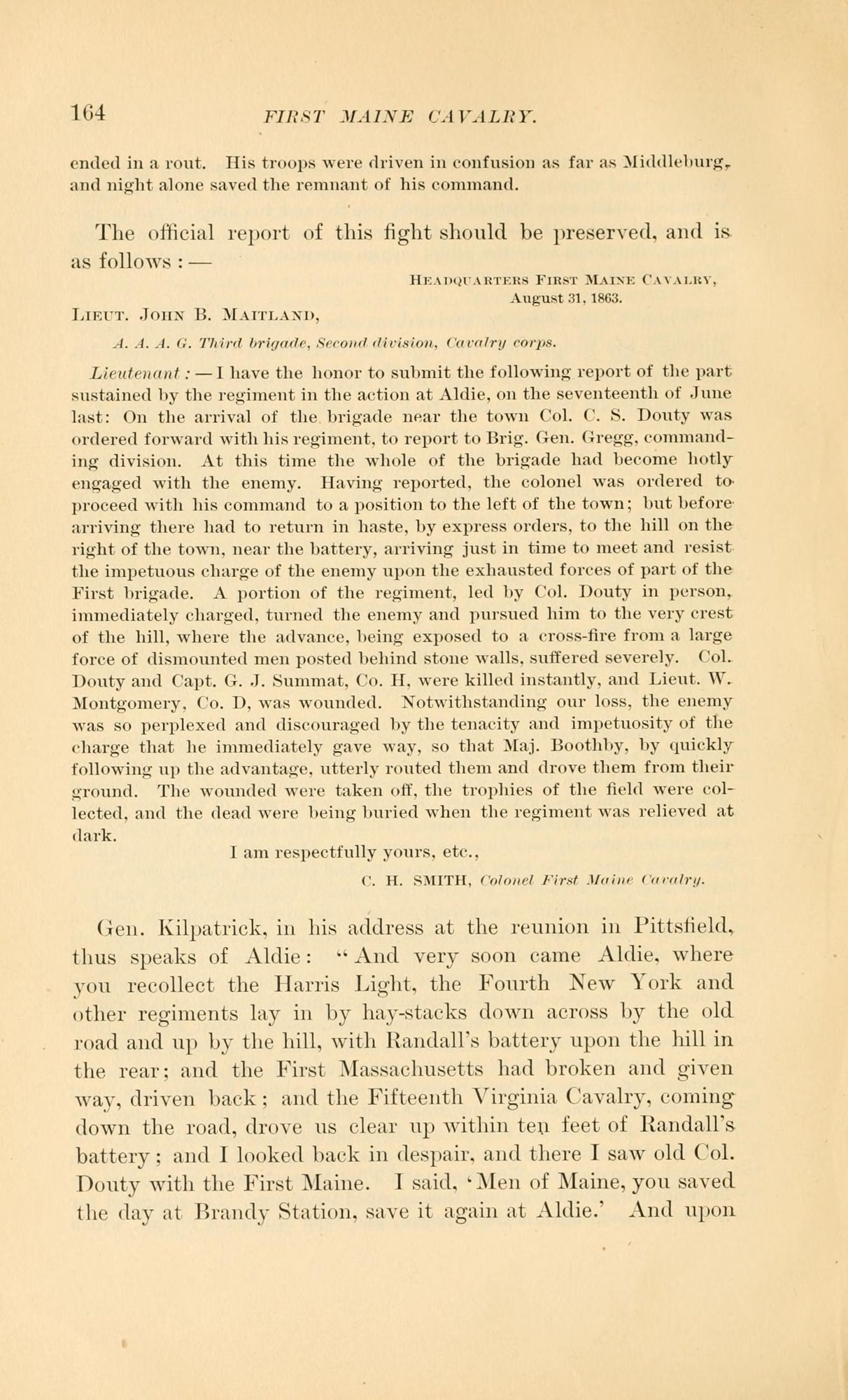
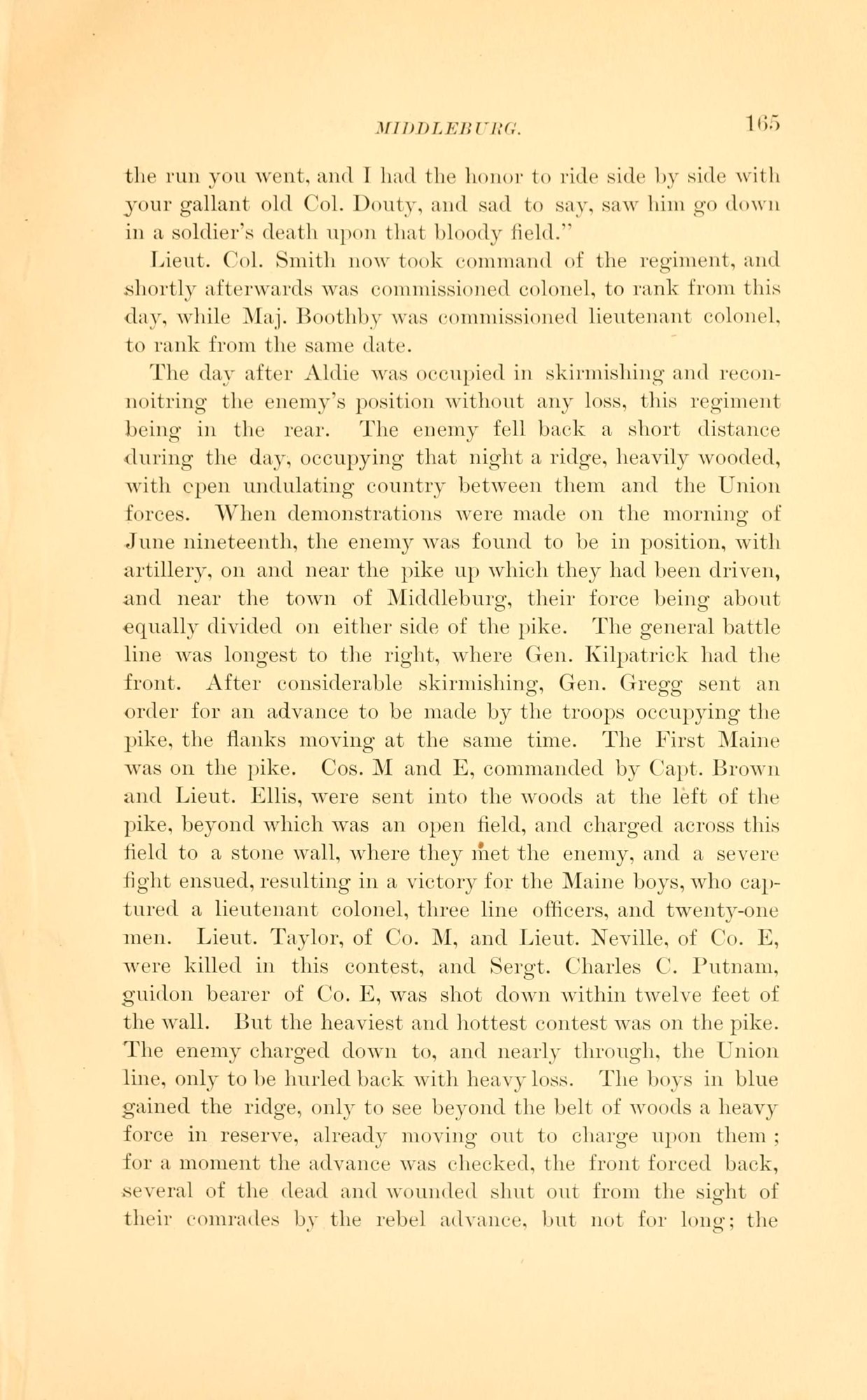
Eight days later, at Aldie, Virginia, Kilpatrick's brigade was being driven back toward Randall's battery. Kilpatrick later told the regiment's veterans: "I looked back in despair, and there I saw old Col. Douty with the First Maine. I said, 'Men of Maine, you saved the day at Brandy Station, save it again at Aldie.' And upon the run you went, and I had the honor to ride side by side with your gallant old Col. Douty, and sad to say, saw him go down in a soldier's death upon that bloody field" (Tobie, pp. 164-165).
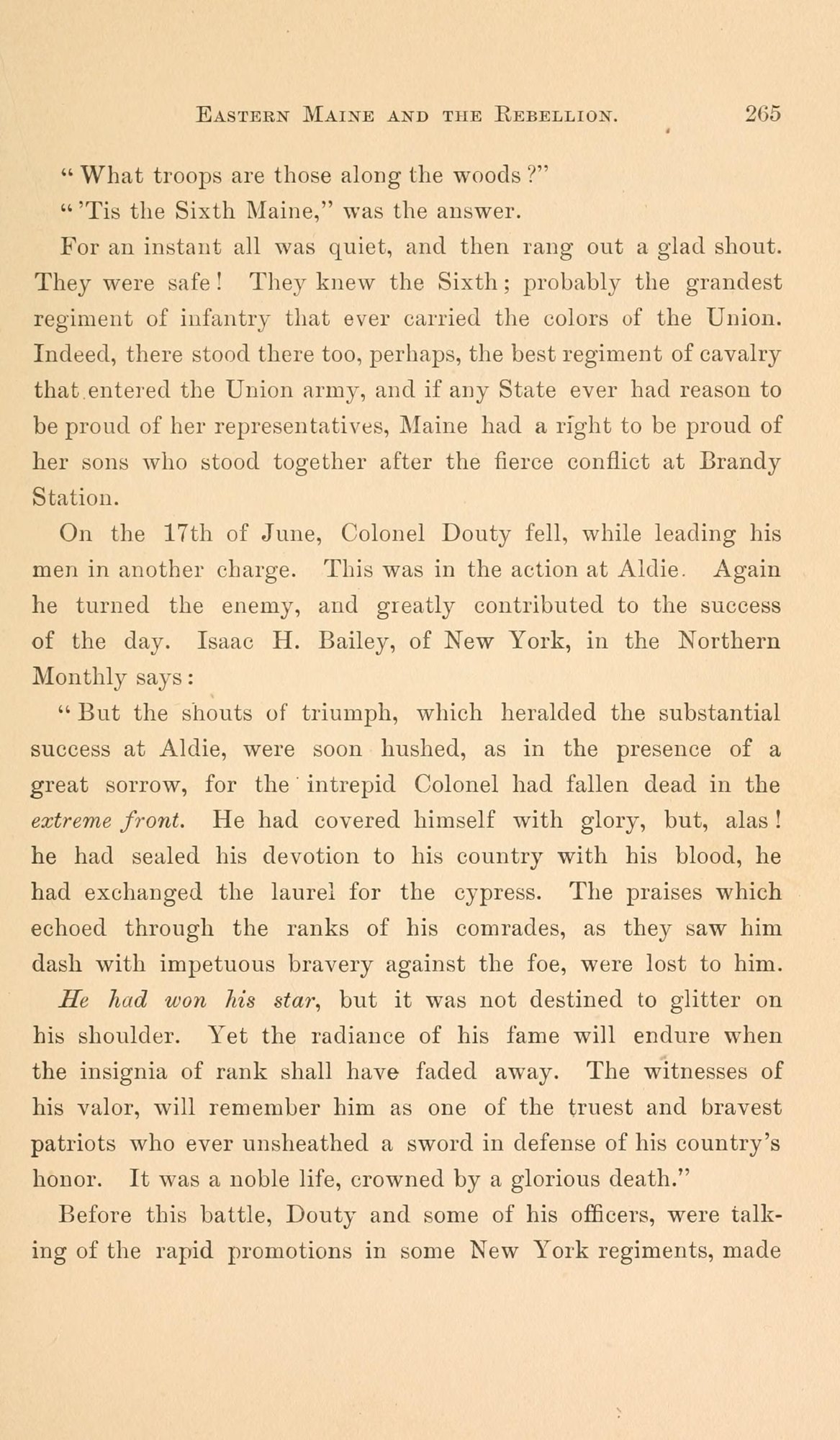
The regiment swept the Confederates off the hill and up to a stone wall, where dismounted men behind the walls met them with a crossfire. "Col. Douty was killed here," Tobie writes. His body "was in the very advance, and was pierced with two bullets, either of which would have proved fatal. The body was sent home for burial" (p. 160). Lt. Henry C. Hall of Company H remembered that Douty had been on the left of the regiment forming the companies, and when he found a charge had been ordered he lost no time "in getting to the head of the charging column"; after the fight "the lifeless form of Col. Douty" was found "beyond those fatal walls" (pp. 161-163). The official report of August 31, 1863, signed by Charles H. Smith, who had succeeded him as colonel, says Douty and Capt. G. J. Summat "were killed instantly" (p. 164). Stanley and Hall record what Douty had said to his officers before the battle, when they talked of quick promotions in other regiments: "If you gentlemen get promoted, it will be by fighting. If I am killed and you survive, you'll have a chance" (pp. 265-266).
The family register adds that "in a month" he "was to have been Brigadier General" (p. 53), and Bailey's sketch says he "had won his star, but it was not destined to glitter on his shoulder" (Tobie, p. 452).
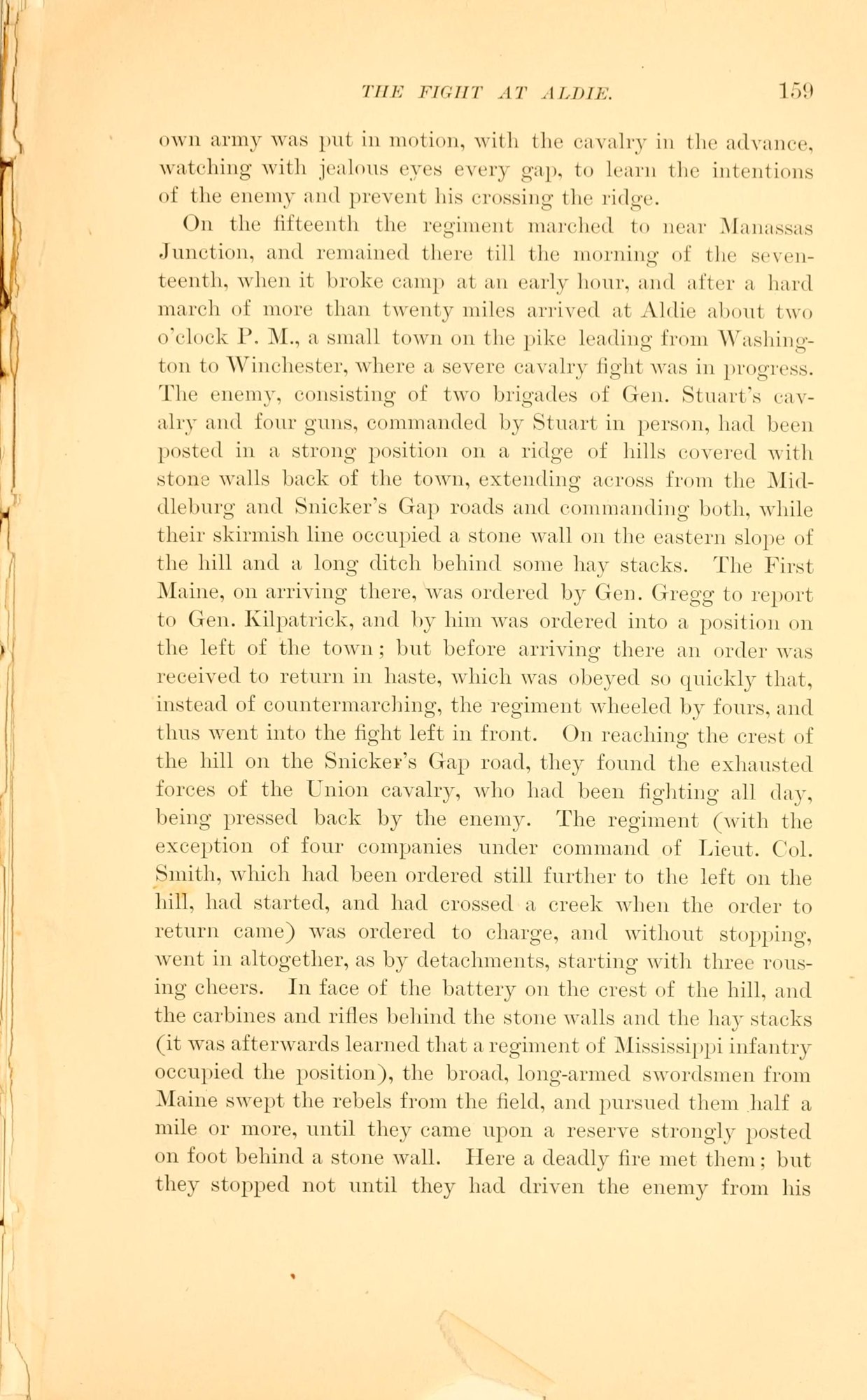
Source: Edward P. Tobie, History of the First Maine Cavalry, 1861-1865, 1887 (Internet Archive)
Image details
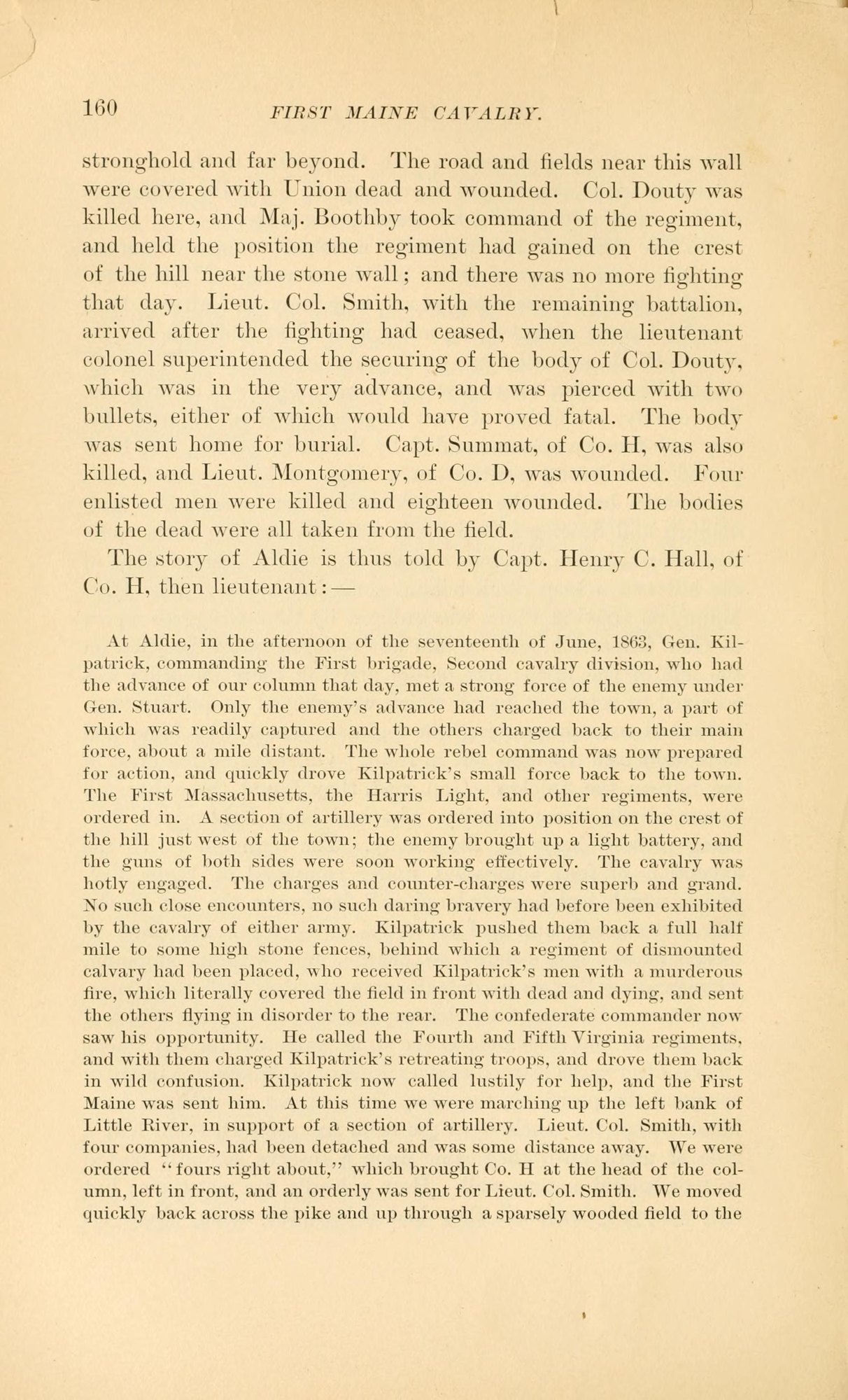
Source: Edward P. Tobie, History of the First Maine Cavalry, 1861-1865, 1887 (Internet Archive)
Image details
Source: Edward P. Tobie, History of the First Maine Cavalry, 1861-1865, 1887 (Internet Archive)
Image details
Source: Edward P. Tobie, History of the First Maine Cavalry, 1861-1865, 1887 (Internet Archive)
Image details
Source: Edward P. Tobie, History of the First Maine Cavalry, 1861-1865, 1887 (Internet Archive)
Image details
Source: Edward P. Tobie, History of the First Maine Cavalry, 1861-1865, 1887 (Internet Archive)
Image details
Source: Edward P. Tobie, History of the First Maine Cavalry, 1861-1865, 1887 (Internet Archive)
Image details
Source: Ruel H. Stanley and George O. Hall, Eastern Maine and the Rebellion, 1887 (Internet Archive)
Image details
The funeral at Dover
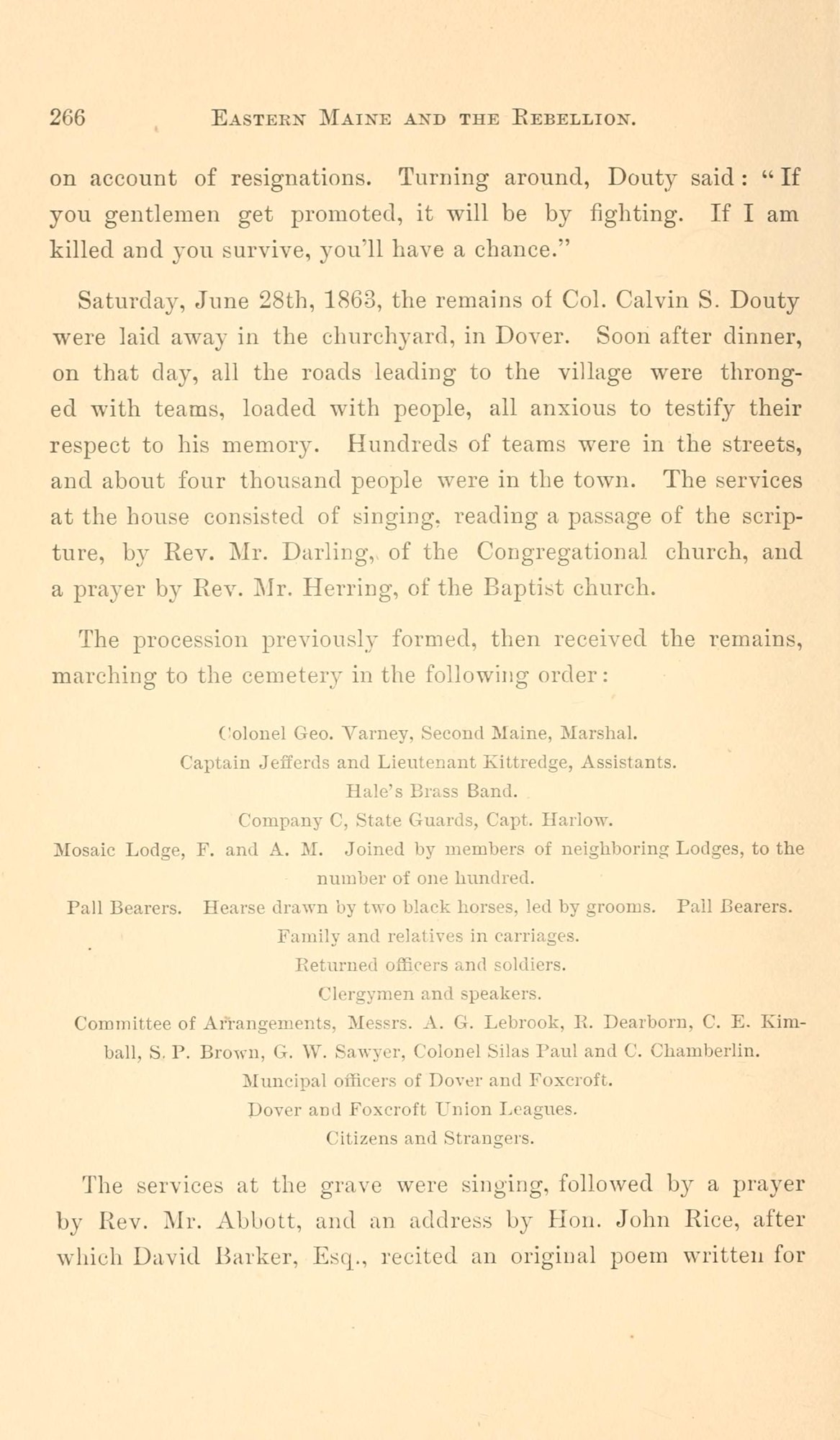
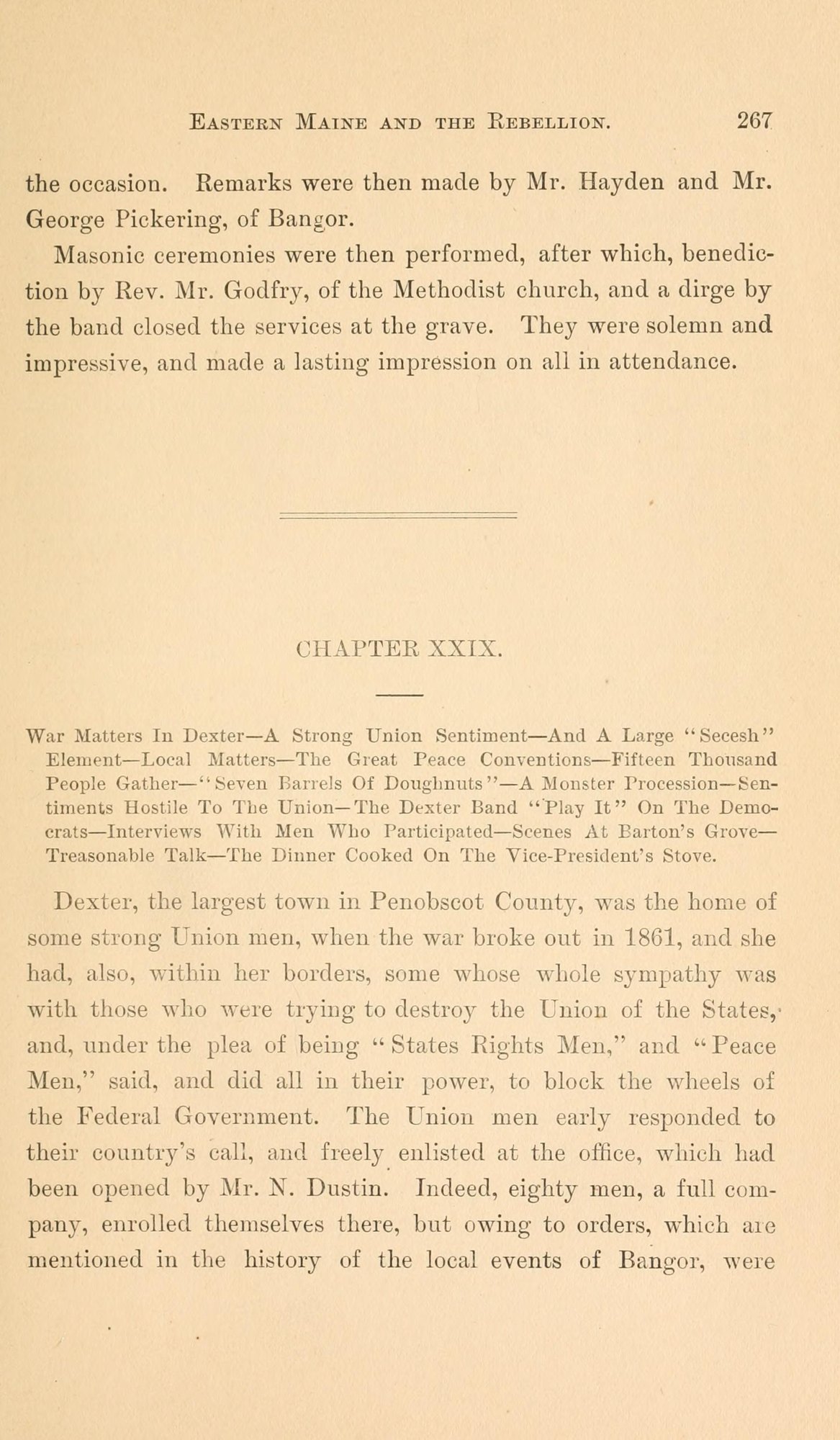
"Saturday, June 28th, 1863, the remains of Col. Calvin S. Douty were laid away in the churchyard, in Dover." Stanley and Hall describe roads "thronged with teams," "about four thousand people" in town, a procession led by Hale's Brass Band with a hundred Masons, the hearse "drawn by two black horses, led by grooms," an address by John Rice, an original poem by David Barker, and Masonic rites at the grave (pp. 266-267).
His grave is in Dover Cemetery, Dover-Foxcroft, under a white marble monument. Its inscription, as read on the photographs at Find a Grave (memorial 23039140), begins "In memory of Calvin Sanger Douty, Colonel 1st Maine Cavalry U.S. Volunteers. Killed on the field of battle at the head of his Regiment on the 17th day of June 1863," gives his age as 50 years, and the memorial's transcription also includes lines for two of the children who died young, Isaac Bailey and Clara Amelia Douty. The regiment held its 1881 reunion at Dover, and Gen. Cilley's address was given at the grave (Tobie, p. 39).
Source: Ruel H. Stanley and George O. Hall, Eastern Maine and the Rebellion, 1887 (Internet Archive)
Image details
Source: Ruel H. Stanley and George O. Hall, Eastern Maine and the Rebellion, 1887 (Internet Archive)
Image details
What is missing
Both histories were written in 1887 for veterans and Maine readers, and the conversations they quote are the officers' and authors' recollections. His compiled service record and any widow's pension file in the National Archives would add official detail, and are still to be obtained. The sources disagree on his birth year (1811 in the register; about 1813 by his monument and Tobie's roster; 1815 at Find a Grave) and on his wife's middle name ("Cummings" in the register; "Thayer" at Find a Grave), and these are not settled here.
Sources
- Edward P. Tobie, History of the First Maine Cavalry, 1861-1865 (Boston: First Maine Cavalry Association, 1887), pp. 34-41, 159-165 and 451-452, and the portrait plate between pp. 126 and 127. Public domain. archive.org/details/historyoffirstma00tobie
- Ruel H. Stanley and George O. Hall, Eastern Maine and the Rebellion (Bangor: R. H. Stanley & Co., 1887), chapter XXVIII, pp. 259-267, and the portrait plate. Public domain. archive.org/details/easternmainerebe00stan
- H. L. Oak, Oak-Oaks-Oakes: Family Register (1906), no. 181, pp. 52-53. Public domain; browse it page by page.
- Find a Grave, memorial 23039140, Calvin Sanger Douty, Dover Cemetery, Dover-Foxcroft, Maine (photographs of the monument, read 12 Oct 2026).