 American Acorns
Daily Arkansas Gazette (Little Rock), 9 June 1907, p. 29: 'The Oakes Family and Its History,' a syndicated surname column that prints the Nathaniel Oak cabin-boy tradition, names his wives Mehitable Rediat and Mary Holloway, and lists Maine descendants.
Image · dated 9 Jun 1907 · source: Daily Arkansas Gazette, Little Rock, Arkansas; Newspapers.com.
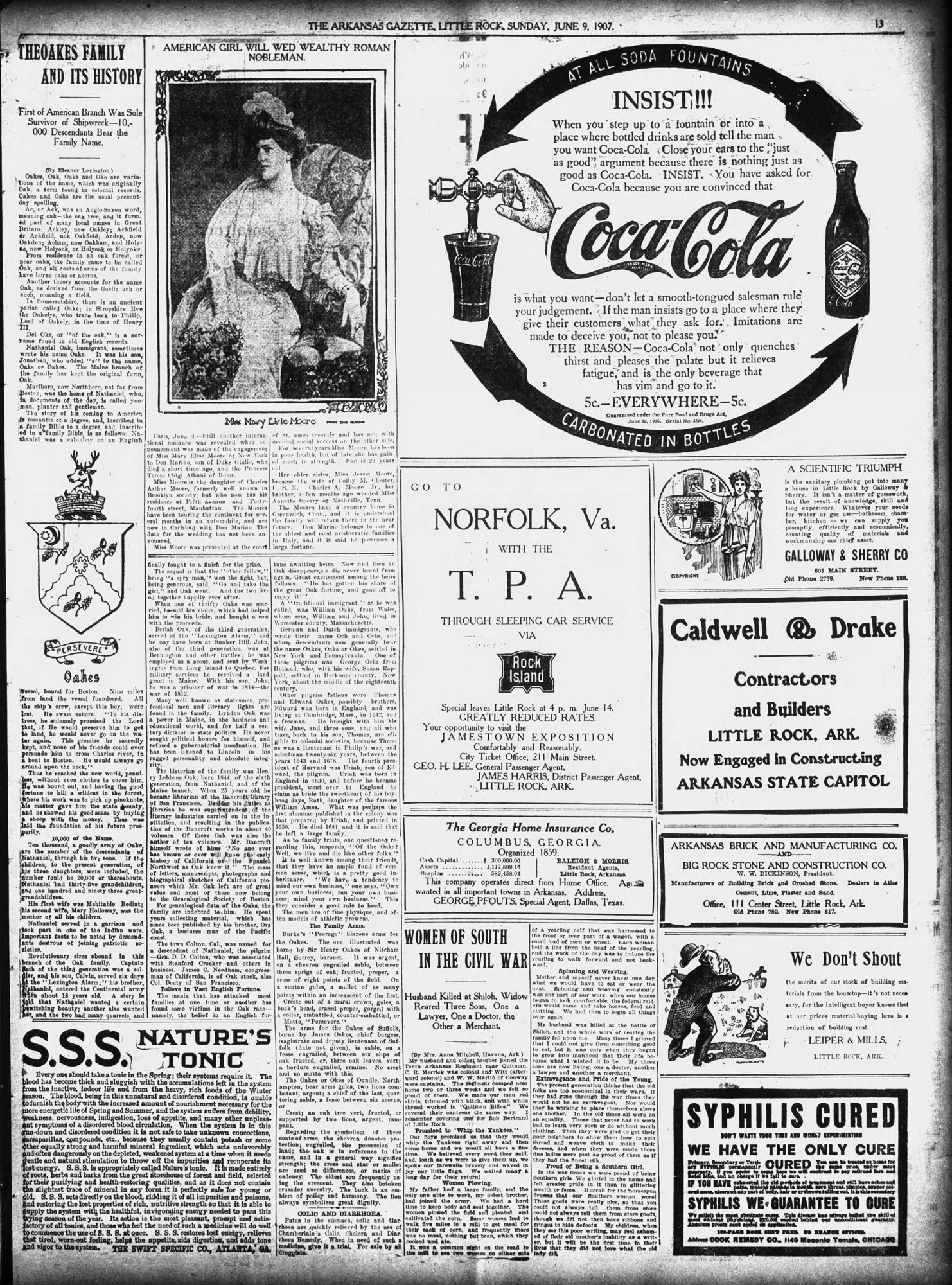
Transcription
**THE OAKES FAMILY AND ITS HISTORY**
First of American Branch Was Sole Survivor of Shipwreck—10,000 Descendants Bear the Family Name.
(By Eleanor Lexington.)
Oakes, Oak, Oaks and Oke are variations of the name, which was originally Oak, a form found in colonial records. Oakes and Oaks are the usual present-day spelling.
Ac, or Ack, was an Anglo-Saxon word, meaning oak—the oak tree, and it formed part of many local names in Great Britain: Ackley, now Oakley; Achfield or Ackfield, now Oakfield; Acden, now Oakden; Acham, now Oakham, and Holyac, now Holyook, or Holyoak or Holyoke.
From residence in an oak forest, or near oaks, the family came to be called Oak, and all coats-of-arms of the family have borne oaks or acorns.
Another theory accounts for the name Oak, as derived from the Gaelic ach or auch, meaning a field.
In Somersetshire, there is an ancient parish called Oake; in Shropshire live the Oakelys, who trace back to Philip, Lord of Oakely, in the time of Henry III.
Del Oke, or "of the oak," is a surname found in old English records.
Nathaniel Oak, immigrant, sometimes wrote his name Oake. It was his son, Jonathan, who added "s" to the name, Oaks or Oakes. The Maine branch of the family has kept the original form, Oak.
Marlboro, now Northboro, not far from Boston, was the home of Nathaniel, who, in documents of the day, is called yeoman, planter and gentleman.
The story of his coming to America is romantic to a degree, and, inscribed in a family Bible, is as follows: Nathaniel was a cabin boy on an English vessel, bound for Boston. Nine miles from land the vessel foundered. All the ship's crew, except this boy, were lost. He swam ashore. "In his distress, he solemnly promised the Lord that, if He would preserve him to get to land, he would never go on the water again. This promise he sacredly kept, and none of his friends could ever persuade him to cross Charles river, in a boat to Boston. He would always go around upon the neck."
[Illustration: a coat of arms — a stag crest above a shield bearing a crescent moon and three sprigs of oak/acorns, with a banner reading "PERSEVERE" and the wordmark "Oakes" beneath.]
Thus he reached the new world, penniless, without even clothes to cover him. He was bound out, and having the good fortune to kill a wildcat in the forest, where his work was to pick up pineknots, his master gave him the state bounty, and he showed his good sense by buying a sheep with the money. Thus was laid the foundation of his future prosperity.
**10,000 of the Name.**
Ten thousand, a goodly army of Oaks, are the number of the descendants of Nathaniel, through his five sons. If the children, to the present generation, of his three daughters, were included, the number would be 20,000 or thereabouts. Nathaniel had thirty-five grandchildren, and one hundred and ninety-three great-grandchildren.
His first wife was Mehitable Rediat; his second wife, Mary Holloway, was the mother of all his children.
Nathaniel served in a garrison and took part in one of the Indian wars. Important facts to be noted by descendants desirous of joining patriotic societies.
Revolutionary sires abound in this branch of the Oak family. Captain Seth of the third generation was a soldier, and his son, Calvin, served six days at the "Lexington Alarm;" his brother, Nathaniel, entered the Continental army when about 18 years old. A story is told that Nathaniel wanted a certain bewitching beauty; another also wanted her, and the two had many quarrels and finally fought to a finish for the prize. The sequel is that the "other fellow," being "a spry man," won the fight, but, being generous, said, "Go and take the girl," and Oak went. And the two lived together happily ever after.
When one of thrifty Oaks was married, he sold his violin, which had helped him to win his bride, and bought a cow with the proceeds.
Beriah Oak, of the third generation, served at the "Lexington Alarm," and he may have been at Bunker Hill. John, also of the third generation, was at Bennington and other battles; he was employed as a scout, and sent by Washington from Long Island to Quebec. For military services he received a land grant in Maine. With his son, John, he was a prisoner of war in 1814—the war of 1812.
Many well known statesmen, professional men and literary lights are found in the family. Lyndon Oak was a power in Maine, in the business and educational world, and for half a century dictator in state politics. He never sought political honors for himself, and refused a gubernatorial nomination. He has been likened to Lincoln in his rugged personality and absolute integrity.
The historian of the family was Henry Lebbens Oak, born 1844, of the sixth generation, from Nathaniel, and of the Maine branch. When 25 years old he became librarian of the Bancroft library of San Francisco. Besides his duties as librarian he was superintendent of the literary industries carried on in the institution, and resulting in the publication of the Bancroft works in about 40 volumes. Of these Oak was also the author of ten volumes. Mr. Bancroft himself wrote of him: "No one ever has known or ever will know the early history of California or the Spanish Northwest as Oak knew it." The mass of letters, manuscripts, photographs and biographical sketches of California pioneers which Mr. Oak left are of great value and most of these now belong to the Genealogical Society of Boston.
For genealogical data of the Oakes, the family are indebted to him. He spent years collecting material, which has since been published by his brother, Ora Oak, a business man of the Pacific coast.
The mania that has attacked most families [continues with a sentence on awaiting heirs — ] Now and then an heir appears, and is never heard from again. Great excitement among the heirs follows: "He has gotten his share of the great Oak fortune, and gone off to enjoy it!"
A "traditional immigrant," as he was called, was William Oaks, from Wales, whose sons, William and John, lived in Worcester county, Massachusetts.
German and Dutch immigrants, who wrote their name Och and Ochs, and whose descendants now generally bear the name Oakes, Oaks or Okes, settled in New York and Pennsylvania. One of these pilgrims was George Ochs from Holland, who, with his wife, Susan Rappold, settled in Herkimer county, New York, about the middle of the eighteenth century.
Other pilgrim fathers were Thomas and Edward Oakes, possibly brothers. Edward was born in England, and was living at Cambridge, Mass., in 1642, and a freeman. He brought with him his wife Jane, and three sons, and all who trace back to his son, Thomas, are eligible to colonial societies, because Thomas was a lieutenant in Philip's war, and a selectman twenty-six years, between 1643 and 1678. The fourth president of Harvard was Uriah, son of Edward, the pilgrim. Uriah was born in England in 1630, and before he became president, went over to England to claim as bride the sweetheart of his boyhood, Ruth, daughter of the famous William Ames. What was perhaps the first almanac published in the colony was that prepared by Uriah, and printed in 1650. He died 1681, and it is said that he left a large family.
As to family traits, one questioned regarding this, responds, "Of the Oakes? Well, we live and die like other folks." It is well known among their friends, that they have an ample fund of common sense, which is a pretty good inheritance. "We have a tendency to mind our own business," one says. "Own your own business; run your own business; mind your own business." This they consider a good rule to heed. The men are of fine physique, and [are] models of athletic prowess.
**The Family Arms.**
Burke's "Peerage" blazons arms for the Oakes. The one illustrated was by Sir Henry Oakes of Nitcham [likely Nettlecombe], Surrey, baronet. It was argent, a chevron engrailed sable, between sprigs of oak, fructed, proper, a cross eight points of the field. On a canton gules, a mullet of as many points within an increscent of the first. Crest: out of a mural crown, gules, a buck's head, erased proper, gorged with a collar, embattled, counter-embattled, or. Motto, "Persevere."
Arms for the Oakes of Suffolk, by James Oakes, chief burgess, magistrate and deputy lieutenant of Suffolk (date not given), is sable, on a chevron engrailed, between six slips of oak fructed, or, three oak leaves, vert; a border engrailed, ermine. No crest or motto with this.
[The] Oakes or Okes of Oundle, Northampton[shire] bear arms gules, two lions combatant, argent; a chief of the last, quarter sable, a fesse between six acorns, or; an oak tree vert, fructed, or, [between/crested by] two lions, argent, rampant.
Regarding the symbolism of these coats-of-arms, the chevron denotes pro[tection]; engrailed, the possession of the oak is in reference to the [name], and in a general way signifies [strength]; the cross and star or mullet [are] used as differences, or marks of [cadency]. The eldest son frequently us[es the] crescent. They also betoken [ancestry]. The buck is an em[blem] of policy and harmony. The lion symbolizes great dignity.
## Answer to item 1's question
**Who it names (Maine/Nathaniel branch, in order of appearance):** Nathaniel Oak (immigrant, "cabin boy" shipwreck survivor; wife 1 Mehitable Rediat, wife 2 Mary Holloway, mother of all his children); son Jonathan (added the "s"); Captain Seth (3rd generation) and his son Calvin (Lexington Alarm); brother Nathaniel (Continental Army, age ~18); Beriah Oak (3rd generation, Lexington Alarm/possibly Bunker Hill); John (3rd generation, Bennington, scout, land grant in Maine, War of 1812 prisoner with his own son John); Lyndon Oak (Maine business/political figure); Henry Lebbens Oak (b. 1844, 6th generation, the family's own genealogist/historian, Bancroft Library librarian, San Francisco) and his brother Ora Oak (publisher of Henry's genealogical material). Other, apparently unrelated, immigrant lines the column also covers under the same surname: William Oaks of Wales (sons William, John, Worcester Co. MA); George Ochs of Holland (wife Susan Rappold, Herkimer Co. NY); Thomas and Edward Oakes (Cambridge, Mass., 1642; Edward's wife Jane; son Uriah Oakes, 4th president of Harvard, wife Ruth Ames); English armigerous Oakeses (Sir Henry Oakes of [Nitcham/Nettlecombe], Surrey; James Oakes of Suffolk; the Oakes/Okes of Oundle, Northamptonshire) — these appear to be offered as same-surname heraldry/trivia, not asserted as the same family as Nathaniel.
**Which branch:** explicitly "the Maine branch," i.e., the line from immigrant Nathaniel Oak through his son Jonathan, wives Mehitable Rediat and Mary Holloway — the same Nathaniel/Mehitable Rediat/Mary Holloway grouping already in the tree's overlay (per the 30 Sep/3 Oct work). This article is almost certainly the published source — or a close relative of the source — for the tree's existing "Family tradition" shipwreck story (FTM rows E452/E462, left untouched by B because the importer has no fourth "family tradition" confidence level).
**Date:** Sunday, 9 June 1907, Daily Arkansas Gazette, Little Rock, Arkansas, page 29. (A national syndicated filler column — likely reprinted in other papers the same season; not independently verified here as unique to this issue.)
**Lead for Main:** Henry Lebbens Oak (b. 1844) is named here as the family's own 19th/20th-c. genealogist (Bancroft Library, San Francisco), author of ten volumes, with his research later published by his brother Ora Oak. If the tree does not already carry this Henry Lebbens Oak as a person/source, he may be the person behind the family's own earlier compiled genealogy that today's secondary sources (including possibly this very column) draw on — worth a targeted search (Bancroft Library catalog, Ora Oak's publication) before citing this newspaper column itself as evidentiary for any fact beyond "family said so in 1907."
How it is shown: Complete page as supplied; no crop, no retouch, no search highlight.
Keep in mind: Family tradition: the shipwreck, pine-knot and wildcat story is printed here as the family's own account, and the column is a syndicated filler piece (byline 'Eleanor Lexington'), not a primary record. The statements above rest on a full transcription of the column. People tagged are those the column names with a stated relationship: Nathaniel Oak (immigrant), his wives Mehitable Rediat and Mary Holloway, his son Jonathan, Capt. Seth (third generation), Seth's sons Calvin and Nathaniel, and Beriah (third generation); the tree matches are by name and generation (Likely). Henry Lebbens Oak (b. 1844), Ora Oak, Lyndon Oak and the column's John (third generation) are named but not tagged: no unambiguous tree person.