American Acorns
Nathaniel Oak and the cabin-boy story
View 2025 Challenge Coin details
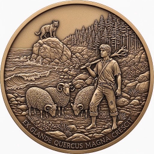

The Oak family challenge coin illustrates the old story of Nathaniel's arrival in America. A young man carries a pine knot while a wildcat stands above him, sheep graze below and waves meet New England pines. The reverse carries an acorn, the spellings Oak, Oaks and Oakes, and "Est. 1660." Its Latin motto means "From the acorn the mighty oak grows."
The Oak challenge coin: what each picture stands for
Each picture on the coin stands for a piece of the story below:
- The waves: a shipwreck nine miles from land, on a ship bound for Boston, with one survivor.
- The pine knot and the pines: the pitch-pine forest where he was put to work, and the weapon he grabbed there.
- The wildcat: the catamount that attacked him, and the bounty paid for its pelt.
- The sheep: what he bought with that bounty, and all he owned when he came of age.
- The acorn and names: the family and the spellings Oak, Oaks and Oakes. Records also use Oake and Oke.
The coin's "Est. 1660" follows a later estimate of his arrival; no record gives the year.
The story the family told
Nathaniel Oak, the story goes, was a cabin boy on an English ship bound for Boston. Nine miles from land the ship went down, and the whole crew was lost except the boy. He swam ashore, promising God on the way that if he reached land he would never go on the water again. He kept that promise. His wife could not get him into a boat even to cross the Charles River to Boston; he walked around by the neck instead.
He came ashore with nothing, "without even clothes to cover him," and with no friends in America he was bound out to work. His master sent him into a pitch-pine forest to gather pine knots, and there a catamount attacked him. He killed it with a pine knot. His master gave him the bounty paid for the pelt, and with it the boy bought a sheep or two and let them out to double. Those sheep were all he owned when he came of age. He used to say that on the long swim he suffered more from hunger than from anything else, and that when he got tired he turned on his back and rested.
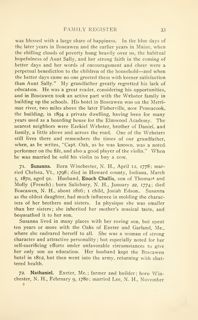
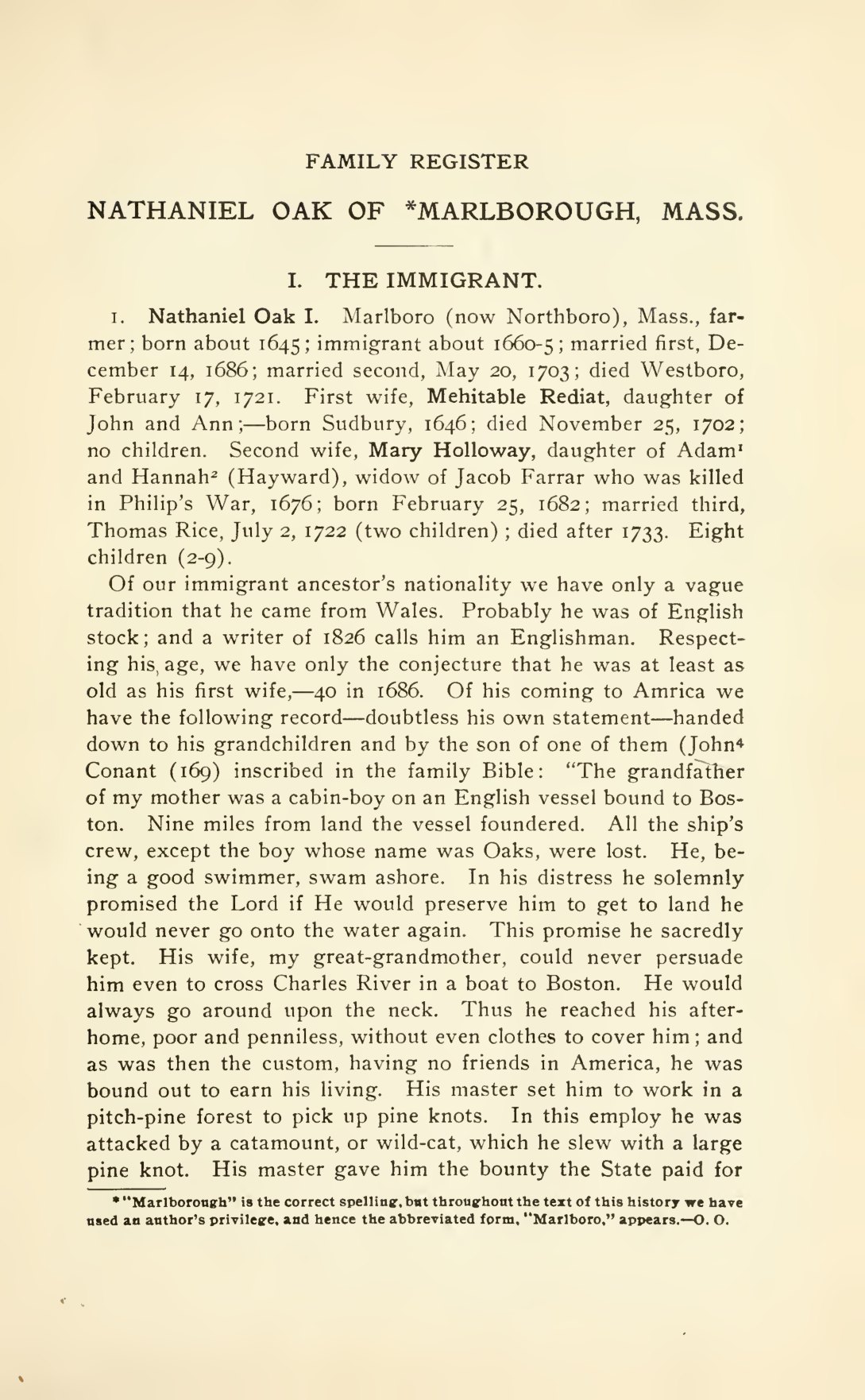
This version of the story was printed in 1906, in the family register compiled by Henry Lebbeus Oak, a kinsman. He attributed it to an inscription in a family Bible by John Conant, Nathaniel's great-grandson, born in 1773, whose note ends: "The above account I have often heard my mother and my uncles relate." It is family memory, told two or three generations after the man it describes. The whole register is public domain: browse it page by page, scan and text together, or read the whole book (PDF, 5 MB), hosted from the copy at the Internet Archive.
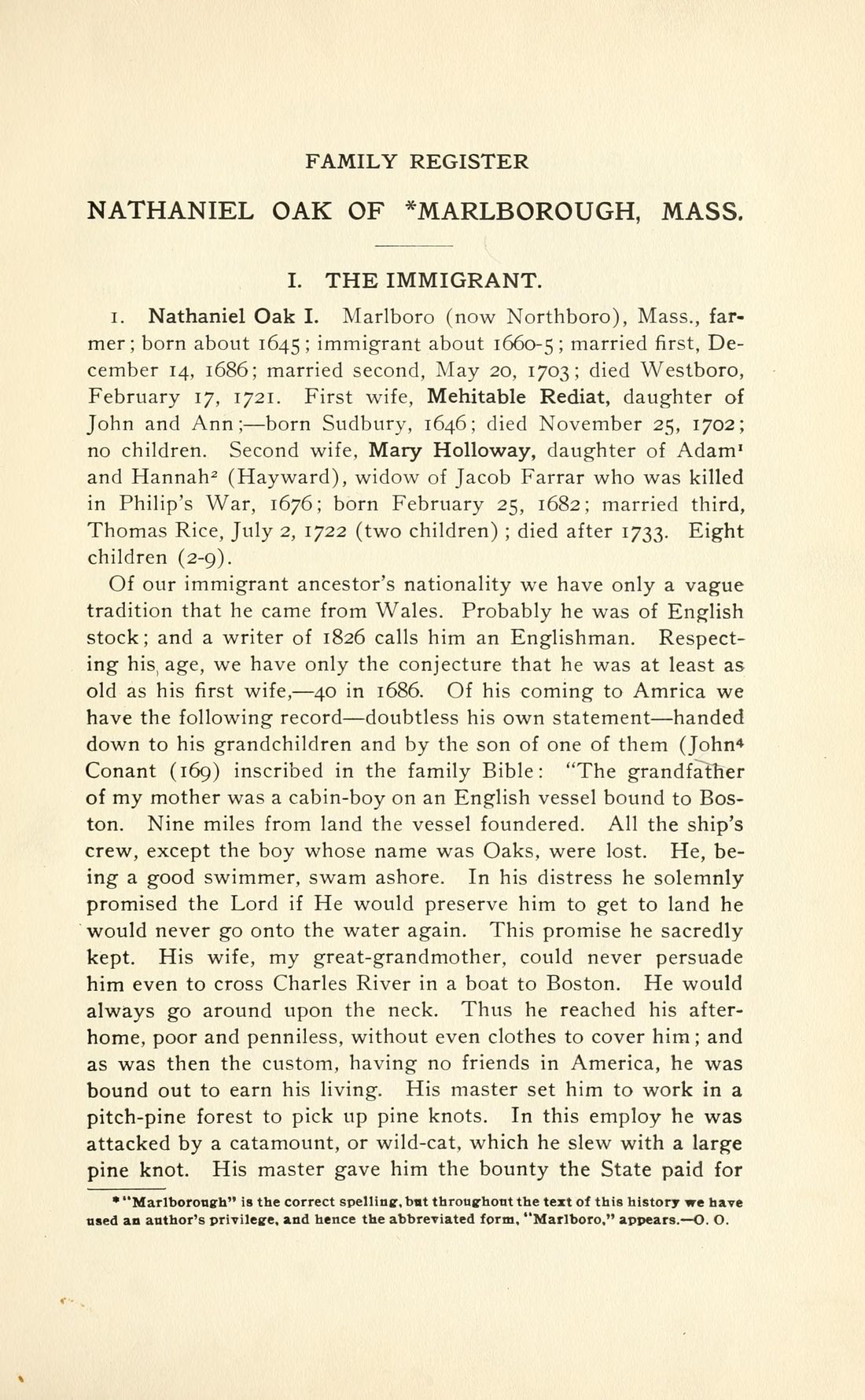
View transcription
Of our immigrant ancestor's nationality we have only a vague tradition that he came from Wales. Probably he was of English stock; and a writer of 1826 calls him an Englishman.
The grandfather of my mother was a cabin-boy on an English vessel bound to Boston. Nine miles from land the vessel foundered. All the ship's crew, except the boy whose name was Oaks, were lost. He, being a good swimmer, swam ashore. In his distress he solemnly promised the Lord if He would preserve him to get to land he would never go onto the water again. This promise he sacredly kept. His wife, my great-grandmother, could never persuade him even to cross Charles River in a boat to Boston. He would always go around upon the neck. Thus he reached his after-home, poor and penniless, without even clothes to cover him; and as was then the custom, having no friends in America, he was bound out to earn his living. His master set him to work in a pitch-pine forest to pick up pine knots. In this employ he was attacked by a catamount, or wild-cat, which he slew with a large pine knot. His master gave him the bounty the State paid for the pelt of this furious beast, with which he bought a sheep or two, which he let out to double. These sheep were all the property he began the world with when he became of age. He often said that while swimming to land he suffered more from hunger than anything else. When tired he would turn on his back and rest. The above account I have often heard my mother and my uncles relate.
The register's text across pages 7 and 8, as printed there (checked against the page images). John Conant's note begins on page 7 and ends on page 8.
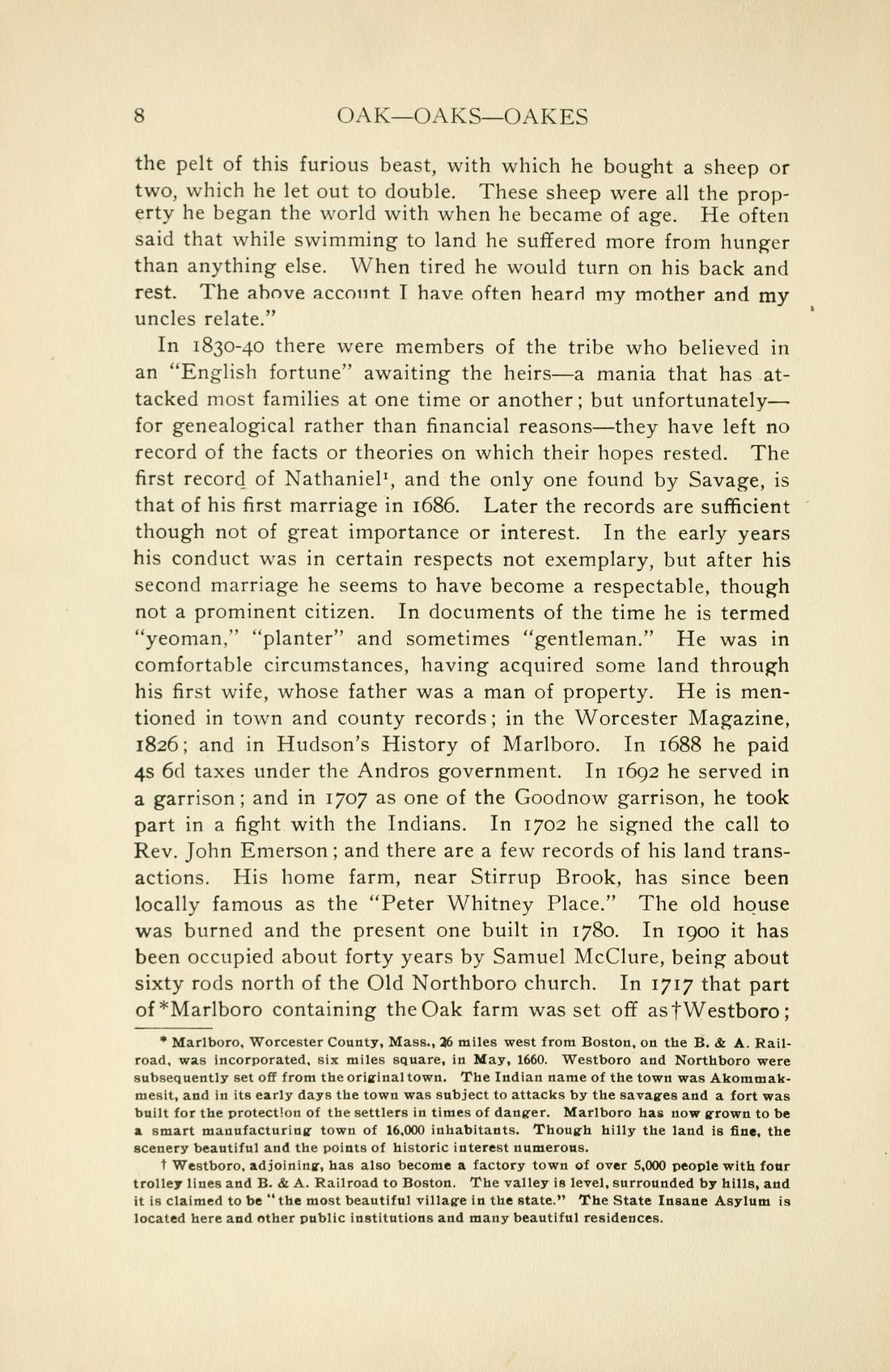
View transcription
The grandfather of my mother was a cabin-boy on an English vessel bound to Boston. Nine miles from land the vessel foundered. All the ship's crew, except the boy whose name was Oaks, were lost. He, being a good swimmer, swam ashore. In his distress he solemnly promised the Lord if He would preserve him to get to land he would never go onto the water again. This promise he sacredly kept. His wife, my great-grandmother, could never persuade him even to cross Charles River in a boat to Boston. He would always go around upon the neck. Thus he reached his after-home, poor and penniless, without even clothes to cover him; and as was then the custom, having no friends in America, he was bound out to earn his living. His master set him to work in a pitch-pine forest to pick up pine knots. In this employ he was attacked by a catamount, or wild-cat, which he slew with a large pine knot. His master gave him the bounty the State paid for the pelt of this furious beast, with which he bought a sheep or two, which he let out to double. These sheep were all the property he began the world with when he became of age. He often said that while swimming to land he suffered more from hunger than anything else. When tired he would turn on his back and rest. The above account I have often heard my mother and my uncles relate.
The end of the note is on this page; the whole note is given here as it runs across pages 7 and 8.
Massachusetts did pay bounties for wolves, catamounts and wild cats; the Boston Gazette of December 25, 1753 (p. 1) printed an act renewing them. That is background only. The act covers the whole province, names no one, renews an earlier law and comes more than sixty years after any arrival year suggested below, so it tells us nothing about Nathaniel's wildcat.
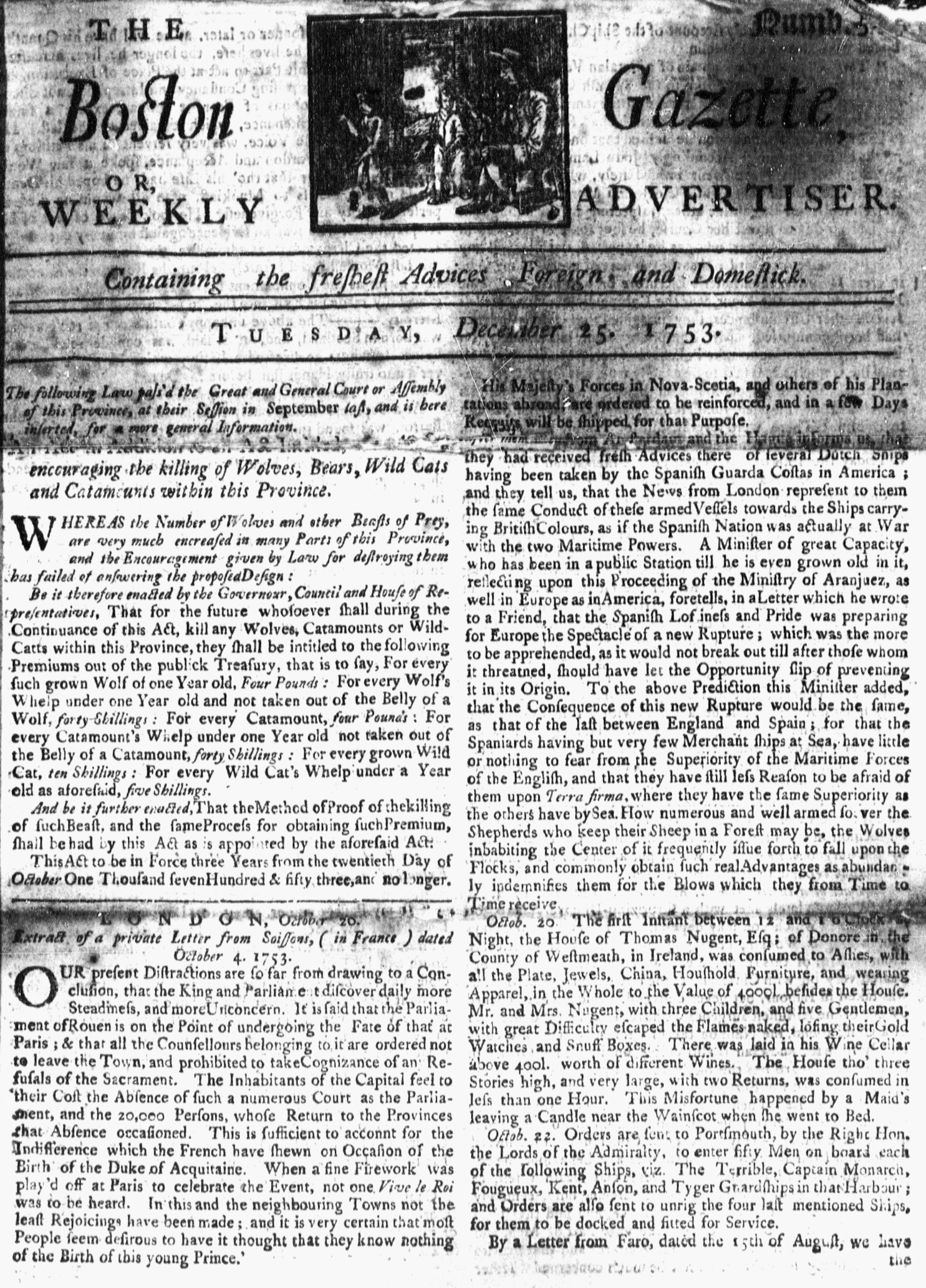
Source: The Boston Gazette, Boston, 25 December 1753; America's Historical Newspapers (Readex), via AmericanAncestors.org
How it is shown: Complete page as supplied; no crop, no retouch, no search highlight. Attached as context to the Nathaniel Oak story, not as a record of his life.
Keep in mind: What the page says: Confirmed from a direct reading. The act renews an earlier one ('the aforesaid Act'; 'the Encouragement given by Law has failed of answering the proposed Design'), so it is not the first Massachusetts bounty law, and the date of the first such law is still open. It runs three years from 20 Oct 1753. Whether this concerns our person: not applicable. The act is province-wide legislation that names no person; Nathaniel Oak is tagged only so that the page can sit with his story as background. It does not date, confirm or corroborate the family's wildcat-bounty tradition, which the story itself places decades before any surviving American newspaper.
Image details
How the story grew in print, 1826 to 1906
In print, the story arrived late. The two oldest accounts, from 1826 and 1862, say only that Nathaniel "came from England." The shipwreck first appears in a Maine newspaper in 1899, and each printing after that adds or drops a piece of the story. Here they are in order, each shown from the printed page.
1826 and 1862: "came from England"
Allen's history of Northborough, printed in the Worcester Magazine in 1826, tells how John Rediat's land came to "Nathaniel Oaks, who married his daughter." A footnote begins: "Nathaniel Oaks came from England, married Mehitabel, daughter of John Rediet, who died Nov. 25th, 1702, without children." It goes on to his second wife, Mary Holloway, and their children.
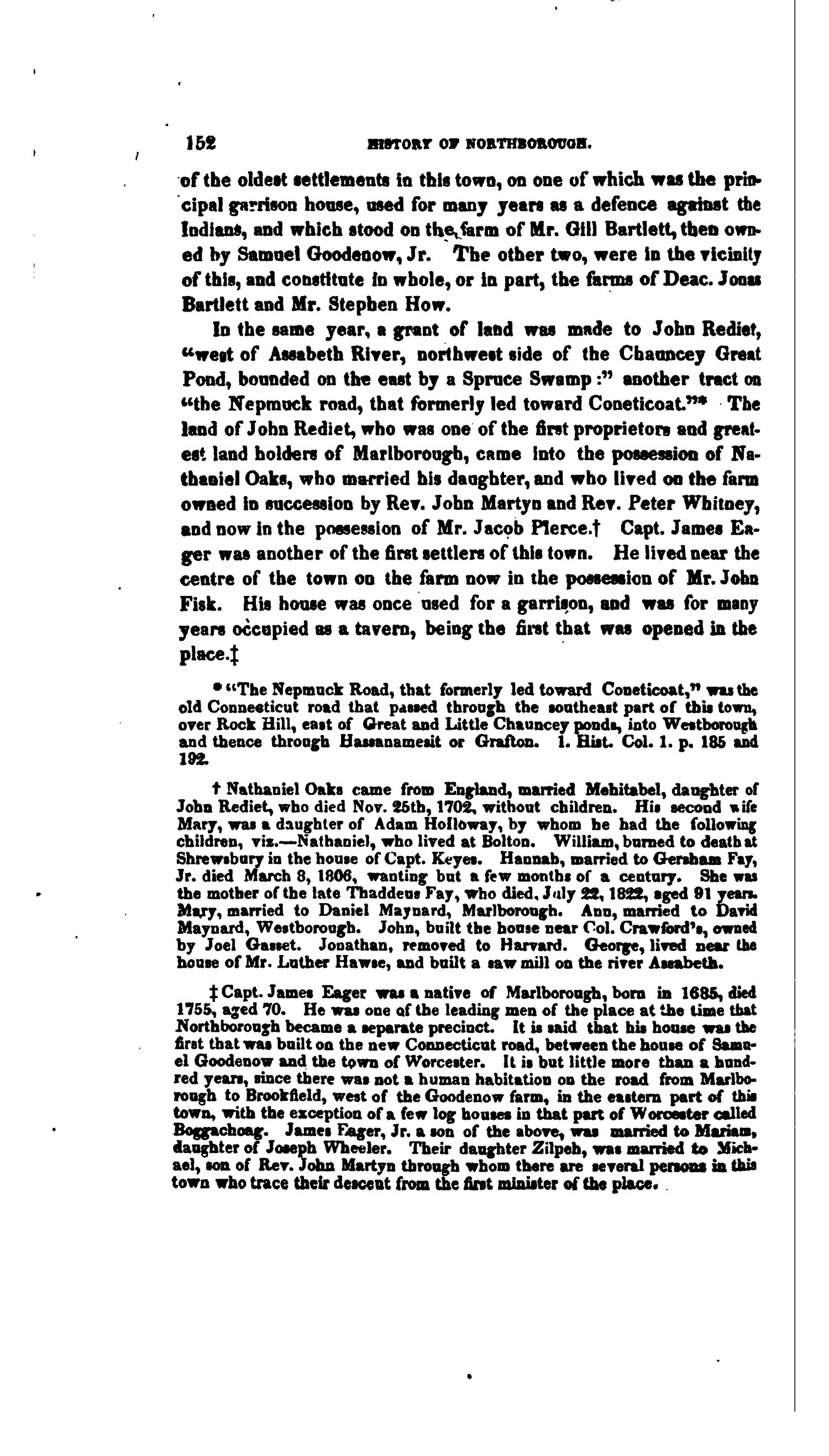
View transcription
In the same year, a grant of land was made to John Rediet, "west of Assabeth River, northwest side of the Chauncey Great Pond, bounded on the east by a Spruce Swamp:" another tract on "the Nepmuck road, that formerly led toward Coneticoat." The land of John Rediet, who was one of the first proprietors and greatest land holders of Marlborough, came into the possession of Nathaniel Oaks, who married his daughter, and who lived on the farm owned in succession by Rev. John Martyn and Rev. Peter Whitney, and now in the possession of Mr. Jacob Pierce.
Footnote: Nathaniel Oaks came from England, married Mehitabel, daughter of John Rediet, who died Nov. 25th, 1702, without children. His second wife Mary, was a daughter of Adam Holloway, by whom he had the following children, viz.-Nathaniel, who lived at Bolton. William, burned to death at Shrewsbury in the house of Capt. Keyes. Hannah, married to Gershom Fay, Jr. died March 8, 1806, wanting but a few months of a century. She was the mother of the late Thaddeus Fay, who died, July 22, 1822, aged 91 years. Mary, married to Daniel Maynard, Marlborough. Ann, married to David Maynard, Westborough. John, built the house near Col. Crawford's, owned by Joel Gasset. Jonathan, removed to Harvard. George, lived near the house of Mr. Luther Hawse, and built a saw mill on the river Assabeth.
Transcribed from the page image: the passage and the footnote about the Rediet land and Nathaniel Oaks only. Spellings and punctuation as printed.
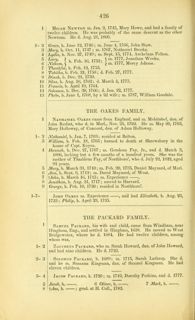
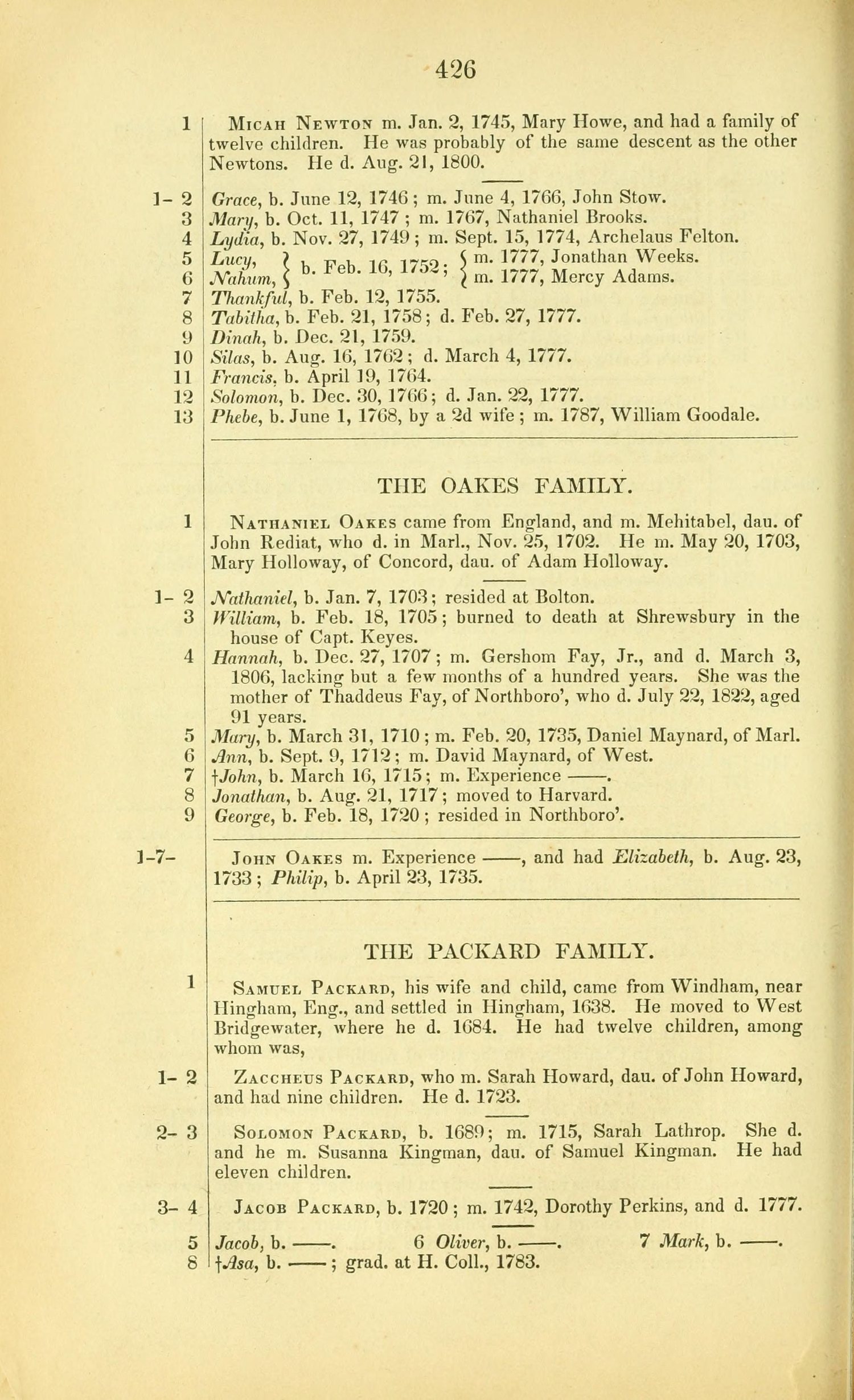
Hudson's History of the Town of Marlborough (1862, p. 426) opens its family entry the same way: "Nathaniel Oakes came from England, and m. Mehitabel, dau. of John Rediat, who d. in Marl., Nov. 25, 1702. He m. May 20, 1703, Mary Holloway, dau. of Adam Holloway." Its list of children follows the same lines.
View transcription
THE OAKES FAMILY.
Nathaniel Oakes came from England, and m. Mehitabel, dau. of John Rediat, who d. in Marl., Nov. 25, 1702. He m. May 20, 1703, Mary Holloway, of Concord, dau. of Adam Holloway.
Nathaniel, b. Jan. 7, 1703; resided at Bolton.
William, b. Feb. 18, 1705; burned to death at Shrewsbury in the house of Capt. Keyes.
Hannah, b. Dec. 27, 1707; m. Gershom Fay, Jr., and d. March 3, 1806, lacking but a few months of a hundred years. She was the mother of Thaddeus Fay, of Northboro', who d. July 22, 1822, aged 91 years.
Mary, b. March 31, 1710; m. Feb. 20, 1735, Daniel Maynard, of Marl.
Ann, b. Sept. 9, 1712; m. David Maynard, of West.
John, b. March 16, 1715; m. Experience ----.
Jonathan, b. Aug. 21, 1717; moved to Harvard.
George, b. Feb. 18, 1720; resided in Northboro'.
Transcribed from the page image: the whole Oakes entry. Spellings and punctuation as printed; the children are numbered in the margin.
Neither book mentions a ship, a wreck, a boy, a wildcat or a Bible, and neither says Wales.
April 29, 1899: the Lewiston Journal
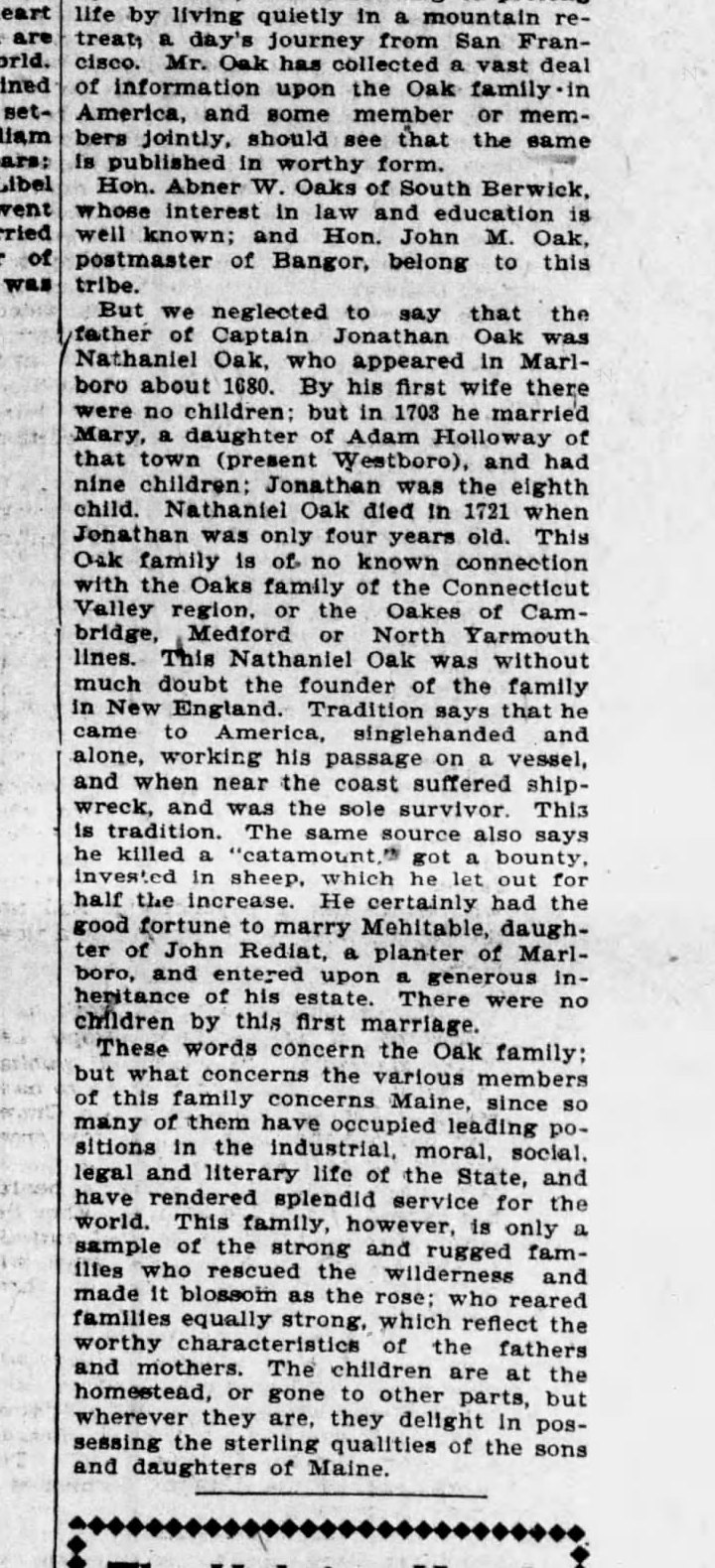
The shipwreck first appears in a Skowhegan feature on Captain Jonathan Oak in the Illustrated Magazine Section of the Lewiston Journal. Near the end, after saying Nathaniel "appeared in Marlboro about 1680," it adds: "Tradition says that he came to America, singlehanded and alone, working his passage on a vessel, and when near the coast suffered shipwreck, and was the sole survivor. This is tradition. The same source also says he killed a 'catamount,' got a bounty, invested in sheep, which he let out for half the increase." The whole article is on its own page.
View transcription
Mr. Oak has collected a vast deal of information upon the Oak family in America, and some member or members jointly, should see that the same is published in worthy form.
Hon. Abner W. Oaks of South Berwick, whose interest in law and education is well known; and Hon. John M. Oak, postmaster of Bangor, belong to this tribe.
But we neglected to say that the father of Captain Jonathan Oak was Nathaniel Oak, who appeared in Marlboro about 1680. By his first wife there were no children; but in 1703 he married Mary, a daughter of Adam Holloway of that town (present Westboro), and had nine children; Jonathan was the eighth child. Nathaniel Oak died in 1721 when Jonathan was only four years old. This Oak family is of no known connection with the Oaks family of the Connecticut Valley region, or the Oakes of Cambridge, Medford or North Yarmouth lines. This Nathaniel Oak was without much doubt the founder of the family in New England. Tradition says that he came to America, singlehanded and alone, working his passage on a vessel, and when near the coast suffered shipwreck, and was the sole survivor. This is tradition. The same source also says he killed a "catamount," got a bounty, invested in sheep, which he let out for half the increase. He certainly had the good fortune to marry Mehitable, daughter of John Rediat, a planter of Marlboro, and entered upon a generous inheritance of his estate. There were no children by this first marriage.
These words concern the Oak family; but what concerns the various members of this family concerns Maine, since so many of them have occupied leading positions in the industrial, moral, social, legal and literary life of the State, and have rendered splendid service for the world. This family, however, is only a sample of the strong and rugged families who rescued the wilderness and made it blossom as the rose; who reared families equally strong, which reflect the worthy characteristics of the fathers and mothers. The children are at the homestead, or gone to other parts, but wherever they are, they delight in possessing the sterling qualities of the sons and daughters of Maine.
Transcribed from the page image: the last paragraphs of the article only, which begin in the same column with the passage about Henry L. Oak.
There is no cabin boy here, no vow, no indenture, no Wales, Bible or John Conant, and no source beyond "tradition." Only this version has the sheep let out "for half the increase."
January 26, 1900: the Vermont Phoenix
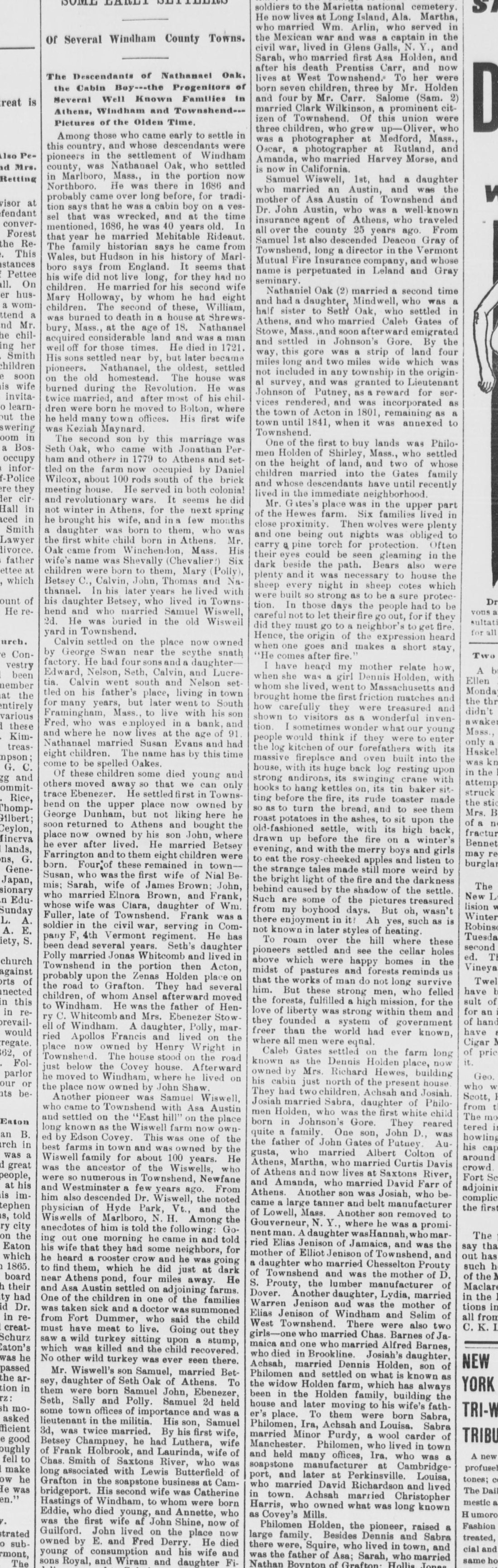
The next January, the Vermont Phoenix of Brattleboro ran a column on "Some Early Settlers of Several Windham County Towns" under the headline "The Descendants of Nathanael Oak, the Cabin Boy." It says Nathaniel was in Marlboro in 1686 "and probably came over long before, for tradition says that he was a cabin boy on a vessel that was wrecked," and that "the family historian says he came from Wales, but Hudson in his history of Marlboro says from England." The column goes on to his descendants at Athens, Windham and Townshend.
View transcription
SOME EARLY SETTLERS Of Several Windham County Towns.
The Descendants of Nathanael Oak, the Cabin Boy---the Progenitors of Several Well Known Families in Athens, Windham and Townshend---Pictures of the Olden Time.
Among those who came early to settle in this country, and whose descendants were pioneers in the settlement of Windham county, was Nathanael Oak, who settled in Marlboro, Mass., in the portion now Northboro. He was there in 1686 and probably came over long before, for tradition says that he was a cabin boy on a vessel that was wrecked, and at the time mentioned, 1686, he was 40 years old. In that year he married Mehitable Rideaut. The family historian says he came from Wales, but Hudson in his history of Marlboro says from England. It seems that his wife did not live long, for they had no children. He married for his second wife Mary Holloway, by whom he had eight children. The second of these, William, was burned to death in a house at Shrewsbury, Mass., at the age of 18. Nathanael acquired considerable land and was a man well off for those times. He died in 1721. His sons settled near by, but later became pioneers. Nathanael, the oldest, settled on the old homestead. The house was burned during the Revolution. He was twice married, and after most of his children were born he moved to Bolton, where he held many town offices. His first wife was Keziah Maynard.
The second son by this marriage was Seth Oak, who came with Jonathan Perham and others in 1779 to Athens and settled on the farm now occupied by Daniel Wilcox, about 100 rods south of the brick meeting house. He served in both colonial and revolutionary wars. It seems he did not winter in Athens, for the next spring he brought his wife, and in a few months a daughter was born to them, who was the first white child born in Athens. Mr. Oak came from Winchendon, Mass. His wife's name was Shevally (Chevalier). Six children were born to them, Mary (Polly), Betsey C., Calvin, John, Thomas and Nathanael.
Transcribed from the page image: the headlines and the first paragraphs. The column goes on with the Athens, Windham and Townshend families and is not transcribed here.
The column has no sole survivor, vow, indenture, wildcat, bounty, sheep, Bible or Conant. It is the first printing found to call him "the Cabin Boy" in a headline, and the first to set Wales, from "the family historian" (Henry L. Oak), against Hudson's England. It also shows the story was told in the Athens, Vermont branch of the family, not only in Maine.
1903: Henry L. Oak's sketch of the Oaks of Garland
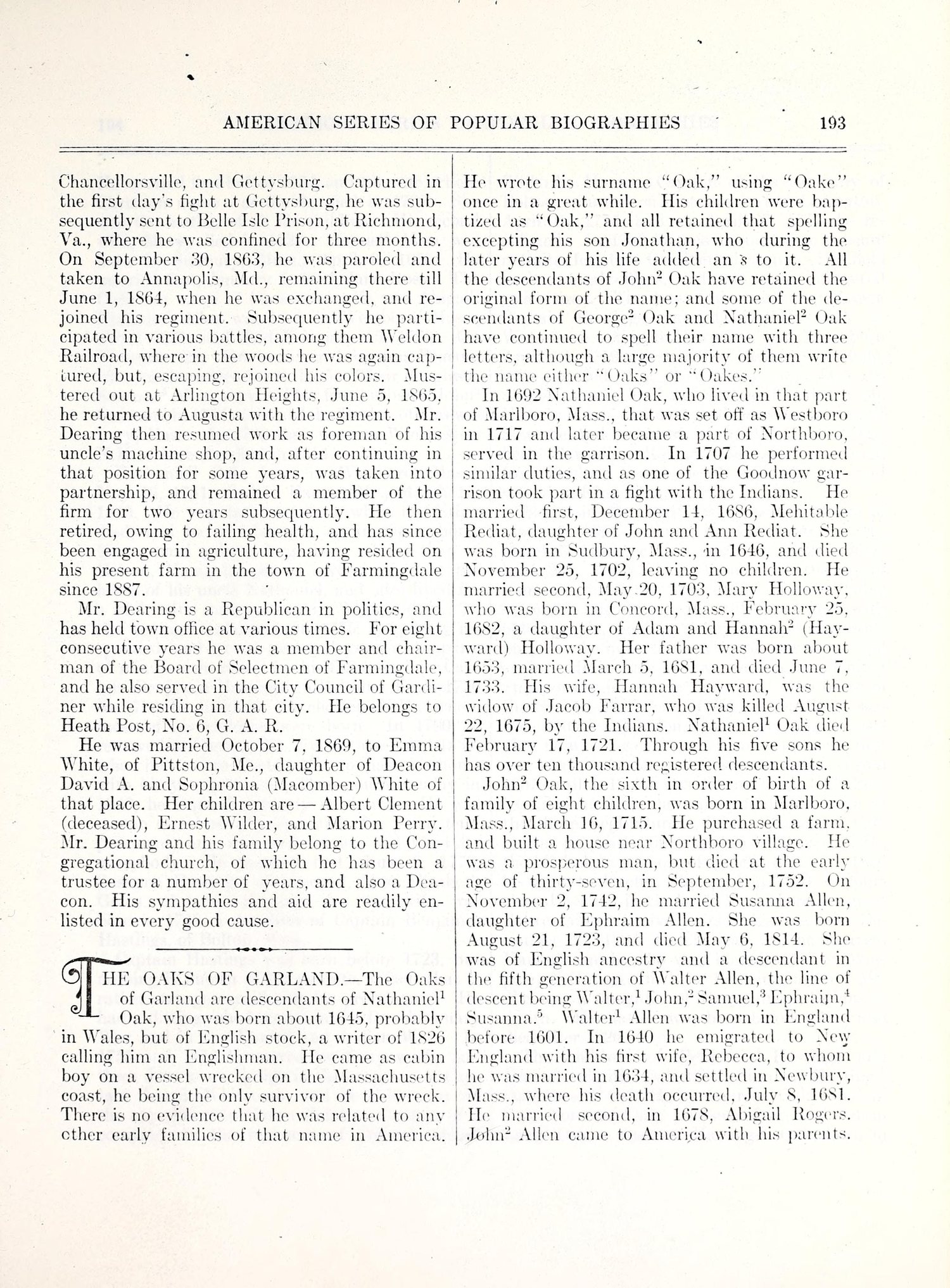
In Biographical Sketches of Representative Citizens of the State of Maine (1903, p. 193), Henry L. Oak wrote that Nathaniel "was born about 1645, probably in Wales, but of English stock, a writer of 1826 calling him an Englishman. He came as cabin boy on a vessel wrecked on the Massachusetts coast, he being the only survivor of the wreck."
View transcription
THE OAKS OF GARLAND.--The Oaks of Garland are descendants of Nathaniel Oak, who was born about 1645, probably in Wales, but of English stock, a writer of 1826 calling him an Englishman. He came as cabin boy on a vessel wrecked on the Massachusetts coast, he being the only survivor of the wreck. There is no evidence that he was related to any other early families of that name in America. He wrote his surname "Oak," using "Oake" once in a great while. His children were baptized as "Oak," and all retained that spelling excepting his son Jonathan, who during the later years of his life added an s to it. All the descendants of John Oak have retained the original form of the name; and some of the descendants of George Oak and Nathaniel Oak have continued to spell their name with three letters, although a large majority of them write the name either "Oaks" or "Oakes."
In 1692 Nathaniel Oak, who lived in that part of Marlboro, Mass., that was set off as Westboro in 1717 and later became a part of Northboro, served in the garrison. In 1707 he performed similar duties, and as one of the Goodnow garrison took part in a fight with the Indians. He married first, December 14, 1686, Mehitable Rediat, daughter of John and Ann Rediat. She was born in Sudbury, Mass., in 1646, and died November 25, 1702, leaving no children. He married second, May 20, 1703, Mary Holloway, who was born in Concord, Mass., February 25, 1682, a daughter of Adam and Hannah (Hayward) Holloway. Her father was born about 1653, married March 5, 1681, and died June 7, 1733. His wife, Hannah Hayward, was the widow of Jacob Farrar, who was killed August 22, 1675, by the Indians. Nathaniel Oak died February 17, 1721.
Transcribed from the page image: the article as it appears on this page (superscript generation numbers left out). It continues on page 194.
Here the cabin boy is "the only survivor," born "about 1645," probably in Wales but of English stock. There is no wildcat, bounty, sheep, vow, indenture or Bible. The "writer of 1826" is Allen, above.
1905: the Jefferson County history
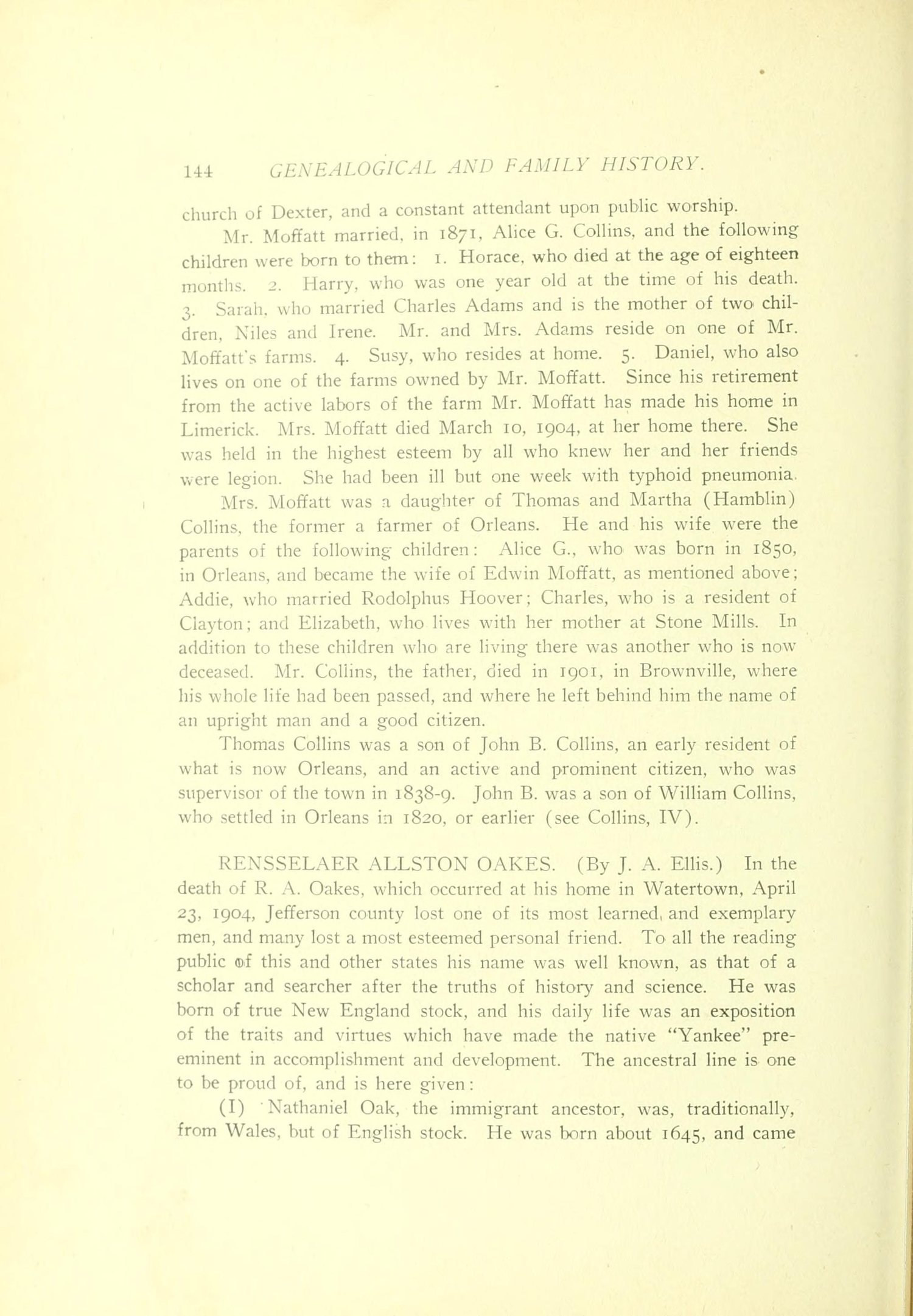
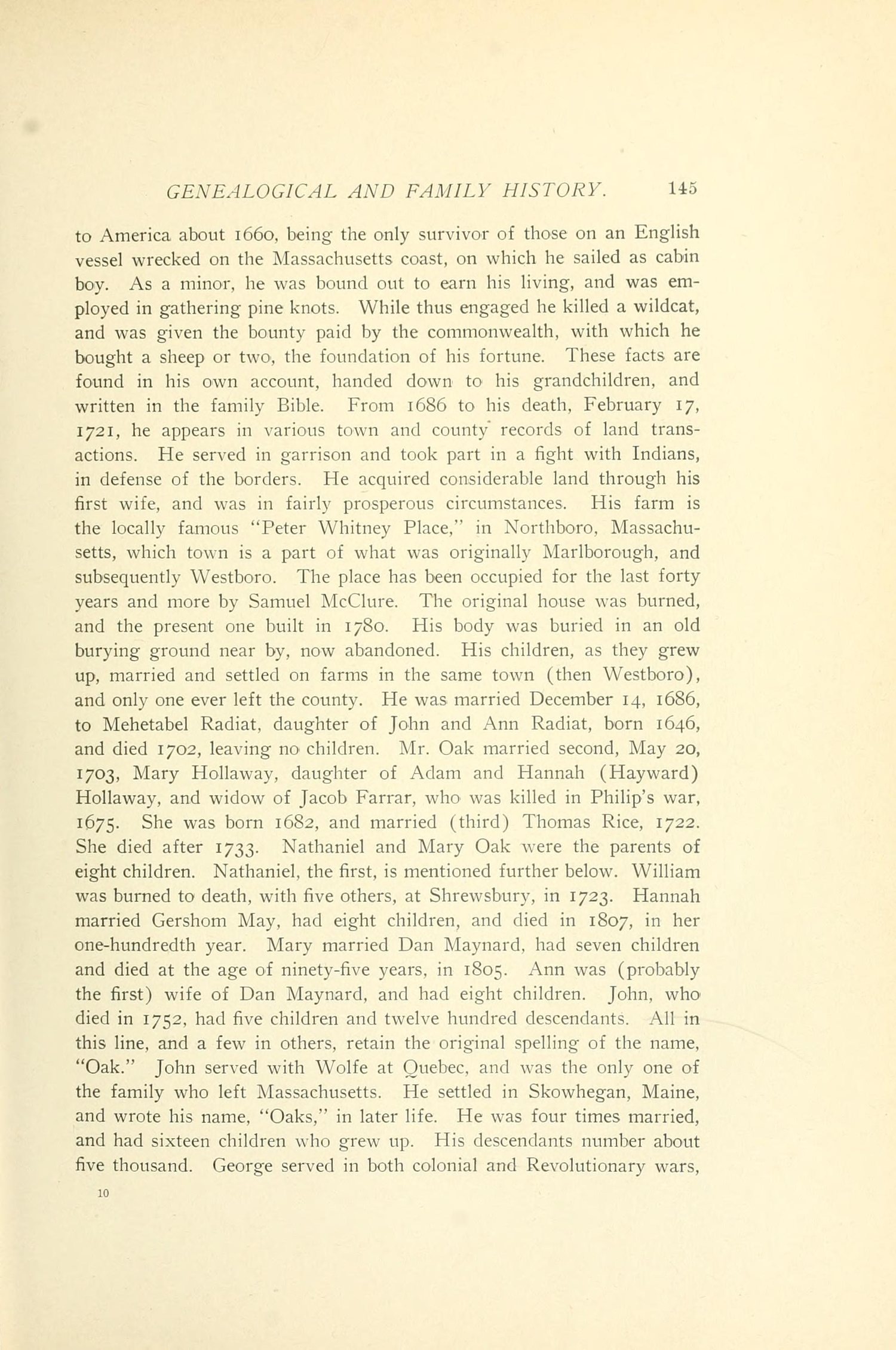
A sketch of Rensselaer Allston Oakes by J. A. Ellis, in Genealogical and Family History of the County of Jefferson, New York (1905, vol. I, pp. 144-145), tells the fuller story as the Athens, Vermont branch knew it. Nathaniel was a cabin boy, "the only survivor of those on an English vessel wrecked on the Massachusetts coast," bound out as a minor and "employed in gathering pine knots." He killed a wildcat, was given "the bounty paid by the commonwealth" and bought "a sheep or two, the foundation of his fortune." The sketch says he came "about 1660," "traditionally, from Wales, but of English stock," and closes: "These facts are found in his own account, handed down to his grandchildren, and written in the family Bible." The same page carries the register's genealogy, errors included, so this is a retelling of the same family note, not an independent source. The book spells the name "Allston."
View transcription
RENSSELAER ALLSTON OAKES. (By J. A. Ellis.) In the death of R. A. Oakes, which occurred at his home in Watertown, April 23, 1904, Jefferson county lost one of its most learned, and exemplary men, and many lost a most esteemed personal friend. To all the reading public of this and other states his name was well known, as that of a scholar and searcher after the truths of history and science. He was born of true New England stock, and his daily life was an exposition of the traits and virtues which have made the native "Yankee" pre-eminent in accomplishment and development. The ancestral line is one to be proud of, and is here given:
(I) Nathaniel Oak, the immigrant ancestor, was, traditionally, from Wales, but of English stock. He was born about 1645, and came
Transcribed from the page image: the start of the sketch at the foot of the page. It continues on page 145.
View transcription
to America about 1660, being the only survivor of those on an English vessel wrecked on the Massachusetts coast, on which he sailed as cabin boy. As a minor, he was bound out to earn his living, and was employed in gathering pine knots. While thus engaged he killed a wildcat, and was given the bounty paid by the commonwealth, with which he bought a sheep or two, the foundation of his fortune. These facts are found in his own account, handed down to his grandchildren, and written in the family Bible. From 1686 to his death, February 17, 1721, he appears in various town and county records of land transactions. He served in garrison and took part in a fight with Indians, in defense of the borders.
Transcribed from the page image: the first paragraph at the top of the page, which continues the sentence from page 144. The rest of the page (his farm, his marriages and his children) is not transcribed here.
What changes from one telling to the next
- A ship and a wreck: 1899, 1900, 1903, 1905 and 1906. Not in 1826 or 1862.
- Only survivor: 1899 ("sole survivor"), 1903, 1905 and 1906. Not stated in 1900.
- A cabin boy: 1900, 1903, 1905 and 1906. Not in 1899, which says he "worked his passage."
- Wildcat, bounty and sheep: 1899, 1905 and 1906. Not in 1900 or 1903.
- Bound out, and the pine knots: 1905 ("bound out to earn his living," "gathering pine knots") and 1906. The vow never to go on the water, the pine knot as a weapon, the swim and the Charles River detail: only in the Conant note as printed in 1906 (the typed copy has the same words).
- A family Bible: 1905 and 1906 only.
- Where he came from: England in 1826 and 1862; nothing in 1899; Wales against England in 1900; Wales with English stock in 1903 and 1905; a vague Welsh tradition in 1906.
- When he arrived: the 1899 newspaper says he "appeared in Marlboro about 1680" and gives no arrival year for America; in Marlboro by 1686 and aged 40 in 1900; born "about 1645" in 1903; arriving "about 1660" in 1905 and about 1660 to 1665 in 1906.
- A named source: none in 1826, 1862 or 1899; "tradition" and "the family historian" in 1900; "his own account" in 1905; John Conant in 1906.
Whether the 1899 and 1900 writers knew Conant's note, or heard the story some other way, neither page says.
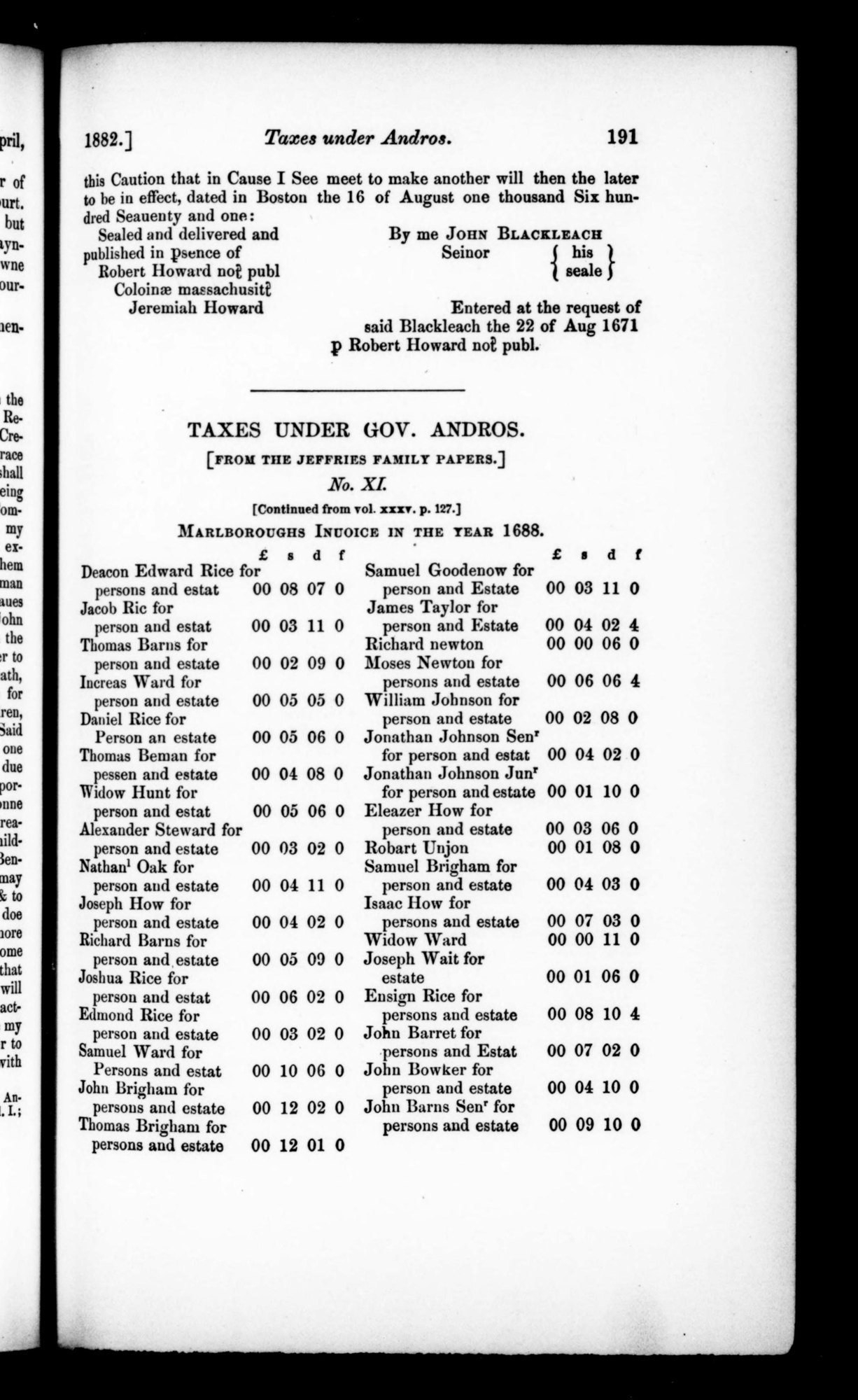
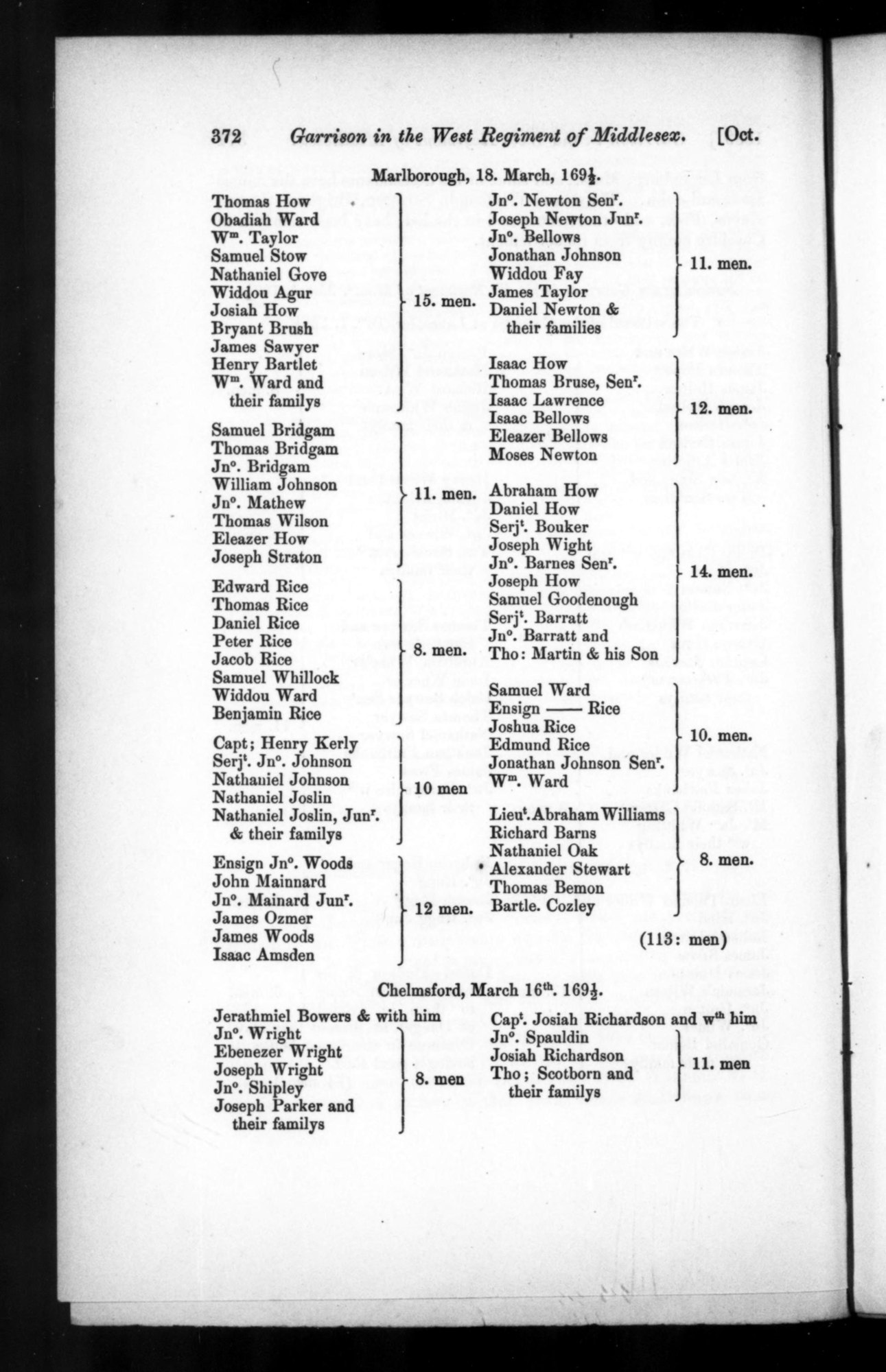
No record gives the year Nathaniel arrived. The earliest records place him at Marlborough by 1688 (tax list, NEHGR 36, p. 191) and 1692 (garrison list, NEHGR 43, p. 372). They show him living there, not when he came to America, and the same is true of the 1899 paper's "appeared in Marlboro about 1680." The later dates are estimates: "born about 1645" in 1903, "to America about 1660" in 1905, "about 1660 to 1665" in the 1906 register. None of the books explains where its figure came from or cites another.
There is one reason to doubt the earliest of them. Nathaniel's youngest recorded child, George, was born February 18, 1720, as Hudson prints it, when a man born about 1645 would have been about seventy-five. If Nathaniel was born instead in the 1660s and came over as a teenager, he would have arrived somewhere between about 1673 and 1688. No record narrows it further.
Who wrote it down: John Conant
John Conant, to whom the note is attributed, was the cabin boy's great-grandson through his mother, Lydia. He later owned a mill and furnace at Brandon, Vermont, and served as a town officer there; his life is told on John Conant of Brandon, Vermont. In 1868, Robert Collyer's life of John's son A. H. Conant described "a curious little manuscript volume inscribed 'Ebenezer Conant, his book, Ashburnham, Jan. 15, 1782,'" written by Ebenezer and John together, the father's pages on religion and the son's about his own life. In it John writes: "My mother's name was Lydia Oakes; she was born in Stowe, Mass., on the 6th of June, 1743," and "John (meaning myself), born Feb. 2, 1773." Lydia's parents aren't named there, but a Lydia born at Stow in 1743 fits the Jonathan Oak who was at Stow by 1748.
Collyer doesn't print the cabin-boy story, and he doesn't call the volume a Bible, so it isn't known whether the note was in that volume or in a Bible; nor has the volume been shown to mention Nathaniel. The Bible with the inscription the register describes hasn't been found, so we can't say when the note was written, by whose hand, or how faithfully it was copied. Where Nathaniel came from, the traditions don't agree: an 1826 writer called him English, the 1905 sketch said "traditionally, from Wales, but of English stock," and the 1906 compiler mentioned a vague Welsh tradition. None gives a birthplace.
A longer copy in Boston
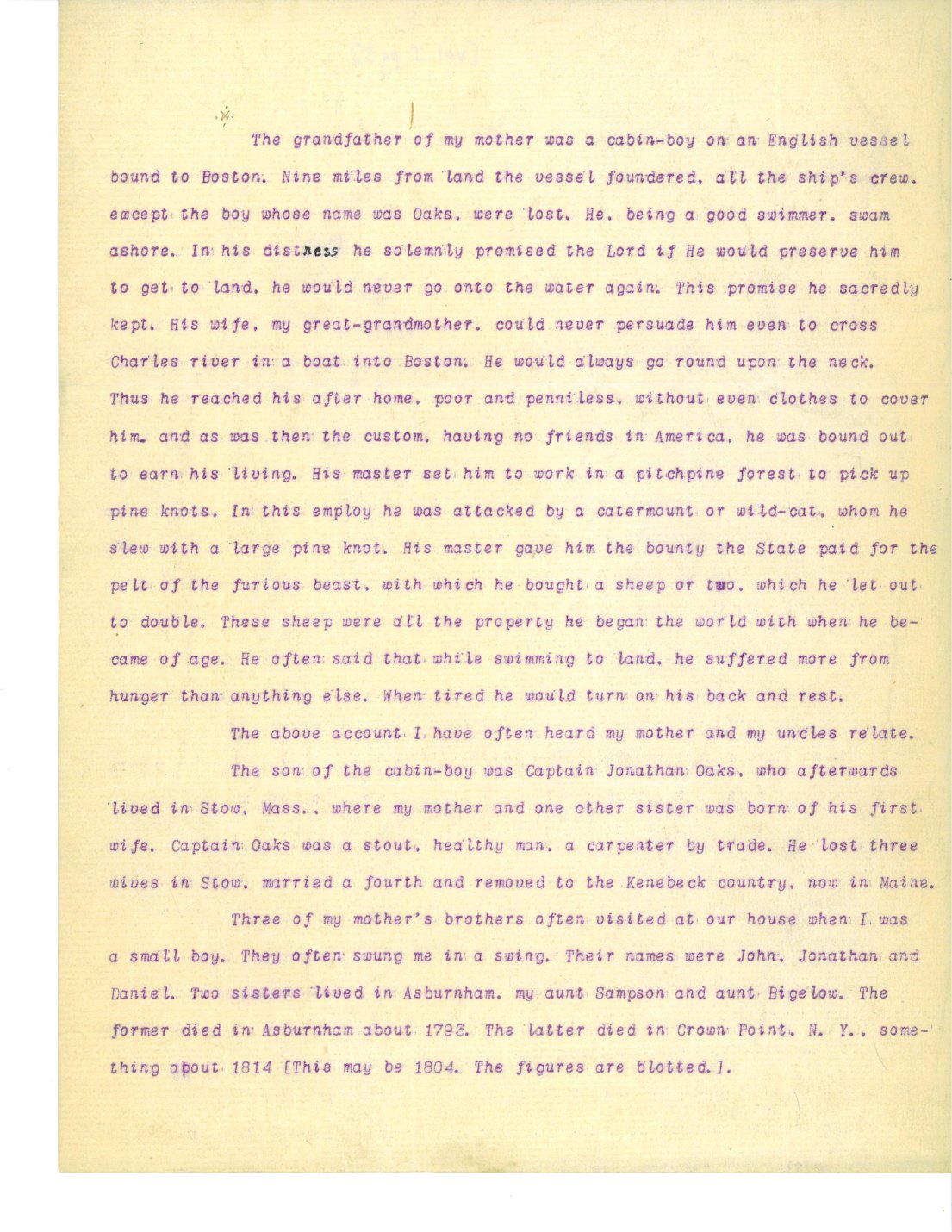
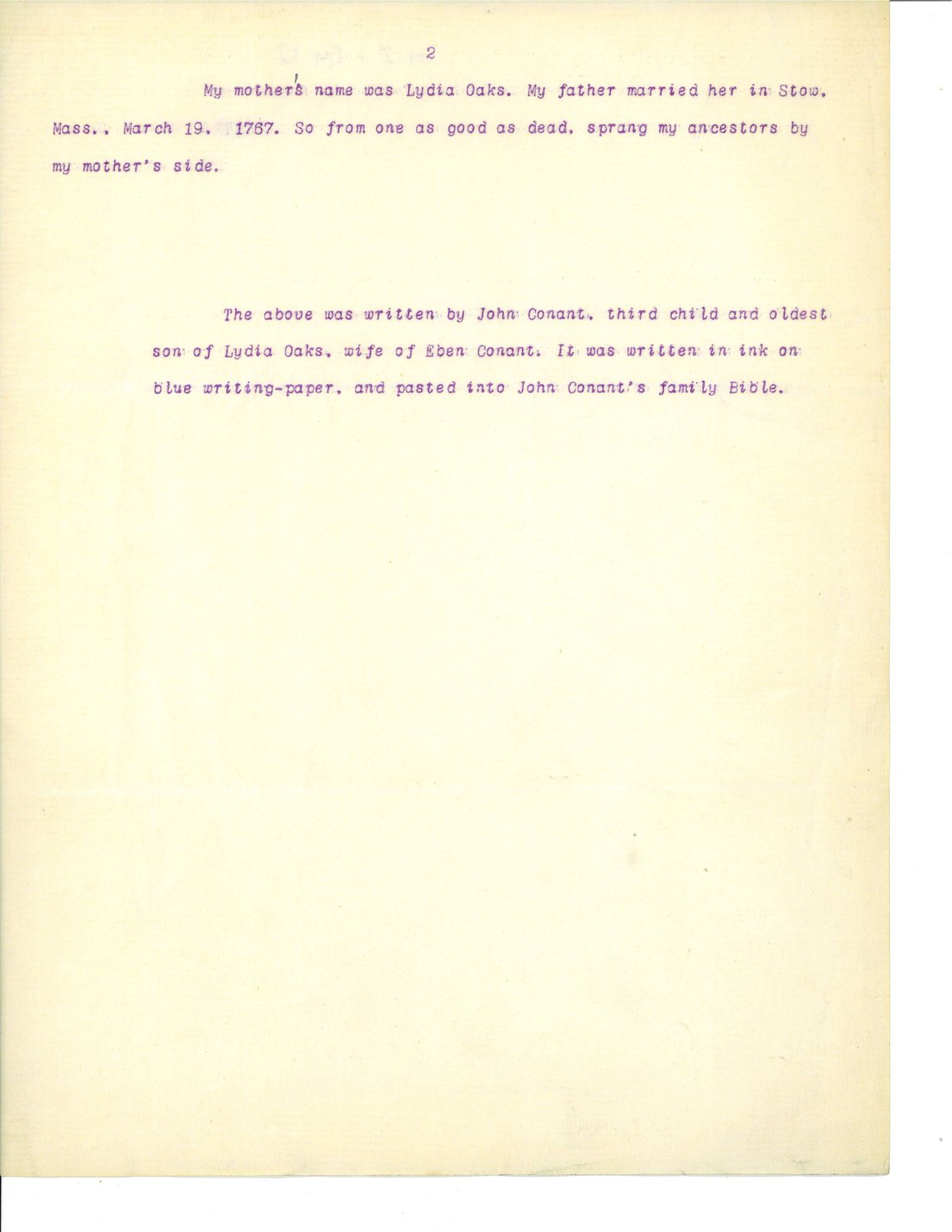
American Ancestors in Boston holds a typed copy of the same note, in a folder of loose papers in its Oak collection (Mss 865, box 9). Who typed it, and when, is not known. A faint notation on the first page seems to point to volume 1, page 2, the entry for Nathaniel, though the archive reports that the entry itself doesn't mention a Bible.
The typed copy keeps going where the register stops. After "my mother and my uncles relate," John Conant names the cabin boy's son as Captain Jonathan Oaks, a carpenter who "lost three wives in Stow, married a fourth and removed to the Kenebeck country, now in Maine." He names his mother, Lydia Oaks; his uncles John, Jonathan and Daniel; and two aunts who lived in Ashburnham, Mrs. Sampson and Mrs. Bigelow. A note about Conant in the third person, apparently added by whoever made the copy, says the original was written in ink on blue writing paper and pasted into his family Bible. If so, it was a loose note kept in the Bible rather than an inscription in it.
Source: Copy supplied by American Ancestors (NEHGS), Mss 865, Box 9, folder 2
How it is shown: Complete page as supplied; no crop, no retouch.
Keep in mind: A typed copy made by someone other than John Conant, who wrote the note; who typed it and when is not known. Family tradition.
Image details
Source: Copy supplied by American Ancestors (NEHGS), Mss 865, Box 9, folder 2
How it is shown: Complete page as supplied; no crop, no retouch. Rotated upright from the sideways scan; nothing else changed.
Keep in mind: A typed copy made by someone other than John Conant, who wrote the note; who typed it and when is not known. Family tradition.
Image details
Checking the story against the records
The later generations in the note can be followed in the records. Marlborough's vital records give Jonathan, son of Nathaniel and Mary, born August 21, 1717. Harvard's records follow a Jonathan Oak from 1749 to 1771, when its church records call him "Capt.," and record the death of his wife Elizabeth on November 23, 1750, and his marriage to Abigail Rand on April 26, 1762.
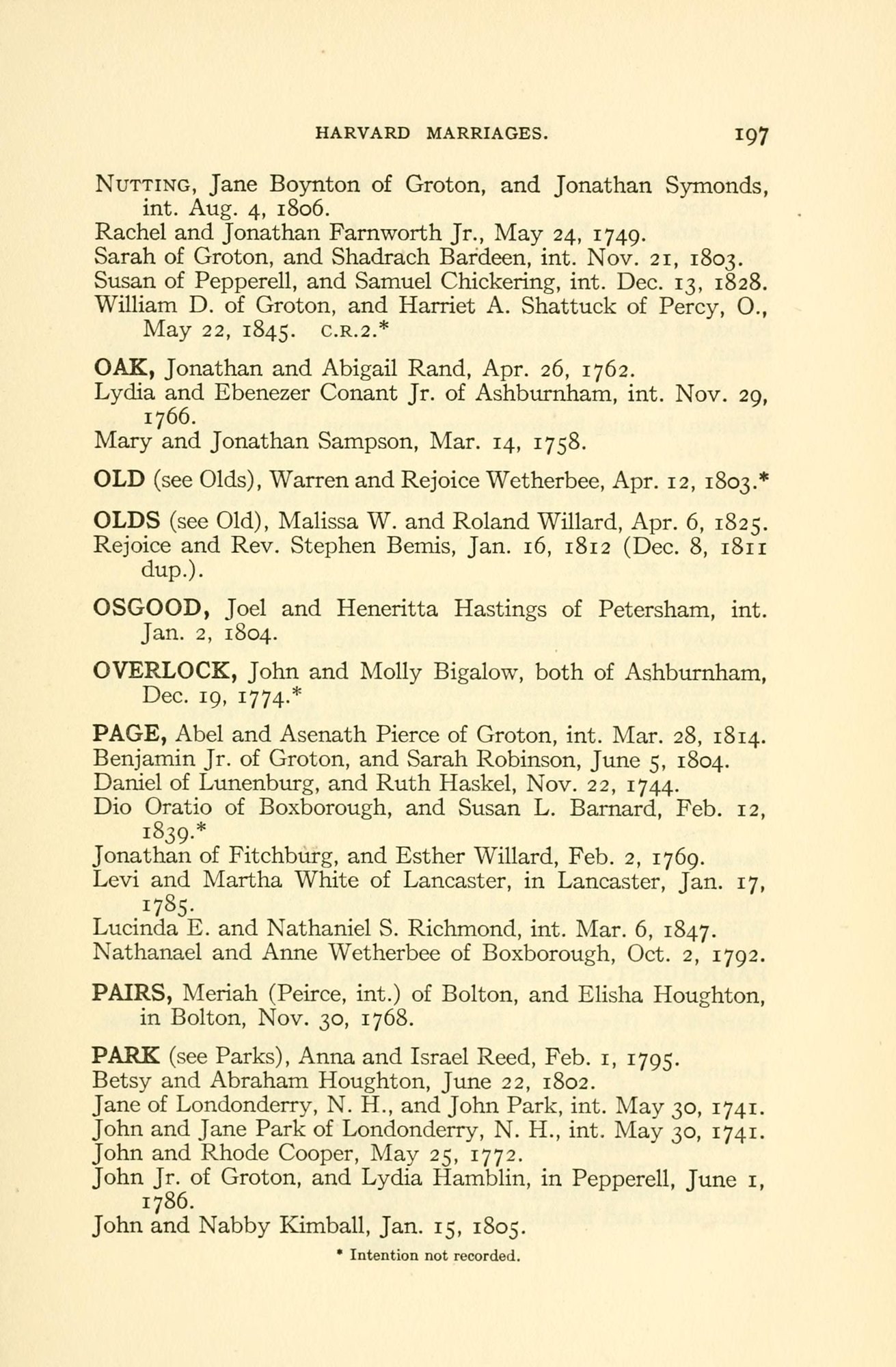
Source: Internet Archive (public-domain scan); vitalrecordsofha00harv.
How it is shown: Complete page as scanned; no crop, no retouch.
Keep in mind: A printed transcription of the town's record, not the manuscript.
Image details
In December 1784, "Jonathan Oaks of Canaan in the County of Lincoln," in what is now Maine, made his will. It was proved on March 12, 1785.
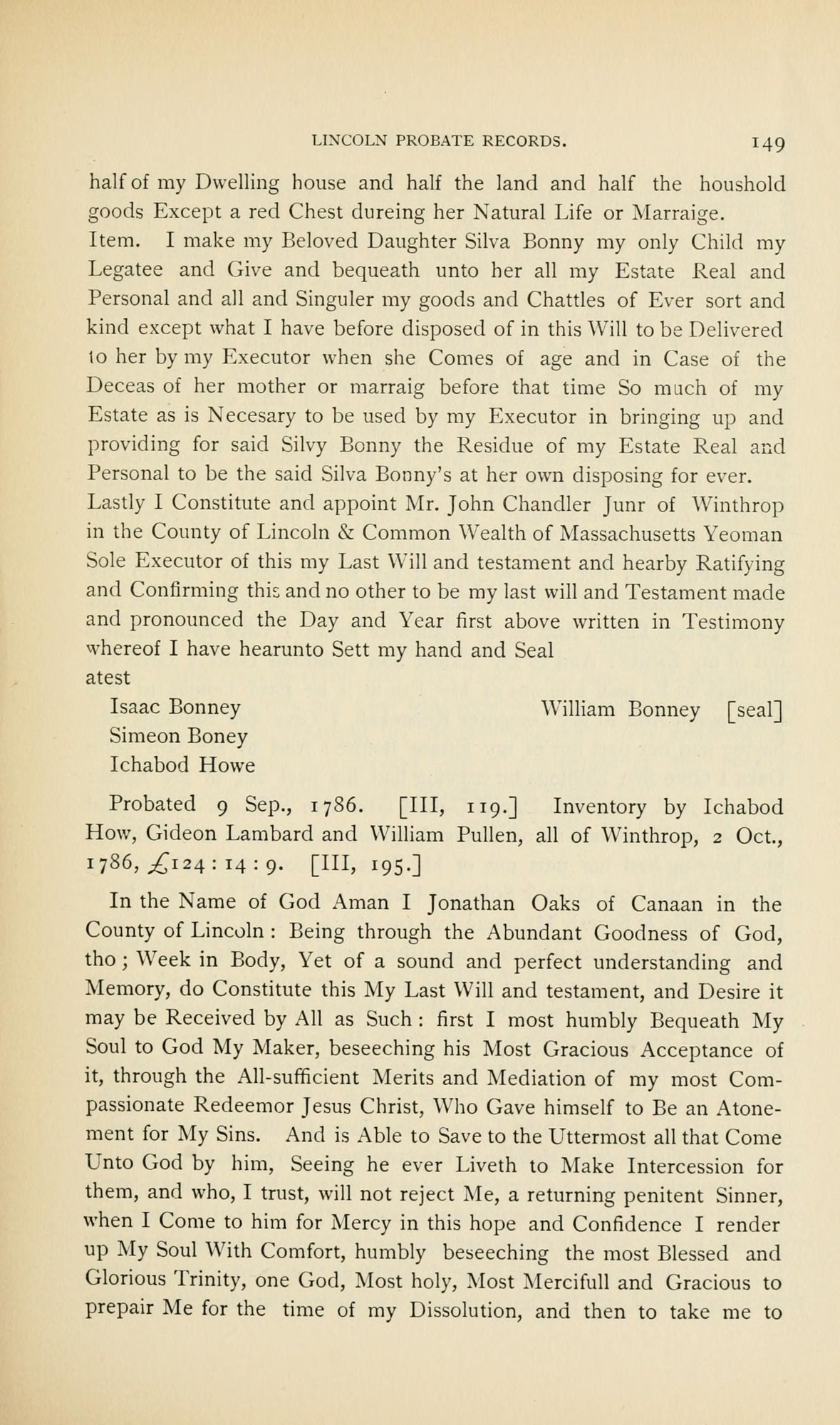
Source: Internet Archive (public-domain scan); probaterecordsof00main.
How it is shown: Complete page as scanned; no crop, no retouch.
Keep in mind: A printed abstract of the probate records, not the manuscript.
Image details
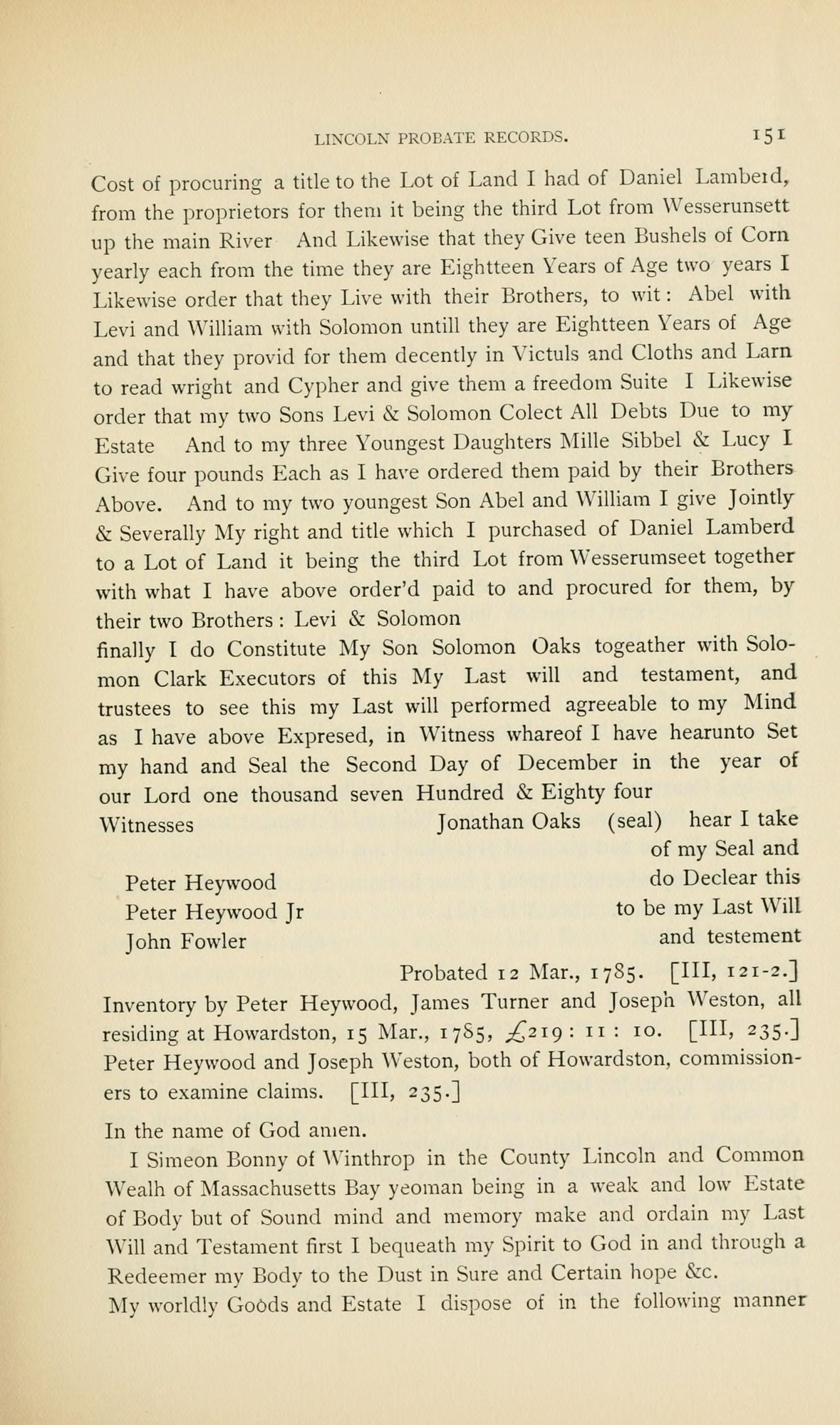
Source: Internet Archive (public-domain scan); probaterecordsof00main.
How it is shown: Complete page as scanned; no crop, no retouch.
Keep in mind: A printed abstract of the probate records, not the manuscript.
Image details
It names sixteen children, among them the Mary, Lydda, Elizabeth, Jonathan, John and Daniel of the note, and mentions his carpenter's tools.
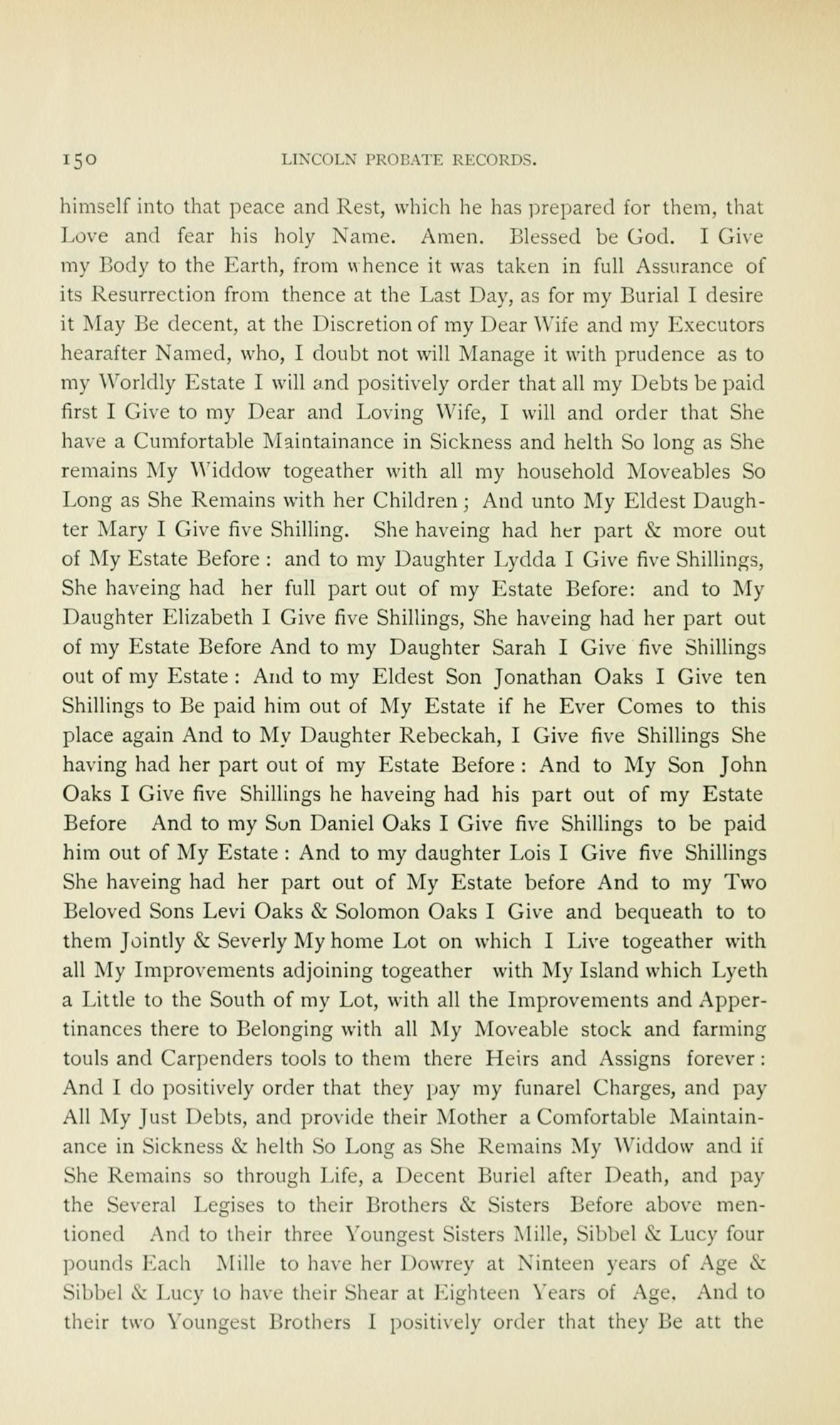
Source: Internet Archive (public-domain scan); probaterecordsof00main.
How it is shown: Complete page as scanned; no crop, no retouch.
Keep in mind: A printed abstract of the probate records, not the manuscript.
Image details
Lydia Oak of Harvard and Ebenezer Conant Jr. of Ashburnham entered their marriage intention in both towns on November 29, 1766, and their son John was born at Ashburnham on February 2, 1773.
So the Captain in the note was probably Nathaniel's son, born in 1717. No single record says so, but the dates, the trade, the move to the Kennebec and the children all fit, and no other Jonathan Oak does.
Some details don't match. Two of the Captain's wives died at Harvard, in 1750 and 1761, not at Stow.
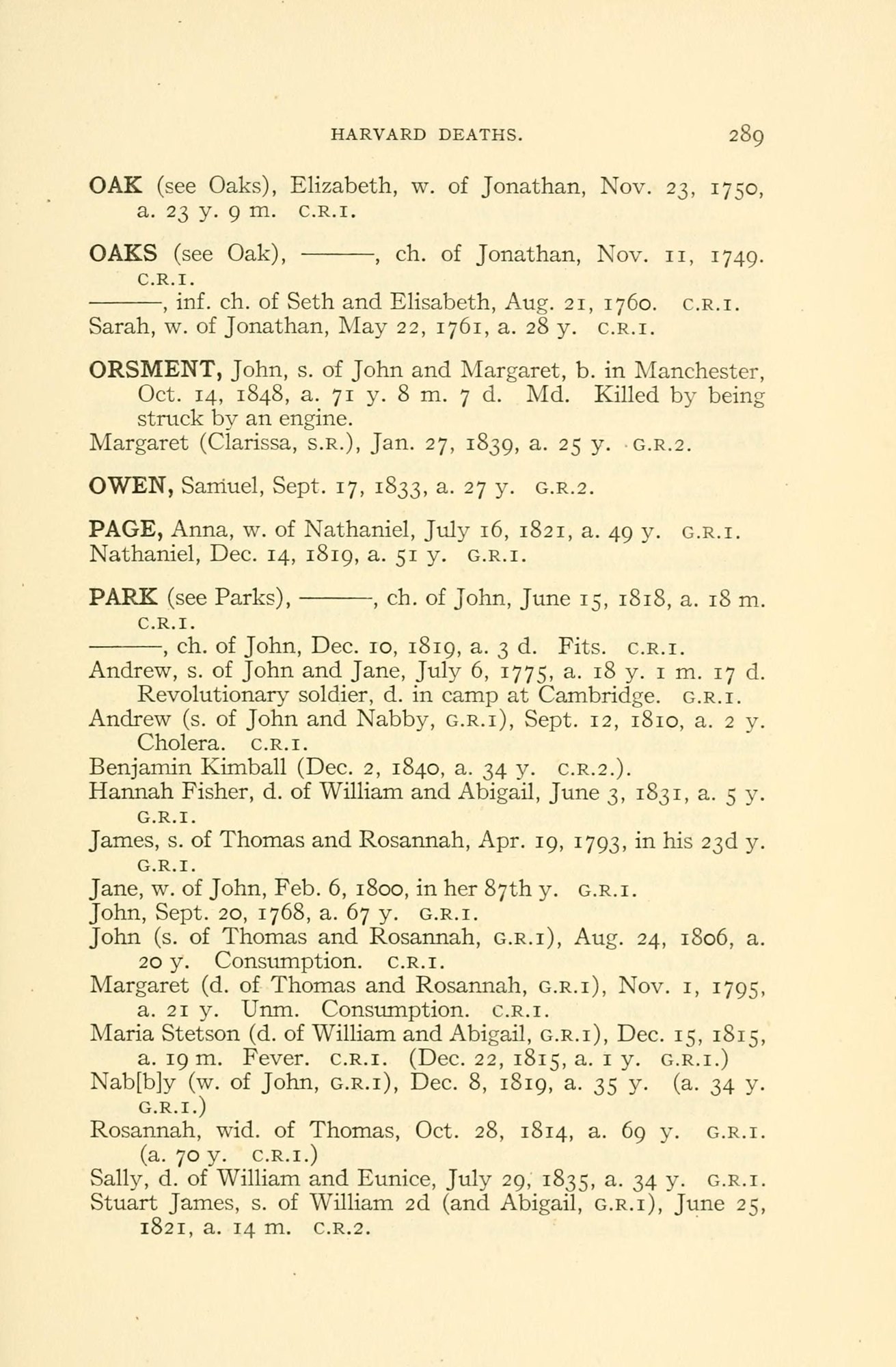
Source: Internet Archive (public-domain scan); vitalrecordsofha00harv.
How it is shown: Complete page as scanned; no crop, no retouch.
Keep in mind: A printed transcription of the town's record, not the manuscript.
Image details
No Stow wedding for Lydia has been found: the note gives March 19, 1767, and the register reads the Bible as November 19, 1767, and neither date is confirmed. The Kennebec town was Canaan. Hanson's History of the Old Towns of Norridgewock and Canaan (1849, pp. 127-128) calls the settler "John Oakes" and puts his death there in 1788; the will names Jonathan and was proved in 1785. Hanson's 1781 assessment of the plantations next to Canaan lists "John Oaks(10)" under Canaan, with its own footnote: "(10.) John, should be Jonathan; he settled about a mile below Skowhegan falls." That correction covers the 1781 list only, not the rest of Hanson's account.
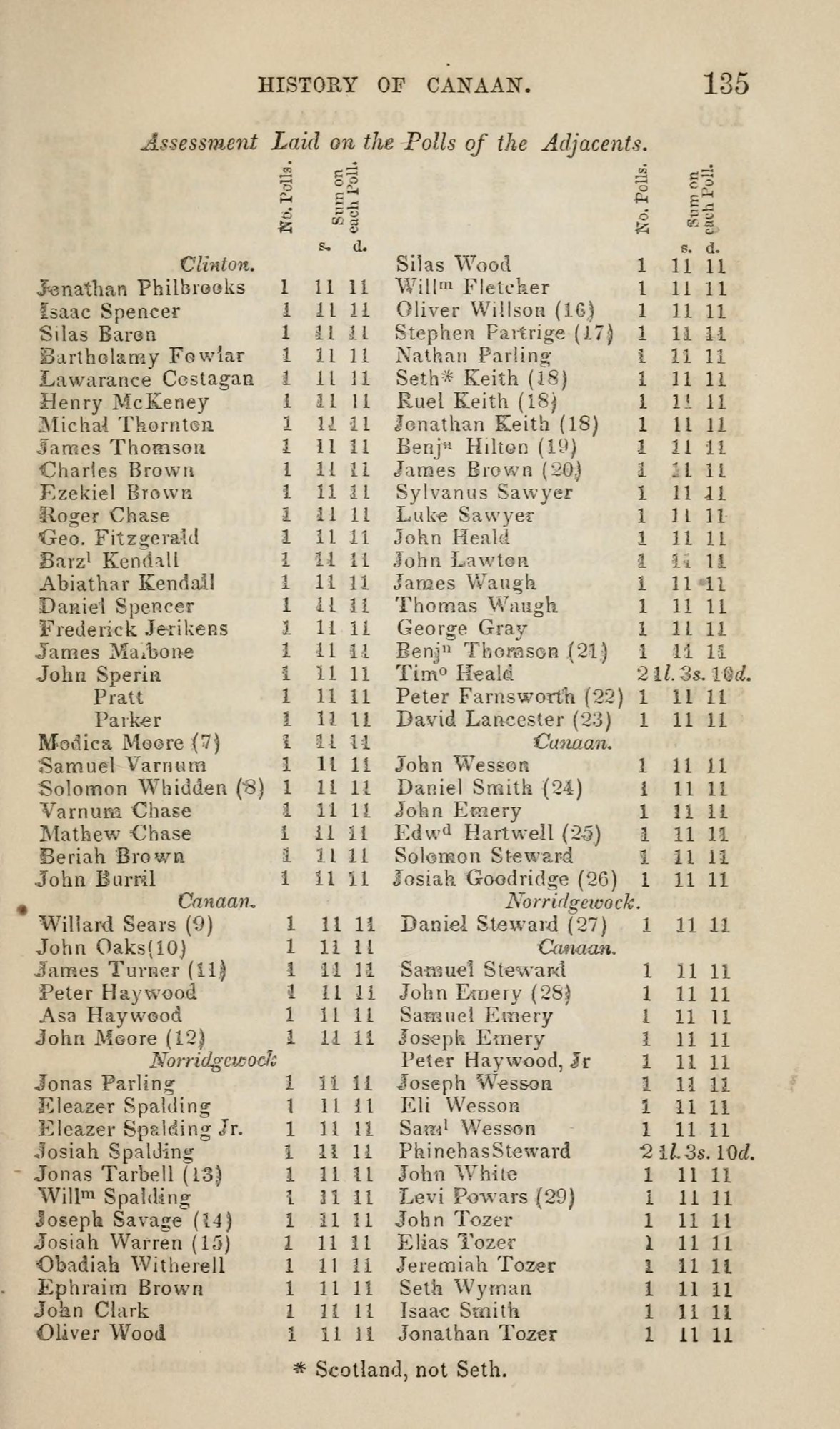
Source: Internet Archive (public-domain scan); historyofoldtown00hans.
How it is shown: Complete page as scanned; no crop, no retouch, no search highlight.
Keep in mind: Confirmed. Note (10) on p. 136 corrects 'John' to 'Jonathan' for this entry only; Hanson's narrative on pp. 127-128 still says 'John Oakes'. Identification with Jonathan Oak b. 1717 of Marlborough rests on the Oak register (1906) and the tree's chain (Westborough, Stow, Harvard, Canaan), not on this page (Unconfirmed).
Image details
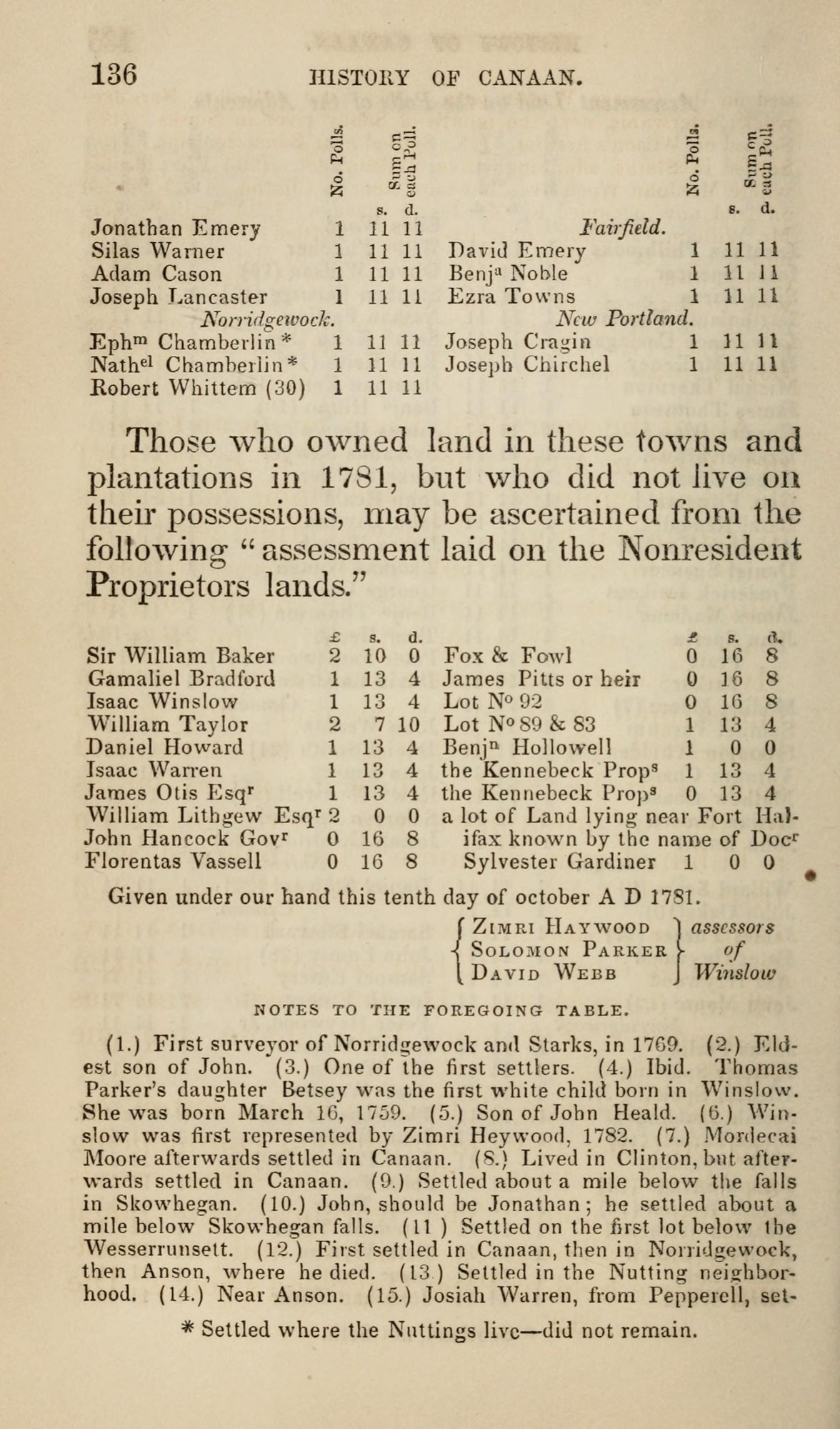
Source: Internet Archive (public-domain scan); historyofoldtown00hans.
How it is shown: Complete page as scanned; no crop, no retouch, no search highlight.
Keep in mind: Confirmed. The correction is attached to the 1781 list only. Identification with Jonathan Oak b. 1717 of Marlborough rests on the Oak register (1906) and the tree's chain (Westborough, Stow, Harvard, Canaan), not on this page (Unconfirmed).
Image details
The note is the family's account as John Conant heard it from his mother and her brothers, tied by name to a Captain Jonathan Oaks whose life the records bear out. It calls the cabin boy only "Oaks." Where the Bible went, and who typed the copy, when and from what, are not known.
The man in the records, 1686–1721
The first record that is probably Nathaniel's is his marriage to Mehitable Rediat of Sudbury in 1686.
From then on he is easier to follow. He farmed at Marlborough, in the part later set off as Westborough and Northborough. He is on the 1688 tax list and on a garrison list of March 1691/2, and the Marlborough proprietors name him from about 1704. Some of his land seems to have come through his first wife's family: the proprietors laid out land to "Nathaniel Oak upon the Right of his father [in-law] John Rediat." Hudson's garrison assignment for 1711 puts a "Nathaniel Oakes," probably this one, at Samuel Goodnow's.
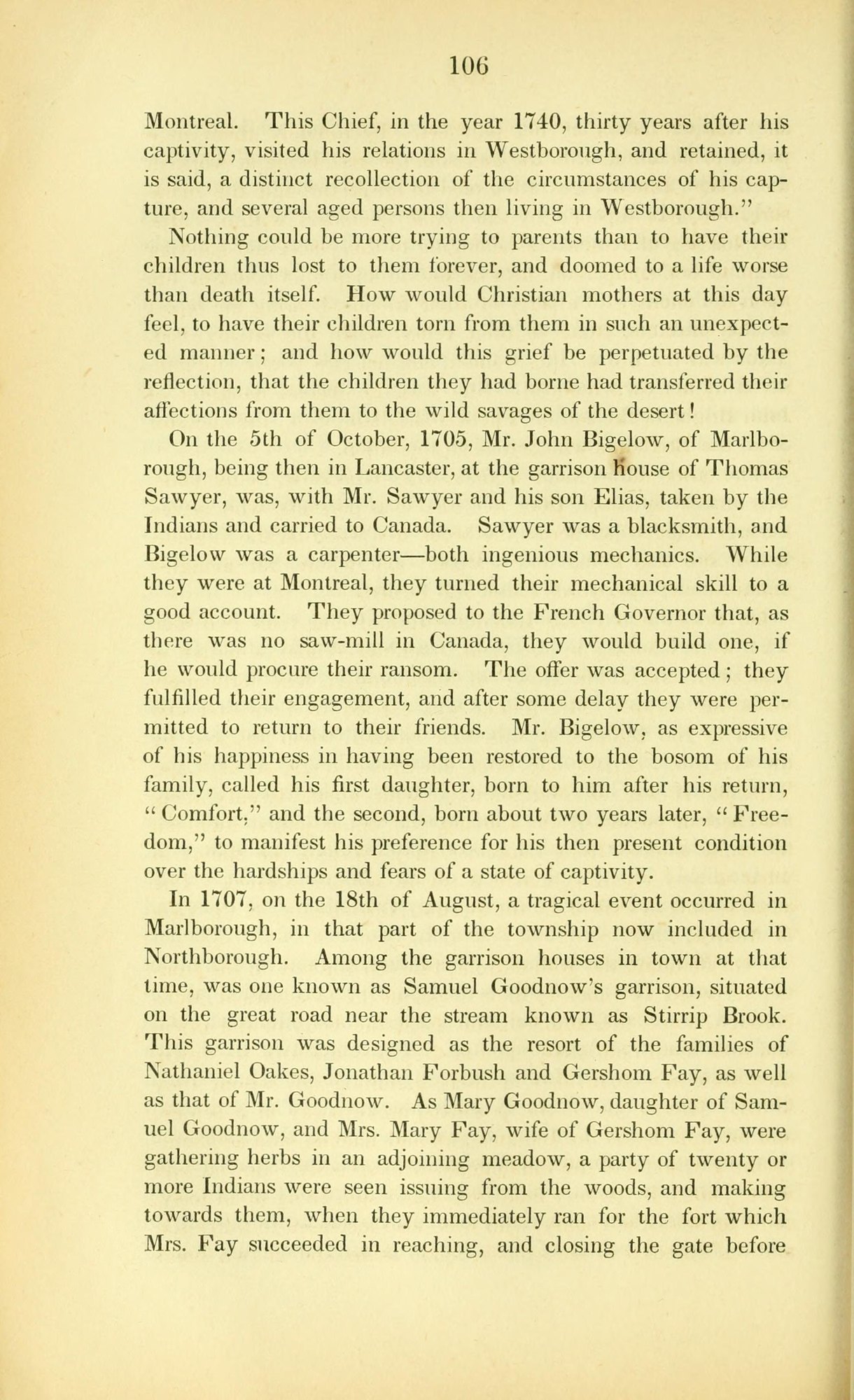
According to the 1906 register, and to Henry L. Oak's 1903 sketch of the Oaks of Garland, he was one of the Goodnow garrison in 1707 when it fought with Native Americans. Hudson's own account of that fight names only "one man in the garrison," and neither book cites a roll, so no record shows him in the fight. The one report of the raid from the time, in the Boston News-Letter of August 25, 1707, names no settlers. It dates the attack "Monday last the 16th Current," though the Monday that week was the 18th, so either date is possible, and it puts the raid at Marlborough without placing Nathaniel in it.
Mehitable died on November 25, 1702, without children, according to the printed family accounts, which make her the daughter of John Rediat of Sudbury. Nathaniel then married Mary Holloway. Concord's town record has "Nathan'll Oakes of Marlbrough & Mary Haleway of Concord ... marryed ... by Justice Minott March ye 2d 1703," though whether that means 1702/3 or 1703/4 isn't settled. Hudson and the 1906 register give May 20, 1703, but no record from the time has been found to support it.
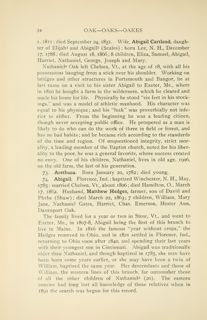
The register adds that in 1702 he signed the call to the Rev. John Emerson, and that "in documents of the time he is termed 'yeoman,' 'planter' and sometimes 'gentleman.'" It also says, without explaining, that "in the early years his conduct was in certain respects not exemplary, but after his second marriage he seems to have become a respectable, though not a prominent citizen." Nothing we have found shows what it meant (register, page 8).
In 1715 he deeded 3½ acres in Chauncy meadow to Samuel Forbush, according to the Westborough Historical Society's Some Old Houses in Westborough (1906); the deed itself hasn't been found. Samuel was one of Westborough's first settlers and a brother of Jonathan Forbush, who later became guardian of Nathaniel's children.
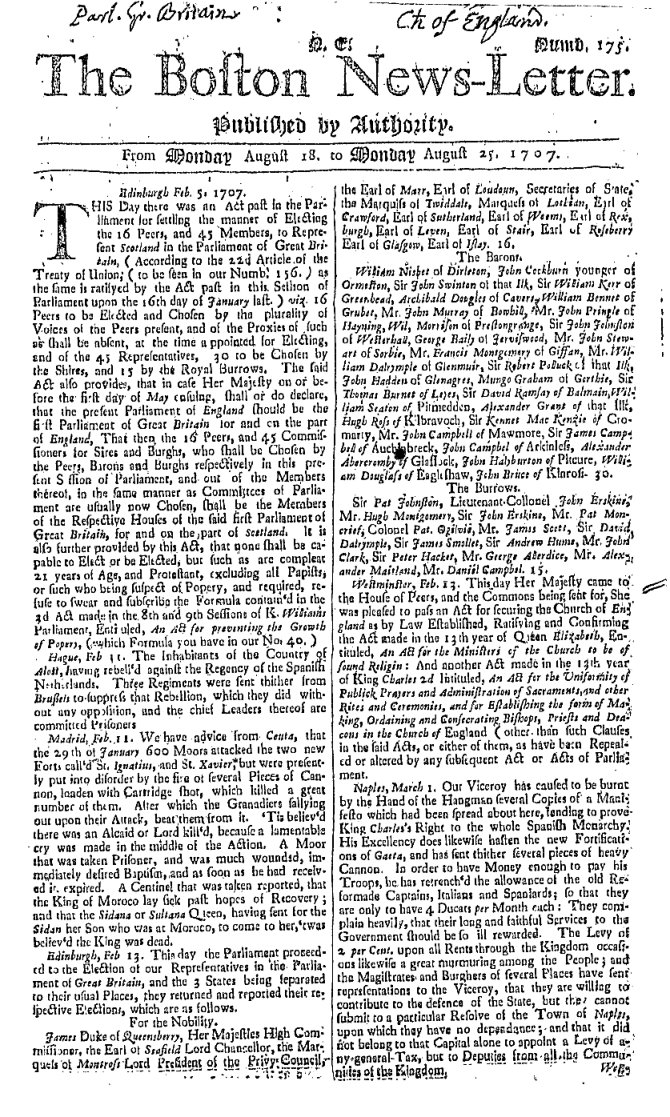
Source: The Boston News-Letter, Boston, 25 August 1707; America's Historical Newspapers (Readex), via AmericanAncestors.org
How it is shown: Complete page as supplied; no crop, no retouch, no search highlight. Attached to Nathaniel Oak as Marlborough context only.
Keep in mind: What the page says: Confirmed. The paper prints 'On Monday last the 16th Current, Thirteen Indians ... surpriz'd two men at their Labour in the Meadows at Marlborough'; one man escaped, a woman was killed, and a pursuit with men from Lancaster and Groton fought the party on Tuesday. The printed '16th' and the weekday disagree: 16 Aug 1707 (Old Style) was a Saturday, and the item's own 'Tuesday at ten of the Clock' and a Lancaster letter dated Tuesday the 19th point to Monday the 18th. Nourse (1884) prints the 16th, Hudson (1862) and Whitney the 18th; no verdict is given here and both are kept. IDENTITY: not applicable. No settler is named, and no Oak or Oakes appears anywhere in the issue; Nathaniel Oak is tagged only as a Marlborough resident whose town the item concerns, the same way the Hudson history pages on the raid are tagged.
Image details
Source: Internet Archive (public-domain scan); oakoaksoakesfami00oakh
How it is shown: Complete page as saved; no crop, no retouch, no search highlight.
Keep in mind: The page number 7 is inferred from the next page (8). The register's origin account is a family tradition and conjecture (Family tradition); the register itself says only that he came from England or Wales. No primary record of the voyage has been found.
Image details
Mary was born at Concord on February 25, 1681/2, a daughter of Adam Holloway, and the men who later became her children's guardians were her relatives: her sister Hannah's husband Jonathan Furbush, her sister Elizabeth's husband Joseph Wheeler, and her brother William Holloway. She and Nathaniel had eight children, among them a son John, born in March 1715. Their son William, born in 1705, was probably the apprentice burned to death in Captain Keyes's house at Shrewsbury in August 1723. After Nathaniel's death, later records appear to show Mary marrying Thomas Rice and then, in 1744, Captain John Fay.
Source: Internet Archive (public-domain scan); sim_new-england-historical-and-genealogical-register_1882-04_36.
How it is shown: Complete page as supplied; no crop, no retouch, no search highlight.
Keep in mind: Confirmed: 4s 11d, not the 4s 6d the 1906 register gives.
Image details
Source: Internet Archive (public-domain scan); sim_new-england-historical-and-genealogical-register_1889-10_43.
How it is shown: Complete page as supplied; no crop, no retouch, no search highlight.
Keep in mind: Confirmed; the editor says the document belonged to the New Hampshire Historical Society (not re-read).
Image details
Source: Internet Archive (public-domain scan); historyoftownofm00huds.
How it is shown: Complete page as scanned; no crop, no retouch, no search highlight.
Keep in mind: Context: the account of the raid on Samuel Goodnow's garrison, which (Hudson p. 106) 'was designed as the resort of the families of Nathaniel Oakes, Jonathan Forbush and Gershom Fay'; the garrison list on p. 109 names Nathaniel Oakes. This page itself does not say that Nathaniel was present on the day. Confirmed. The News-Letter text as Hudson prints it says 'Monday, the 16th', but 16 Aug 1707 was a Saturday; Hudson's own sentence on p. 106 says 18 August (a Monday), and the Lancaster letter of 19 Aug places the Tuesday fight on the 19th.
Image details
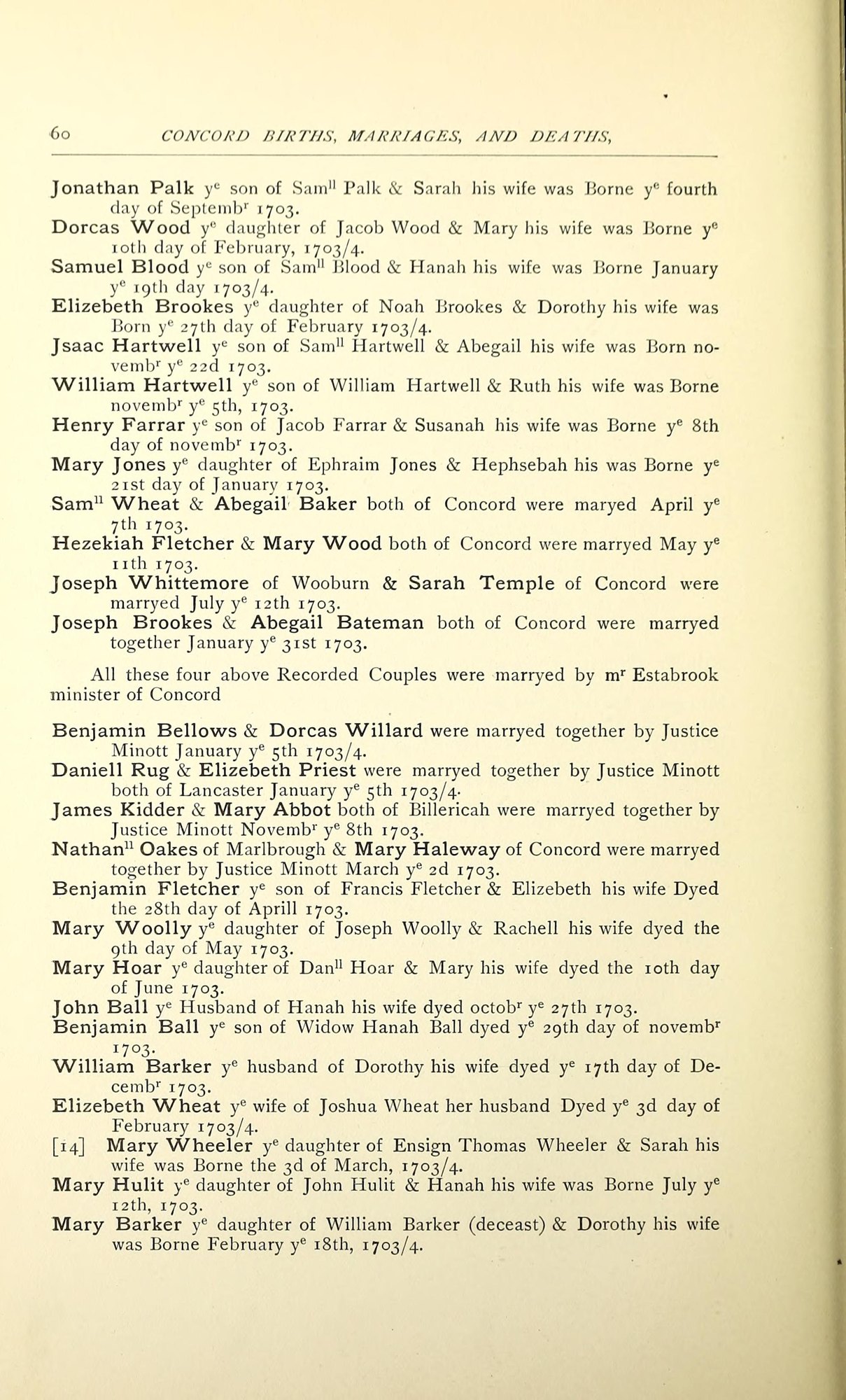
Source: Internet Archive (public-domain scan); concordmassachus1635conc.
How it is shown: Complete page as supplied; no crop, no retouch, no search highlight.
Keep in mind: A printed transcription of the town record, not the manuscript. Confirmed as printed: 2 Mar 1703 (the family register says 20 May 1703). The bride's surname is printed Haleway (Holloway).
Image details
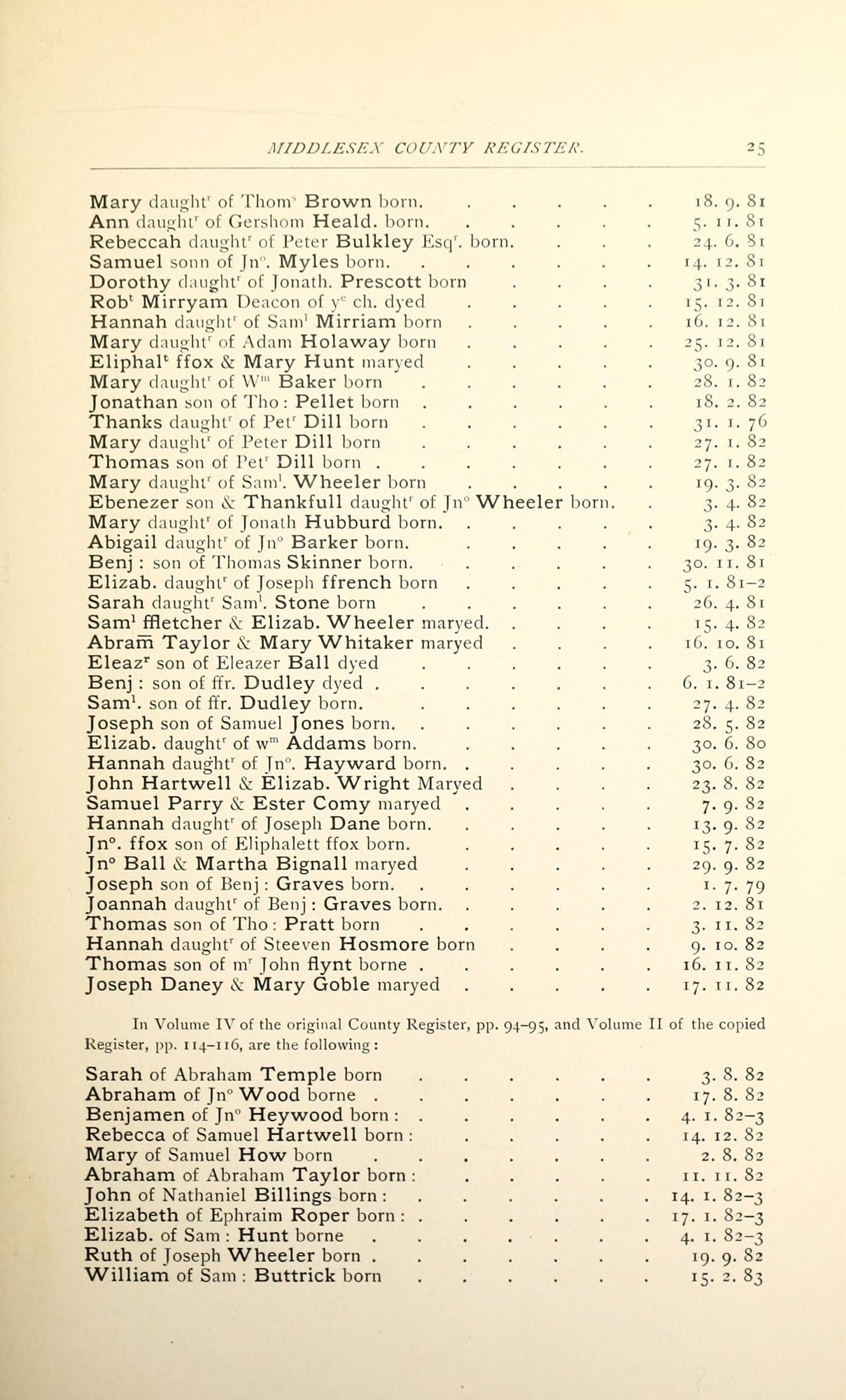
Source: Internet Archive (public-domain scan); concordmassachus1635conc.
How it is shown: Complete page as scanned; no crop, no retouch, no search highlight.
Keep in mind: Confirmed. The surname is spelled Holaway on this page (Holloway on p. 24).
Image details
Nathaniel died at Westborough about February 17, 1720/21, by the heading of the inventory in his probate file, where the day is hard to read. He left no will. The appraisers, sworn on May 23, 1721, valued his estate at £835 15s: £620 in land and buildings, and £215 15s in personal estate, including oxen, cows, sheep, swine, three horses, a few books and arms. Mary administered the estate. In early February 1721/2, Jonathan Forbush of Sutton became guardian of eight children of "ye late Nathaniell Oak late of Westborow": Mary, Anne, John, Jonathan, George, Nathaniel, William and Hannah.
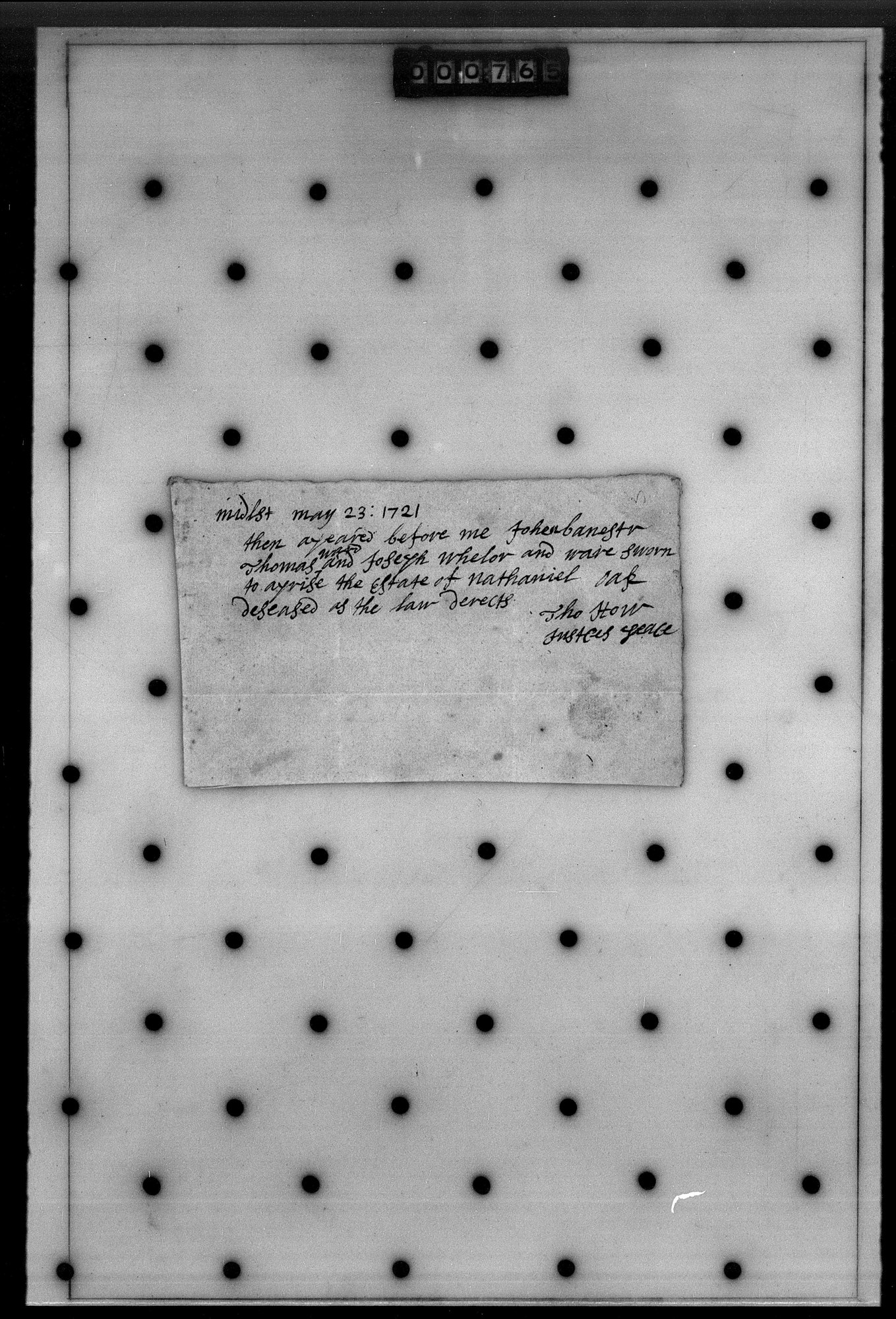
Source: FamilySearch, Probate records 1648-1924 (Middlesex County, Massachusetts), film 007553698, image 767.
How it is shown: Complete frame (original, unaltered); no crop, no retouch, no search highlight.
Keep in mind: Transcribed (frames 766-782); a first reading was made. Confirmed text (B read it in 100-pixel strips). The interlined surname after Thomas (read 'Ward') is Likely, from the inventory signatures on the next frame.
Image details
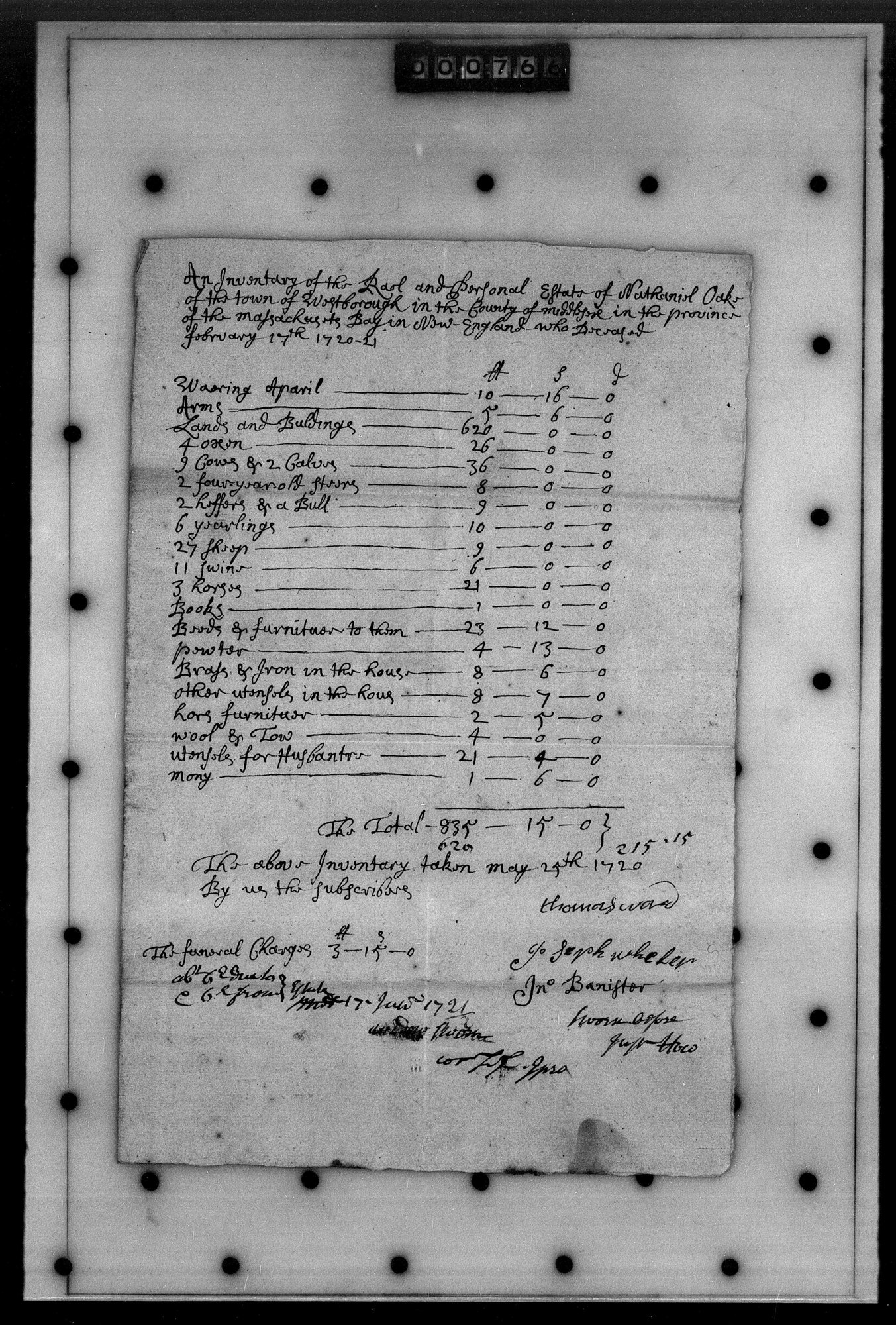
Source: FamilySearch, Probate records 1648-1924 (Middlesex County, Massachusetts), film 007553698, image 768.
How it is shown: Complete frame (original, unaltered); no crop, no retouch, no search highlight.
Keep in mind: Transcribed (frames 766-782); a first reading was made. Confirmed: heading, the year '1720-21' and the figures (a separate addition of the 20 lines gives 835-15-0). Likely: the day figure '17th' (the 7 carries a tick) and the item wording. The line 'inventory taken may [2?]th 17[2?]' is only partly legible; the appraisers were sworn 23 May 1721 (frame 767). The funeral-charges line and the notes below it are not reliably read.
Image details
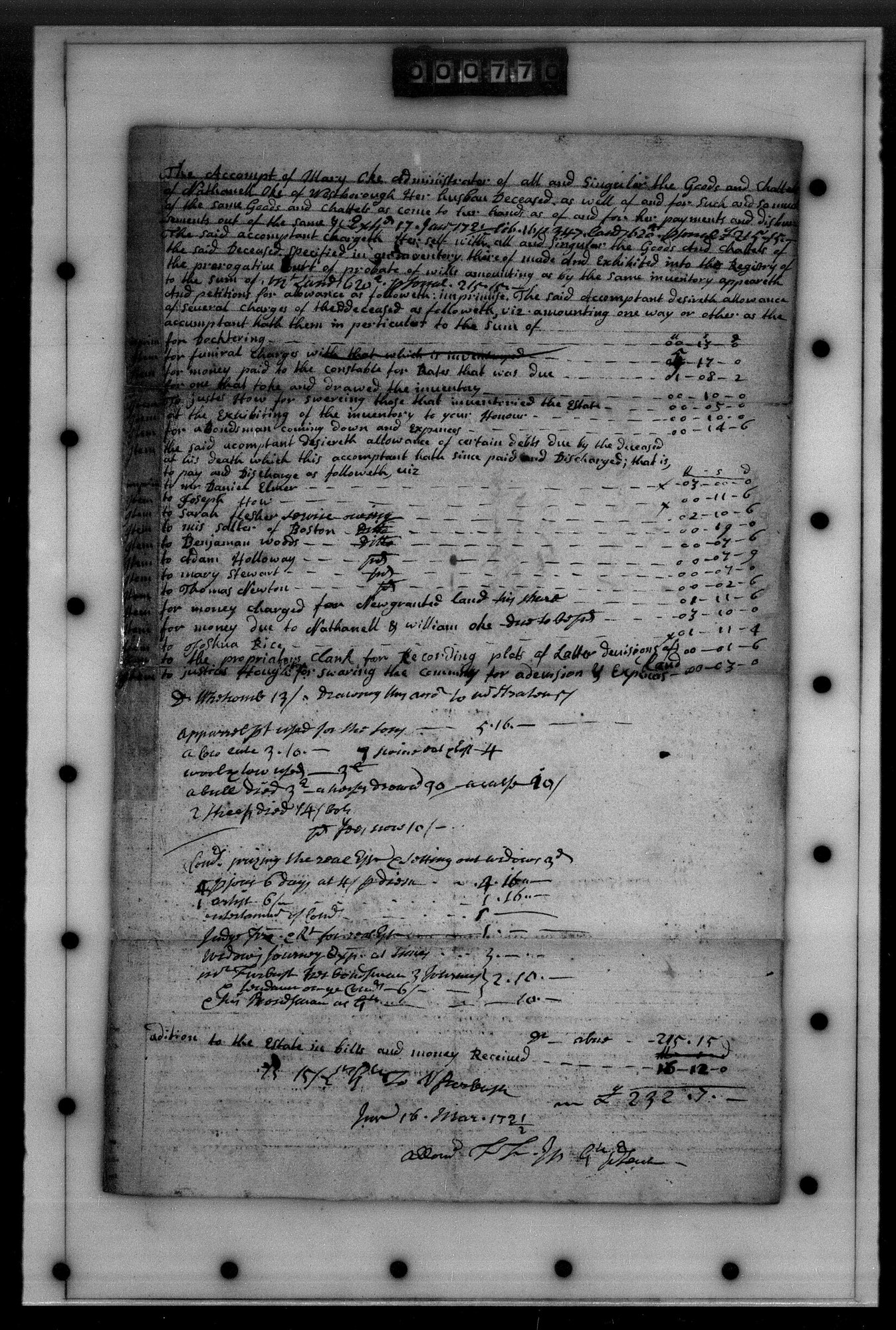
Source: FamilySearch, Probate records 1648-1924 (Middlesex County, Massachusetts), film 007553698, image 772.
How it is shown: Complete frame (original, unaltered); no crop, no retouch, no search highlight.
Keep in mind: Transcribed (frames 766-782); a first reading was made. Likely: descriptions Likely, amounts only partly read, and the pairing of several amounts with names is not reliable. The closing allowance, balance and date were not recovered. A line read 'Nathanell & William Oke' is Likely only, and whether it means two sons is unknown. Further parties tagged on 4 Oct 2026: Adam Holloway (1655–1733) (creditor 'to Adam Holloway' in Mary Oke's account (Likely reading in the transcription; Adam Holloway, Mary's father)).
Image details
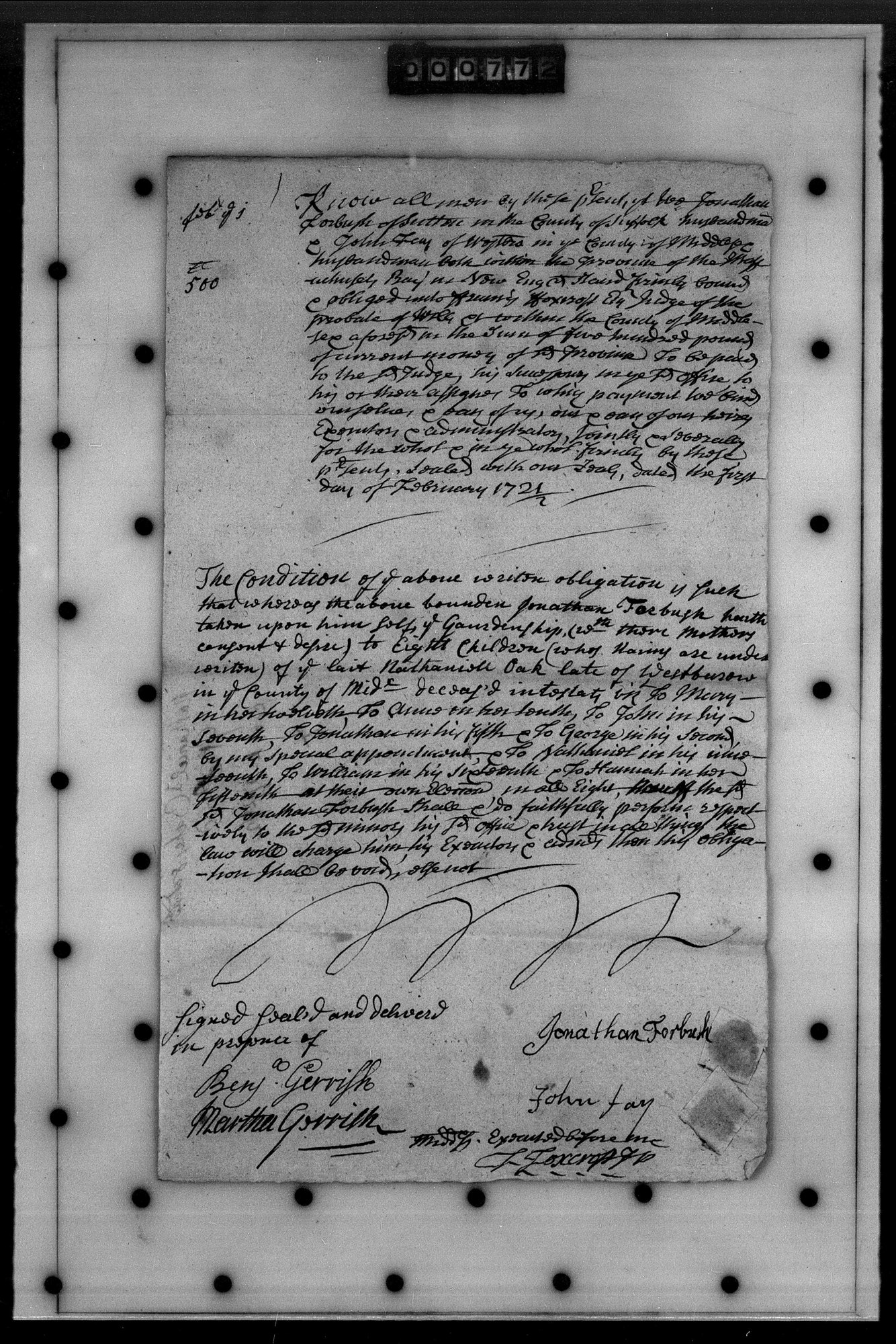
Source: FamilySearch, Probate records 1648-1924 (Middlesex County, Massachusetts), film 007553698, image 774.
How it is shown: Complete frame (original, unaltered); no crop, no retouch, no search highlight.
Keep in mind: Transcribed (frames 766-782); a first reading was made. Confirmed: the eight children and the ordinals for John (seventh), Jonathan (fifth) and George (second). Likely: Anne (tenth) and Hannah (fifteenth). Not reliably read: the ages for Mary, Nathaniel and William. Date and sum Likely. Tagging the eight to the tree's persons rests on the names and the 1906 register order (Likely).
Image details
Jonathan is described as "in his fifth" year, which fits his recorded birth at Marlborough on August 21, 1717. In August 1732 Jonathan, "a minor aged about fifteen years son of Nathaniel Oak late of Westborough," chose Jonathan Forbush as his guardian. Nothing in the file mentions a ship, a place in England or any earlier home.
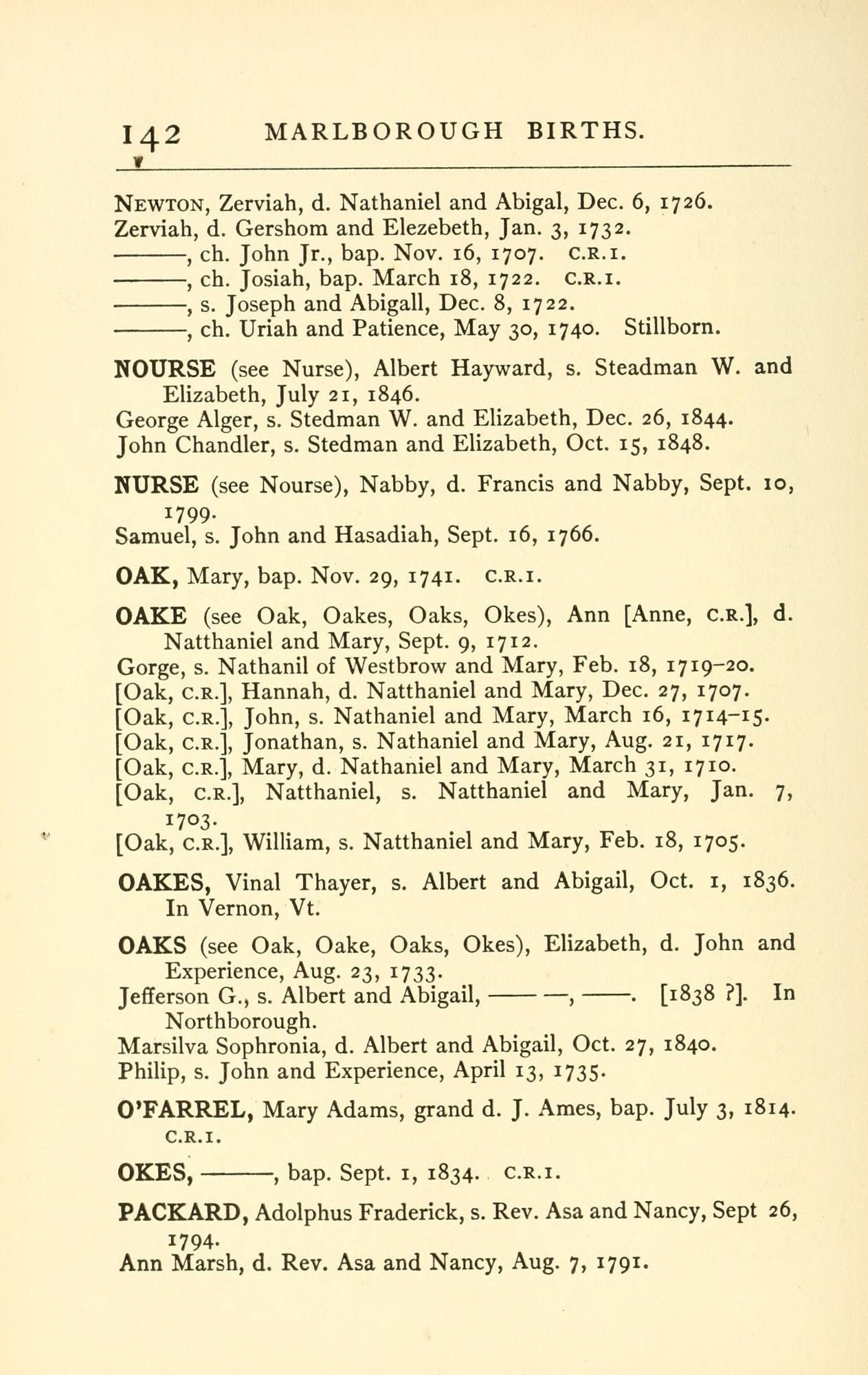
Source: Internet Archive (public-domain scan); vitalrecordsofma00marl.
How it is shown: Complete page as scanned; no crop, no retouch.
Keep in mind: A printed transcription of the town's record, not the manuscript.
Image details
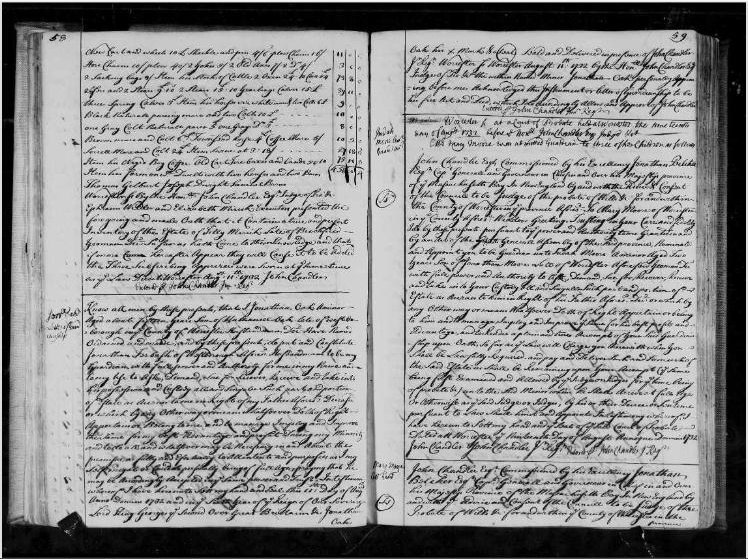
Source: FamilySearch, Worcester. Probate Records 1731-1770, image 48.
How it is shown: Cropped to the two-page document image: the FamilySearch viewer's menus, account name and machine-transcript panel are removed; no retouch of the document, no search highlight. The saved original screenshot stays private.
Keep in mind: A viewer capture of the spread, not an original file. FamilySearch's own machine transcript (which reads 1782) was not relied on. Ties the boy Jonathan to Nathaniel's estate in 1732; it does not tie him to the later Jonathan of Harvard and Canaan (that rests on the 1906 register). Further parties tagged on 4 Oct 2026: Nathaniel Oak(e) (first record 1686; died 1720/21) (the father named on the page: 'son of Nathaniel Oak late of Westborough' (Likely)). Re-released 4 Oct 2026 as a crop of the document image only, replacing the full viewer screenshot.
Image details
From his son John, probably the John Oak of Westborough, the line runs to another Nathaniel: the Revolutionary soldier who marched on the Lexington alarm in April 1775 and, at 87, moved to Maine to spend his last days with a son. Their profiles carry the details and the evidence for each link, and the family tree shows how they connect.
What we still don't know
We still don't know when or where Nathaniel was born, who his parents were, what ship he sailed on or when he arrived. The 1906 compiler's birth about 1645 and arrival about 1660–1665 are estimates.
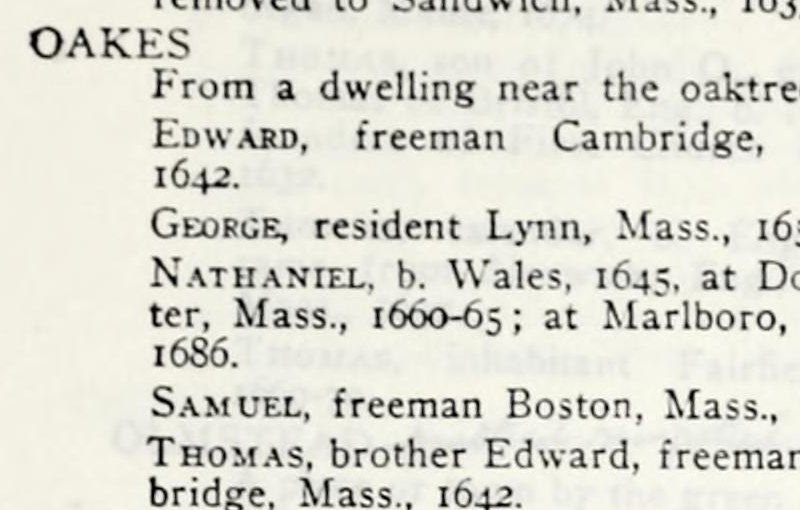
Later reference books repeated them. Frank Holmes's 1923 directory of New England heads of families has him born in Wales in 1645 and at Dorchester, Massachusetts, in 1660–65, and an Ancestry passenger index gives "Arrival Year 1660" from Holmes. Both go back to the 1906 register, which says only "about 1645" and "about 1660–5," with a vague Welsh tradition, and never mentions Dorchester. Neither is a record of an arrival.
Source: Internet Archive scan of a 1923 printed book (public domain)
Image details
Some online trees give his parents as John Oakes and Elizabeth Harrison of Staffordshire. That comes from an unsourced tree entry, repeated elsewhere; its places and dates don't fit together, and we have found no record for it.
We also don't know where the 1899 and 1900 newspapers got their versions.
A summary of the searches so far is on the research log; the full log, with what each search found and when, is kept in the family area so new records and leads can be checked against it.
Sources
- H. L. Oak, Oak-Oaks-Oakes: Family Register: Nathaniel Oak of Marlborough, Mass., and Three Generations of His Descendants (Los Angeles, 1906), pp. 7-8 (shown above as page images). Public domain; read the whole book: PDF, 5 MB, from the copy at the Internet Archive; also on the Downloads page.
- Vital Records of Marlborough, Massachusetts, to the End of the Year 1849 (printed), p. 142, shown inline above; also on the Downloads page.
- Worcester Magazine, vol. 2 (1826), p. 152. archive.org/details/worcestermagazi00unkngoog
- Charles Hudson, History of the Town of Marlborough (1862), p. 426. archive.org/details/historyoftownofm00huds
- Frank R. Holmes, Directory of the Ancestral Heads of New England Families, 1620-1700 (1923), p. 176. archive.org/details/directoryofances00holm_0
- Middlesex County, Mass., probate papers, cases 16185 and 16186 (Nathaniel Oak, Westborough, 1721-1722): inventory, appraisal oath and guardian's bond, read from the original frames of film 007553698, frames 766-782.
- American Ancestors (New England Historic Genealogical Society), Mss 865, box 9: typed copy of a note by John Conant, supplied by the archive in October 2026.
- Vital Records of Marlborough, Massachusetts, births; Vital Records of Harvard, Massachusetts (including marriage intentions, p. 149); Vital Records of Ashburnham, Massachusetts.
- Will of Jonathan Oaks of Canaan, Lincoln County (Maine), 2 December 1784, proved 12 March 1785: Lincoln County probate records, pp. 149-151.
- Frederick Odell Conant, A History and Genealogy of the Conant Family (1887), pp. 236-237; John Wesley Hanson, History of the Old Towns of Norridgewock and Canaan (1849).
- Black River Gazette (Ludlow, VT), EXTRA edition, July 4, 1876, "Brandon: From Its Settlement to the Present Day" (American Antiquarian Society, catalog 10203; reference scans supplied by AAS, 7 October 2026; private original).