 American Acorns
Herbert Clarkson and the report on Patton, 1943
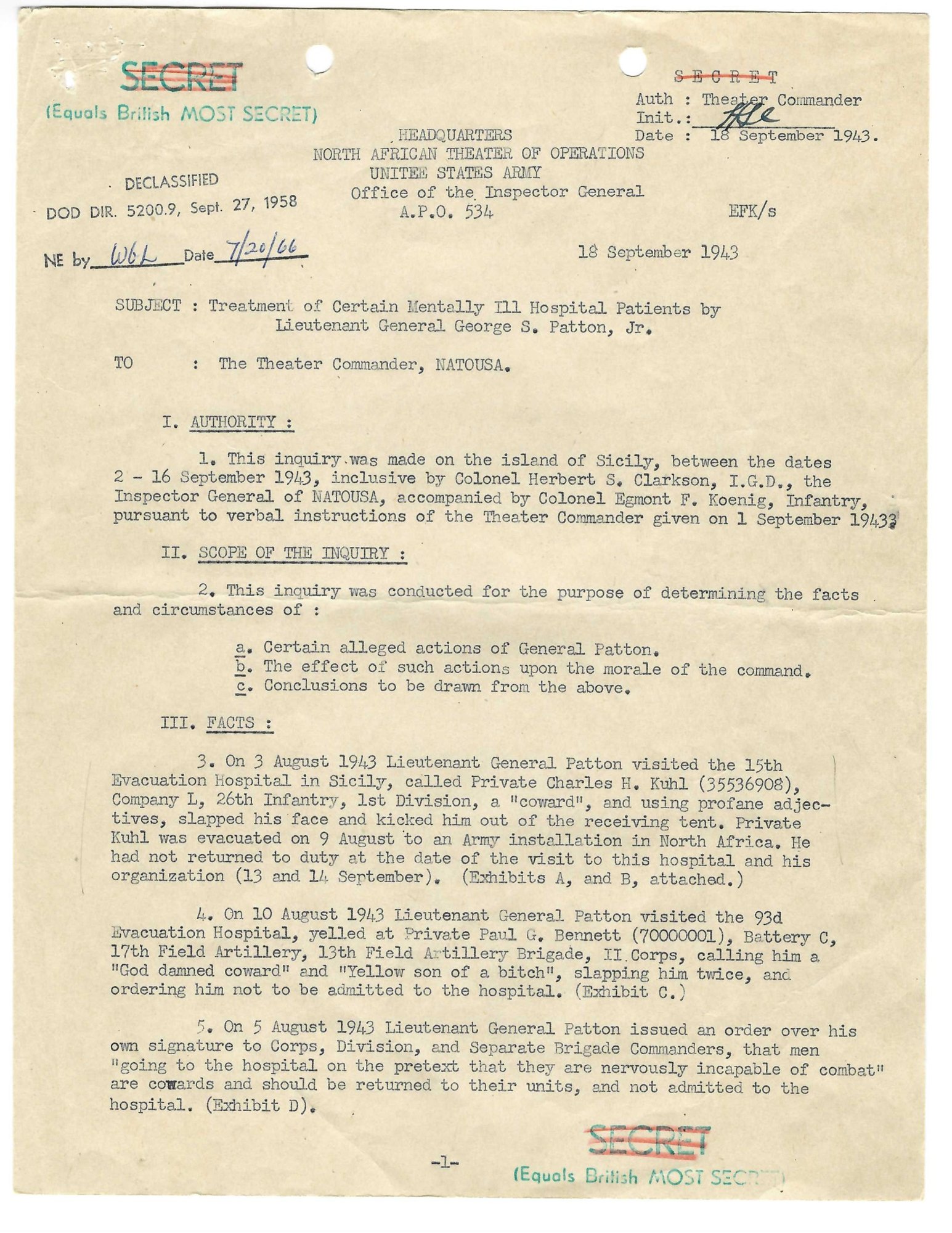
On September 18, 1943, Colonel Herbert Slayden Clarkson, Inspector General of the North African Theater of Operations, signed a four-page secret report to Eisenhower. Its subject was "Treatment of Certain Mentally Ill Hospital Patients by Lieutenant General George S. Patton, Jr." Four days later, a handwritten note on its last page says, Eisenhower read it at La Marsa and ordered it placed in the headquarters' secret file. The report was declassified in 1966, and the Eisenhower Library sent this site a copy in October 2026.
Source: Eisenhower Library, Pre-Presidential Papers, Box 91
Image details
The assignment
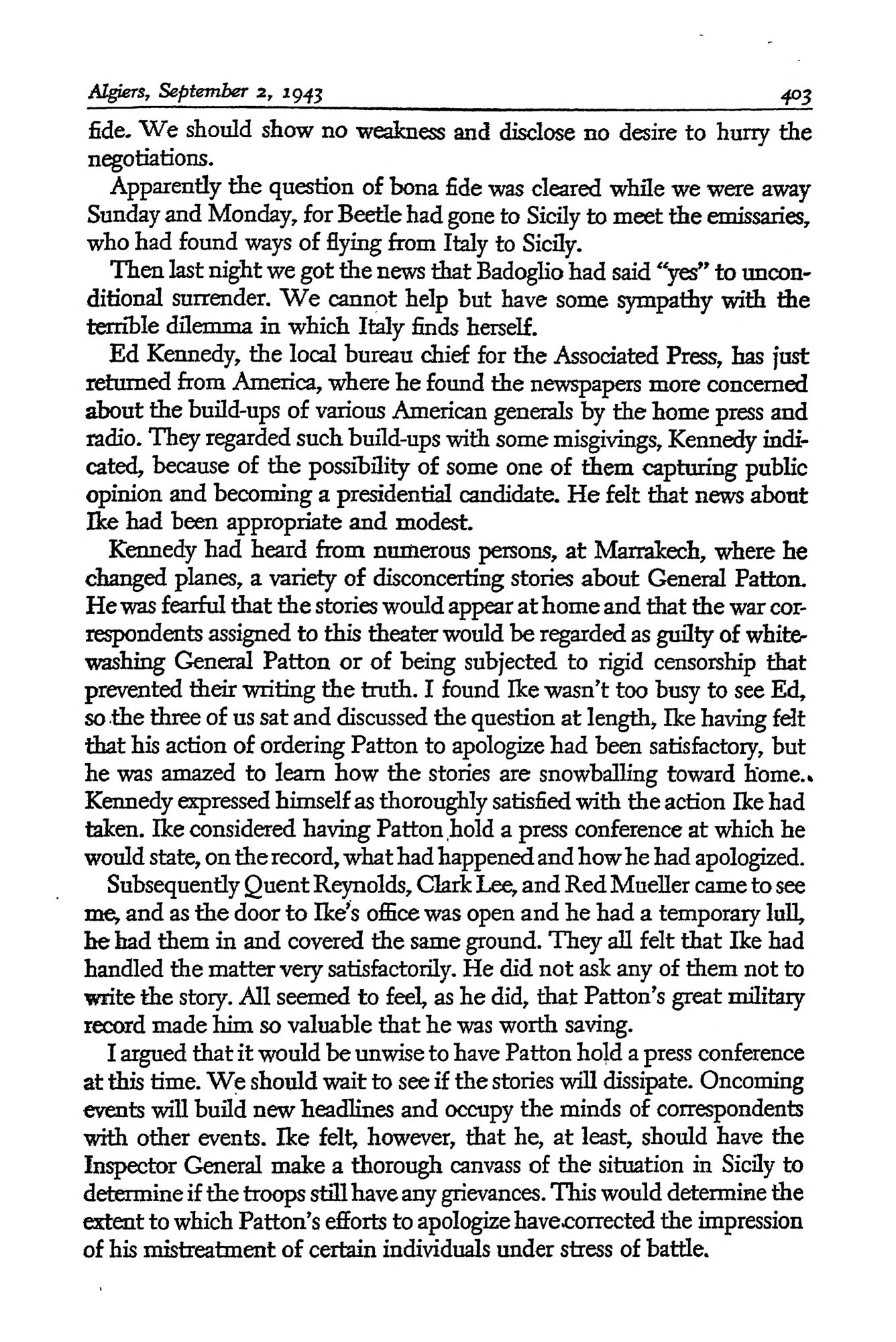
In August 1943, in Sicily, Patton, commanding the U.S. Seventh Army, slapped two soldiers who were in hospital. On September 2, Harry Butcher, Eisenhower's naval aide, wrote in his diary that Eisenhower wanted the Inspector General to make a thorough canvass of Sicily and find out whether the troops still had grievances. The diary does not name the officer.
Source: Harry C. Butcher, My Three Years with Eisenhower (Simon and Schuster, 1946); page image from an Internet Archive scan
How it is shown: Complete page image as supplied from the Internet Archive scan; no crop, no retouch, no search highlight. Copyrighted book,
Keep in mind: Confirmed as the printed page. Butcher does not name Clarkson or any inspector general: the identification of that officer as Colonel Clarkson comes from Hirshson (Likely). This is the published diary of 1946; the original manuscript diary has not been inspected.
Image details
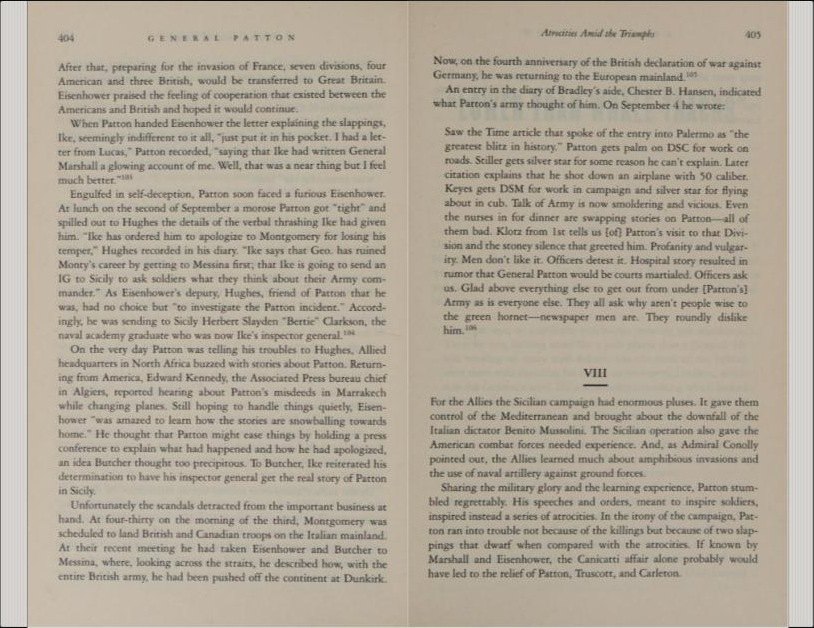
The report does. It says the inquiry was made in Sicily from September 2 to 16, 1943, "by Colonel Herbert S. Clarkson, I.G.D., the Inspector General of NATOUSA, accompanied by Colonel Egmont F. Koenig, Infantry, pursuant to verbal instructions of the Theater Commander given on 1 September 1943." The historian Stanley Hirshson, drawing on the diary of Everett Hughes, Eisenhower's deputy, writes that Hughes was sending Clarkson, "Ike's inspector general," to Sicily; the report itself credits the order to Eisenhower.
Source: Stanley P. Hirshson, General Patton: A Soldier's Life (HarperCollins, 2002; Harper Perennial, 2003); page image from an Internet Archive lending copy.
How it is shown: Cropped to the document only: the viewer's toolbar, buttons, page counter and any account name are removed; no retouch of the document, no highlight. The saved original screenshot stays private.
Keep in mind: Likely: this is a secondary account that cites an unread Hughes diary (2 Sep 1943) and the Official Army Register; the Naval Academy detail is Confirmed separately.
Image details
What Clarkson found
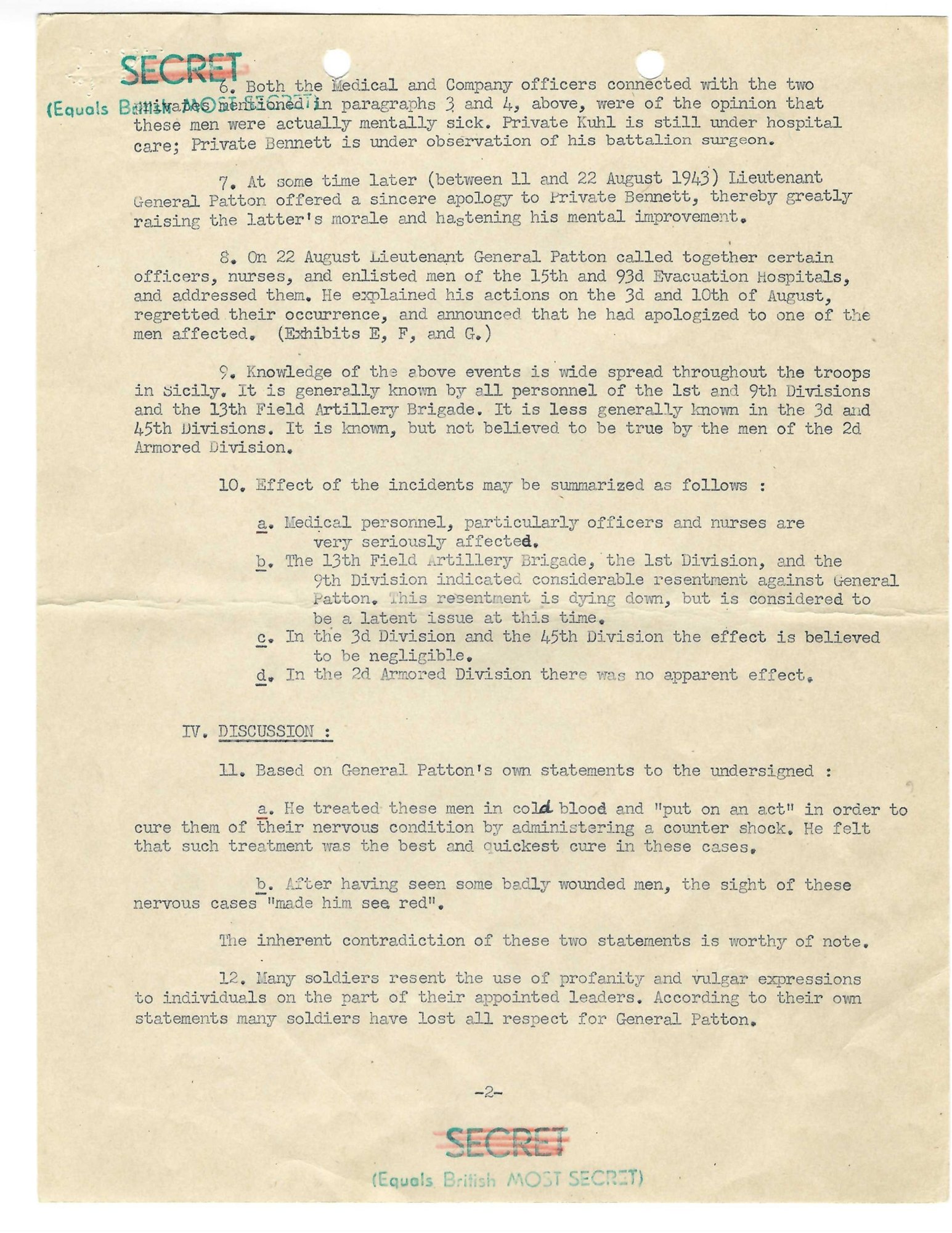
The report sets out the two incidents. On August 3, at the 15th Evacuation Hospital, Patton called Private Charles H. Kuhl of the 26th Infantry a "coward," slapped his face and kicked him out of the receiving tent. On August 10, at the 93d Evacuation Hospital, he called Private Paul G. Bennett of the 17th Field Artillery a "God damned coward," slapped him twice and ordered that he not be admitted. The medical and company officers of both men thought them "actually mentally sick." Patton later apologized to Bennett, and on August 22 he addressed officers, nurses and enlisted men of both hospitals and "regretted their occurrence."
Source: Eisenhower Library, Pre-Presidential Papers, Box 91
Image details
Patton gave Clarkson two explanations. He had treated the men "in cold blood" and "put on an act" to cure them "by administering a counter shock"; and, after seeing badly wounded men, the sight of these nervous cases "made him see red." Clarkson wrote: "The inherent contradiction of these two statements is worthy of note."
He and Koenig visited every major unit in Sicily and nearly every hospital, with the purpose "disguised as a 'morale survey'," and talked with "hundreds of individuals." They questioned junior officers and enlisted men out of their own officers' hearing, and raised their opinions of their leaders "only indirectly." The report weighs the witnesses openly. Medical officers and nurses, it says, were biased against anyone interfering with their work, and their opinions were "given relatively light weight." Officers were loath to criticize superiors. Men who had served long under Patton, like the 2d Armored Division, were very enthusiastic about him, while enlisted men of the 1st and 9th Divisions, who had served under Patton but not under his immediate command, were "prone to listen to and believe stories unfavorable to him."
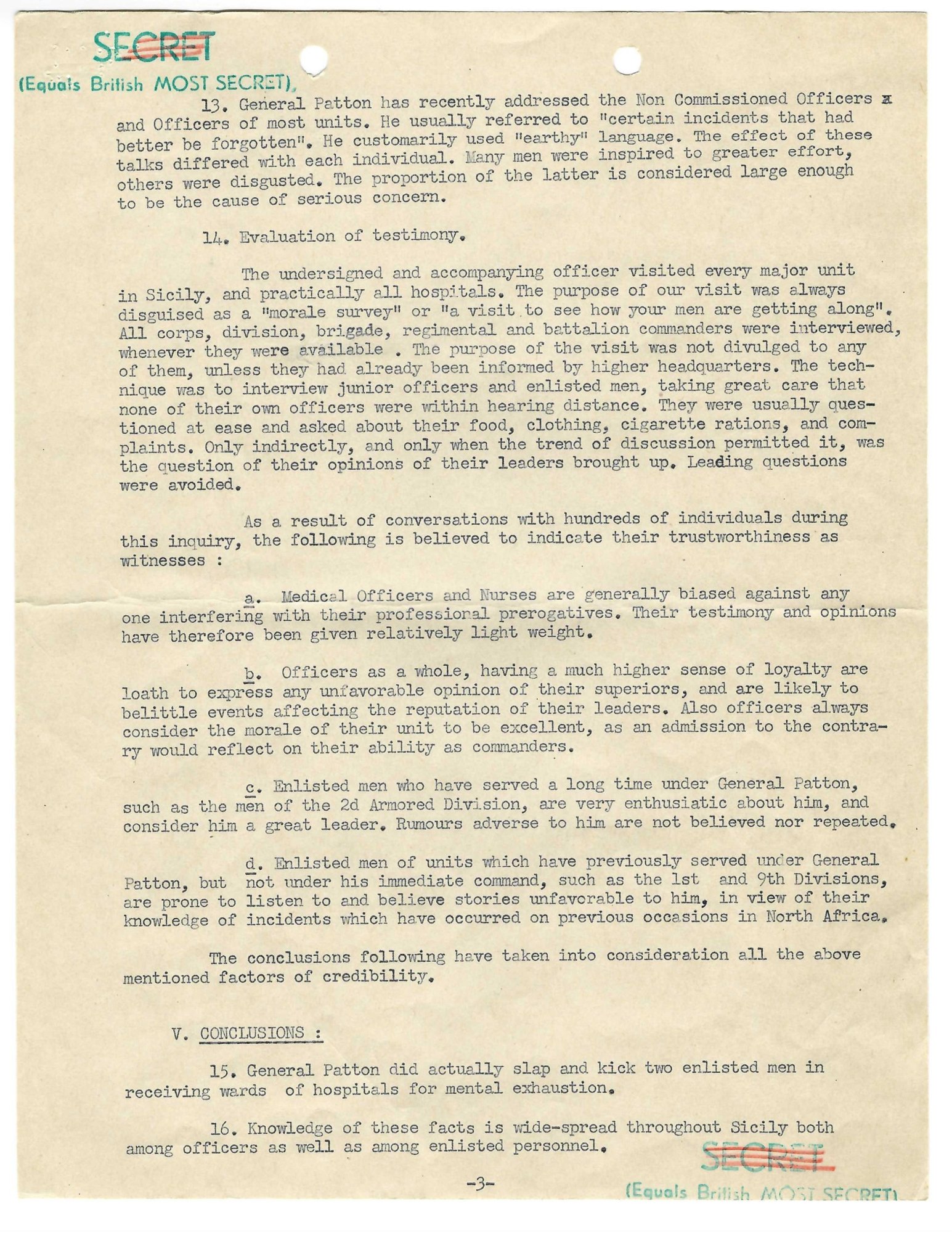
Source: Eisenhower Library, Pre-Presidential Papers, Box 91
Image details
What it concluded, and recommended
The conclusions are plain. "General Patton did actually slap and kick two enlisted men in receiving wards of hospitals for mental exhaustion." Knowledge of it was widespread in Sicily, and at least two members of the press knew. There was "much evidence," it found, that these and other acts had affected Patton's standing in the eyes of his officers and men "as a high commander and as an officer and a gentleman," but had "not seriously affected" his standing "as a tactical leader who successfully concluded in record time a very complicated military maneuver, and whom they would again be willing to follow into battle."
The report makes one recommendation. Because the incidents were known to the press and throughout the theater, and might be published or reach "high governmental authorities," which "might result in embarrassment to the War Department," it recommends "that this matter be transmitted to the Chief of Staff, United States Army, for his information, in order fully to acquaint him with the situation." It does not recommend that Patton be disciplined or relieved.
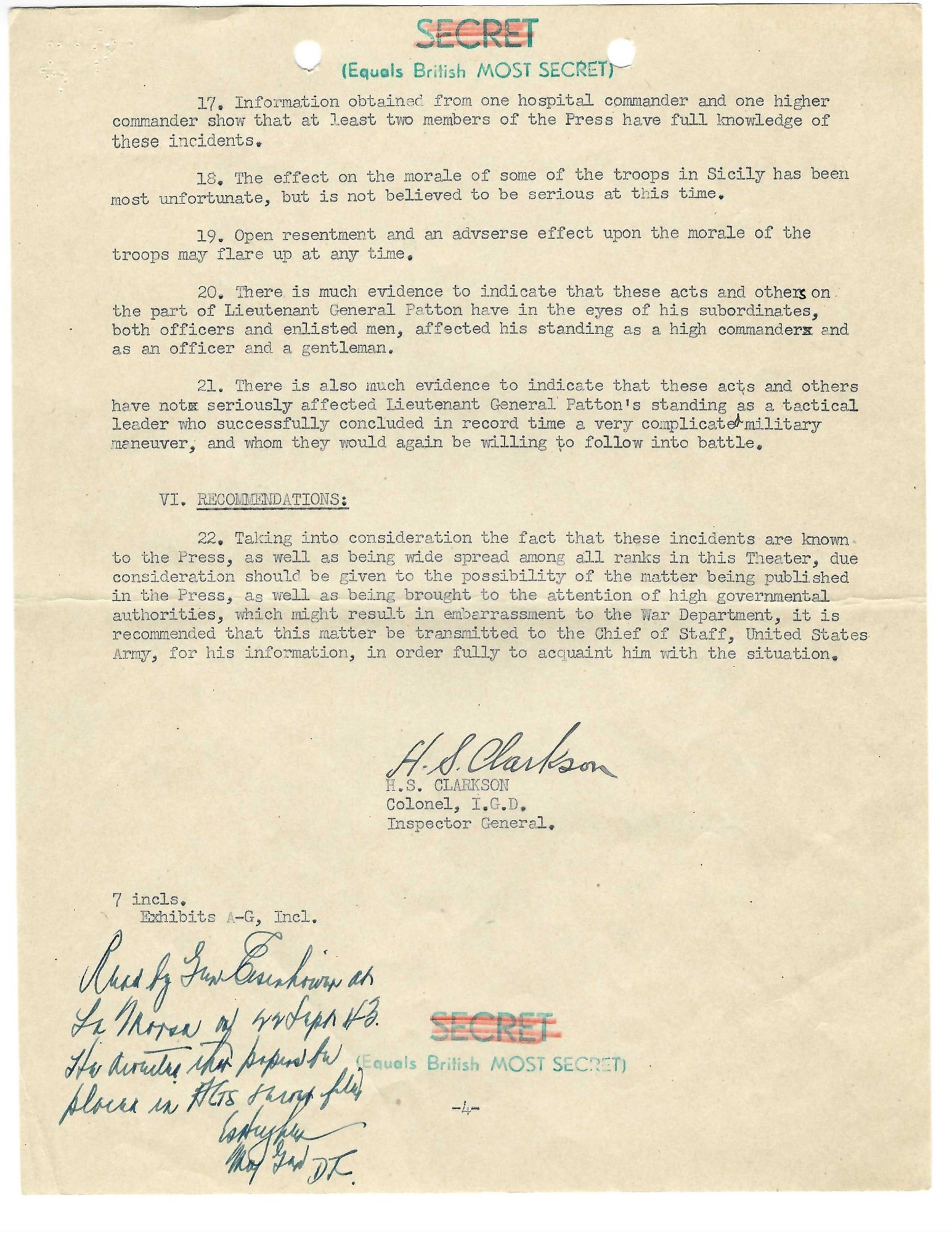
Source: Eisenhower Library, Pre-Presidential Papers, Box 91
Image details
The note below Clarkson's signature reads: "Read by Gen Eisenhower at La Marsa on 22 Sept 43. He directs that papers be placed in HQs secret file." It is signed by Hughes, as major general. The seven exhibits the report lists, A to G, were not in the copy sent.
Hirshson's account, and where it differs
Hirshson cites the report by its date, September 18, in Box 91 of the Eisenhower papers, and the words he quotes from it are accurate: the "put on an act" and "see red" explanations, and Clarkson's note of their "inherent contradiction." His summary of the troops is looser. He describes the 1st and 9th Divisions as men who had been with Patton "only a short time"; the report says they had served under him but not under his immediate command, and already knew of earlier incidents in North Africa. But he goes further than the report. He writes that Clarkson urged Eisenhower to inform General Marshall, "ensuring that Patton would be disciplined, probably relieved," and then that Clarkson "recommended that he be disciplined." The report recommends only that the matter go to the Chief of Staff, then General Marshall, for his information. It says nothing about what should follow.
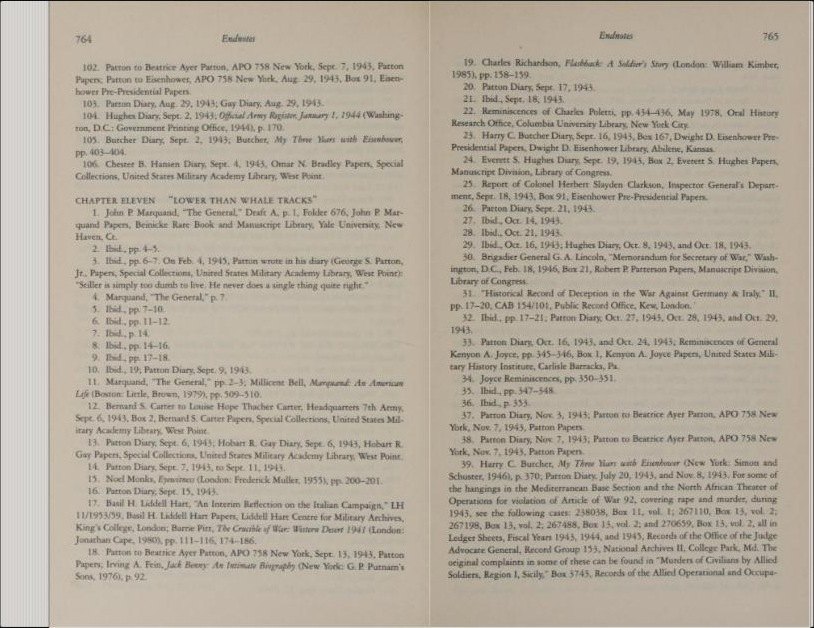
Source: Stanley P. Hirshson, General Patton: A Soldier's Life (HarperCollins, 2002; Harper Perennial, 2003); page image from an Internet Archive lending copy.
How it is shown: Cropped to the document only: the viewer's toolbar, buttons, page counter and any account name are removed; no retouch of the document, no highlight. The saved original screenshot stays private.
Keep in mind: Confirmed that Hirshson cites a report of that date. The library's copy, dated 18 September 1943, is shown on this page.
Image details
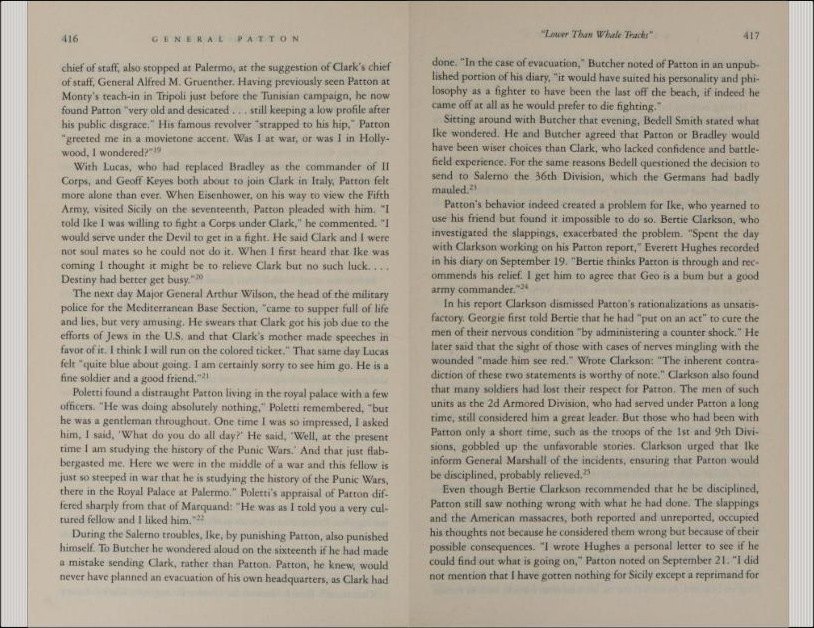
Source: Stanley P. Hirshson, General Patton: A Soldier's Life (HarperCollins, 2002; Harper Perennial, 2003); page image from an Internet Archive lending copy.
How it is shown: Cropped to the document only: the viewer's toolbar, buttons, page counter and any account name are removed; no retouch of the document, no highlight. The saved original screenshot stays private.
Keep in mind: Confirmed as the printed page. The words Hirshson quotes from the report match the library's copy; his statement that Clarkson recommended discipline does not.
Image details
Hirshson also quotes Hughes's diary for September 19, the day after the date on the report. Hughes spent the day with Clarkson "working on his Patton report," and wrote: "Bertie thinks Patton is through and recommends his relief. I get him to agree that Geo is a bum but a good army commander." If the diary is right, relief was Clarkson's view in conversation. The signed report does not recommend it, and it finds Patton's standing as a tactical leader not seriously affected. The diary itself has not been seen for this account.
The library's finding aid lists the report in Box 91, in the folder "PATTON, George S., Jr. (3) [Sept. 1943 - Nov. 1943]." The library found no other reference to H. S. Clarkson in its descriptive material.
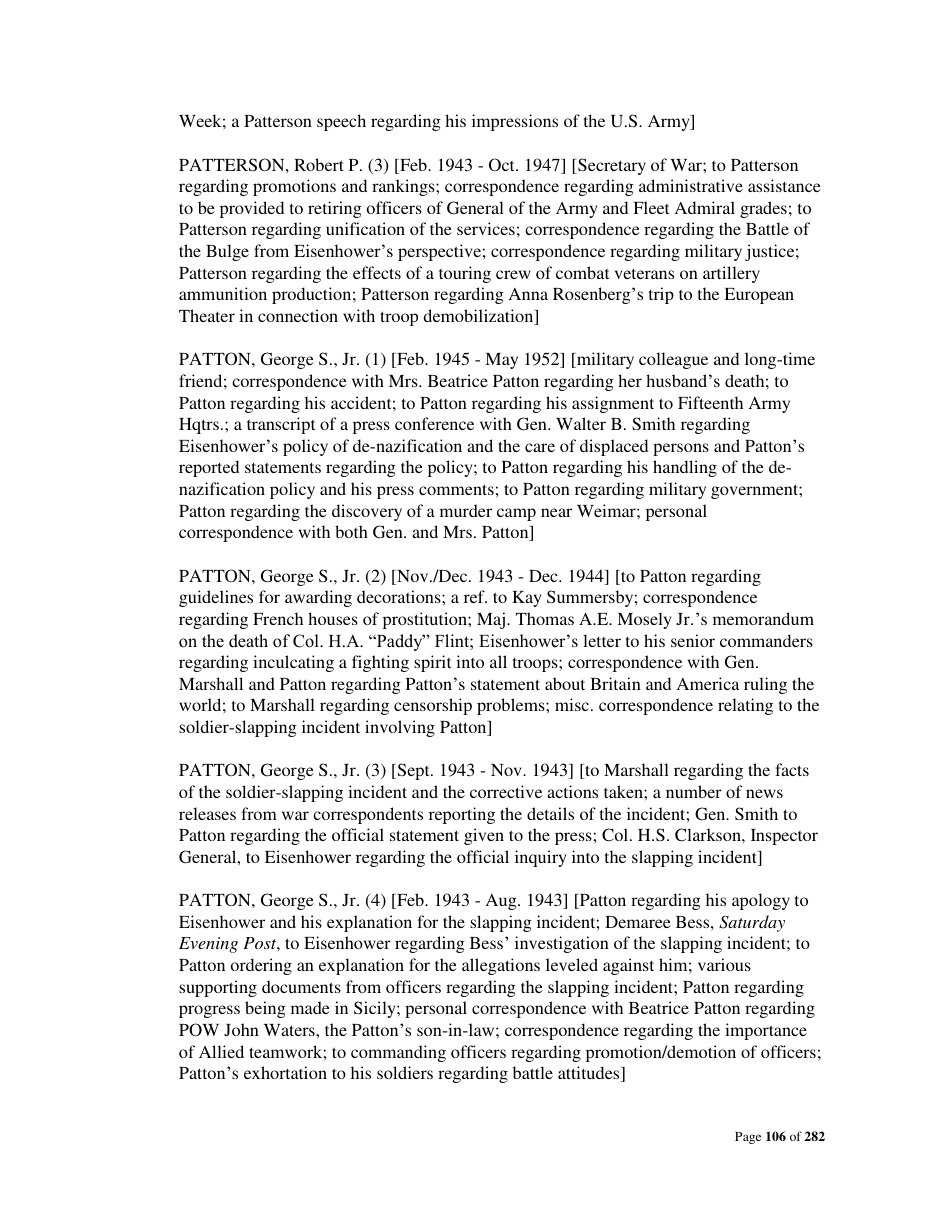
Source: Dwight D. Eisenhower Presidential Library, National Archives (finding aid; U.S. government work).
How it is shown: Complete finding-aid page rendered as a PNG from the captured PDF; no crop, no retouch, no search highlight.
Keep in mind: Confirmed that the finding aid lists the item. The library supplied a copy of the report in October 2026; it is shown on this page.
Image details
Who Clarkson was
Herbert Slayden Clarkson was born in Texas on May 19, 1891, the son of William Banton Clarkson of Houston and San Antonio, and went to the Naval Academy; the 1913 Lucky Bag shows him as "Bertie," of San Antonio. He was commissioned a second lieutenant of Field Artillery in 1913, moved to the Inspector General's Department in April 1939 and was a regular colonel in 1942. The Army register of January 1, 1944 gives his birth date and place and lists the Naval Academy, 1913, and the Command and General Staff School, 1928. His career is told in Clarkson-line military service.
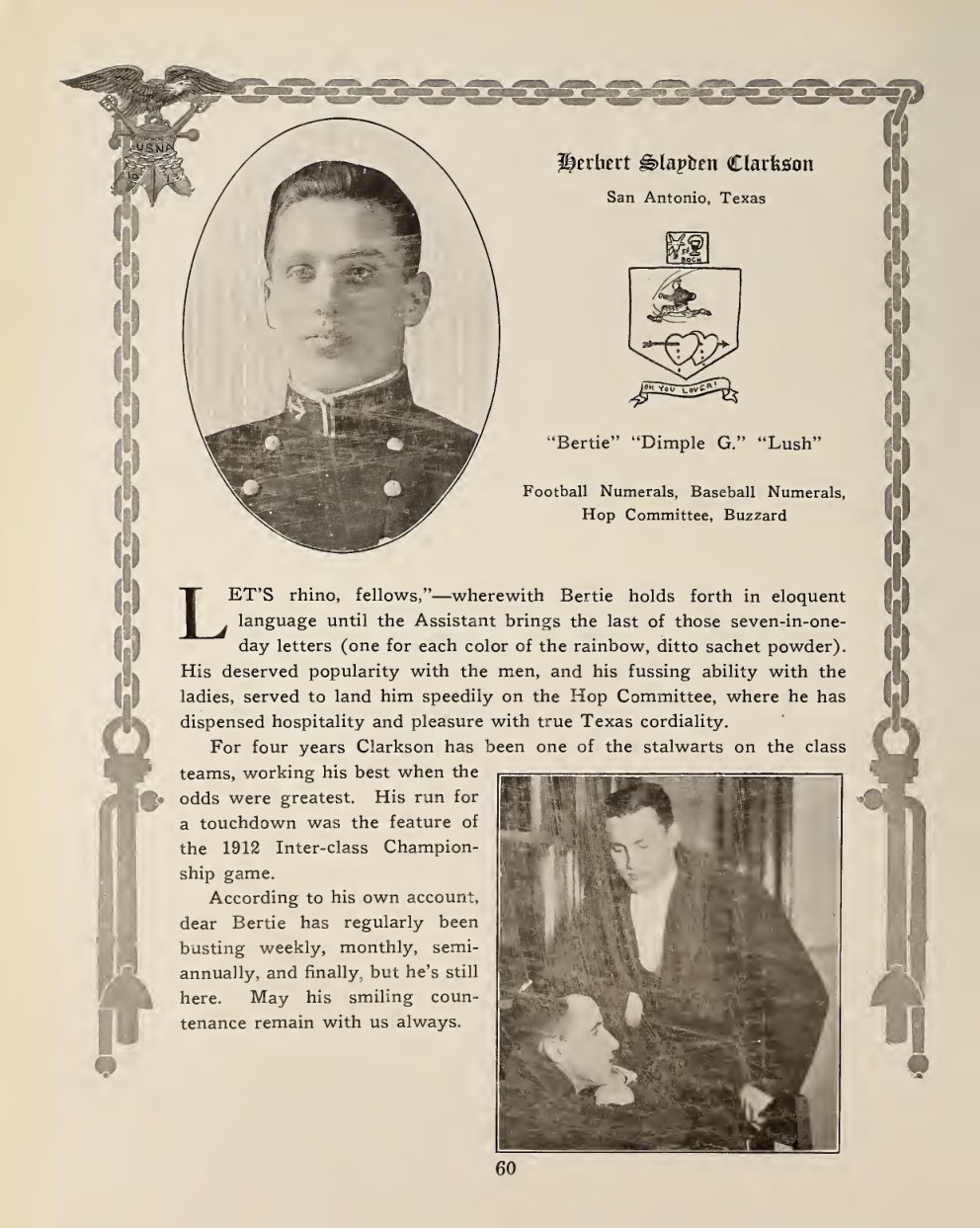
Source: Internet Archive (public-domain scan); luckybag1913unse.
How it is shown: Complete page rendered from the scan as a PNG; no crop, no retouch, no search highlight.
Keep in mind: Confirmed as printed. Why he moved from the Navy to the Army is not stated in any source.
Image details
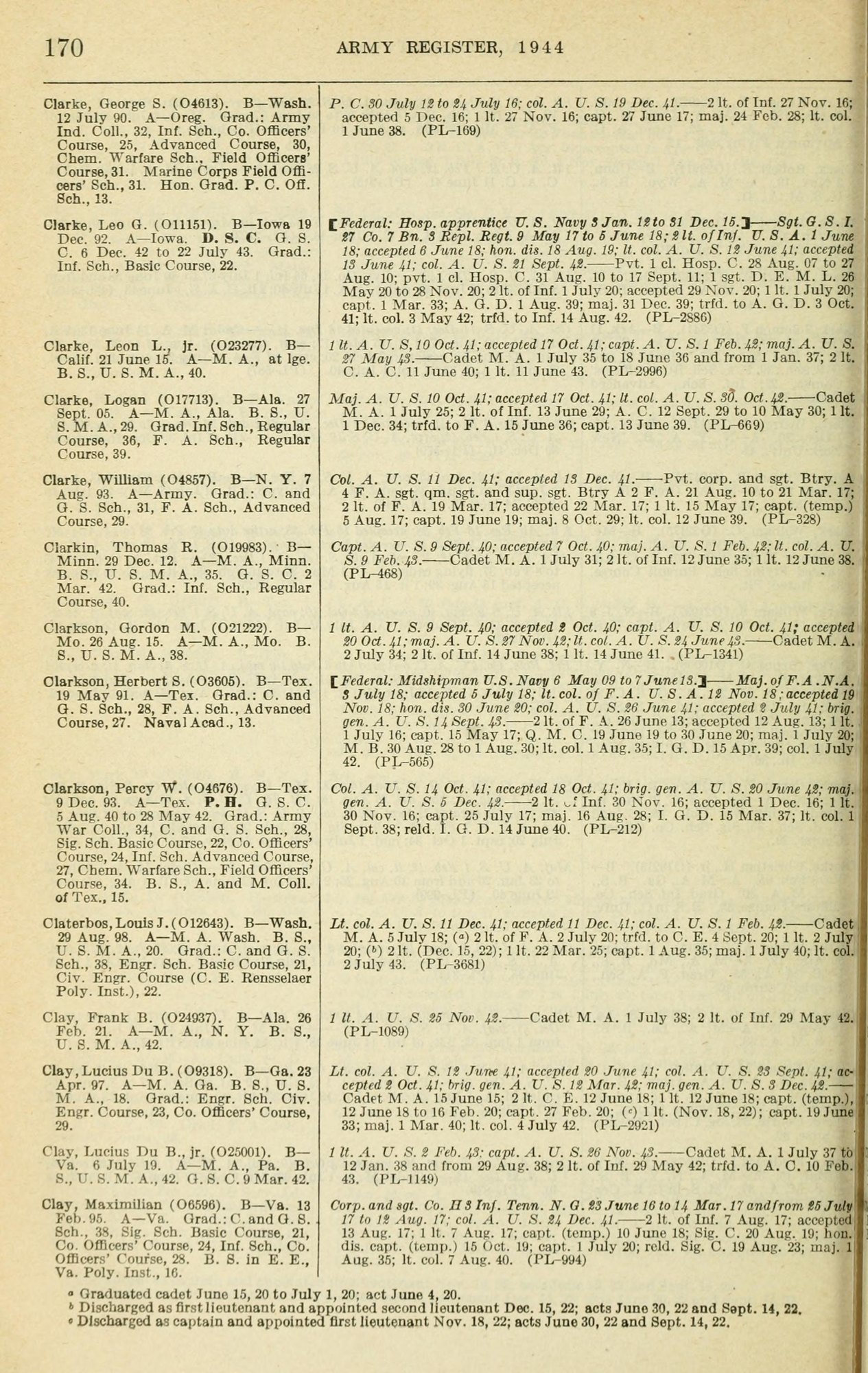
Source: U.S. War Department publication (Internet Archive scan); officialarmyregi1944unit.
How it is shown: Complete page as supplied; no crop, no retouch, no search highlight.
Keep in mind: Confirmed as printed. A federal government publication, released public although dated after 1931.
Image details
After the report
On September 28, 1943, Clarkson was nominated, as a colonel of Field Artillery, for temporary appointment as brigadier general; the Senate confirmed the list on October 7. The Army Register later dated the appointment from September 14, 1943, four days before he signed the report. No source examined connects the promotion to the report. A Signal Corps photograph taken near Lucca, Italy, on October 13, 1944 is captioned with his name as Brig. Gen. Herbert Clarkson, Inspector General, North African Theater of Operations.
Sources
- H. S. Clarkson, Colonel, I.G.D., Inspector General, to the Theater Commander, NATOUSA, "Treatment of Certain Mentally Ill Hospital Patients by Lieutenant General George S. Patton, Jr.," 18 September 1943, 4 pp., with the handwritten note of 22 September 1943. Eisenhower Library, Abilene, Kansas, Pre-Presidential Papers, Principal File, Box 91, "PATTON, George S., Jr. (3)." Declassified 20 July 1966; copy supplied by the library, October 2026.
- Harry C. Butcher, My Three Years with Eisenhower (1946), p. 403, entry for September 2, 1943.
- Stanley P. Hirshson, General Patton: A Soldier's Life (2002; 2003 printing), pp. 404-405, 416-417 and endnotes 25, 104 and 105 on pp. 764-765.
- Eisenhower Library, Pre-Presidential Papers, Principal File, finding aid p. 106: Box 91, "PATTON, George S., Jr. (3) [Sept. 1943 - Nov. 1943]."
- Official Army Register, January 1, 1944, p. 170; January 1, 1946; The Lucky Bag (U.S. Naval Academy, 1913), p. 60.
- Senate nominations of September 28, 1943 and confirmation of October 7, 1943, Congressional Record; Signal Corps photograph, near Lucca, Italy, October 13, 1944 (National WWII Museum).