 American Acorns
Dempsey Nash, the "Abolition" candidate
A newspaper line, 1832
In April 1832 the voters of Norfolk County, Virginia, went to the polls at Portsmouth and at Great Bridge to choose two delegates to the state legislature in Richmond. Five men stood. John W. Murdaugh and Dr. William Collins were returned. Last of the five, with 49 votes in the first count (a later paper gave 51), was Dempsey Nash. Under the figures the Norfolk Beacon added a sentence that the Richmond papers copied: "Mr. Nash was the only 'Abolition' candidate."

"Abolition" is the Norfolk Beacon's description; the other papers repeated it. No platform or speech is given. On July 3, 1832, a Norfolk County meeting of National Republican Young Men named Dempsey Nash among its delegates to a convention at Staunton.

The clipping fits the family's memory of a Nash running in Virginia as an abolitionist. It does not identify which Dempsey Nash stood for election.
Which Dempsey Nash?
A Dempsey Nash, born in Virginia about 1809, lived in Portsmouth, in Norfolk County. In 1850 and 1860 the census takers found him there with his wife Elizabeth; in 1850 he was listed as a "gentleman" who held six enslaved people, and in 1860 as a clerk. The will of a Portsmouth widow, Elizabeth Nash, is reported to leave land and enslaved people to "my daughter Elizabeth Nash, wife of Dempsey Nash." That reading of the will is an undated volunteer transcription. Nothing yet connects the Portsmouth man to the Dempsey Nash of Williamson County, Tennessee, in the family tree.
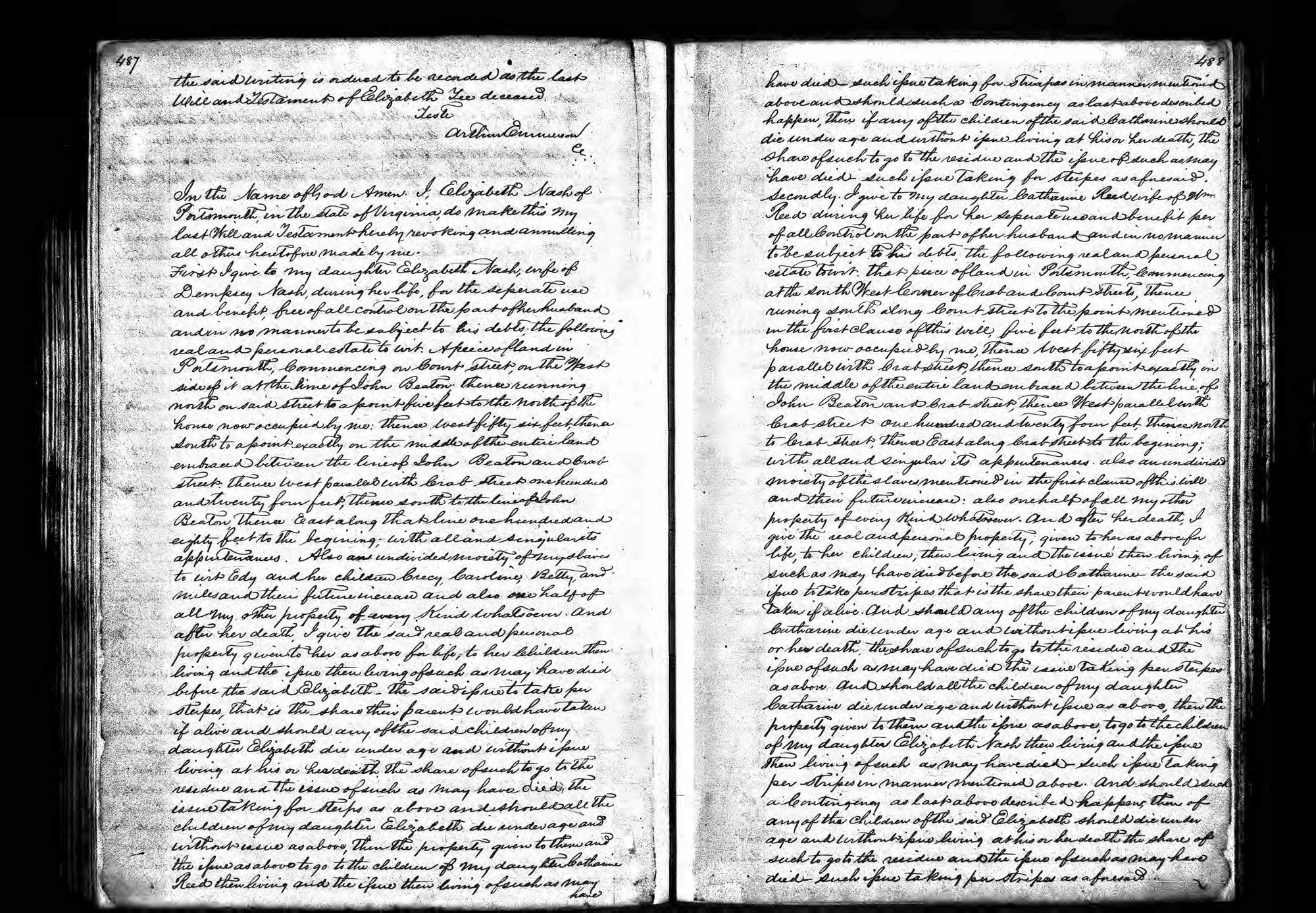
Source: Norfolk County (Virginia) wills, via Ancestry
How it is shown: Complete image as supplied; no crop, no retouch, no search highlight.
Keep in mind: Likely only as to content: the summary rests on Ancestry's machine/volunteer reading of the page. The will's date is not shown. The folder treats the Portsmouth Dempsey Nash (the husband of the testator's daughter Elizabeth) as the likely 1832 candidate for the Texas family's Dempsey, but no link to a tree person is shown, so no tree person is tagged. The will names enslaved people (Edy and her children); they are named here as they appear in the will.
Image details
He lived in the county where the election was held, which makes him the likelier candidate. But nothing in these later records says he stood for the legislature in 1832.
The family's Dempsey Nash lived in Williamson County, Tennessee. An unsourced tree places his birth around 1790 in Norfolk and his marriage to Lucy Garrett in Tennessee in 1805. His estate petition appears to place his death around January 1, 1833, though the year remains uncertain.
Evidence note: One reading of the handwritten death year is 1835. The July 1833 report and January 1834 decree support 1833, but the digit remains uncertain. No cited record places the Tennessee man in Virginia during the election. The Portsmouth man is a plausible candidate; neither identification is secure, and another man of the same name remains possible.
What happened to Dempsey Nash's estate, Tennessee, 1833
Dempsey Nash's Williamson County estate file is in the county's Pleas and Quarter Sessions records. Its jacket reads: "Children: William Nash, John Nash, Lucretia Crouch (Mrs. Charles W.)."
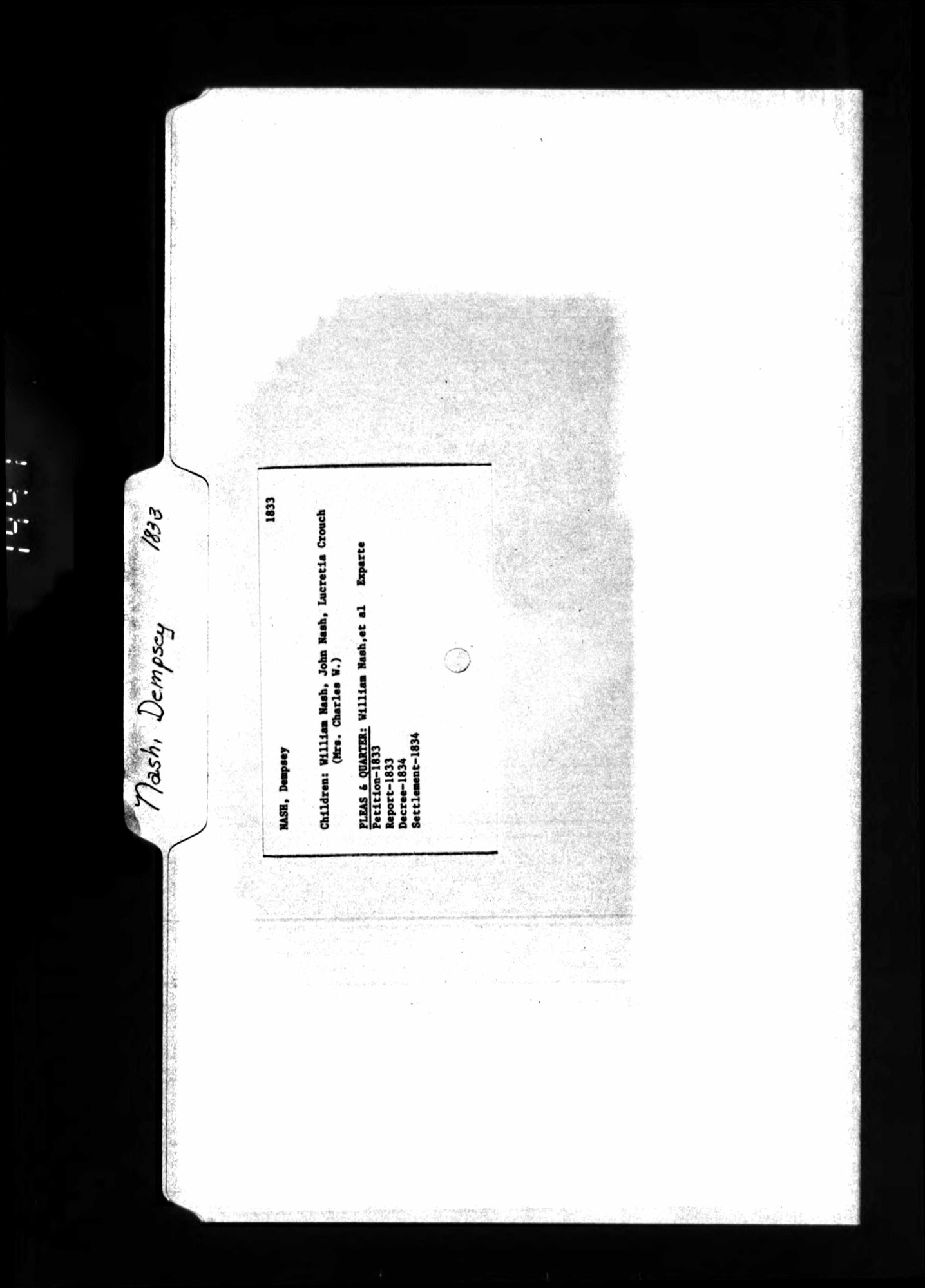
Source: Williamson County, Tennessee court records (TSLA microfilm), via Ancestry.
How it is shown: Complete page as supplied; no crop, no retouch, no search highlight.
Keep in mind: Confirmed as a Pleas and Quarter estate-division file (not a divorce, as a RootsWeb page labelled it). The files name a son William, a son John and a daughter Lucretia (Mrs. Charles W. Crouch); that this William is Colonel William Nash of Kaufman County, Texas, and this John is John D. "Jack" Nash is Likely (tree and secondary accounts), not proved. Names of the enslaved people are read from handwriting and are uncertain where marked in the private account. Further parties tagged on 4 Oct 2026: Lucrecia Nash (1810–1844); Charles W. Crouch (Lucretia (Mrs Charles W.) Crouch and her husband, named in the jacket, petition, report and decree of the estate file).
Image details
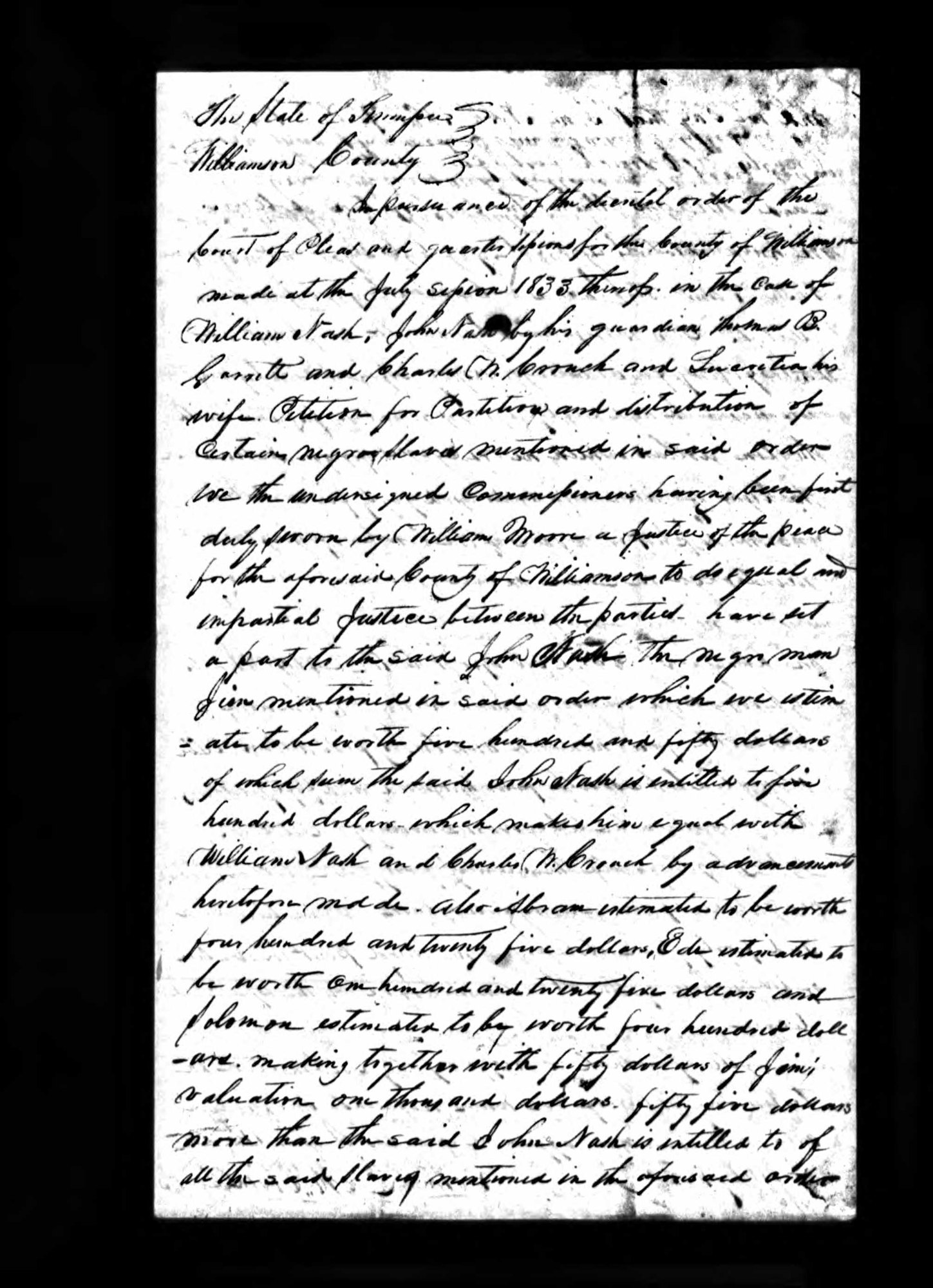
The petition in it is written in a large, careful hand. William Nash, John Nash (a minor, who petitions "by his guardian Thomas B. Garrett") and Charles W. Crouch with his wife Lucretia tell the court that "sometime about the first of January 1833 Dempsey Nash departed this life intestate, leaving your petitioners William, John & Lucretia … his only children." Crouch had been made administrator of the estate at the January session. Part of the estate, the petition says, was "the following negro slaves for distribution": Ben, Sam or Tom, Abram, Jim, Abe, Solomon, Hannah, Edy, Jenny and Patty, ten people in all.
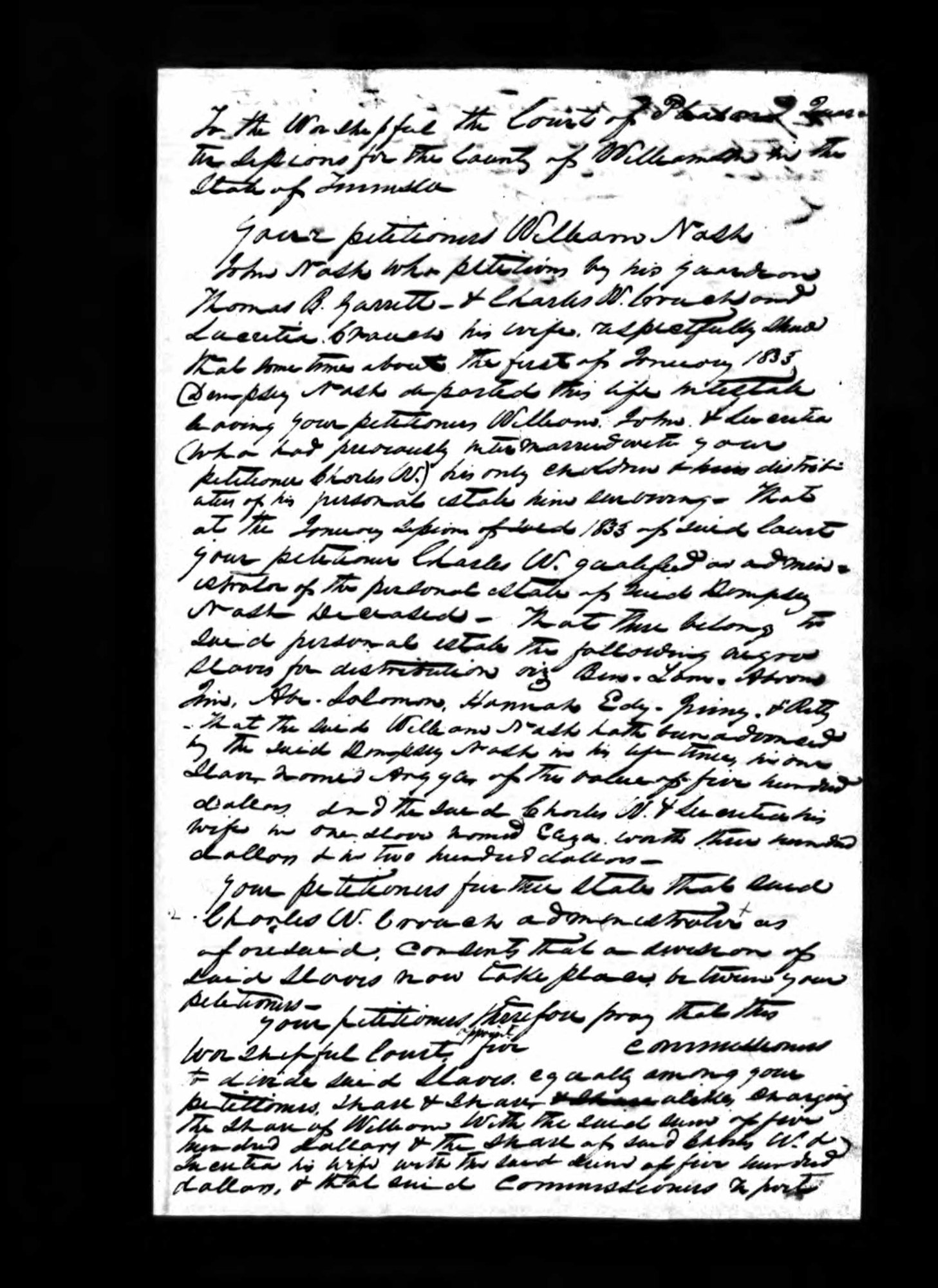
Source: Williamson County, Tennessee court records (TSLA microfilm), via Ancestry.
How it is shown: Complete page as supplied; no crop, no retouch, no search highlight.
Keep in mind: Confirmed as a Pleas and Quarter estate-division file (not a divorce, as a RootsWeb page labelled it). The files name a son William, a son John and a daughter Lucretia (Mrs. Charles W. Crouch); that this William is Colonel William Nash of Kaufman County, Texas, and this John is John D. "Jack" Nash is Likely (tree and secondary accounts), not proved. Names of the enslaved people are read from handwriting and are uncertain where marked in the private account. Further parties tagged on 4 Oct 2026: Lucrecia Nash (1810–1844); Charles W. Crouch (Lucretia (Mrs Charles W.) Crouch and her husband, named in the jacket, petition, report and decree of the estate file).
Image details
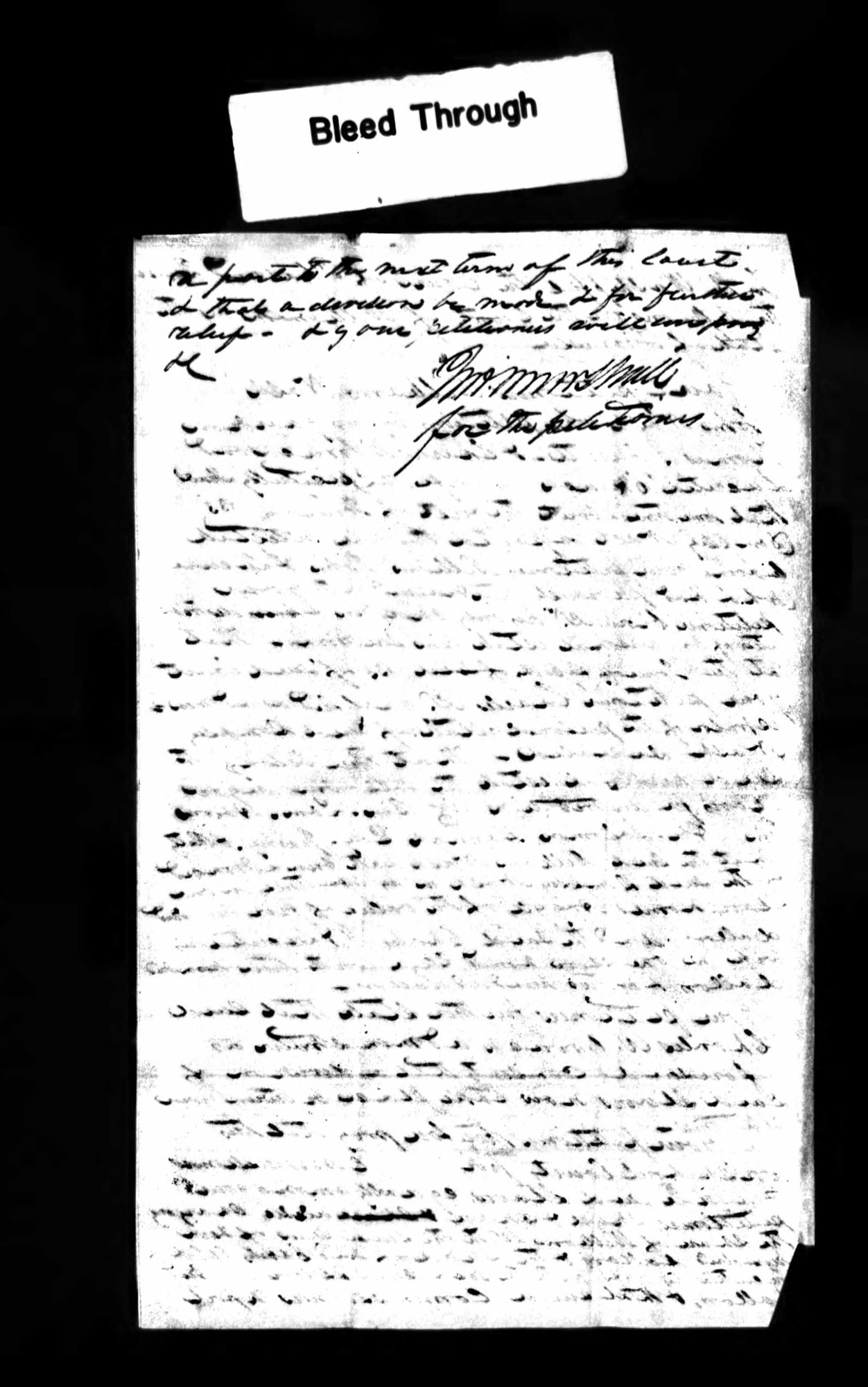
Source: Williamson County, Tennessee court records (TSLA microfilm), via Ancestry.
How it is shown: Complete page as supplied; no crop, no retouch, no search highlight.
Keep in mind: Confirmed as a Pleas and Quarter estate-division file (not a divorce, as a RootsWeb page labelled it). The files name a son William, a son John and a daughter Lucretia (Mrs. Charles W. Crouch); that this William is Colonel William Nash of Kaufman County, Texas, and this John is John D. "Jack" Nash is Likely (tree and secondary accounts), not proved. Names of the enslaved people are read from handwriting and are uncertain where marked in the private account. The page is the end of the petition, with bleed-through.
Image details
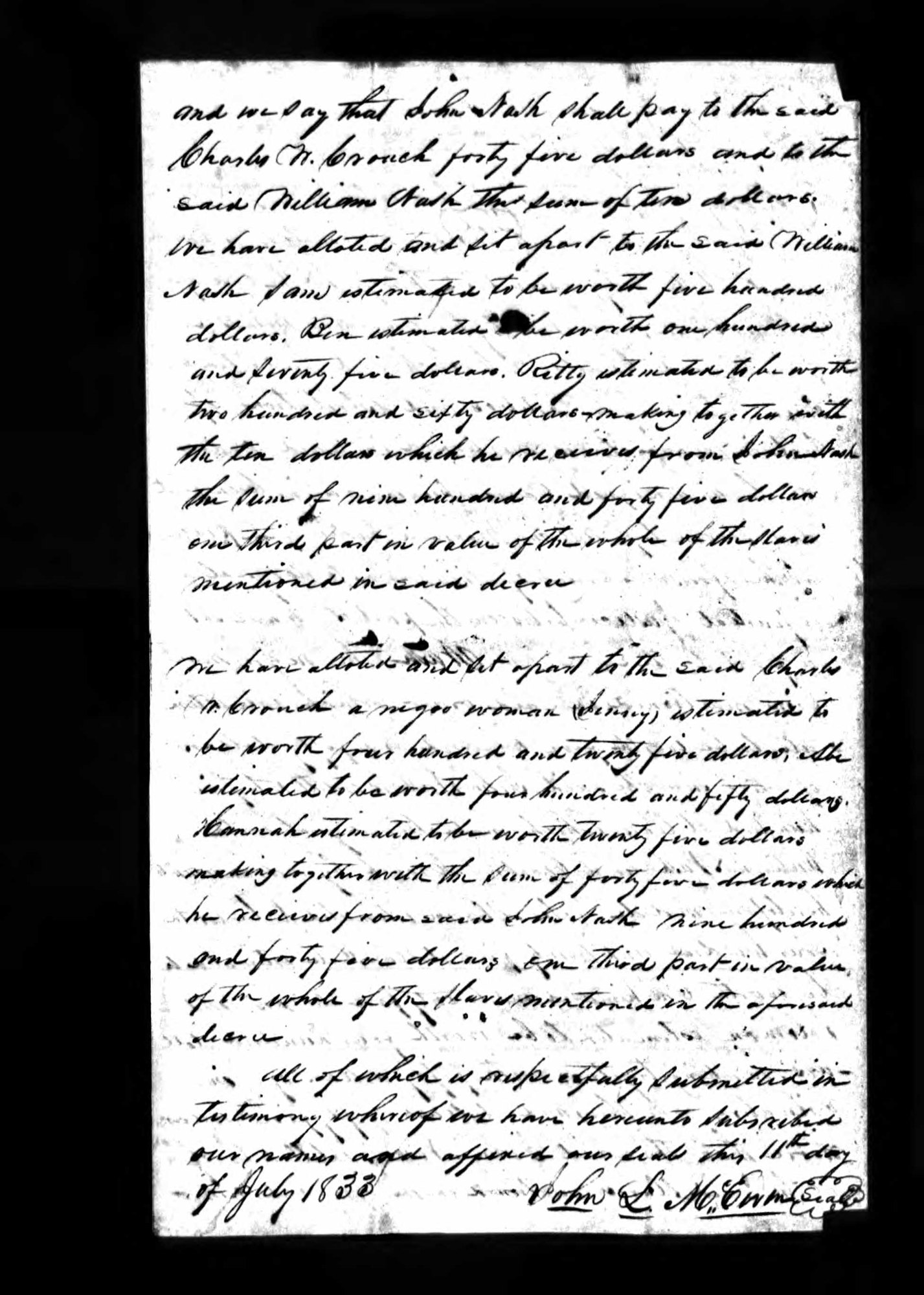
Some of the estate had already been given out. William had been "advanced" in his father's lifetime one enslaved person valued at $500; the Crouches, one valued at $300 together with $200, also $500. No advancement to John, the youngest, is recorded. So the petition asked that the ten people be divided into thirds, with the earlier gifts counted against William and the Crouches.
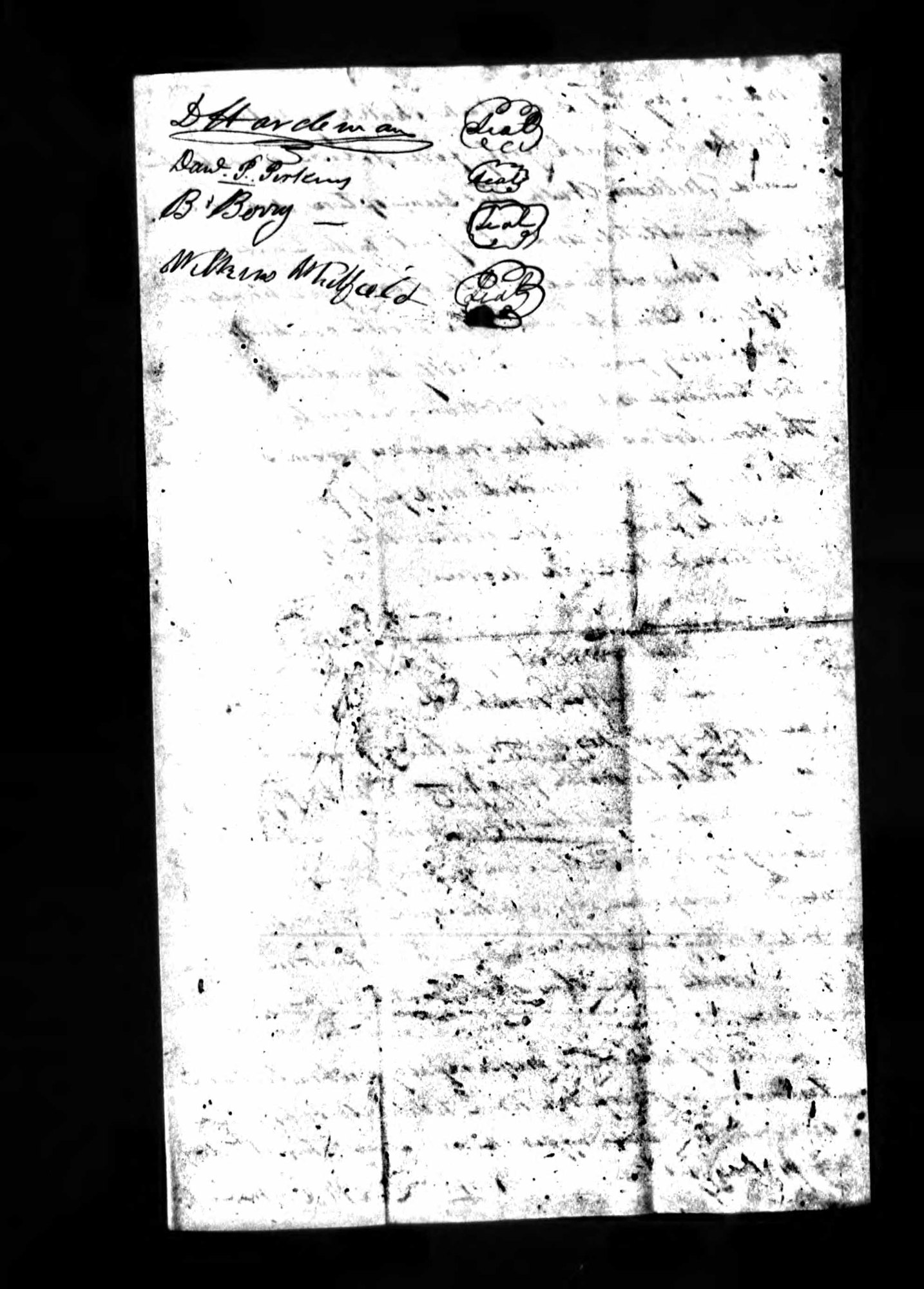
Commissioners divided them, and reported on 11 July 1833. They set a price on each person: John received Jim ($550), Abram ($425), Ede or Edy ($125) and Solomon ($400), totaling $1,500; William received Sam ($500), Ben ($175) and Patty ($260), totaling $935; Charles and Lucretia Crouch received Jenny ($425), Abe ($450) and Hannah ($25), totaling $900. Because William and the Crouches had already been advanced $500 apiece in Dempsey's lifetime and John had not, the report has John pay $10 to William and $45 to the Crouches. That leaves John with $1,445 and William and the Crouches with $945 each, which with their $500 advancements also comes to $1,445. Each heir's share was equal. In January 1834 the court confirmed the report, vesting each allotment in the heir who received it.
Source: Williamson County, Tennessee court records (TSLA microfilm), via Ancestry.
How it is shown: Complete page as supplied; no crop, no retouch, no search highlight.
Keep in mind: Confirmed as a Pleas and Quarter estate-division file (not a divorce, as a RootsWeb page labelled it). The files name a son William, a son John and a daughter Lucretia (Mrs. Charles W. Crouch); that this William is Colonel William Nash of Kaufman County, Texas, and this John is John D. "Jack" Nash is Likely (tree and secondary accounts), not proved. Names of the enslaved people are read from handwriting and are uncertain where marked in the private account. Further parties tagged on 4 Oct 2026: Lucrecia Nash (1810–1844); Charles W. Crouch (Lucretia (Mrs Charles W.) Crouch and her husband, named in the jacket, petition, report and decree of the estate file).
Image details
Source: Williamson County, Tennessee court records (TSLA microfilm), via Ancestry.
How it is shown: Complete page as supplied; no crop, no retouch, no search highlight.
Keep in mind: Confirmed as a Pleas and Quarter estate-division file (not a divorce, as a RootsWeb page labelled it). The files name a son William, a son John and a daughter Lucretia (Mrs. Charles W. Crouch); that this William is Colonel William Nash of Kaufman County, Texas, and this John is John D. "Jack" Nash is Likely (tree and secondary accounts), not proved. Names of the enslaved people are read from handwriting and are uncertain where marked in the private account. Further parties tagged on 4 Oct 2026: Lucrecia Nash (1810–1844); Charles W. Crouch (Lucretia (Mrs Charles W.) Crouch and her husband, named in the jacket, petition, report and decree of the estate file).
Image details
Source: Williamson County, Tennessee court records (TSLA microfilm), via Ancestry.
How it is shown: Complete page as supplied; no crop, no retouch, no search highlight.
Keep in mind: Confirmed as a Pleas and Quarter estate-division file (not a divorce, as a RootsWeb page labelled it). The files name a son William, a son John and a daughter Lucretia (Mrs. Charles W. Crouch); that this William is Colonel William Nash of Kaufman County, Texas, and this John is John D. "Jack" Nash is Likely (tree and secondary accounts), not proved. Names of the enslaved people are read from handwriting and are uncertain where marked in the private account.
Image details
Source: Williamson County, Tennessee court records (TSLA microfilm), via Ancestry.
How it is shown: Complete page as supplied; no crop, no retouch, no search highlight.
Keep in mind: Confirmed as a Pleas and Quarter estate-division file (not a divorce, as a RootsWeb page labelled it). The files name a son William, a son John and a daughter Lucretia (Mrs. Charles W. Crouch); that this William is Colonel William Nash of Kaufman County, Texas, and this John is John D. "Jack" Nash is Likely (tree and secondary accounts), not proved. Names of the enslaved people are read from handwriting and are uncertain where marked in the private account. This ledger page was not transcribed.
Image details
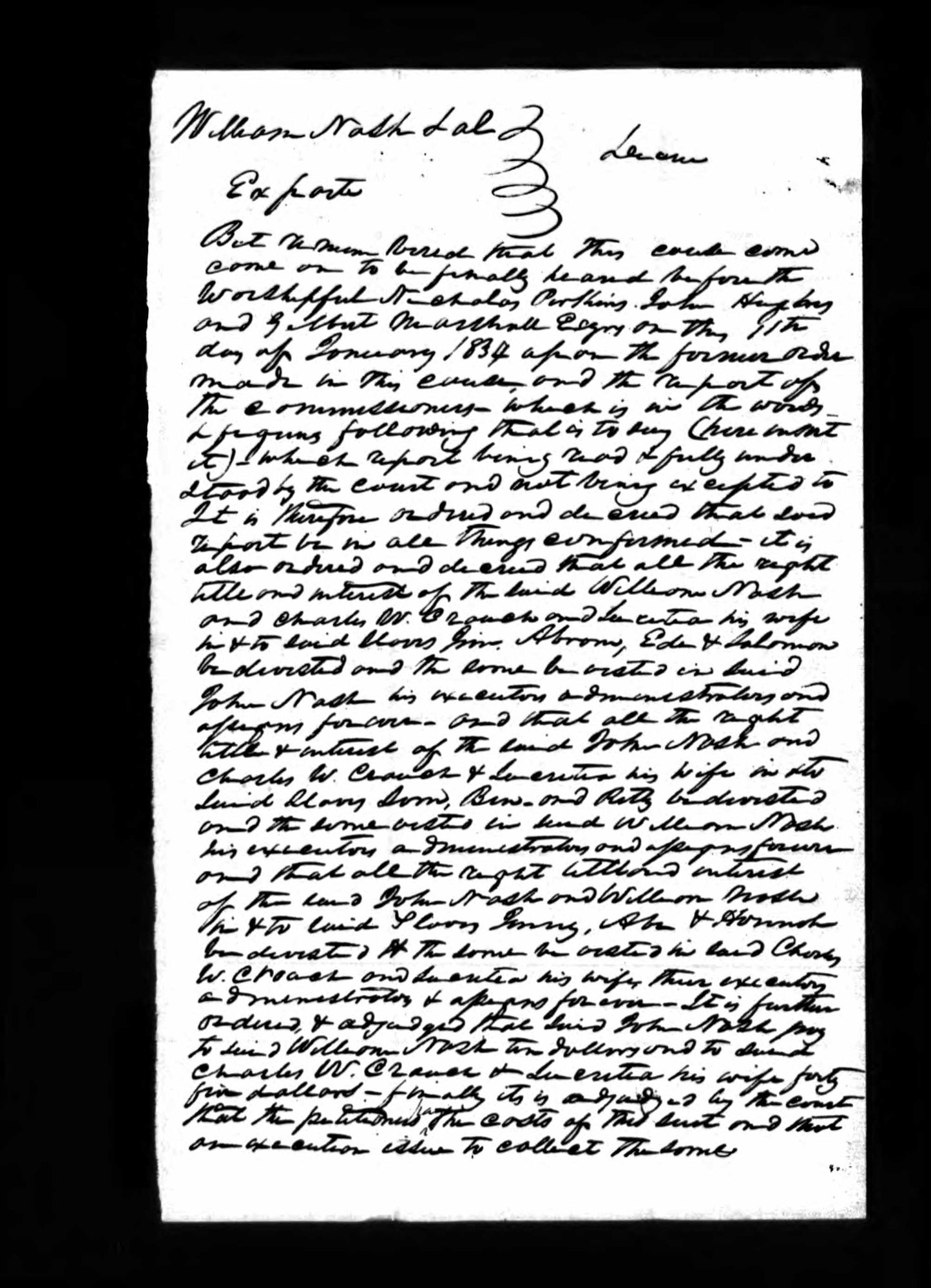
Source: Williamson County, Tennessee court records (TSLA microfilm), via Ancestry.
How it is shown: Complete page as supplied; no crop, no retouch, no search highlight.
Keep in mind: Confirmed as a Pleas and Quarter estate-division file (not a divorce, as a RootsWeb page labelled it). The files name a son William, a son John and a daughter Lucretia (Mrs. Charles W. Crouch); that this William is Colonel William Nash of Kaufman County, Texas, and this John is John D. "Jack" Nash is Likely (tree and secondary accounts), not proved. Names of the enslaved people are read from handwriting and are uncertain where marked in the private account. The day of the decree reads [7th?] January 1834. Further parties tagged on 4 Oct 2026: Lucrecia Nash (1810–1844); Charles W. Crouch (Lucretia (Mrs Charles W.) Crouch and her husband, named in the jacket, petition, report and decree of the estate file).
Image details
These are the ten people of whom the file gives the names: Jim, Abram, Ede, Solomon, Sam, Ben, Patty, Jenny, Abe and Hannah. Several of the handwritten names could be read another way, and are marked as uncertain. The file says nothing about who they were, whether they were related, or where they went. It records them only by a price, from $550 to $25.
The petition identifies Dempsey's children as William, John and Lucretia. The tree and later accounts make those sons probably the later Colonel William Nash of Kaufman County and John D. "Jack" Nash of Bastrop.
Two Nashes at Austin, 1861
T. J. Nash of Dallas County and William Nash of Kaufman County both served at the Texas Secession Convention in 1861. No relationship between them has been established.
T. J. Nash of Dallas County was born in Virginia, raised in Kentucky, and had come to Texas in 1854. A descendant's biography says he thought slavery wrong, favored Henry Clay's plan of gradual emancipation with compensation to owners, and, having inherited enslaved people through his wife's family, held them. Those views come only from that biography; his votes and signatures are recorded in the convention journal. On the adoption of the Ordinance of Secession he is among the yeas in the printed vote of 166 to 8. He signed the ordinance. He also signed the Declaration of Causes, which states that the government was founded "exclusively by the white race" and that "the servitude of the African race" is "mutually beneficial to both bond and free." No evidence connects him to this family, and no source calls him an abolition candidate.


The convention records identify William Nash of Kaufman County as Tennessee-born and 52. He had been elected, but did not attend the first session. He took his seat on 2 March 1861, after the secession ordinance had been adopted. He therefore did not vote on its adoption. He did sign it, along with the other late-seated delegates, and on 5 March the journal lists "Nash of Kaufman," with "Nash of Dallas," among the yeas on an ordinance uniting Texas with the Confederate States. He is very likely the family's Colonel William Nash. Whether he is also the William who petitioned in Williamson County in 1833 is not proved.


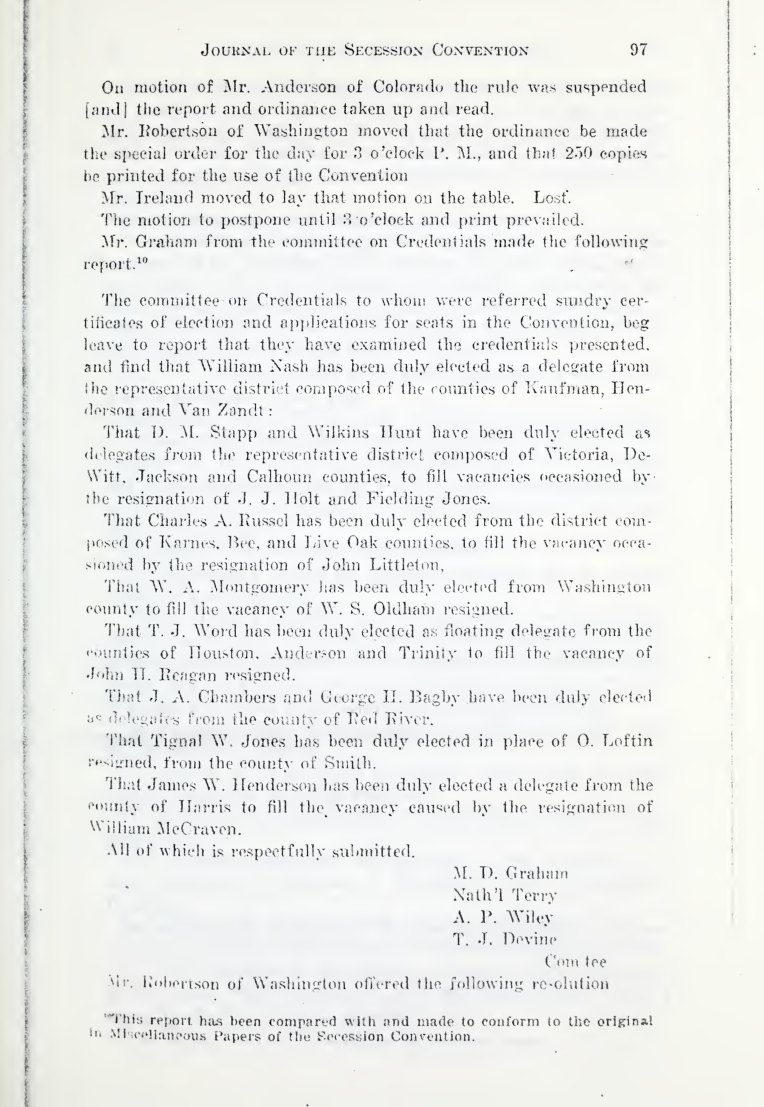
Source: Internet Archive (public-domain scan of a 1912 state publication); journalofsecessi00texa.
How it is shown: Complete page rendered from the scan as a PNG; no crop, no retouch, no search highlight.
Keep in mind: Confirmed. The William Nash of Kaufman County of 1861 is Likely (not proved) to be the tree's Colonel William Nash (b. 1809 Tennessee, d. 1865 Kaufman) per the delegate list and secondary accounts; he is not shown to be the William of the 1833 Tennessee petition. T. J. Nash of Dallas, who also appears in the Journal, is not shown to be in the family.
Image details
The family's separate memory of a Nash opposing rights for Black Texans has not been matched to a specific event. The 1861 journal establishes these men's actions on secession and slavery; it does not establish the remembered later episode.
Were the Virginia and Texas Nashes father and son?
The records identify an "Abolition" candidate named Dempsey Nash in Virginia and a William Nash who signed Texas's secession ordinance and voted for union with the Confederacy. They do not establish that the two were father and son.
Sources
- Constitutional Whig (Richmond), 20 April 1832, p. 3, reprinting the Norfolk Beacon: the Norfolk County election return.
- Staunton Spectator, 13 July 1832, p. 3: delegates elected to the Staunton Convention, Norfolk County.
- 1850 and 1860 U.S. censuses, Portsmouth, Norfolk County, Virginia (index-read); the will of Elizabeth Nash of Portsmouth.
- Williamson County, Tennessee, Pleas and Quarter Sessions, "Nash, Dempsey," 1833–1834 court file (petition, commissioners' report of 11 July 1833, decree of January 1834).
- E. W. Winkler, ed., Journal of the Secession Convention of Texas, 1861 (Austin, 1912): archive.org/details/journalofsecessi00texa
- Searched without finding a Nash delegate: the Texas conventions of 1845, 1866, 1868–69 and 1875.