 American Acorns
Records & photos · Family histories and trees
Biographical Sketches of Representative Citizens of the State of Maine (1903), p. 195: 'The Oaks of Garland'.
Image · dated 1903 · source: Internet Archive (public-domain scan); biographicalsket00newe.
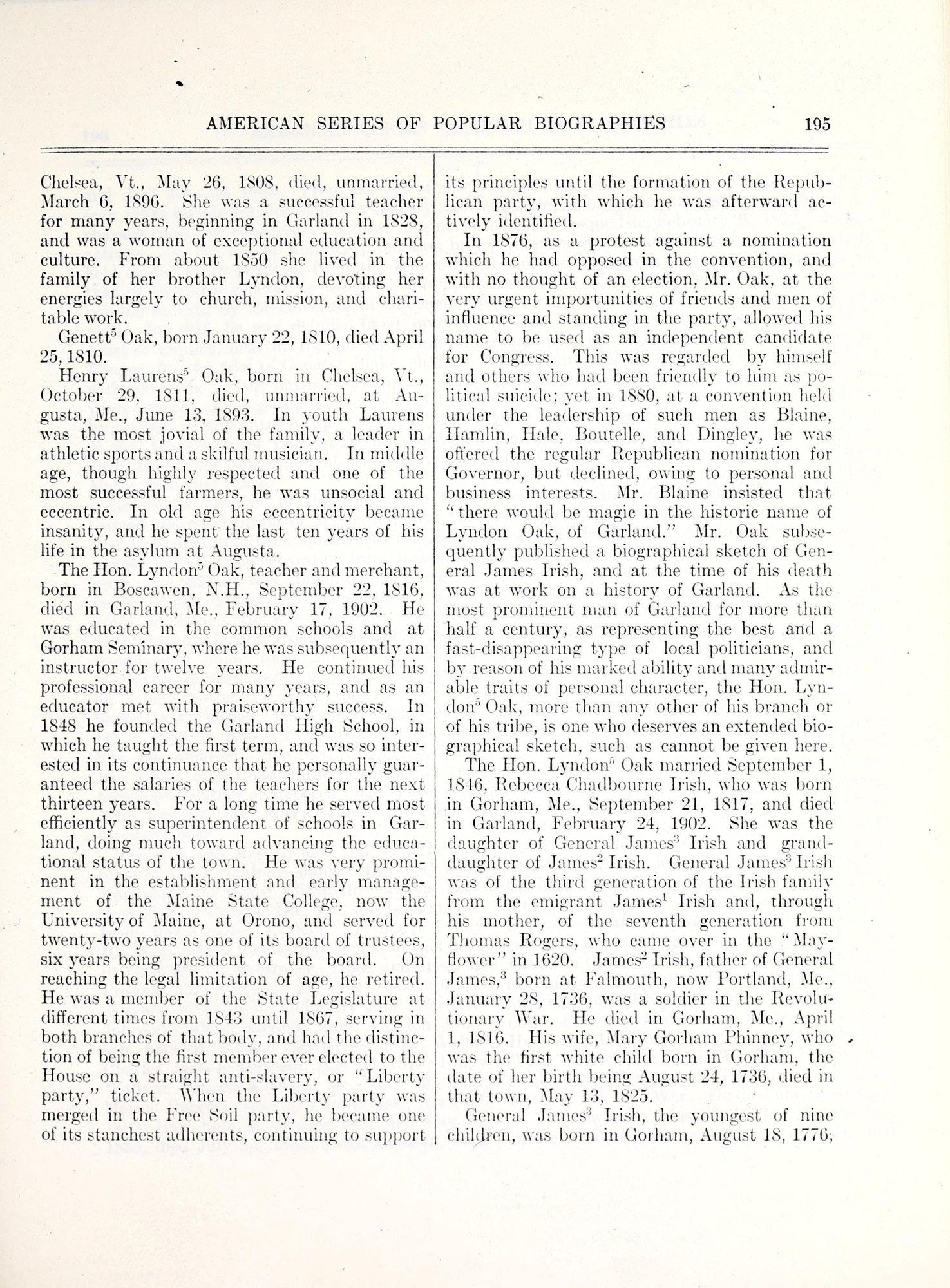
Transcription
Word-for-word transcription (spellings kept; uncertain letters in brackets).
Chelsea, Vt., May 26, 1808, died, unmarried, March 6, 1896. She was a successful teacher for many years,
beginning in Garland in 1828, and was a woman of exceptional education and culture. From about 1850 she
lived in the family of her brother Lyndon, devoting her energies largely to church, mission, and
charitable work.
Genett^5 Oak, born January 22, 1810, died April 25, 1810.
Henry Laurens^5 Oak, born in Chelsea, Vt., October 29, 1811, died, unmarried, at Augusta, Me., June 13,
1893. In youth Laurens was the most jovial of the family, a leader in athletic sports and a skilful
musician. In middle age, though highly respected and one of the most successful farmers, he was unsocial
and eccentric. In old age his eccentricity became insanity, and he spent the last ten years of his life
in the asylum at Augusta.
The Hon. Lyndon^5 Oak, teacher and merchant, born in Boscawen, N.H., September 22, 1816, died in
Garland, Me., February 17, 1902. He was educated in the common schools and at Gorham Seminary, where he
was subsequently an instructor for twelve years. He continued his professional career for many years, and
as an educator met with praiseworthy success. In 1848 he founded the Garland High School, in which he
taught the first term, and was so interested in its continuance that he personally guaranteed the
salaries of the teachers for the next thirteen years. For a long time he served most efficiently as
superintendent of schools in Garland, doing much toward advancing the educational status of the town. He
was very prominent in the establishment and early management of the Maine State College, now the
University of Maine, at Orono, and served for twenty-two years as one of its board of trustees, six years
being president of the board. On reaching the legal limitation of age, he retired. He was a member of the
State Legislature at different times from 1843 until 1867, serving in both branches of that body, and had
the distinction of being the first member ever elected to the House on a straight anti-slavery, or
"Liberty party," ticket. When the Liberty party was merged in the Free Soil party, he became one of its
stanchest adherents, continuing to support
[col. 2]
its principles until the formation of the Republican party, with which he was afterward actively
identified.
In 1876, as a protest against a nomination which he had opposed in the convention, and with no thought of
an election, Mr. Oak, at the very urgent importunities of friends and men of influence and standing in the
party, allowed his name to be used as an independent candidate for Congress. This was regarded by himself
and others who had been friendly to him as political suicide; yet in 1880, at a convention held under the
leadership of such men as Blaine, Hamlin, Hale, Boutelle, and Dingley, he was offered the regular
Republican nomination for Governor, but declined, owing to personal and business interests. Mr. Blaine
insisted that "there would be magic in the historic name of Lyndon Oak, of Garland." Mr. Oak subsequently
published a biographical sketch of General James Irish, and at the time of his death was at work on a
history of Garland. As the most prominent man of Garland for more than half a century, as representing
the best and a fast-disappearing type of local politicians, and by reason of his marked ability and many
admirable traits of personal character, the Hon. Lyndon^5 Oak, more than any other of his branch or of
his tribe, is one who deserves an extended biographical sketch, such as cannot be given here.
The Hon. Lyndon^5 Oak married September 1, 1846, Rebecca Chadbourne Irish, who was born in Gorham, Me.,
September 21, 1817, and died in Garland, February 24, 1902. She was the daughter of General James^3 Irish
and granddaughter of James^2 Irish. General James^3 Irish was of the third generation of the Irish family
from the emigrant James^1 Irish and, through his mother, of the seventh generation from Thomas Rogers,
who came over in the "Mayflower" in 1620. James^2 Irish, father of General James,^3 born at Falmouth, now
Portland, Me., January 28, 1736, was a soldier in the Revolutionary War. He died in Gorham, Me., April 1,
1816. His wife, Mary Gorham Phinney, who was the first white child born in Gorham, the date of her birth
being August 24, 1736, died in that town, May 13, 1825.
General James^3 Irish, the youngest of nine children, was born in Gorham, August 18, 1776,
[article continues on p. 196]
NOTE ON READING UNCERTAINTY: the Irish-family dates in the last paragraph of p.195 (Gorham 1816/1776) were
read at reduced scale; re-check at full resolution before relying on them (they are not Oak-line facts).
Excerpt: the article 'The Oaks of Garland' only (the other column of the page is a different sketch); every date was re-read against the page image. [sic] marks indicate the transcriber's own notation.
How it is shown: Complete page as supplied; no crop, no retouch, no search highlight.
Keep in mind: Written by Henry L. Oak, the compiler of the 1906 register: one witness, not two (Main's review, 2 Oct 2026). Family-written text; several dates in it are wrong (see the review). Unconfirmed where only this text says it.