 American Acorns
Benjamin Hastings Oak: Chelsea, Boscawen and Garland
The Oaks of Garland, Maine, began with a family that left New Hampshire in September 1826 "with family and household effects in an old chaise and one-horse wagon." The father was Benjamin Hastings Oak, the oldest son of Capt. Nathaniel Oak of Chelsea, Vermont. His son Lyndon Oak became a Maine legislator and wrote the town's history, and two of his grandsons, Henry Lebbeus Oak and Ora Oak, produced the 1906 family register. The register's entry for him (no. 70, pages 32 and 33) is written by a grandson, and it does not spare him.
Source: Copied into the family tree from another contributor.
Image details
Chelsea, 1790 to 1812
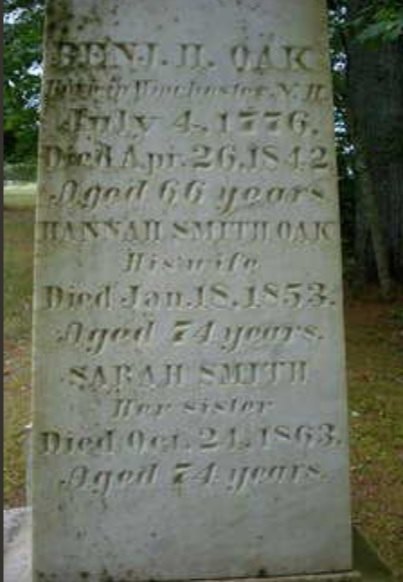
His gravestone reads "Born in Winchester, N.H. July 4, 1776." The register gives March 3, 1776, also at Winchester. He went to Vermont at fourteen, when his father moved the family to Chelsea in 1790, and the register remembers him as "a boy of remarkable physical strength; but in a hayfield contest for charitable purposes he injured himself and was never a well man again." It says he served in the army for a year or two as a musician, being in 1799 "in the Second Regiment of Artillerists and Engineers, stationed at New London, Conn.," then became a clerk in a store and probably went into business for himself; "insolvency proceedings are recorded in 1808."
Chelsea's records follow him from there. FamilySearch's index of the town's records enters his marriage to Hannah Smith on December 23, 1804, and the births and early deaths of their first children (William S., 1805 to 1806; Genett, January 22 to April 28, 1810, where the 1903 sketch gives her death as April 25), and a daughter, Susannah Hastings Oak, born May 26, 1808. The town's printed lists show him as town clerk in 1807 and as Chelsea's representative to the Vermont legislature in 1810. The register says he was clerk from 1807 to 1812. The story of his father's years in Chelsea is on Captain Nathaniel Oak of Chelsea, Vermont.
The Boscawen hotel, 1812 to 1826
From 1812 to 1826, the register says, he kept a hotel at Boscawen, New Hampshire. "His hotel in Boscawen was on the Merrimac river, two miles above the later Fisherville, now Pennacook," and the building, a private dwelling in 1894, had long been a boarding house for the Elmwood Academy. "The nearest neighbors were Ezekiel Webster, brother of Daniel, and family, a little above and across the road." He "took an active part with the Webster family in building up the schools," and, though he "greatly regretted his lack of education," he "was a great reader, considering his opportunities." A Webster still living there remembered him: "Capt. Oak, as he was known, was a noted performer on the fife, and also a good player of the violin." The register adds that "when he was married he sold his violin to buy a cow." His sister Susanna's husband, Enoch Challis, kept the Boscawen hotel in 1812, according to the same book.
The register does not soften the end of those years: "Finally, failing business, bad health and excessive use of liquor effected his financial ruin."
Exeter and Garland, 1826 to 1842
The family moved in 1826 to Exeter, Maine, where his brother Nathaniel had farmed since 1810. His son Lyndon's History of Garland (1912) gives the next step from the town's side: "In 1829, Benjamin H. Oak of Exeter purchased this house, and the forty acres of land connected with it and moved into it in the spring of 1830, where he lived until his death in 1842." The house had been built by a Mr. Church, who built the town's grist-mill by hand; about 1844 it passed to the Rev. Leonard Hathaway, who took it down and built a larger one on the site.
Garland's town meetings chose him a selectman and assessor in 1832, 1833 and 1834, and treasurer in 1836 and 1837. In 1835, when the division of the fund from the sale of the ministerial lands among the town's religious societies became "the occasion of a somewhat acrimonious contention," the matter went to two outside arbiters, and "Benjamin H. Oak was appointed to present the case in behalf of the town." In 1836 he was one of five men appointed to redistrict the town for its schools. When the Congregational parish built Garland's first meeting house, begun in 1835 and finished in 1837, "Benjamin H. Oak was chosen treasurer and chairman of the building committee." One of the building company's by-laws "forbade the use of any alcoholic drink by any person employed on the building, and that no such drink should be furnished at its raising," which the history calls "in advance of the public sentiment of the times."
The register says that "though the family had a hard struggle with poverty and the father never escaped the burden of debt, yet he became an esteemed and useful citizen, serving alternately as selectman and town treasurer to the last; an influential member of the Congregational church society, and often an arbiter of disputes between townsmen. He abandoned his drinking habit, and brought up five sons who never used liquor nor tobacco." The grandson writing the entry adds, "Not quite so much can be said for his grandsons, yet even they are often sober."
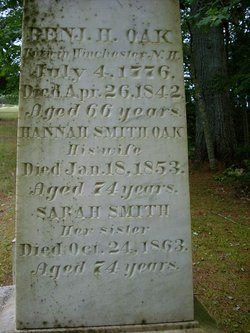
He died on April 26, 1842. His gravestone says "Aged 66 years," which fits the register's March birth date rather than the July 4 cut on the same stone, by which he was sixty-five. The register gives the same day of death. The family tree places the death at Garland.
Source: Copied into the family tree from another contributor.
Image details
Hannah and "Aunt Sally"
The register calls his wife Hannah Smith, daughter of Benjamin and Hannah Smith of Walpole, New Hampshire, "a good woman and conscientious mother," who "was subject to great depression of spirits, and inspired more respect than affection." It names eight children: William S., Susan H., Genett, Henry Laurens, Lyndon, Lorenzo, Lebbeus and Edson Lang.
"In all but blood the veritable mother of the children and one of the best friends of all the Oaks for three generations was her sister, 'Aunt Sally,' who lived in the family, latterly as housekeeper for Laurens, from the early days in New Hampshire, to her own death." Lyndon Oak, her nephew, wrote of her: "In the blue days of the later years in Boscawen and the earlier years in Maine, when the chilling clouds of poverty hung heavily over us, the habitual hopefulness of Aunt Sally, and her strong faith in the coming of better days and her words of encouragement and cheer were a perpetual benediction to the children of the household—and when the better days came no one greeted them with keener satisfaction than Aunt Sally."
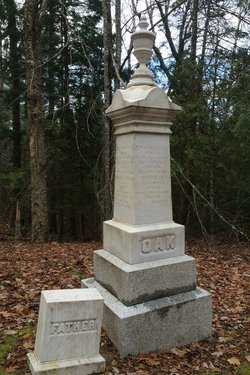
The three are on one stone: "Benj. H. Oak," then "Hannah Smith Oak, His wife, Died Jan. 18, 1853, Aged 74 years," then "Sarah Smith, Her sister, Died Oct. 24, 1863, Aged 74 years." The register puts Sally's death in 1862 at seventy-four; the stone reads 1863.
Source: provenance not confirmed
Image details
His children
Henry Lebbeus Oak's 1903 sketch of the Garland family gives Benjamin's children their own lines. Susanna Hastings Oak (1808-1896), who never married, "was a successful teacher for many years, beginning in Garland in 1828," and from about 1850 lived with her brother Lyndon, giving her energies "largely to church, mission, and charitable work." Henry Laurens Oak (1811-1893) was in youth "the most jovial of the family, a leader in athletic sports and a skilful musician," and later one of the most successful farmers in town, but "in old age his eccentricity became insanity, and he spent the last ten years of his life in the asylum at Augusta." Lyndon became the family's public man. Lorenzo (1818-1875), "a skilful accountant and a man of great energy," was town clerk, selectman and town treasurer, assistant assessor of internal revenue and a representative in 1873. Lebbeus (1820-1905), "perhaps, the most popular member of the Oak family," as captain of the town militia and then major of the regiment "did more than any other person toward raising the Garland quota of recruits for service in the Civil War"; he was the father of Henry Lebbeus Oak. His son Ora's memoir adds that he learned "his trade of harness-maker, in Bangor, Me., and Haverhill, Mass.," was "a great reader, and a well informed man on all current events," and, though "very averse to making social and formal calls," was "much pleased to have any of them or neighbors drop in to spend an hour with him of a Sunday afternoon"; he spent 1898-1900 in Los Angeles "visiting his boys" (register, p. 67; the 1903 sketch has him in California from 1899 to 1901). The county history confirms the rank: when the legislature formed the State Guards in 1863, "Lebbens Oak, of Garland," became major of the First Regiment (History of Penobscot County, 1882, p. 102). Its Garland sketches add that he was born at Boscawen, New Hampshire, on December 13, 1821 (the family tree has 1820), was brought to Exeter at five and to Garland three years later, and was still in Garland in 1882, "engaged in harness manufacturing." He married Sarah E. Merriam, a daughter of Josiah and Sarah (Hill) Merriam, in 1844 (the 1903 sketch gives January 18, 1843), and they had four children: Henry L. and Addie S., then unmarried; Ora, married to Bertha Millett; and the son Henry's obituary calls Orman, married to Belle Haskell, with one child (p. 355). Edson Lang Oak (1822-1892), tanner and currier and later a boot and shoe manufacturer, was "the youngest, tallest, strongest, richest, father of the most children, and probably, also, the best all-round business man of the family"; like Lyndon "a fine singer," he also sat in the legislature.
What is missing
The army service of 1799, the 1808 insolvency and the Boscawen hotel rest on the register; none has yet been checked against muster rolls, Vermont court records or New Hampshire deeds. His Garland offices come from his son's printed history of the town, not from the town's original records. The stone's photographs came into the family tree from other contributors, and the cemetery is not named on them. The register and the stone disagree on his birthday and on Sally's death year.
Sources
- H. L. Oak, Oak-Oaks-Oakes: Family Register (1906), no. 70, pp. 32-33, no. 71, p. 33, and no. 72 (his brother Nathaniel of Exeter), pp. 33-34. Public domain; browse it page by page.
- Lyndon Oak, History of Garland, Maine (Dover, Maine, 1912), pp. 108-109, 231-233, 238, 243-246 and 248. Public domain. Lyndon left it in manuscript; the preface, by the printer Liston P. Evans, says "the manuscript came into the hands of John M. Oak of Bangor after the death of his father," who had it published, with editing by Ellen M. Haskell of Garland. The scanned copy is Boston University Library's, with the bookplate of Lewis S. Conant and a library label recording it as the "bequest of Emma L. Conant in memory of her husband Lewis S. Conant, 1951." archive.org/details/historyofgarland00oakl
- H. L. Oak, "The Oaks of Garland," in Biographical Sketches of Representative Citizens of the State of Maine (Boston, 1903), pp. 193-198. archive.org/details/biographicalsket00newe/page/n440/mode/1up
- History of Penobscot County, Maine (Cleveland: Williams, Chase & Co., 1882), p. 102 (the State Guards, 1863) and p. 355 (Garland sketches). Public domain. archive.org/details/historyofpenobsc00will
- "Vermont, Vital Records, 1760-1954," FamilySearch index: Chelsea entries for Benjamin H. Oak, Hannah Smith and their children (index lines only).
- Chelsea's printed lists of town clerks and representatives, as cited on Captain Nathaniel Oak of Chelsea, Vermont.
- Gravestone of Benj. H. Oak, Hannah Smith Oak and Sarah Smith, photographs in the family tree, shown above.