 American Acorns
Henry Lebbeus Oak and the family register
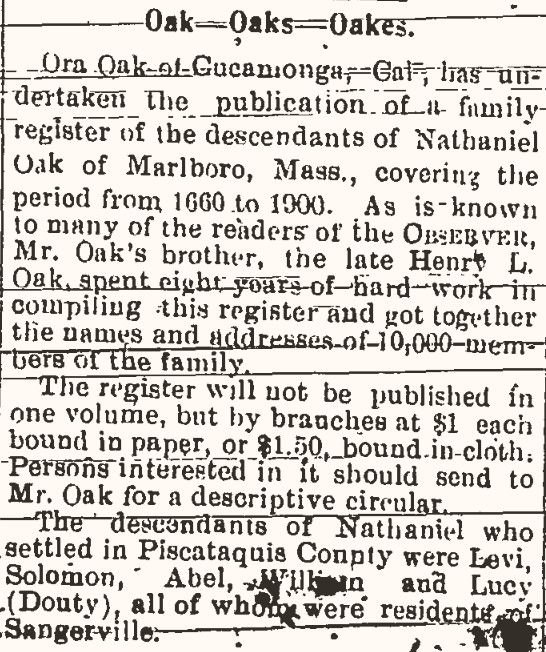
A newspaper clipping saved with his photographs reports that after Henry Lebbeus Oak's death in 1905, his brother Ora Oak of Cucamonga, California, took over publishing the Oak family register by branches. The book Ora continued was Henry's own work: a genealogical record of the Oak, Oaks and Oakes families that appeared in 1906, a year after he died, and that this site still draws on for the Nathaniel Oak cabin-boy story and others. Before the register, Henry had spent most of his working life in San Francisco as librarian of the historian Hubert Howe Bancroft's library and superintendent of the writing done there.
Source: Find a Grave, memorial 41810366
Image details
From Garland to the Bancroft Library
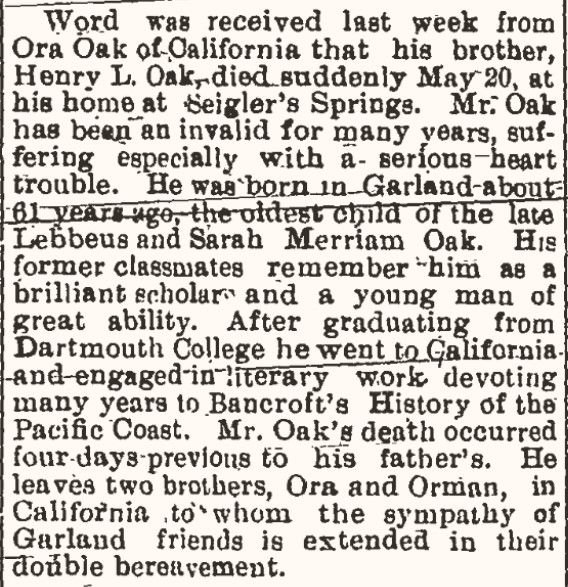
Henry Lebbeus Oak was born May 13, 1844, in Garland, Maine, the oldest child of Lebbeus Oak and Sarah Merriam Oak, and a grandson of Benjamin Hastings Oak (register, pp. 67-68; 1903 sketch, p. 197). His sketch of his uncle, Lyndon Oak of Garland, appears at the front of Lyndon's History of Garland, published in 1912. His obituary, saved among his photographs, says that after graduating from Dartmouth College he went to California and "engaged in literary work devoting many years to Bancroft's History of the Pacific Coast." In his own account, printed by his brother, "Early in 1869 he became Librarian of the Bancroft Library of San Francisco, a position which he held for 18 years to 1887" (register, page 71). He left the library in June 1887 (p. 79) and afterward lived at Siegler Springs, California, where he spent his later years compiling the Oak family's own history.
A 1903 family sketch, "The Oaks of Garland," gives the steps the obituary skips. It carries no byline, but the 1912 History of Garland says its own sketch of Lyndon "was taken from an article written by Henry L. Oak for the American Series of Popular Biographies," the series the 1903 book belongs to. The sketch says Henry graduated from Dartmouth in 1865, having "partly paid his expenses by teaching in the public schools of Exeter, Garland, and Westport," and taught a year at Morristown, New Jersey. Going to California in 1866, he clerked in a warehouse at Petaluma, was principal of the Hayward public school and acting principal of the Napa Collegiate Institute in 1867, and in 1868 was office editor of the San Francisco Occident. "From 1869 until 1887 he was librarian of the Bancroft Library in San Francisco and superintendent of the literary industries connected with the library, being the author of ten of the thirty-nine volumes comprising Bancroft's 'Native Races and History of the Pacific Coast.'" Since then, the sketch goes on, he had lived "as a semi-invalid hermit in his mountain cabin at Seigler Springs, Cal., whiling away his time by smoking a good deal of tobacco, as he says, and by dabbling somewhat in genealogical matters." Unable to get his kinsmen to share the cost of publishing, "he will give the manuscript to some library, probably to the New England Historic Genealogical Society of Boston." He was unmarried. The same sketch says Lebbeus and Sarah had six children, three of whom had died, leaving Henry, Ora and Orman; the 1882 county history lists four children.
His brother Ora's memoir in the register fills in the early years. Their mother, Sarah Elizabeth (Merriam), spent a legacy of a few hundred dollars from her uncle John Boynton Hill on Henry's education, "in the fond hope and expressed wish that he too should become a minister of the gospel." According to Ora, Henry "sincerely desired to carry out her ambition for him," but could not, "and the fact clouded both their lives" (p. 68). For his last term of preparation Henry and his cousin Leander walked to Exeter Corner, "3½ miles and back each day," and in 1862 he entered Bowdoin College. His cousin and roommate L. O. Merriam remembered him as a boy: "He could run faster, swim better, play better ball, jump farther, climb higher, and was more of an athlete in every way than any other boy in school." "The whole class were suspended for 'cutting' one of the recitations of an unpopular tutor," Ora writes, and Henry "was the last to be allowed to return"; he left for Dartmouth with his classmate George R. Williams. His parents would not let him enlist when the war came. In July 1866 he went to California "by steamer from New Jersey," and when illness ended his warehouse job at Petaluma, "his life was saved only by the kind attentions of Mr. Williams, his classmate at Dartmouth, and his sister, Mrs. Laura J. Barstow," that is, Williams's sister (register, pages 68-71).
Henry was hard on himself. His autobiography, as Ora prints it, calls the boy "unambitious and indolent." Ora answered: "Some of us have learned that a boy who is 'indolent' and 'unambitious,' does not often find himself 'fitted for college' at 17" (p. 69). Of the self-portrait as a whole, Ora wrote, "His defects were very largely imaginary. He was much esteemed by all with whom he associated in any capacity" (p. 84).
Source: Find a Grave, memorial 41810366
Image details
Source: Find a Grave, memorial 41810366
Image details
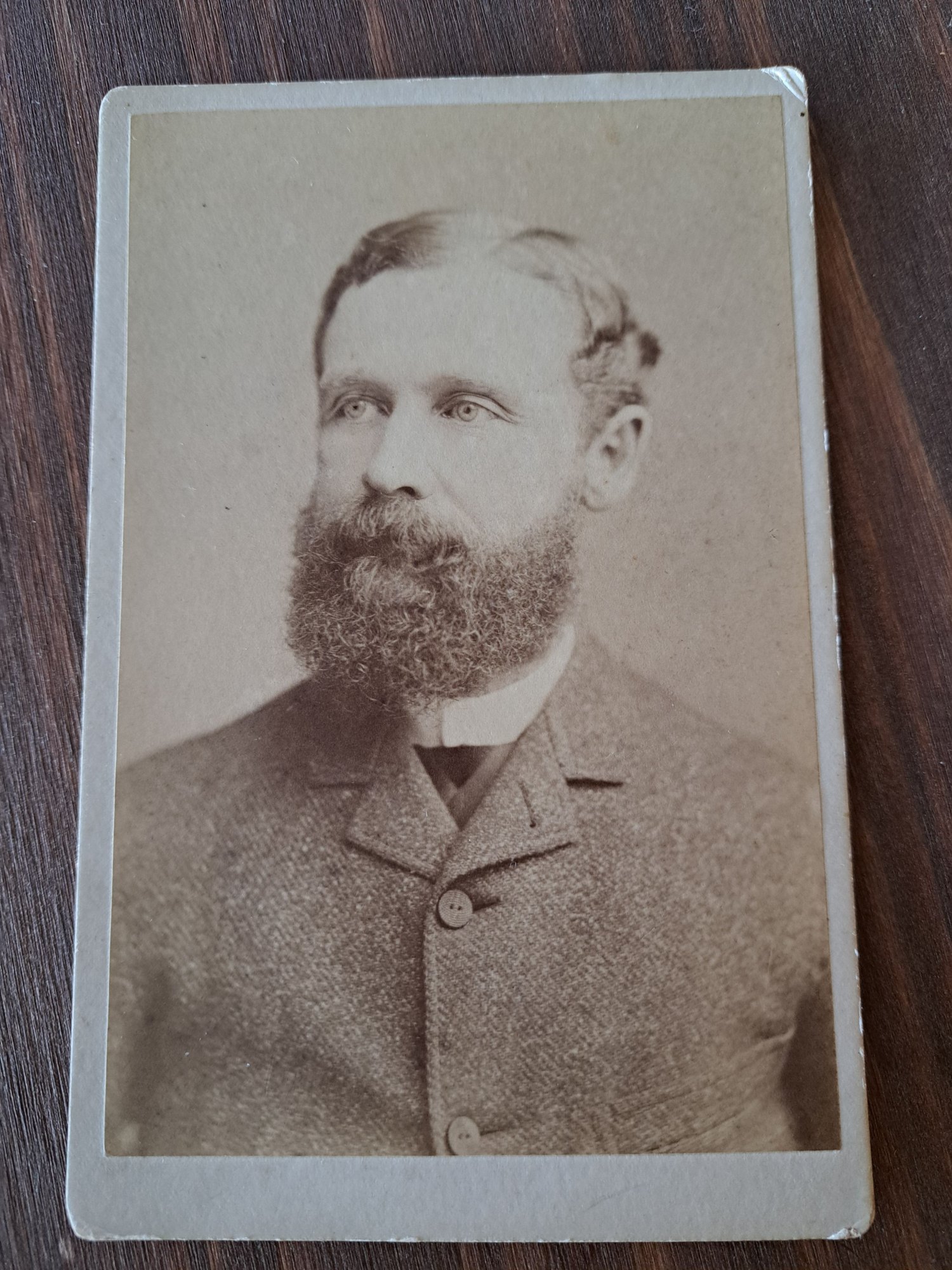
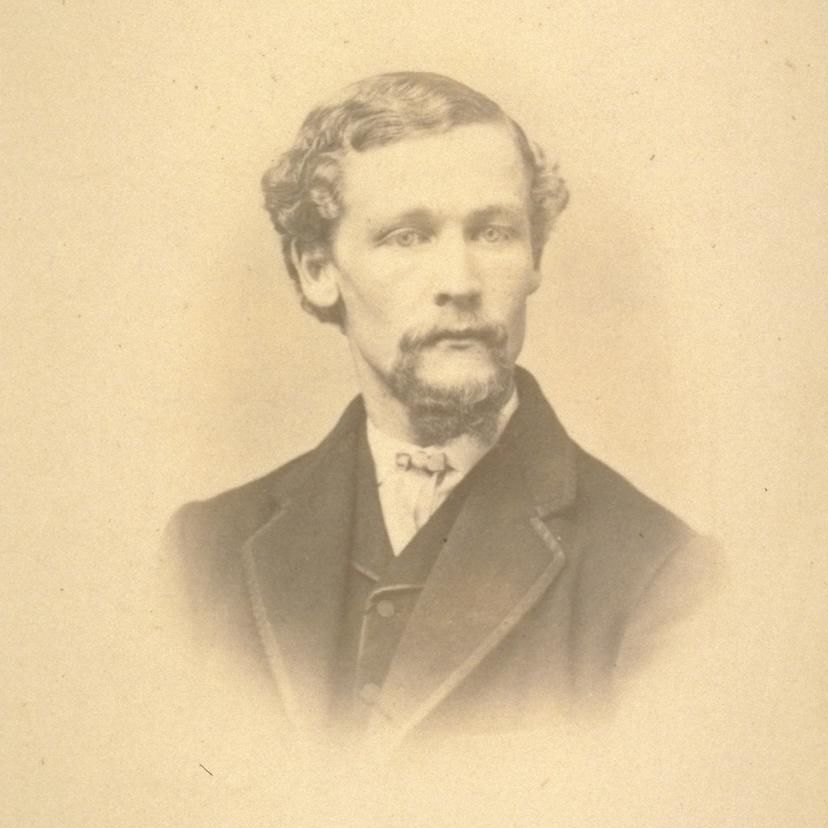
Two undated cabinet-card portraits survive: a fuller beard in one, a shorter beard and bow-tie cravat in the other. Neither is captioned on its front.
His brother's memoir
Ora Oak closed the 1906 register with a memoir of Henry (it ends the book on p. 84 with "FINIS"), and much of what is known of Henry's working life comes from it. Ora came to California himself "at his brother's suggestion, in January, 1872," worked for the Bancroft company and lived with Henry, "who had rooms on the library floor." Later he spent "the most of four years (1881-5) travelling in Mexico" as manager of the firm's Mexican department, and had "a personal interview with President Diaz" (register, page 83).
According to his brother, Henry paid for the library's output with his health. "It may be noted," Ora wrote, "that while Mr. Bancroft went to Mexico, to Europe and all over the United States, enjoying constant change and recreation, Mr. Oak remained at his desk, working from fourteen to sixteen hours a day," proofreading and directing the others by day and "writing his own portion of the manuscript at night, until overcome by insomnia, dyspepsia and nervous prostration, he was forced to leave the library, as soon as he had finished the History of California to 1849." To show who wrote that history, Ora printed Bancroft's letters to Henry: "You can go on and close up the volumes on California without sending me proof," one of several letters Ora prints about the California volumes, and, from 1876, "You have done the work, and it is no more than right the world should know it" (register, page 77).
In 1887, after Ora's first wife died, the brothers "journeyed together with a single horse, by slow stages," from San Luis Obispo to San Diego. "I had just buried my wife; he had left all that made life dear to him." Ora went home to Maine from San Diego, and later found in Henry's diary: "Ora has gone, and the trip will be lonely." Henry settled at Siegler's, in Lake County. Ora named his brother's greatest mistake as "not getting married": "When he came to California in 1866 he was engaged to a most estimable young lady. His ill health and 'bad luck' the first few years discouraged him, and he broke the engagement" (register, pages 83-84).
The Bancroft histories
When Henry took charge of Hubert Howe Bancroft's library in 1869 it held 16,000 volumes. In May 1870 it moved to the fifth floor of the Bancroft building at 721 Market Street, "in a room 35x170 feet," where "Mr. Oak also 'roomed'"; it grew past 50,000 volumes, moved in 1881 to 1538 Valencia Street, and was later sold to the University of California (register, page 73). Henry's autobiography, as Ora prints it, lists what he wrote of the thirty-nine-volume Bancroft Works. In The Native Races it names chapters on the "Columbians," "General View of Civilized Nations," "Aztec Picture-Writing" and "Maya Hieroglyphics," the entire volume of Antiquities, and chapters on Nahua annals and the earliest Maya records, "making in the Native Races 1597 pages out of a total of 4000." In the History of the Pacific States, a separate work, it names "seven and a half consecutive volumes on the annals of the Spanish Northwest": North Mexican States I, Arizona and New Mexico, California I-V and the first half of Northwest Coast I, with a few chapters elsewhere. "Mr. Oak's work as a writer is not acknowledged by Mr. Bancroft, though credit is given for his services as librarian and superintendent" (pages 71-72).
Ora makes the case with Bancroft's own words. In Literary Industries Bancroft wrote of him, "No one ever has known, or ever will know the early history of California or the Spanish Northwest as we knew it," a sentence Ora says was "Originally written as 'Oak knew it'" (p. 74). A Bancroft letter told Henry that the rest of the staff "will turn out three or four galleys a week, while you single-handed, with all your proof-reading, will do six" (p. 76). According to Ora, in eighteen years Henry "never asked for a raise in salary" and once, after a serious fire, "reduced his own salary" (p. 73); and Bancroft's will provided that Henry "should receive $10,000 and full authority in the library to complete the work in hand" if Bancroft died (p. 74). The two men split over method: "Mr. Bancroft strove for effect, Mr. Oak for facts... Mr. Oak insisted on absolute accuracy, and on this rock they finally split" (page 78). Fourteen years after he left the library (pp. 79-80), Henry asked Bancroft for the help he had been promised and printed the exchange in a pamphlet, Literary Industries in a New Light, of which "only a dozen or so were printed." Bancroft's reply, as Ora quotes it: "I doubt if authors are in the habit of giving their employees any credit at all." One bound set of Henry's historical writing went to Dartmouth College Library (page 80).
"A thorough Agnostic" and "essentially a Mugwump"
Henry described his own politics and religion in his autobiography, which Ora quotes. Of his politics: "from being a Republican he has become essentially a 'Mugwump,' taking a deep interest, but no active part, in the broader political questions of the day." Of his religion: "In religion he has long been a thorough Agnostic, yet in sympathy with any religious belief that helps men to be better" (register, page 82).
The 1903 sketch, "The Oaks of Garland," in Biographical Sketches of Representative Citizens of the State of Maine, tells the cabin-boy story — Nathaniel Oak's shipwreck and the lone survivor — without the wildcat, the bounty or the Bible note that other versions of the family story include.
Death and the niche at Oakland
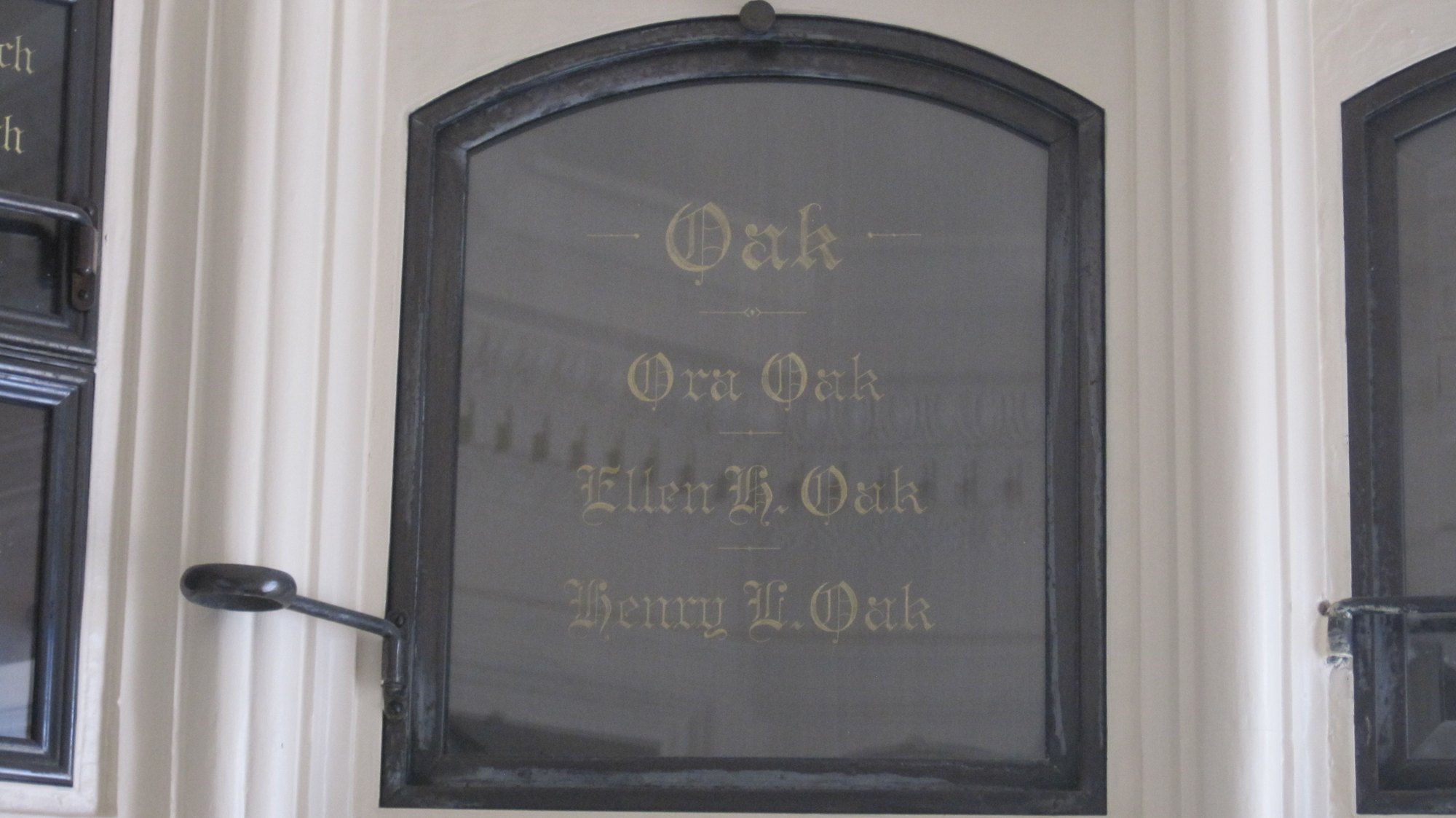
Henry Lebbeus Oak died May 20, 1905, at Siegler Springs. The San Francisco Call's notice gave his age as 62; by the register's birth date he was 61. His father, Lebbeus Oak, died at Garland a few days later: "four days" after Henry by his obituary, "three days after Henry's death" by Ora's memoir (p. 67). The obituary names two surviving brothers in California, Ora and Orman. Ora writes that he was "found dead on his bed, apparently having died suddenly and painlessly," and describes him: "about 5 feet 10 inches in height, weighing 160 to 165 pounds," with "blue eyes, light wavy hair and a thick curly beard, which he generally wore full" (p. 82). Henry's own autobiography ends: "He uses whiskey in moderation and tobacco to excess. If the Oaks of coming generations can find in his life any example to be carefully avoided they are welcome to the benefit, and his life will not have been lived altogether in vain" (p. 82). Ora attributed Henry's declining health and death to excessive tobacco use: his long evenings alone with "his open fire, his pipe, his books and his bitter memories, were too numerous, and excessive use of tobacco brought on rheumatism of chest and heart, and finally killed him" (p. 84). The register says his remains were cremated at the Oakland crematory and that "his ashes rest in the columbarium of that institution" (p. 82). Photographs of a niche plate in an Oakland columbarium, filed under the Chapel of Memories, read "Ora Oak / Ellen H. Oak / Henry L. Oak." The 1903 sketch identifies her: Ora married, second, on September 12, 1889, Ellen Hewitt, a daughter of the Rev. Enoch and Lucy (Beardslee) Hewitt, so Ellen H. Oak was Henry's sister-in-law.
Source: Find a Grave, memorial 41810366
Image details
Source: Find a Grave, memorial 41810366
Image details
A newspaper clipping under the heading "Oak—Oaks—Oakes" reports that Ora Oak took up publishing the family register after Henry's death, continuing it by branches, and names several descendants — Levi, Solomon, Abel, William and Lucy (Douty) Oak — who had settled in Piscataquis County, Maine. The 1906 register lists all five, children of Captain Jonathan Oaks and his fourth wife, Abigail Rand (p. 11), as of Sangerville, Piscataquis County (nos. 30-36, pp. 23-24), and says that "In 1806-8 several of them settled in Sangerville" (p. 13); Lucy married David Douty, and William was the Baptist elder William Oakes.
Source: Find a Grave, memorial 41810366
Image details
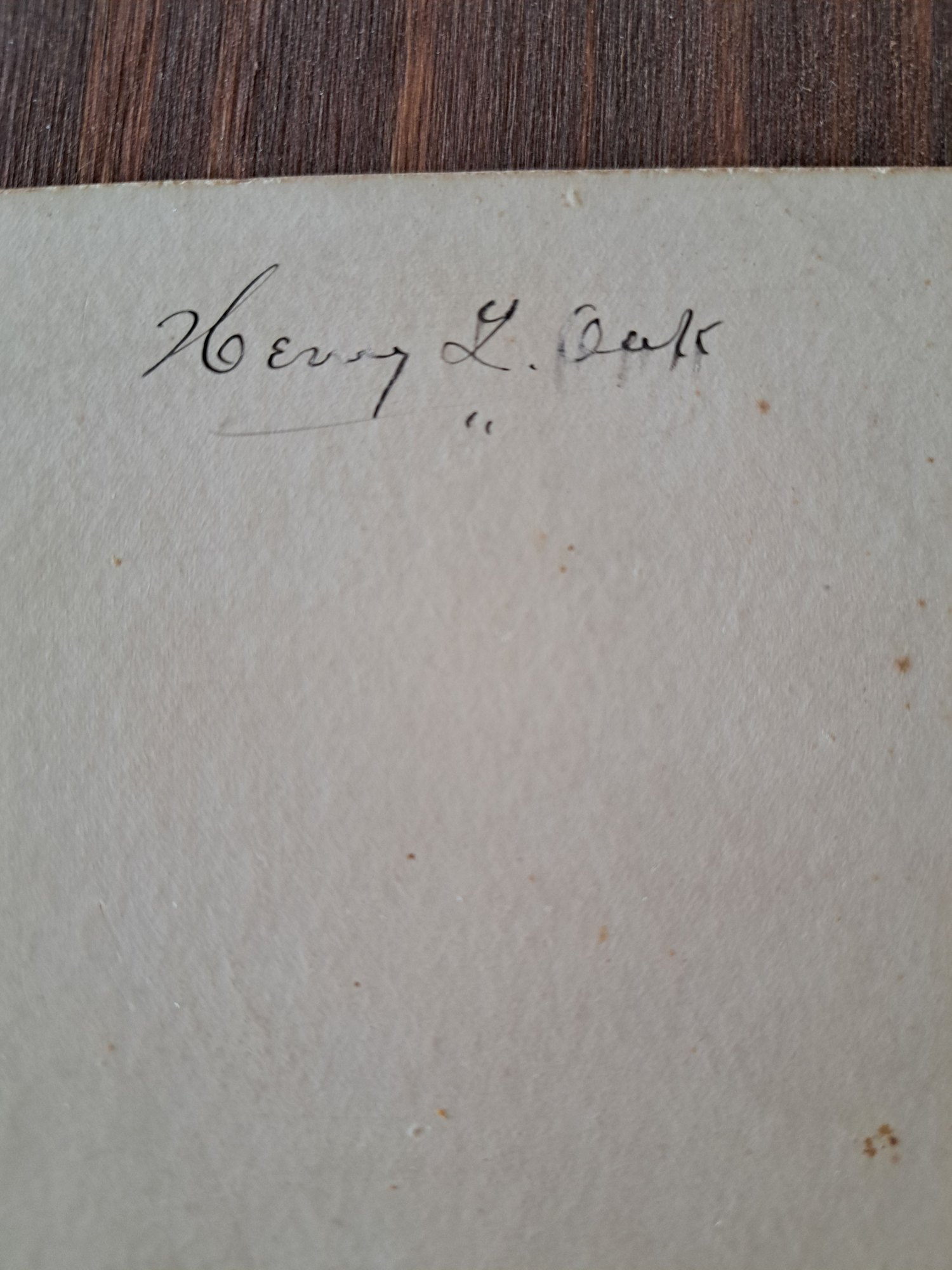
The back of one portrait card is inscribed "Henry L. Oak."
Why he made the register
Henry's preface says he began in 1891 because at Garland and Exeter, where his great-grandfather and grandfather had died, "there were but five of the name surviving, all in old age" (p. 3). He meant at first to print "a small pamphlet record" of his great-grandfather's family, but "the scope of the work was extended to include all descendants of our immigrant ancestor." Living in the mountains of California, he worked by letter and through paid searchers ("Searchers and copyists are by no means infallible"), and he thanked the family members who answered him, "especially to the older women of the tribe—most enthusiastic and helpful of all." He recorded the daughters' lines too, against the custom of the day: "The distinction between male and female lines is purely an artificial one, resulting from the custom of children taking the father's name" (register, pages 3-4). His introduction, which follows and is signed at Seigler Springs in March 1900, reckoned about 10,000 descendants through the immigrant's sons, perhaps 20,000 in all (p. 5), and named the Rev. Anson Titus of Tufts College as the most helpful of the experts he employed (p. 6).
How the manuscript survived
In 1900, after eight years' work and with no help from the family toward printing, Henry stopped (pp. 80-81). According to Ora, "he did not feel warranted in expending the necessary amount of money from his decreasing store, knowing that his earning capacity was gone, and fearing years of invalidism." "He had securely bound in morocco the four volumes of manuscript, three of photographs, and one of autographs," and bequeathed them to the New England Historic Genealogical Society, which "cheerfully and willingly loaned the volumes" to Ora for publication. After Henry's death Ora also found in his cottage "duplicate volumes, ready, or nearly so, for the printer," and "hundreds of letters and packages of data and notes of all sorts and kinds." Henry's letter of instructions, written a year before his death, told Ora to "take only what you want as relics for yourself or others of the family, but burn the rest." It added: "In case of doubt, burn." Ora's answer, in print: "I burned nothing" (register, page 81). Henry had left Ora the manuscript and part of his property, "and while he did not instruct or request me to publish it," Ora wrote, "I should feel guilty if I did not devote at least a part of his means to that end" (pp. 81-82).
Ora's own closing note in the 1906 register, signed at Cucamonga in November 1906, says what Henry left behind and how nearly it was destroyed. The manuscript "includes the most of the 5th, 6th and 7th generations and some data down to the 8th and 9th generation"; "the volume of autographs includes about 1000 names and the volume of photographs includes several hundred persons"; and a fourth volume, the "Collateral Pedigree," held "the names and genealogical information of 545 families with which the Oak tribe are intermarried." Ora wrote that had Henry been able to revise the final proofs he would have changed some of the wording: "He would also have avoided some of the errors which I have made through ignorance and inexperience in this line of work." Then the escape: "That the manuscript volumes were not destroyed by the earthquake and fire in San Francisco, in April, 1906, was because the administrator of Mr. Oaks' estate happened to keep them at his residence in Oakland instead of at his office in San Francisco, which with its contents was totally consumed." The printed book, Ora wrote, embraced "less than 250 out of the 10,000 recorded descendants" (register, pages 61-62). Much of it came by letter. One correspondent the register singles out is Araminta Page of Dexter, Maine, a daughter of the Baptist elder William Oakes of Sangerville: "Though an invalid, confined to her room for years by a malady of the eyes, she has taken the greatest interest in the family record, and has supplied a very large amount of information about members of several different branches" (p. 45). She had married Fred Page, an expressman, on November 26, 1863, "by Justice Lorenzo Oak," Lyndon's brother (no. 135, p. 45; 1903 sketch, pp. 194, 197).
A letter now in the Bancroft Library names the administrator and shows the volumes changing hands. On April 4, 1906, two weeks before the earthquake, Nathaniel Cushing Nash, treasurer of the New England Historic Genealogical Society, wrote from Boston to George R. Williams of East Oakland, "Executor of the will of Henry L. Oak," asking him to deliver to Ora Oak at Cucamonga the "genealogical records of 'the Oaks' in 8 bound volumes" that the late Henry Lebbeus Oak had left to the Society. Below the signature Ora wrote his receipt: "Received this day 5/24/06 from Geo R Williams the genealogical records of 'the Oaks' in 8 bound volumes, above mentioned." The executor was very probably the George R. Williams who went from Bowdoin to Dartmouth with Henry and nursed him at Petaluma in 1866, though the letter does not say so. The volumes went back to Boston after Ora had used them: the Society's accession record notes a bequest received on September 16, 1916, from the Henry Lebbeus Oak estate, and they are now its manuscript collection Mss 865. What became of the duplicate volumes and the letters and notes that Ora kept is still not known.
Sources
- "The Oaks of Garland," in Biographical Sketches of Representative Citizens of the State of Maine (Boston, 1903; American Series of Popular Biographies), pp. 193-199; Henry's own entry is on p. 197. No author is named on the sketch; Liston P. Evans's preface to the 1912 History of Garland credits Henry L. Oak with the article its Lyndon sketch was taken from. archive.org/details/biographicalsket00newe/page/n440/mode/1up
- H. L. Oak (comp.), Oak-Oaks-Oakes: Family Register (Los Angeles, 1906): Henry's preface, pp. 3-4, and introduction, pp. 5-6; Captain Jonathan Oaks's wives, p. 11; Captain Jonathan's family, p. 13 and nos. 30-36, pp. 23-24; Araminta Page, p. 45, and no. 135; Ora's closing note, pp. 61-62; and Ora Oak's memoir "Henry Lebbeus Oak," pp. 67-84, with the autobiography and Bancroft letters it prints. Public domain; browse it page by page.
- Lyndon Oak, History of Garland, Maine (Dover, Maine, 1912): Liston P. Evans's preface and "Brief Sketch of Author" by Henry L. Oak, pp. 3-4. archive.org/details/historyofgarland00oakl
- Nathaniel Cushing Nash, treasurer, New England Historic Genealogical Society, to George R. Williams, executor of the will of Henry L. Oak, Boston, April 4, 1906, with Ora Oak's receipt of May 24, 1906, on the lower margin: Henry Lebbeus Oak papers, BANC MSS C-B 386, Part III (estate correspondence of George R. Williams, 1906-1928), The Bancroft Library, University of California, Berkeley; reference copy supplied by the library, October 2026, which does not permit the images to be published. oac.cdlib.org/findaid/991043098469706532
- The Oaks 1686-1900, Mss 865, R. Stanton Avery Special Collections, New England Historic Genealogical Society: accession note, "Bequest received 16 September 1916 from Henry Lebbeus Oak Estate, Seigler Springs, Cal." (supplied by the Society's archivist, October 2026).
- Hubert Howe Bancroft, Literary Industries, and Henry L. Oak, Literary Industries in a New Light, as quoted in Ora Oak's memoir in the 1906 register.
- San Francisco Call, 23 May 1905, p. 14, death notice: "OAK—In Siegler Springs, May 20, 1905, Henry L. Oak, a native of Garland, Maine, aged 62 years." Library of Congress, Chronicling America, www.loc.gov/resource/sn85066387/1905-05-23/ed-1/?sp=14 (also California Digital Newspaper Collection, SFC19050523.2.134.2).
- History of Penobscot County, Maine (Cleveland: Williams, Chase & Co., 1882), p. 355: Lebbeus Oak's four children, "Henry L., unmarried; Ora ..."
- His obituary notice, a Maine newspaper's report beginning "Word was received last week from Ora Oak of California," and a newspaper clipping headed "Oak—Oaks—Oakes," both saved with his photographs and shared on Find a Grave (memorial 41810366); the newspapers that printed them are not yet identified. The two portraits, the inscription on the back of one portrait card, and the Oakland niche plate: the same memorial.