 American Acorns
Lyndon Oak of Garland
On February 26, 1844, on the ninth ballot of a contest that had run since the previous September, the voters of Garland and Exeter, Maine, which shared a seat, elected a twenty-seven-year-old Liberty party candidate from Garland to the state House of Representatives. Lyndon Oak drove to Augusta by horse and sleigh, a trip of "a part of two days," and took his seat that Thursday. He told the story himself, in the third person, in the history of Garland he spent his last years writing: "He believes himself to have been the first representative in the Legislature of Maine who was elected on the straight anti-slavery issue."
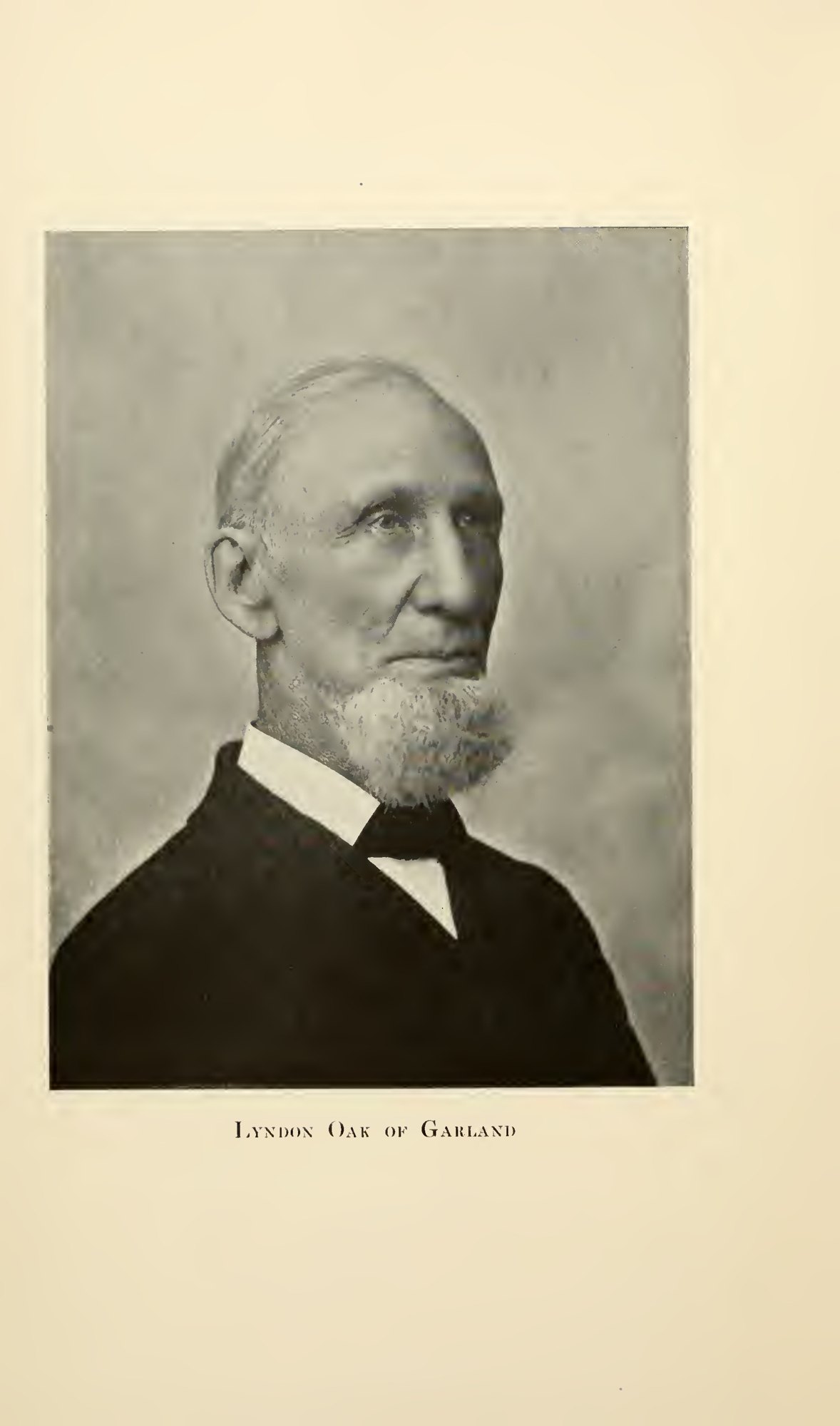
Source: Lyndon Oak, History of Garland, Maine (1912), frontispiece
Image details
Boscawen to Garland
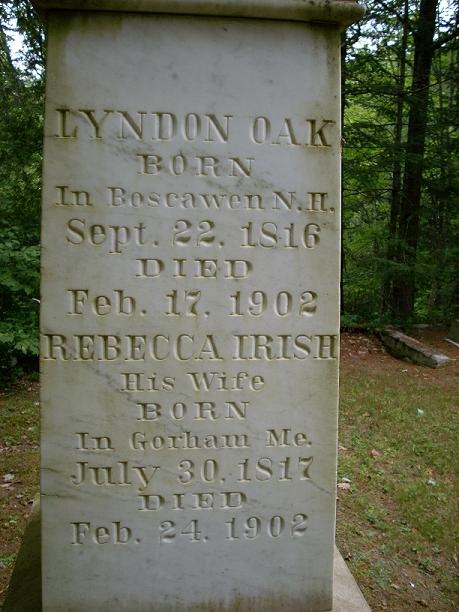
Lyndon was born at Boscawen, New Hampshire, on September 22, 1816 (his gravestone and his nephew's sketch; his own 1898 book gives the 21st), a son of Benjamin Hastings Oak, who kept a hotel there, and Hannah Smith. The family moved to Exeter, Maine, in 1826 and to Garland in 1830. Lyndon's history remembers the town's yearly protracted meetings, and one visiting preacher, the Rev. Jotham Sewall, "a man of large size and impressive personality": "The writer, then a boy of sixteen, was a listener to one of his sermons" (p. 346). A sketch of him by his nephew, Henry Lebbeus Oak, says he was "educated in the common schools and at Gorham Seminary, where he was subsequently a teacher for twelve years." He married Rebecca Chadbourne Irish of Gorham in September 1846, on the 1st by Henry's sketch or the 21st by his own book. She was a daughter of Gen. James Irish of Gorham and, Henry's sketch says, "a descendant in the eighth generation from Thomas Rogers who came over in the Mayflower in 1620." Her gravestone gives her birth as July 30, 1817; Henry's sketch and Lyndon's own book give September 21. They had three children: James H., born in Garland on October 4, 1849; John M., born June 16, 1851; and Grace Elizabeth, born June 1, 1858, who became Mrs. J. N. Parker.
The 1850 census at Garland lists him as "Lyndon Oake, 33," a boot and shoe merchant. Lyndon's history says that in 1846 Samuel S. Clark "entered into partnership with Lorenzo and Lyndon Oak, for the manufacture of boots and shoes, under the firm name of S. S. Clark & Co.," known for its lumbermen's boots, which they went on to sell wholesale to merchants in many towns of Penobscot, Piscataquis and other counties. The contract for Garland's new town house, voted in 1847 and finished in the summer of 1848, went "in due time" to the firm of "L. & L. Oak & Co." On the day of the 1848 tornado, the history says, "the writer, accompanied by a friend, was at Silver's Mills in Northeast Dexter, after a load of lumber for the Garland town house." Trees blown across the road stopped the team until "axemen soon came to our relief."
Henry's 1903 sketch follows the children. James Hastings Oak became a lumberman at Presque Isle, "one of the largest shippers of railroad ties and telegraph poles in Aroostook County"; widowed in 1894 with seven children, most of them young, he was praised for "the courage he has always shown in the up-hill fight," and his eldest sons, Lyndon and Walter, served in Companies H and K of the First Maine Infantry in the war with Spain. John Marshall Oak graduated from the Maine State College in 1873, was clerk and superintendent of schools in Garland, a travelling salesman and then a partner in Oak & Clark, clothiers of Bangor, and on October 1, 1898 was appointed postmaster of Bangor by President McKinley, reappointed by President Roosevelt in 1903; the sketch says he "can probably call more people by their names than any other man in Penobscot County." He is the John M. Oak who had his father's history printed. Grace Elizabeth married Jacob Nason Parker, a commercial traveller, on June 22, 1891.
The schools
"The first high school in Garland was opened under the instruction of Lyndon Oak, in the autumn of 1848, in the new town house which had just been completed." The town refused aid and no help could be expected from the state, so it ran on its pupils' fees, with a few villagers pledged to cover any deficit. Henry's sketch says Lyndon "personally guaranteed the salaries of the teachers for the next thirteen years"; the history, more modestly, says that over fifteen years the school drew "only five dollars upon private funds." Garland chose him for its school committee in 1838, 1839, 1840 and again in 1864, 1865 and 1867 (pp. 316-319), and as supervisor of schools from 1857 to 1860. On September 10, 1849, the day of the state election, the town named Lyndon, George Curtis and Samuel W. Knight "a committee to select a location for a cemetery, the site of which should be in convenient proximity to the village"; the result, the history says, was "the cemetery now known as 'Maple Grove Cemetery'" (p. 296).
He served for more than twenty years as a trustee of the Maine State College at Orono, now the University of Maine, and for several years as president of its board. Merritt C. Fernald, the college's first acting president and later its president, wrote a tribute for the end of the Garland history. He could not remember Lyndon missing a single trustees' meeting, though each meant "a carriage drive of not less than forty miles" and two or three days away from his business, without pay. He had kept Lyndon's letters and reread them: "there was not a line in them all which was not alike creditable to his head and to his heart." When a state law barring anyone past seventy from reappointment ended his service on the college board, the governor named him at once to the board of another state institution, which Fernald does not name.
His obituary in the Bangor Daily Commercial of February 19, 1902 quotes more of Fernald: Lyndon's first appointment as trustee was in 1867, his service ran twenty-one years to 1888 (in the tribute printed in the Garland history, Fernald says he retired "after three appointments for the period of seven years each," p. 387), he was for many years secretary of the board and for the last six its president, and in 1871, "if I recall the date correctly," he "devoted several months to work on the college campus, superintending building, and other operations then in progress." Fernald added that "a large and substantial brick building in the college campus, known as Oak Hall," already carried his name. The hall still does. The University of Maine says Oak Hall "is named after University Trustee Lyndon Oak"; the first building, "made from local clay bricks," burned in 1936 and was rebuilt, and it is a residence hall on the west side of the Orono campus today. The library's photograph of the fire dates it to January 1936. The Fogler Library's record of the photograph below calls the old hall the college's "first dormitory, built in 1871 from bricks of clay taken from the campus area," replaced after the fire "on the same site." That is the year Fernald remembered Lyndon spending months on the campus "superintending building," so the hall named for him may have been one of the buildings he oversaw, though neither source says so. The same obituary says Lyndon "served the state for six years as a trustee of the insane hospital at Augusta," which may be the board Fernald left unnamed.
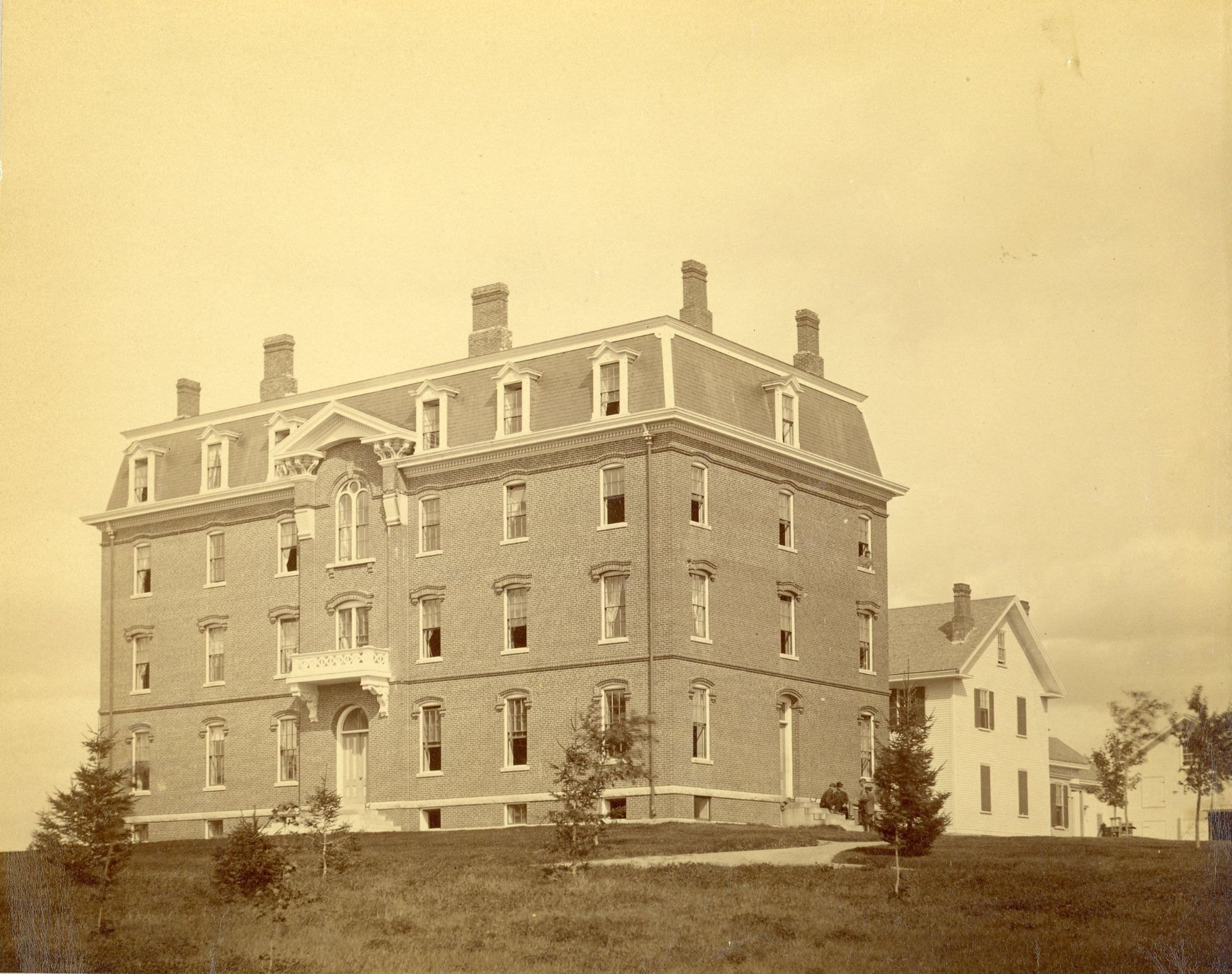
Source: Raymond H. Fogler Library Special Collections, University of Maine
Image details


The university also received his portrait. A photograph in the University of Maine's collections shows two framed oil paintings on easels, a woman standing beside each. The painting on the right, of a white-haired man with a white chin beard and a bow tie, matches the published photographs of Lyndon on this page. The other is his son John Marshall Oak (1851-1932), who graduated from the college in 1873, was the first president of its Penobscot Valley alumni association, and served as a trustee himself from 1908 to 1915. A note on the back of the photograph reads: "picture of Mrs. John Oak and Mrs. J.R./ Parker at time of presentation of portraits of John and Lyndon Oak to the 'Alumnus.'" Mrs. John Oak was John's widow, Jennie (West) Oak; John had died in September 1932. Mrs. Parker was very likely Lyndon's daughter Grace, who had married Jacob Nason Parker and appears as "Mrs. J. N. Parker" in the 1912 Garland history. The note does not say which woman is which. The university archives date the occasion: a 1934 folder of the president's office, filed as "John Marshall Oak Portrait," holds "Correspondence regarding the portrait of Lyndon Oak which went on display in the University Library during Arthur Andrew Hauck's tenure as University of Maine president."

The anti-slavery vote
Lyndon went back to the House in 1846, elected on the "Anti-Slavery" ticket at the third trial. He ran for the state Senate in 1855 and 1856. In the 1860s he was elected as a Republican, and the history records the moment he had waited twenty years for: "As a member of the House of Representatives of 1865, Mr. Oak had the satisfaction of voting for the ratification of the thirteenth amendment." When people had asked him "in a spirit of derision" when abolition would come, "his reply in substance was, that there might be a long period of waiting for the event, but it was sure to come."
A biographical sketch reprinted from the Bangor Whig and Courier while he was still living adds the politics. It says he was elected to the Senate in 1856, chaired the joint select committee on slavery and the committee on temperance, and in 1869 cast "the one deciding vote" for Hannibal Hamlin's election to the United States Senate. Henry's sketch says that in 1876 he let his name stand as an independent protest candidate for Congress, which "he regarded, as did his friends, as political suicide," and that in 1880 party leaders including Blaine, Hale, Hamlin and Dingley urged him to accept the Republican nomination for governor, which he declined "owing to personal and business interests." Mr. Blaine, Henry adds, insisted that "there would be magic in the historic name of Lyndon Oak of Garland."
The 1902 obituary tells the governorship story with a different year: in 1879, "at a time when the GreenBack movement in the state was at its height," party leaders "with Mr. Blaine at their head" offered him the nomination, which "promised to be a very expensive honor," and it went to Daniel F. Davis. It quotes an unnamed Bangor politician: "no man, not even making an exception in favor of the late James G. Blaine, was the power behind the appointment and election of more men to office than Mr. Oak," and "Mr. Oak always reminded me greatly of Abraham Lincoln." It also explains the Hamlin vote. In the fall of 1868 Lyndon withdrew his name from the state Senate convention because he "could only receive the nomination by pledging himself in advance for Mr. Hamlin." Elected to the House instead, he "threw the one deciding vote for Mr. Hamlin" anyway: "he objected to have his nomination as senator hinge upon a pledge."
The war reached Garland's purse too. When one of the town's quotas could be filled only if the government bounty were raised by a hundred dollars a man, "twenty of its citizens promptly pledged one hundred dollars each, and six others fifty dollars each to avoid a draft"; the list of subscribers begins "Lyndon Oak, $100" and includes "Edson L. Oak, 100," though "a subsequent act of the government relieved those patriotic citizens of the burden they had voluntarily offered to assume" (p. 384).
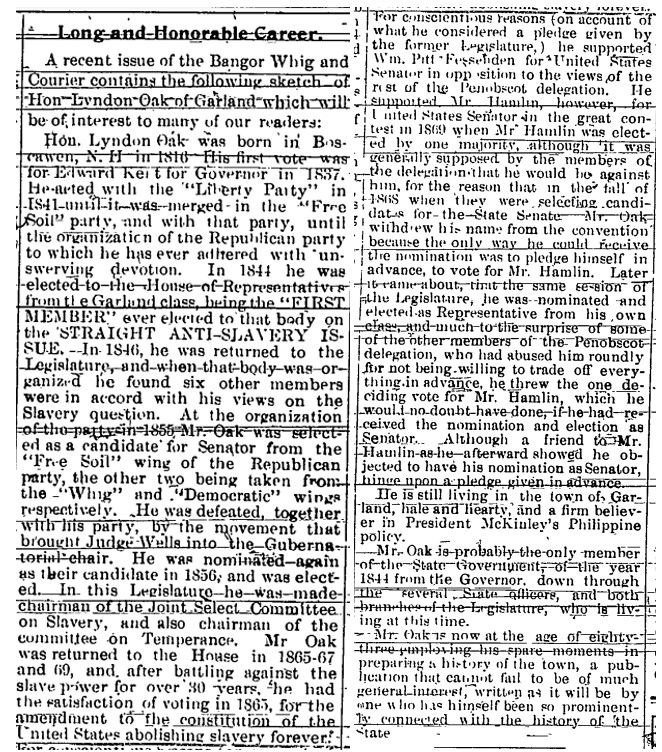
Source: Find a Grave, memorial 42365678
Image details
Town meetings and the ballot box
Garland's returns, printed year by year in Lyndon's own history, show how often the town turned to him. In September 1845 he took forty-five Garland votes for the legislature on the Anti-Slavery ticket; the first and second trials failed to elect, and "At the third trial, on October 20, Lyndon Oak was elected" (p. 286). He served on the 1847 committee appointed "to select and purchase a site in the village" for the town house (p. 289), was chosen moderator of the town meetings of March 12, 1849 and March 10, 1851 (pp. 295, 299), and in 1853 was one of three men appointed "to ascertain whether a suitable home for the residence of the poor could be procured at reasonable cost" (p. 302). In 1854 Garland gave him 134 votes for the legislature to 132 for Thomas K. Holt, but "Mr. Holt received a majority of the votes in the class" (p. 304). For the state Senate the town gave him 172 votes in 1855, when "The Democratic candidates were elected," and 194 in 1856 (pp. 305, 307). In the 1860s the margins widened: 208 to 111 in 1864, 206 to 101 in 1866 and 209 to 132 in 1868 (pp. 317, 319, 321).
The history and the end
He had published one book already. In 1898 Lee & Shepard of Boston printed his A Sketch of the Life of General James Irish of Gorham, Me., 1776-1863, a life of Rebecca's father, with a portrait of Lyndon himself and a genealogy of the Irish family that lists Rebecca, Lyndon and their children and grandchildren.
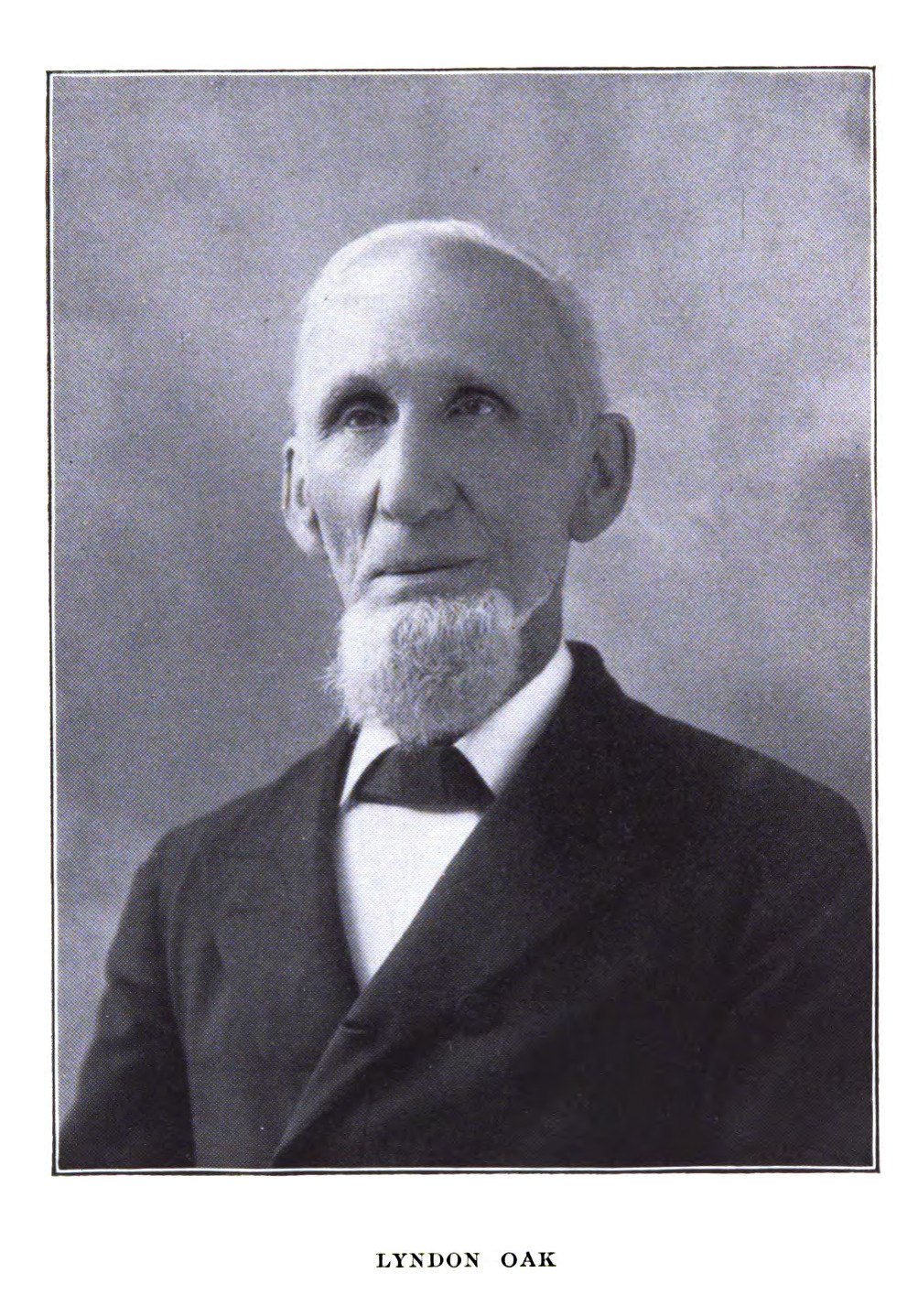
Source: Lyndon Oak, A Sketch of the Life of General James Irish (Boston, 1898)
Image details
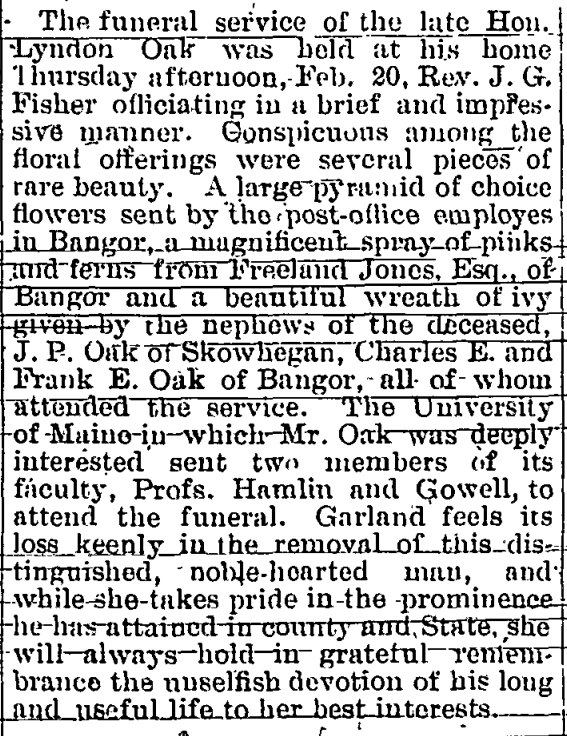
The Bangor sketch found him "hale and hearty" at eighty-three, "employing his spare moments in preparing a history of the town." He died at Garland on February 17, 1902, before it was finished. His wife Rebecca died a week later, on February 24. The funeral was held at his home on Thursday, February 20. Flowers came from the post-office employees in Bangor, and a wreath of ivy from his nephews J. P. Oak of Skowhegan and Charles E. and Frank E. Oak of Bangor, sons of his brother Edson (Joseph Prescott, Charles Edson and Frank Evans Oak, in the 1903 sketch); the University of Maine sent two professors, Hamlin and Gowell.
Source: Find a Grave, memorial 42365678
Image details
Source: Find a Grave, memorial 42365678
Image details
He built the history partly from memory. "In 1846, and the years immediately following, the writer was an occasional listener to stories of pioneer life in Garland from the lips of the pioneers" (p. 21). For the years 1802 to 1811 he could find no record, so "The material for the history of the nine eventful years that precede the incorporation of the town, is, therefore, of a traditional character" (p. 19). He named his informants, Deacon John S. Haskell and his sons and Moses Gordon and his sons, with "Special acknowledgements" to Moses G. Gordon "for much valuable information relating to the earliest inhabitants of the town" (p. 20). The printer, Liston P. Evans, remembered visiting him in his last years and being "greatly interested in the extracts which it gave him pleasure to read to me" (preface).
The manuscript passed to his son. "The manuscript came into the hands of John M. Oak of Bangor after the death of his father," the printer Liston P. Evans wrote in the preface, "and when he decided to have the history published," it was printed at Evans's office in Dover in 1912, edited by Ellen M. Haskell of Garland. Evans noted that much of what Lyndon had gathered on families and individuals was left as notes "the author had collected but did not live to extend," and could not be included.
The Lyndon Oak Memorial Library
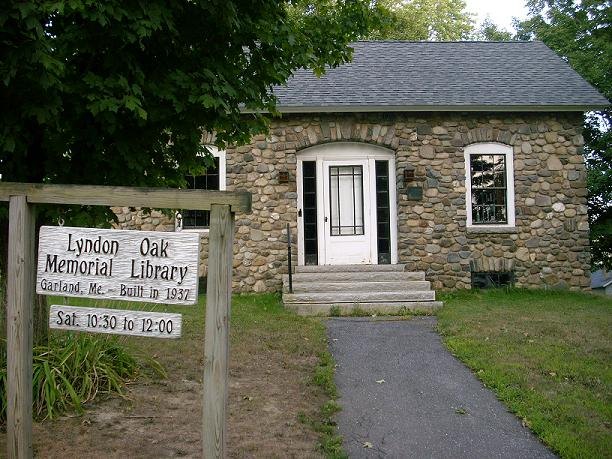
Garland's public library carries his name. It is a small fieldstone building on the Corinth Road, and its sign reads "Lyndon Oak Memorial Library, Garland, Me. - Built in 1937."
Source: Find a Grave, memorial 42365678
Image details
The Maine State Library's photographer John Kinkead Jones photographed it on May 16, 1988; the library's catalog describes it as "now closed." Its website, begun in 2012, gives Saturday-morning hours, 10:30 to noon, the hours painted under its sign, and carries a transcription of Lyndon's 1902 obituary. In September 2016 it announced plans to mark his birthday at Garland Days with a parade group, a book sale and an open house (Piscataquis Observer, September 7, 2016). The national public-library directory lists it at 20 Corinth Road, Garland, with about 8,000 volumes, serving the town's 1,088 residents.
The library itself answers the question of who built it. A story it wrote for Garland Days in 2004 calls it the little fieldstone library "built by John Oak in honor of his father." John Marshall Oak had died in September 1932, five years before the date on the sign, and the story does not say how the work went forward after his death. The library still keeps a section of books that were part of Lyndon's own collection, its secretary wrote to the family in October 2026.
That same Garland Days, on Saturday, September 11, 2004, the library welcomed one of Lyndon's descendants. Merle Oak, ninety-five and living in Brunswick (the library's announcement gave his age as ninety-four), a grandson of James Hastings Oak, came to Garland, walked in the parade behind the library's banner and stayed afterward at the library to meet the town. His life is told with his wife's, in Jessie Lawrence Oak, home demonstration agent.

His brothers in the town record
Lyndon's history names his brothers too. Lorenzo Oak was Garland's town clerk in most years from 1842 to 1853 and its treasurer in most years from 1844 to 1855, then a selectman from 1856 to 1860 and again in 1865, town agent in 1863 and tax collector in 1868 and 1869, and was chosen to the superintending school committee in 1842, 1843, 1844, 1847 (with his brother Edson) and 1851 (pp. 275-321); "L. Oak's store" serves the book as a landmark on the village roads, and he was for a time one of the occupants of the village's first store, "built in 1823 by Isaac Wheeler" (p. 208). Edson L. Oak served on the school committee in 1847, 1848 and 1863 and as town agent in 1861 and 1862. Lebbeus Oak, Henry's father, appears on the partial roll of the town's artillery company, formed in 1838. A "Nathaniel Oak of Exeter," probably their uncle, received eleven of Garland's votes for the legislature in 1823.
What is missing
The offices and votes come from Lyndon's own history of the town and from family sketches, not from the town's original records or the legislature's journals. Henry's sketch appears twice, in Biographical Sketches of Representative Citizens (1903) and, reworded, at the front of the 1912 history; quotations here follow the 1912 text. Lyndon's 1898 book gives September 21 for three dates: his own birth, Rebecca's and their wedding. The gravestone or Henry's sketch differs from it on each, and the sources here cannot settle which is right. The Bangor sketch is undated on the clipping, but it gives his age as eighty-three, which places it between September 1899 and September 1900. The "L. & L. Oak & Co." of the town-house contract is probably Lorenzo and Lyndon, but the book does not spell out the name. Henry's sketch dates the offer of the governorship to 1880 and the 1902 obituary to 1879. The obituary is known here from the library's transcription, not from the newspaper page. The library's 2004 account says John Oak built it, but John died in 1932, and no source here says how the 1937 building was paid for or carried out. The nephews at the funeral and Lyndon's children after 1912 have not been traced here.
Sources
- Lyndon Oak, History of Garland, Maine (Dover, Maine, 1912): preface by Liston P. Evans; "Brief Sketch of Author" by Henry L. Oak, pp. 3-4; pp. 132, 207, 256, 277, 279-280, 283, 286, 288, 290, 293, 295, 296, 300, 346, 384 and the town-meeting years 1838-1869; tribute by Merritt C. Fernald, pp. 385-387. Public domain. The scanned copy is Boston University Library's, the bequest of Emma L. Conant in memory of her husband Lewis S. Conant, 1951. archive.org/details/historyofgarland00oakl
- H. L. Oak, "The Oaks of Garland," in Biographical Sketches of Representative Citizens of the State of Maine (Boston, 1903), pp. 193-198. archive.org/details/biographicalsket00newe/page/n440/mode/1up
- Lyndon Oak, A Sketch of the Life of General James Irish of Gorham, Me., 1776-1863 (Boston: Lee & Shepard, 1898), portrait plate and the Irish genealogy, p. 68. Harvard College Library copy, digitized by Google.
- "Long and Honorable Career," biographical sketch reprinted from the Bangor Whig and Courier; funeral account, February 1902; both clippings shown above (Find a Grave, memorial 42365678).
- 1850 U.S. census, Garland, Penobscot County, Maine, dwelling 16.
- Gravestone of Lyndon and Rebecca Irish Oak, Evergreen Cemetery, Garland; Lyndon Oak Memorial Library sign; photographs shown above.
- "Hon. Lyndon Oak," obituary, Bangor Daily Commercial, February 19, 1902, p. 5, as transcribed on the Lyndon Oak Memorial Library's website. lyndonoakmemoriallibrary.wordpress.com/lyndon-oak/
- University of Maine Housing, "Oak Hall." umaine.edu/housing/residence-halls/oak-hall/
- "Oak Hall (Old)," photograph, undated (building 1871-1936), Raymond H. Fogler Library Special Collections, University of Maine; formerly DigitalCommons@UMaine, University Photographs no. 1737.
- "Oak Hall (Old)," photograph of the fire, January 1936, and "Oak Hall (New)," photograph, University Photographs, Raymond H. Fogler Library Special Collections, University of Maine; formerly DigitalCommons@UMaine univ_photos 1657 and 4050 (copies from the Internet Archive's Wayback Machine, 2022 captures).
- "Students - Early, folder 1," photograph with the note "picture of Mrs. John Oak and Mrs. J.R./ Parker at time of presentation of portraits of John and Lyndon Oak to the 'Alumnus,'" University Photographs (formerly DigitalCommons@UMaine univ_photos 4547), Raymond H. Fogler Library Special Collections, University of Maine; UMaine Digital Collections record 991048539014208681.
- "John Marshall Oak Portrait, 1934," Office of the President (University of Maine) Records, UA RG 0003.007.002, Box 175, Folder 1, Raymond H. Fogler Library University Archives. archives.library.umaine.edu/repositories/3/archival_objects/203697
- John Kinkead Jones, "Lyndon Oak Memorial Library, Garland, Maine," slide photograph, May 16, 1988, Maine State Library, JKJ-670. digitalmaine.com/jones_library_slides/1261
- Ellen Curtiss, "Lyndon Oak Memorial Library ready for Garland Days," Piscataquis Observer, September 7, 2016. observer-me.com/2016/09/07/around-the-region/lyndon-oak-memorial-library-ready-for-garland-days/
- Lyndon Oak Memorial Library, story for Garland Days, September 2004, on Merle Oak's visit, with the parade photograph; sent to the family by Mary Adams, secretary-treasurer, for the library's board, October 2026.
- Library Technology Guides (libraries.org), Lyndon Oak Memorial Library, record 19243 (data from the Institute of Museum and Library Services; record updated August 10, 2017). librarytechnology.org/library/19243