 American Acorns
The Lewiston Journal of April 29, 1899: what it says about Nathaniel Oak
On Saturday, April 29, 1899, the Illustrated Magazine Section of the Lewiston Journal ran a page headed in hand lettering "On Maine's Historic Ground." Its dateline is "Skowhegan, Me., April 29 (Special)," it carries no byline, and it opens: "Captain Jonathan Oak was a pioneer of Skowhegan. He was not a young man when he went there with his family in 1772." It is the earliest printing found of the shipwreck, sole-survivor, wildcat and sheep story of Nathaniel Oak, the Marlborough man the family calls the founder. Nearly nine months later, on January 26, 1900, the Vermont Phoenix printed its column about "Nathanael Oak, the cabin boy"; the 1903 sketch of the Oaks of Garland came four years after this page.
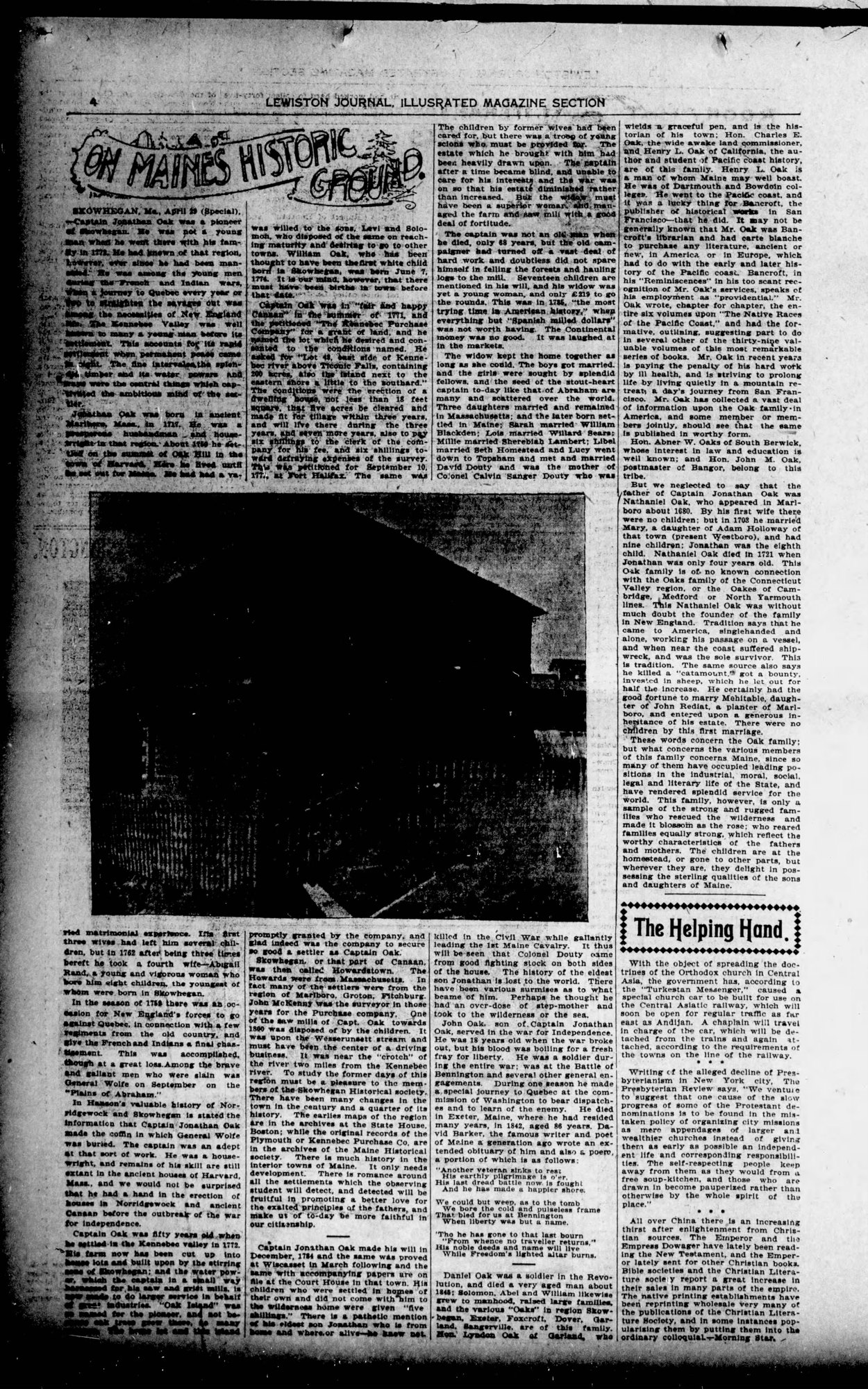
Source: Newspapers.com, full-page original download.
How it is shown: Complete image as saved; no crop, no retouch, no search highlight.
Keep in mind: Original page; see the Lewiston Journal page for the transcription of the Nathaniel paragraph.
Image details
Mostly about Captain Jonathan
The page is a local-history feature about the captain, not about Nathaniel. It follows Jonathan Oak from his birth "in ancient Marlboro, Mass., in 1717" to Oak Hill in Harvard "about 1750," then to Canaan on the Kennebec in 1772, with his petition of September 10, 1771 at Fort Halifax for "Lot 48, east side of Kennebec river above Ticonic Falls, containing 200 acres, also the island next to the eastern shore a little to the southard." It gives his four marriages, ending with Abigail Rand in 1762; says "Captain Jonathan Oak made his will in December, 1784 and the same was proved at Wiscasset in March following"; and traces the sons Levi and Solomon, the daughters' marriages and a grandson, Colonel Calvin Sanger Douty, killed commanding the 1st Maine Cavalry.
Much of it matches the records. The will of Jonathan Oaks of Canaan is dated December 2, 1784 and was proved on March 12, 1785; the inventory came to £219 11s 10d, and the page's "only 219 to go the rounds" agrees.
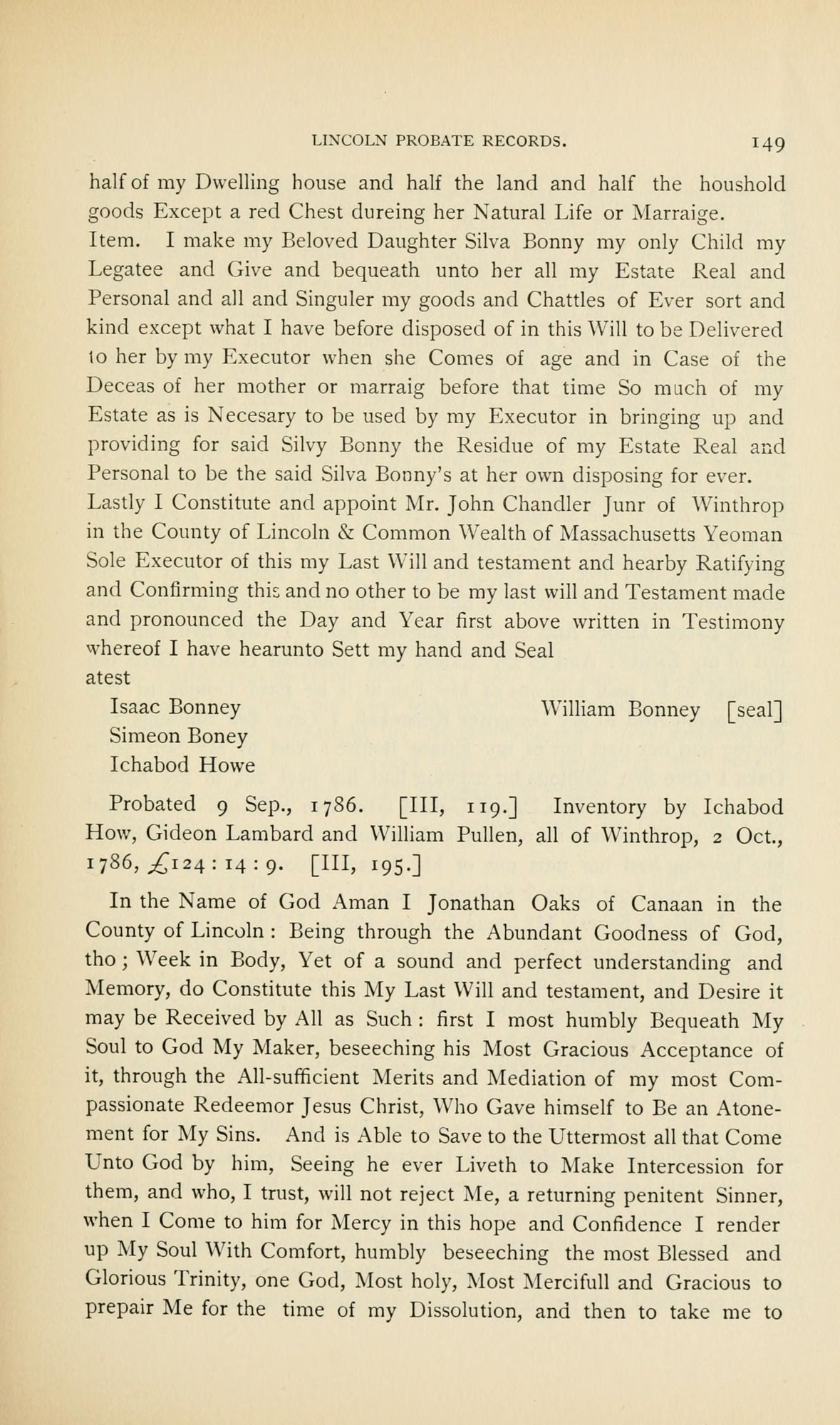
Source: Internet Archive (public-domain scan); probaterecordsof00main.
How it is shown: Complete page as scanned; no crop, no retouch.
Keep in mind: A printed abstract of the probate records, not the manuscript.
Image details
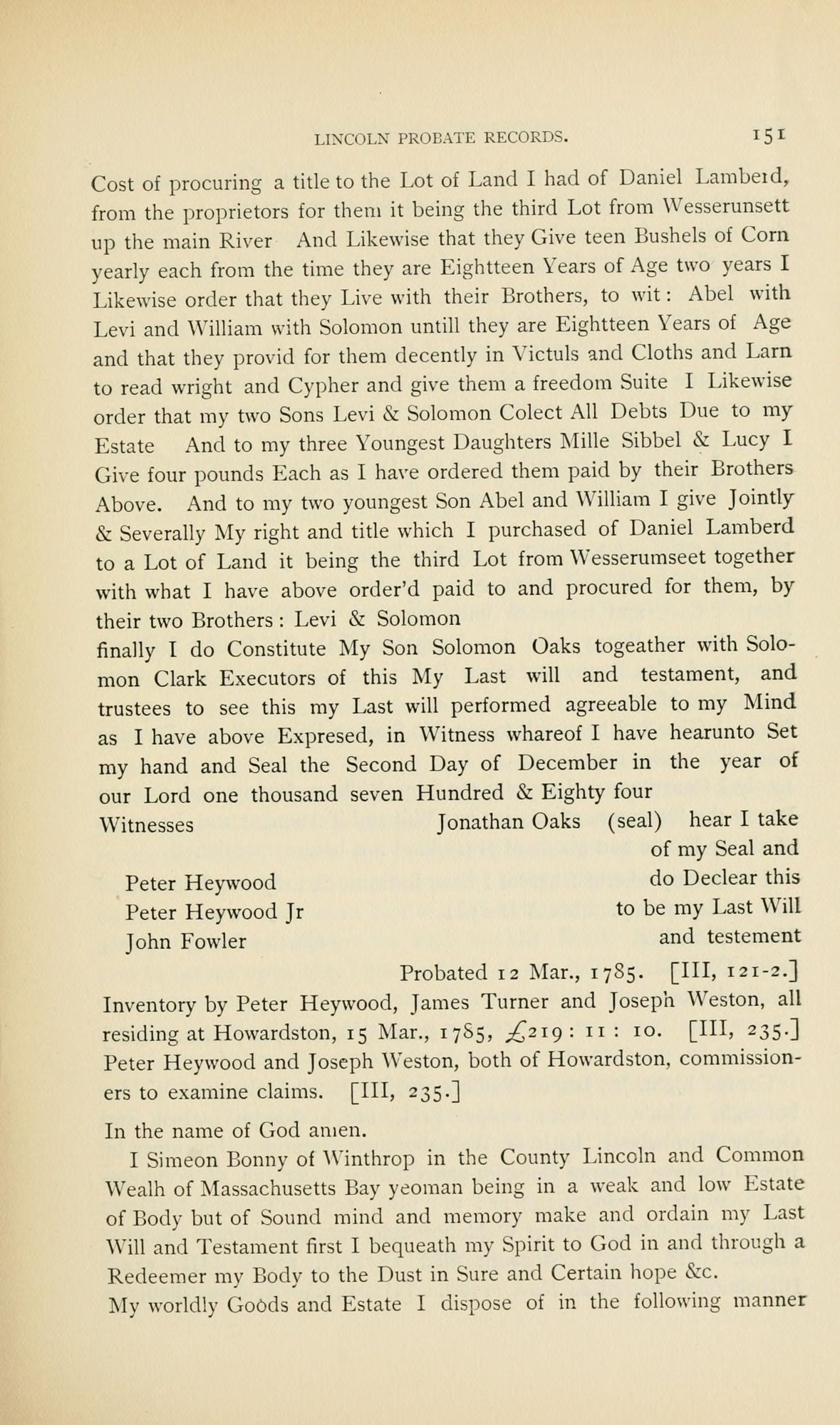
Source: Internet Archive (public-domain scan); probaterecordsof00main.
How it is shown: Complete page as scanned; no crop, no retouch.
Keep in mind: A printed abstract of the probate records, not the manuscript.
Image details
Jonathan was born at Marlborough on August 21, 1717, married Abigail Rand at Harvard on April 26, 1762, and a "Capt. Jonathan Oak" sat in the third seat when Harvard reseated its meeting-house in 1766. The will's "island a Little to the South of my Lot" matches the island the petition asked for. The captain's story explains why these records are probably his. The page counts "seventeen children" in the will, where the printed will names sixteen.
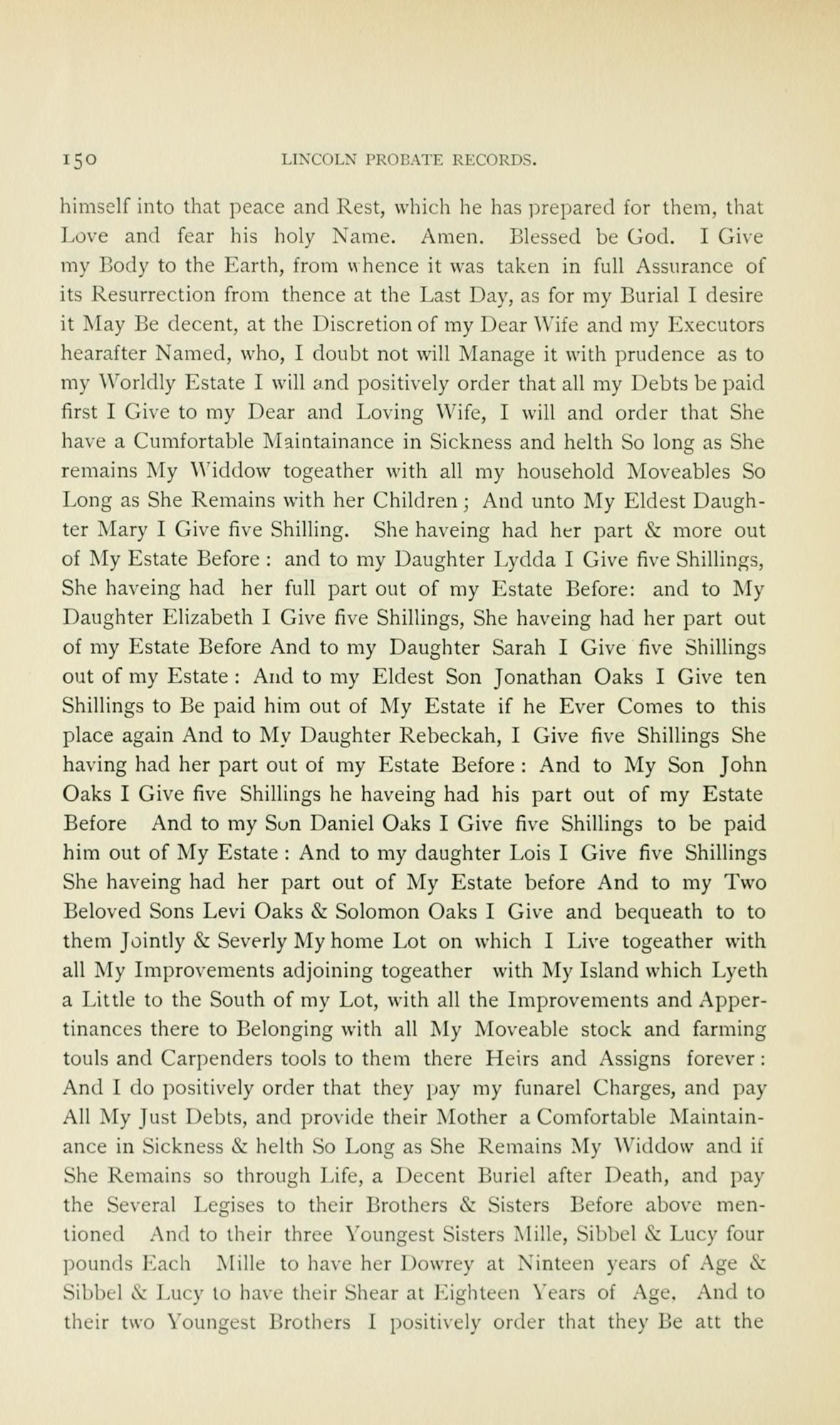
Source: Internet Archive (public-domain scan); probaterecordsof00main.
How it is shown: Complete page as scanned; no crop, no retouch.
Keep in mind: A printed abstract of the probate records, not the manuscript.
Image details
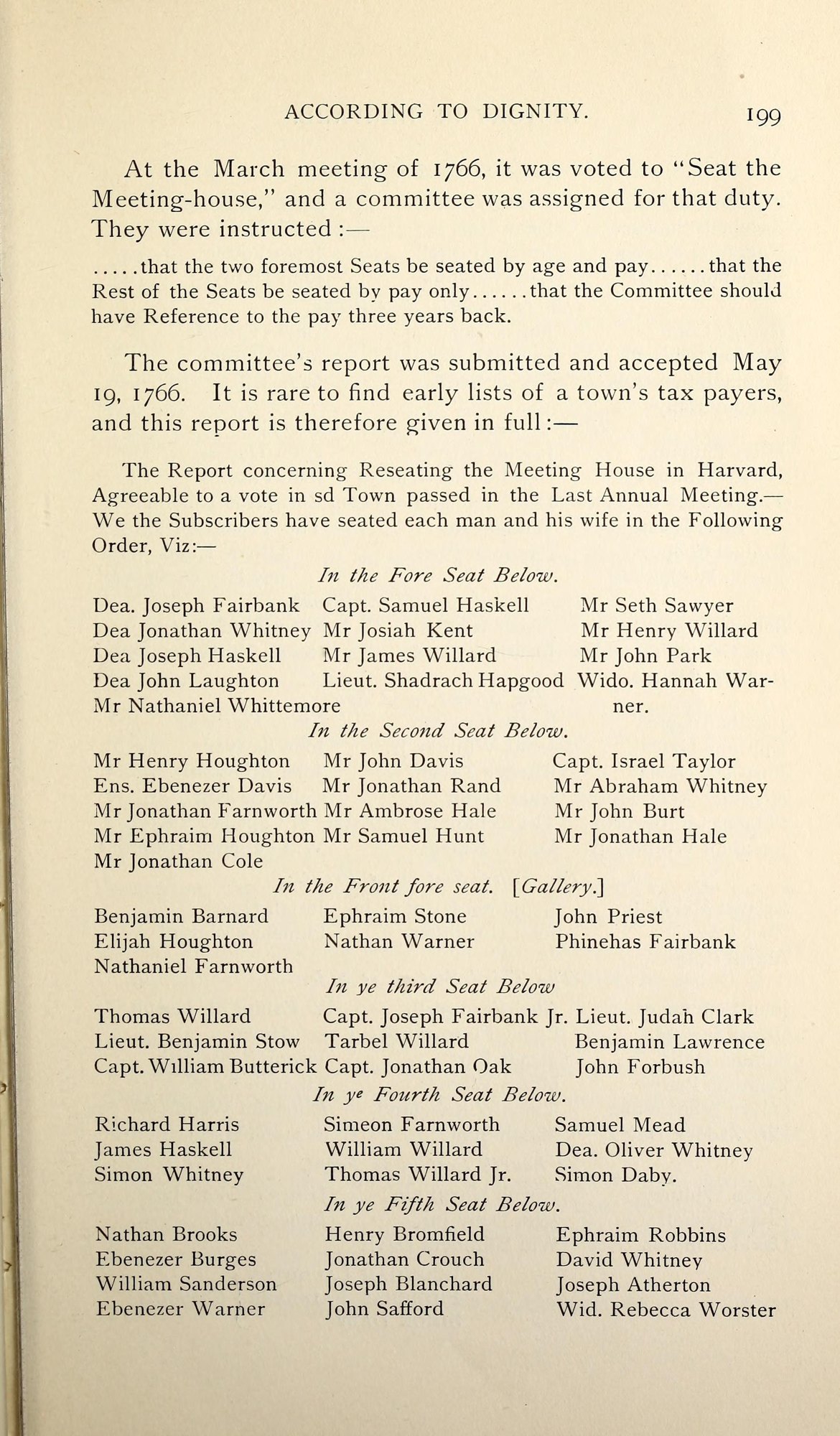
Source: Internet Archive (public-domain scan); historyoftownofh1732nour.
How it is shown: Complete page as scanned; no crop, no retouch, no search highlight.
Keep in mind: Confirmed. The seating reflects tax standing, not age; no other Oak name is on the page. Identification with Jonathan Oak b. 1717 of Marlborough rests on the Oak register (1906) and the tree's chain (Westborough, Stow, Harvard, Canaan), not on this page (Unconfirmed).
Image details
What it says about Nathaniel
The Nathaniel paragraphs come near the end, after a note on Henry L. Oak of California, Bancroft's librarian, who "has collected a vast deal of information upon the Oak family in America." They read:
"But we neglected to say that the father of Captain Jonathan Oak was Nathaniel Oak, who appeared in Marlboro about 1680. By his first wife there were no children; but in 1703 he married Mary, a daughter of Adam Holloway of that town (present Westboro), and had nine children; Jonathan was the eighth child. Nathaniel Oak died in 1721 when Jonathan was only four years old."
"Tradition says that he came to America, singlehanded and alone, working his passage on a vessel, and when near the coast suffered shipwreck, and was the sole survivor. This is tradition. The same source also says he killed a 'catamount,' got a bounty, invested in sheep, which he let out for half the increase. He certainly had the good fortune to marry Mehitable, daughter of John Rediat, a planter of Marlboro, and entered upon a generous inheritance of his estate. There were no children by this first marriage."
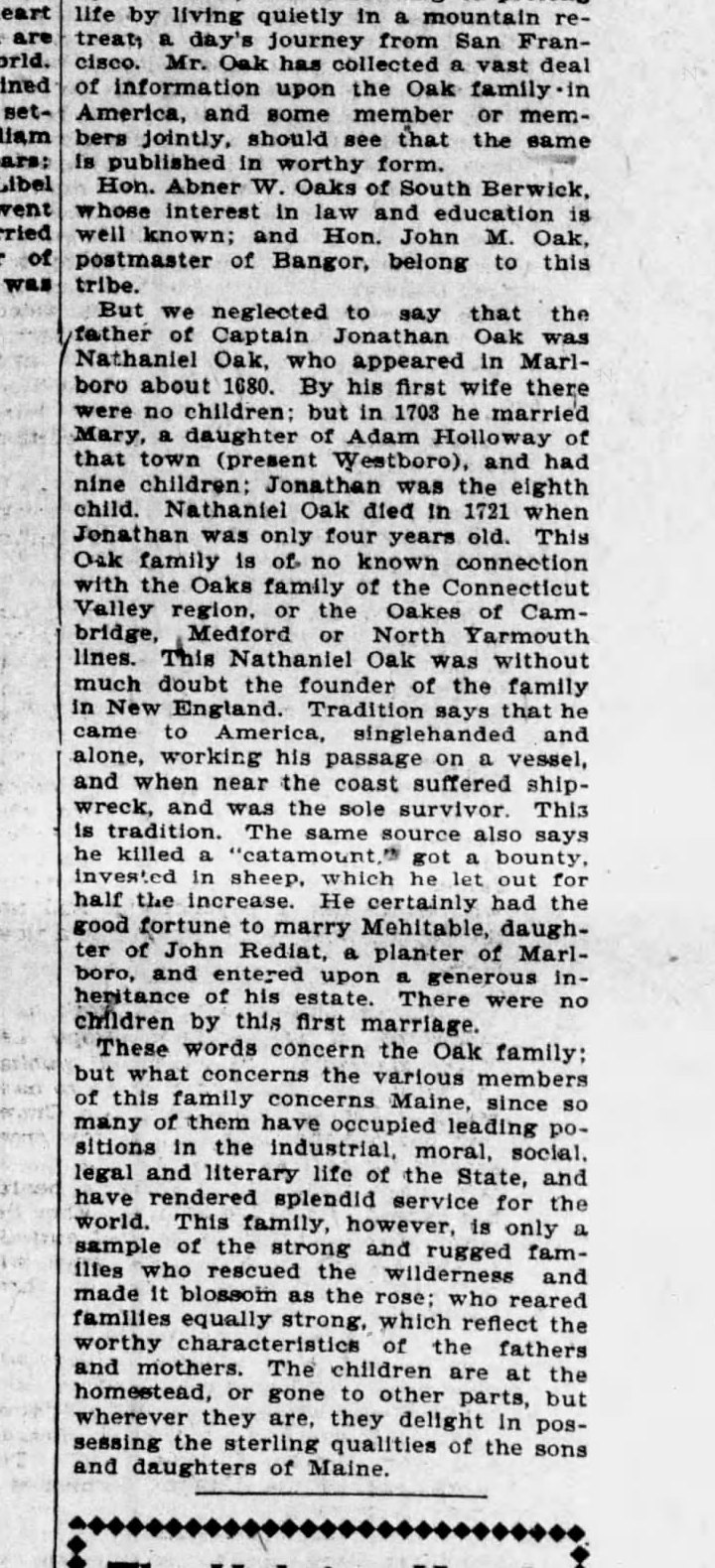
View transcription
Mr. Oak has collected a vast deal of information upon the Oak family in America, and some member or members jointly, should see that the same is published in worthy form.
Hon. Abner W. Oaks of South Berwick, whose interest in law and education is well known; and Hon. John M. Oak, postmaster of Bangor, belong to this tribe.
But we neglected to say that the father of Captain Jonathan Oak was Nathaniel Oak, who appeared in Marlboro about 1680. By his first wife there were no children; but in 1703 he married Mary, a daughter of Adam Holloway of that town (present Westboro), and had nine children; Jonathan was the eighth child. Nathaniel Oak died in 1721 when Jonathan was only four years old. This Oak family is of no known connection with the Oaks family of the Connecticut Valley region, or the Oakes of Cambridge, Medford or North Yarmouth lines. This Nathaniel Oak was without much doubt the founder of the family in New England. Tradition says that he came to America, singlehanded and alone, working his passage on a vessel, and when near the coast suffered shipwreck, and was the sole survivor. This is tradition. The same source also says he killed a "catamount," got a bounty, invested in sheep, which he let out for half the increase. He certainly had the good fortune to marry Mehitable, daughter of John Rediat, a planter of Marlboro, and entered upon a generous inheritance of his estate. There were no children by this first marriage.
These words concern the Oak family; but what concerns the various members of this family concerns Maine, since so many of them have occupied leading positions in the industrial, moral, social, legal and literary life of the State, and have rendered splendid service for the world. This family, however, is only a sample of the strong and rugged families who rescued the wilderness and made it blossom as the rose; who reared families equally strong, which reflect the worthy characteristics of the fathers and mothers. The children are at the homestead, or gone to other parts, but wherever they are, they delight in possessing the sterling qualities of the sons and daughters of Maine.
Transcribed from the page image: the last paragraphs of the article only, which begin in the same column with the passage about Henry L. Oak.
Matches and differences
The page agrees with the records on several parts of Nathaniel's life. His probate inventory places his death about February 17, 1720/21, though the day digit is unclear. Concord's town record dates his marriage to Mary Holloway "March ye 2d 1703," with the year form, 1702/3 or 1703/4, still unsettled. The records also establish her father's name as Adam Holloway. John Rediat's 1687 will names Nathaniel's first wife as "Mehitable, his d. w. of Nathaniel Oakes", and the Marlborough farm came down from Rediat's grant.
Other details differ. Mary was born at Concord, not at Marlborough or Westborough. Savage places Nathaniel at Marlborough in 1686, not "about 1680." The guardian's bond of February 1721/2 names eight children, and the Marlborough birth order does not make Jonathan the eighth. The writer had the right family but not every detail.
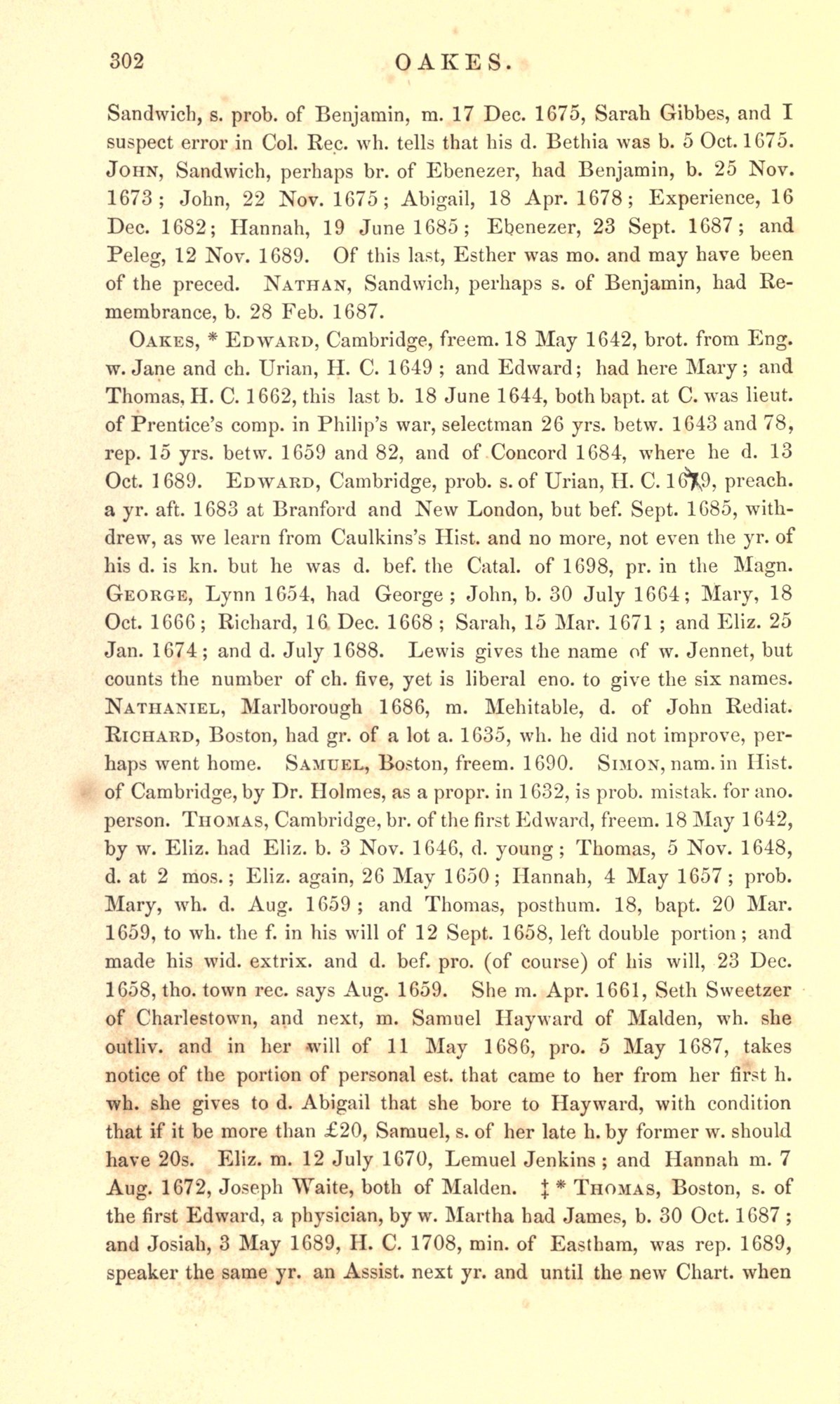
Source: Internet Archive (public-domain scan); genealogicaldic03savarich.
How it is shown: Complete page as scanned; no crop, no retouch, no search highlight.
Keep in mind: Confirmed. Savage does not say where Nathaniel came from. A secondary compilation (Savage's own digest).
Image details
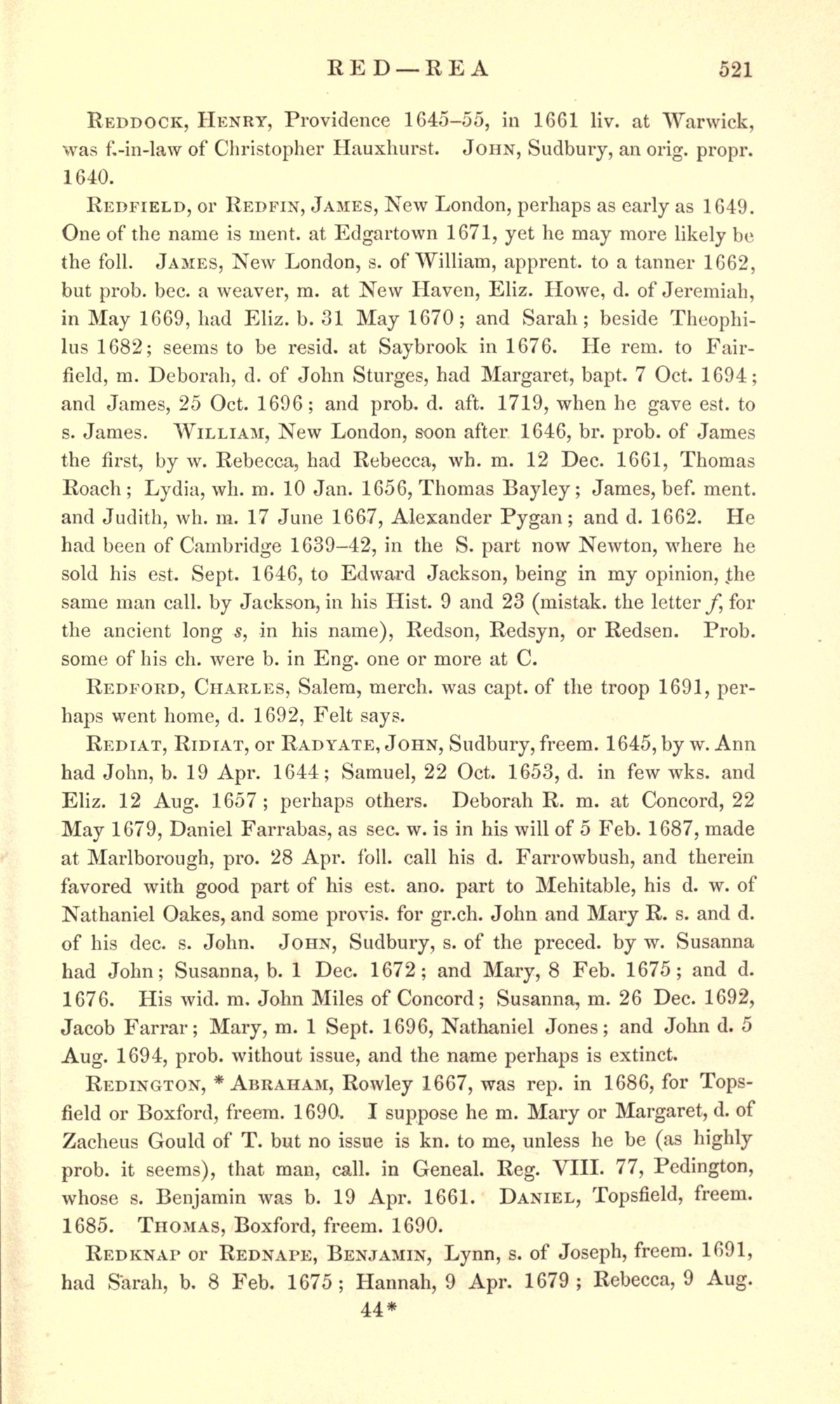
Source: Internet Archive (public-domain scan); genealogicaldic03savarich.
How it is shown: Complete page as scanned; no crop, no retouch, no search highlight.
Keep in mind: Confirmed. 'Mehitable, his d. w. of Nathaniel Oakes' is Savage's abbreviated paraphrase of the will, not its text; the will itself was not seen. Mehitable is not in Savage's list of John Rediat's children (John 1644, Samuel 1653, Eliz. 1657).
Image details
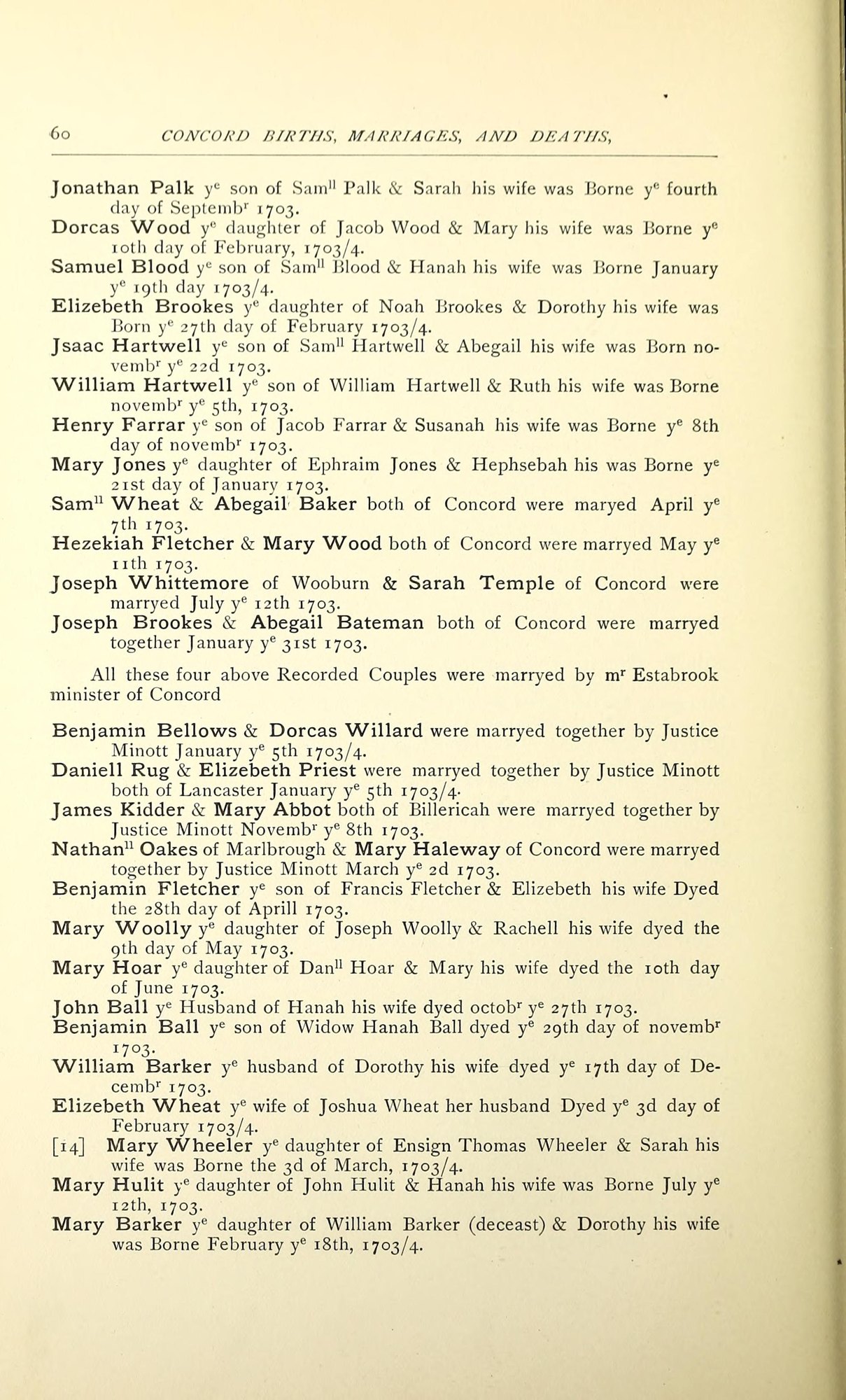
Source: Internet Archive (public-domain scan); concordmassachus1635conc.
How it is shown: Complete page as supplied; no crop, no retouch, no search highlight.
Keep in mind: A printed transcription of the town record, not the manuscript. Confirmed as printed: 2 Mar 1703 (the family register says 20 May 1703). The bride's surname is printed Haleway (Holloway).
Image details
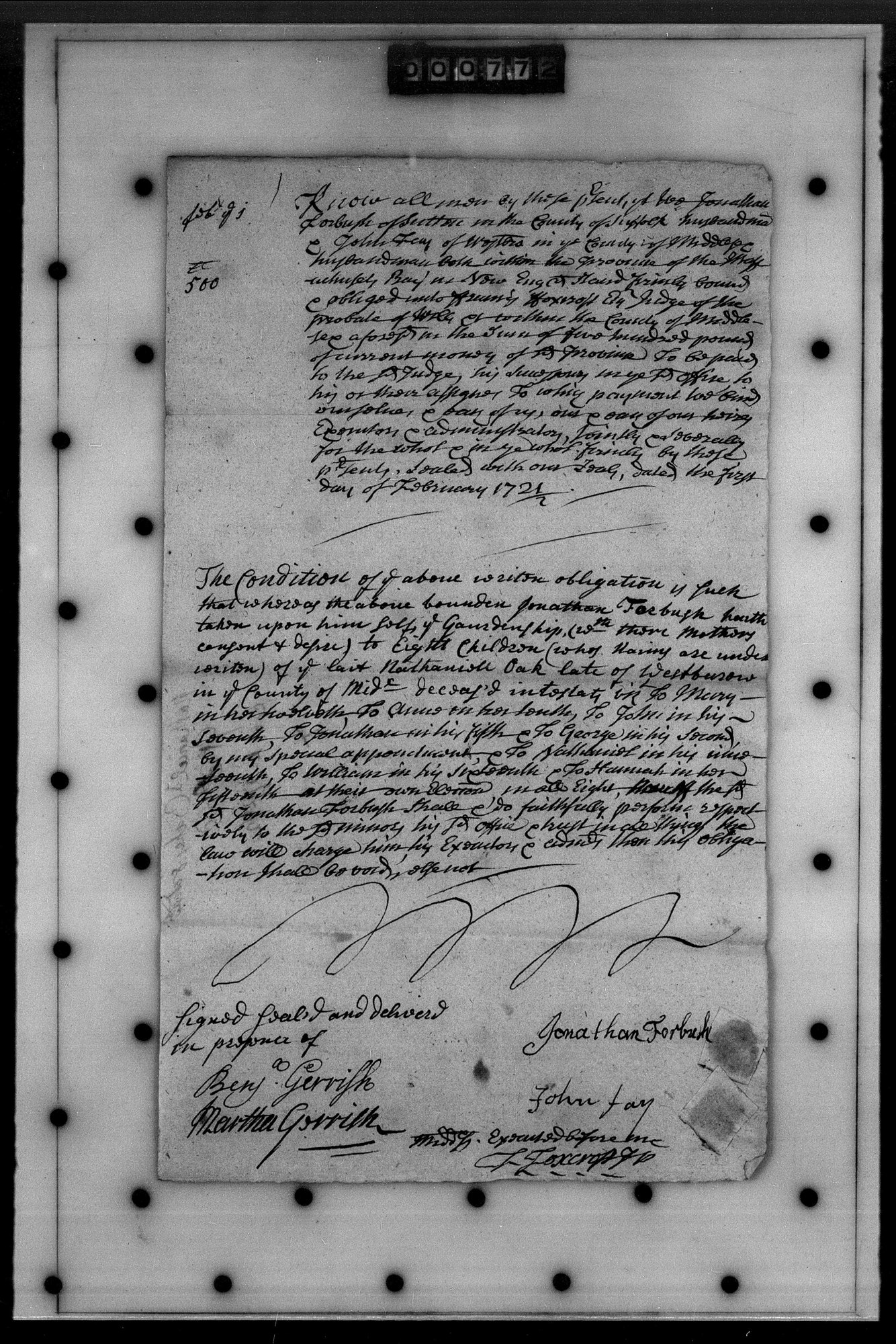
Source: FamilySearch, Probate records 1648-1924 (Middlesex County, Massachusetts), film 007553698, image 774.
How it is shown: Complete frame (original, unaltered); no crop, no retouch, no search highlight.
Keep in mind: Transcribed (frames 766-782); a first reading was made. Confirmed: the eight children and the ordinals for John (seventh), Jonathan (fifth) and George (second). Likely: Anne (tenth) and Hannah (fifteenth). Not reliably read: the ages for Mary, Nathaniel and William. Date and sum Likely. Tagging the eight to the tree's persons rests on the names and the 1906 register order (Likely).
Image details
What it does not say
It does not say "cabin boy." Later versions make Nathaniel a cabin boy; here he "worked his passage." It gives no year for the voyage, no name for the ship, no place for the wreck, and says nothing of Wales, a vow, an indenture, a family Bible or John Conant, whose note is the source of the longer story. It calls the account "tradition" twice and does not say whose.
Where "tradition" came from
The page names its sources for other things: Hanson's history of Norridgewock and Canaan for Captain Jonathan making Wolfe's coffin, the Skowhegan and Maine historical societies, and David Barker's obituary and poem for John Oak of Exeter. For Nathaniel it names none. The phrase "The same source" points to an account available to the writer, but does not establish that it was printed; the page names Henry L. Oak only as a man who had gathered much about the family. He may have been the source, but the page does not say so. The page's own details on Nathaniel's marriages and children are close enough to the records to suggest that its writer had a family account or papers beyond Hanson.
The next piece in time is the Lewiston Journal of December 30, 1899, which printed a sketch of Oak. It says he was "compiling a genealogy of his family," and does not mention Nathaniel.
The page's condition
The left column of the upper band is dark and damaged and is not transcribed.
Sources
- Lewiston Journal, Illustrated Magazine Section, April 29, 1899, p. 20, "On Maine's Historic Ground" (Newspapers.com, Sun-Journal).
- Lewiston Journal, December 30, 1899, p. 24, "Sons and Daughters of Maine".
- Will of Jonathan Oaks of Canaan: Patterson, Probate Records of Lincoln County, Maine (1895); Middlesex County probate case 16185 (death and guardian's bond of Nathaniel Oak); Vital Records of Marlborough, of Concord and of Harvard; John Rediat's will, 1687, as quoted by Savage.
The cabin-boy story's later history is on Nathaniel Oak and the cabin-boy story handed down; the Exeter son John is on John Oaks of Exeter; the searches are summarized on the research log.