American Acorns
Captain Jonathan Oaks: a carpenter from Marlborough to the Kennebec
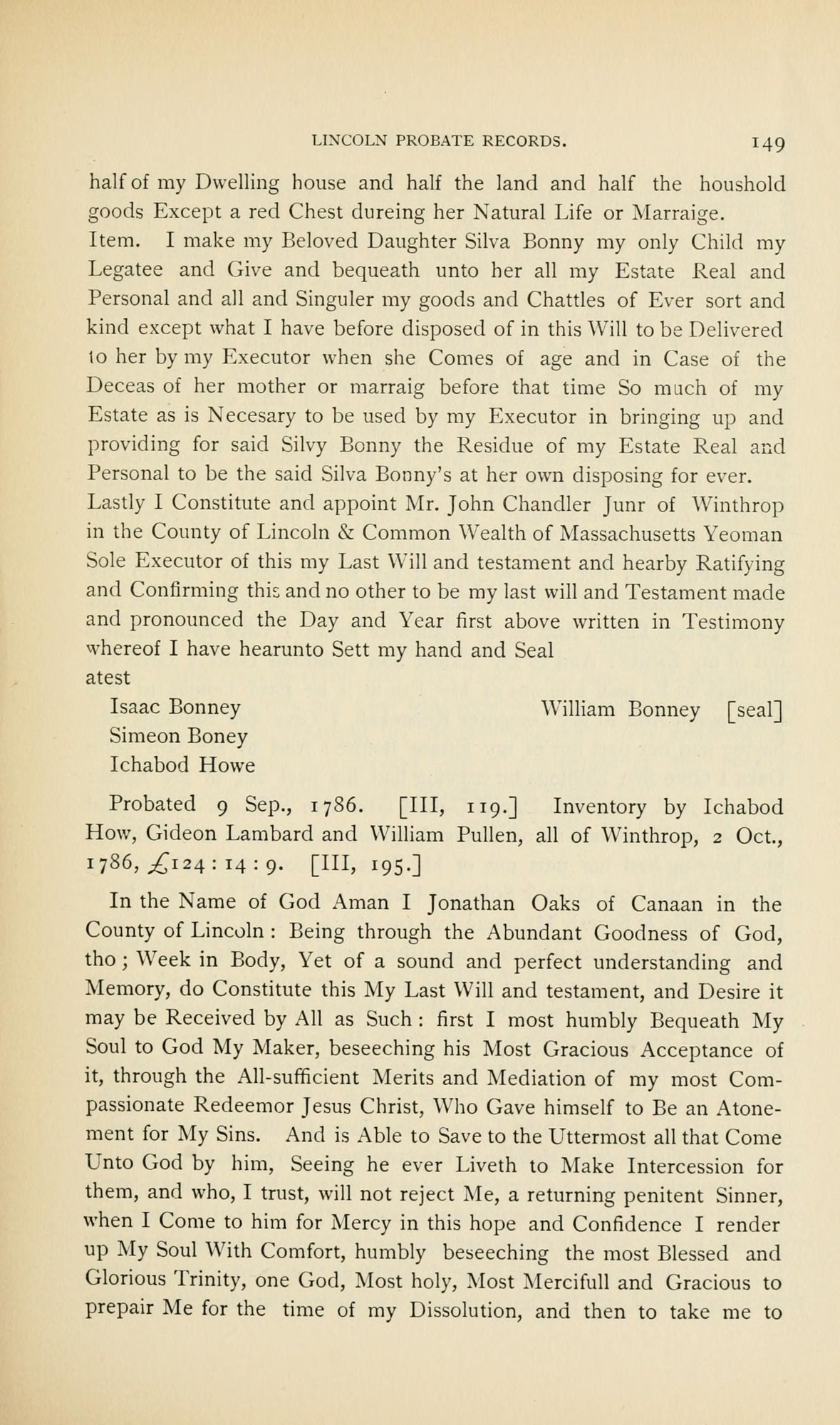
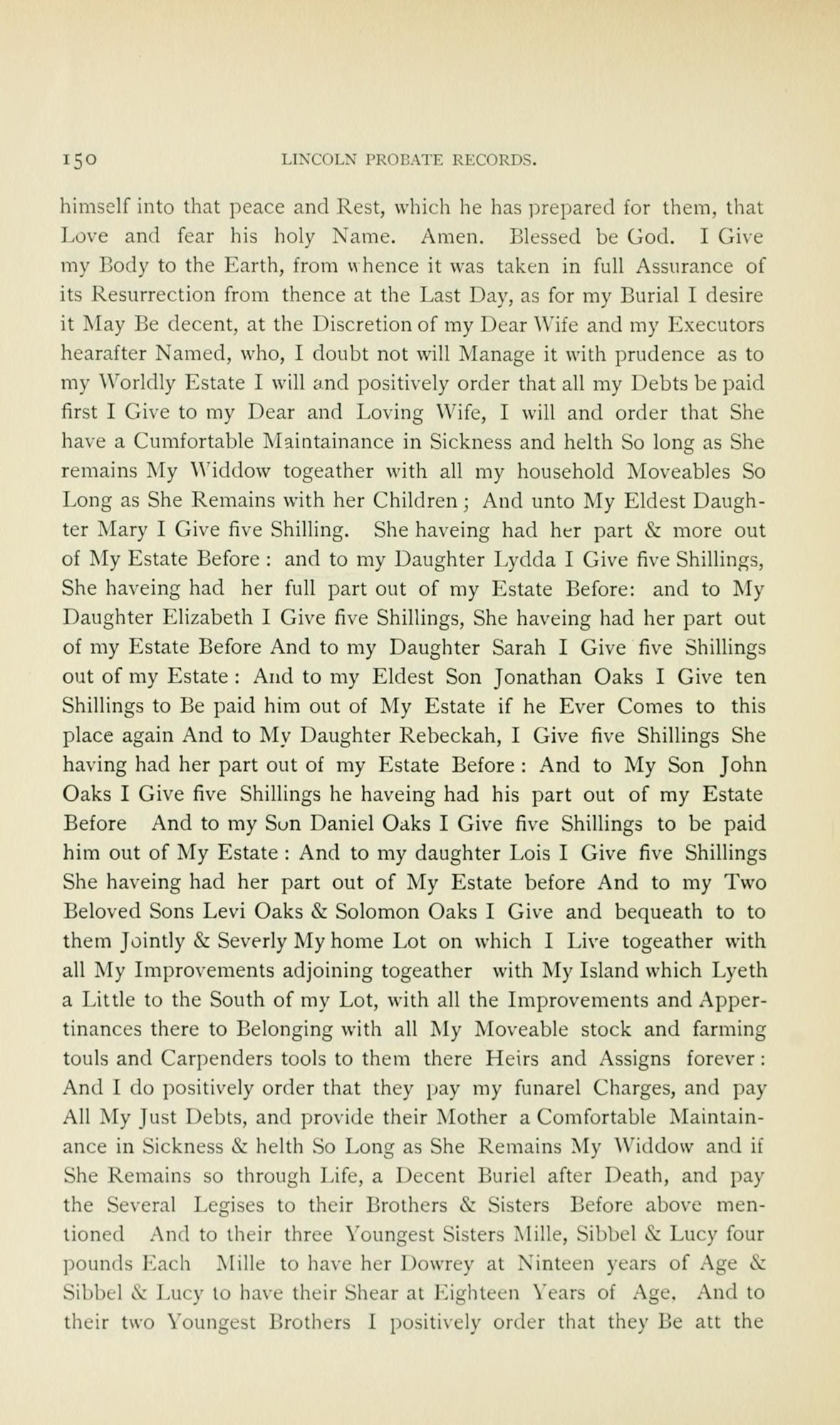
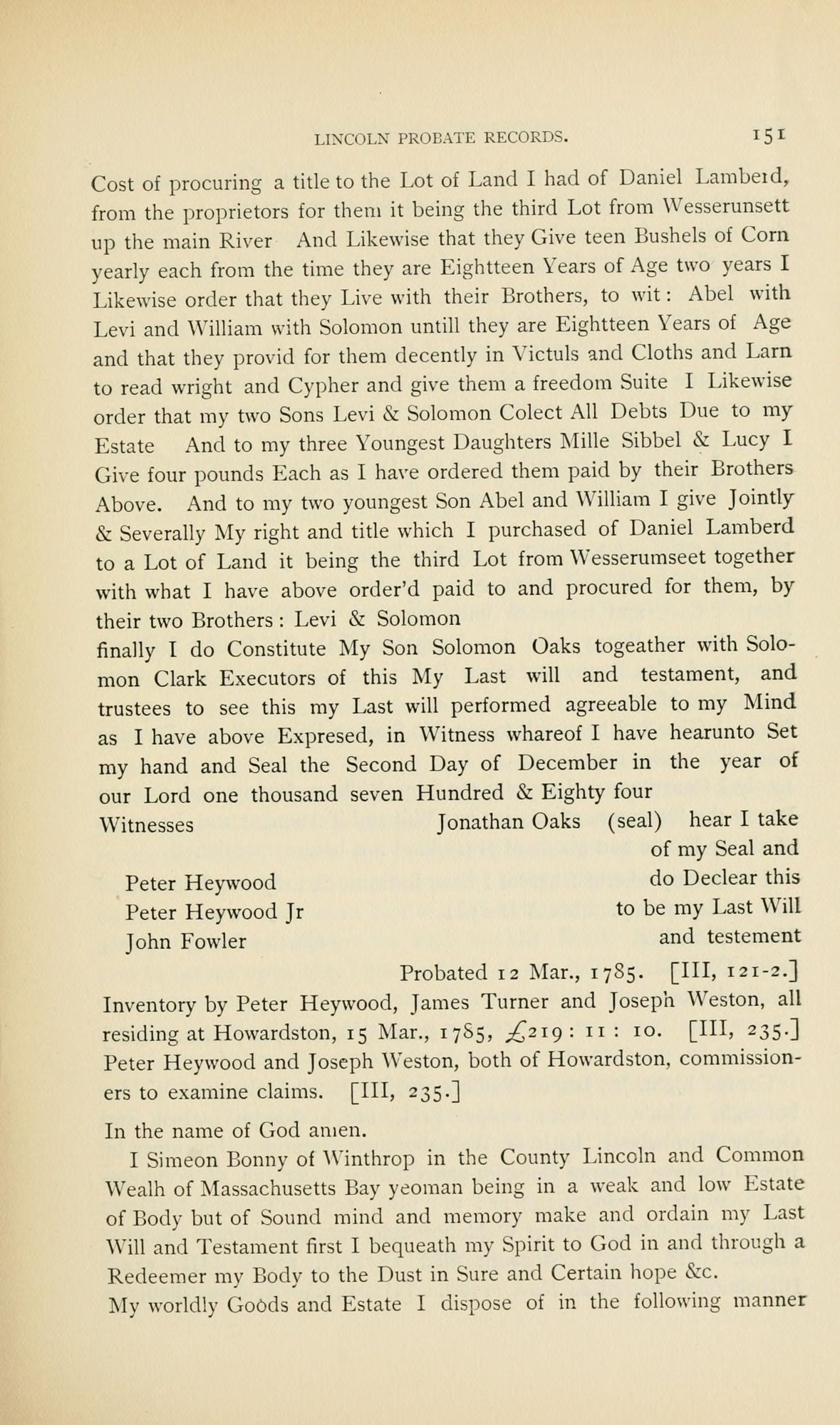
On December 2, 1784, Jonathan Oaks of Canaan, in what is now Maine, made his will. It names sixteen children, leaves most of them five shillings because they had "had their part out of my Estate Before," and gives his eldest son Jonathan ten shillings "if he Ever Comes to this place again." The will was proved on March 12, 1785, so he died within those three months. The probate record is the last document of a life that ran from Marlborough through Stow and Harvard to the Kennebec River, where a Massachusetts carpenter had moved his family.
Source: Internet Archive (public-domain scan); probaterecordsof00main.
How it is shown: Complete page as scanned; no crop, no retouch.
Keep in mind: A printed abstract of the probate records, not the manuscript.
Image details
What the will leaves, and to whom
Jonathan left his wife, whom it does not name, "a Cumfortable Maintainance in Sickness and helth" for as long as she remained his widow, with the household movables. His sons Levi and Solomon received the home lot "on which I Live," the island "a Little to the South of my Lot," the stock, the farming tools and "Carpenders tools." Solomon and Solomon Clark were executors. The two youngest sons, Abel and William, were to have a lot he bought of Daniel Lambeid, "the third Lot from Wesserunsett up the main River," and Levi and Solomon were to keep them until eighteen, see that they "Lam to read wright and Cypher" and give each "a freedom Suite." The three youngest daughters, Mille, Sibbel and Lucy, were to receive four pounds each. The inventory, made at Howardston on March 15, 1785 by Peter Heywood, James Turner and Joseph Weston, came to £219 11s 10d.
Source: Internet Archive (public-domain scan); probaterecordsof00main.
How it is shown: Complete page as scanned; no crop, no retouch.
Keep in mind: A printed abstract of the probate records, not the manuscript.
Image details
Source: Internet Archive (public-domain scan); probaterecordsof00main.
How it is shown: Complete page as scanned; no crop, no retouch.
Keep in mind: A printed abstract of the probate records, not the manuscript.
Image details
Marlborough, Stow and Harvard
Jonathan was born at Marlborough on August 21, 1717, the son of Nathaniel and Mary Oake. In August 1732, as "a minor aged about fifteen years son of Nathaniel Oak late of Westborough," he chose Jonathan Forbush as his guardian. He is probably the Jonathan Oak later found in Stow, Harvard and Canaan. The dates, the trade, the move to the Kennebec and the children all match, though no single record calls him "Jonathan Oaks of Harvard, son of Nathaniel."
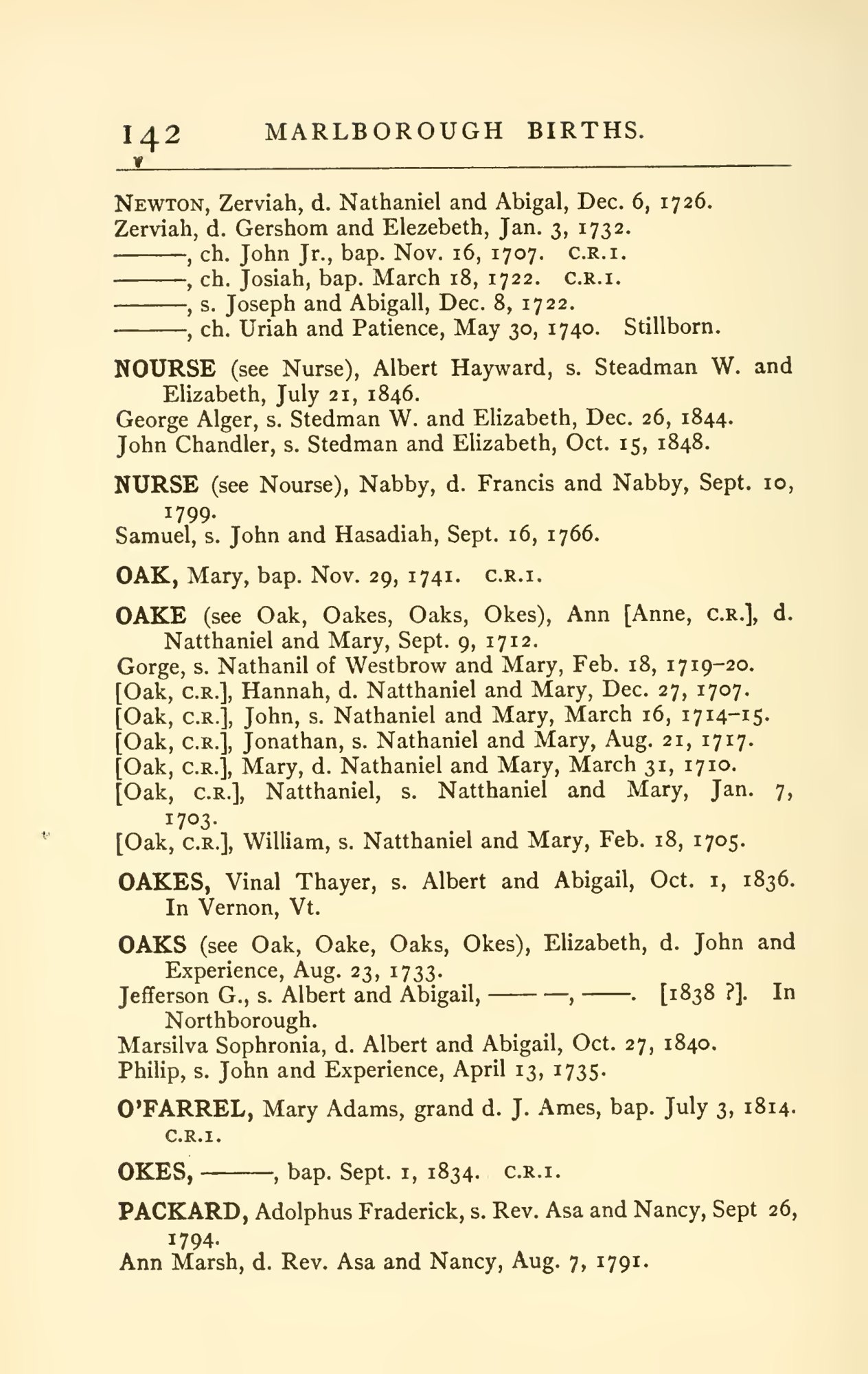
Source: Vital Records of Marlborough (NEHGS, 1908); Internet Archive (public domain)
How it is shown: Complete page as supplied; no crop, no retouch, no search highlight.
Keep in mind: What the page says: Confirmed from the page image, with the dates as printed: Ann, d. Natthaniel and Mary, Sept. 9, 1712; Gorge, s. Nathanil of Westbrow and Mary, Feb. 18, 1719-20; Hannah, Dec. 27, 1707; John, March 16, 1714-15; Jonathan, Aug. 21, 1717; Mary, March 31, 1710; Natthaniel, Jan. 7, 1703 (the year is printed 1703); William, Feb. 18, 1705; most with the note that the church record spells the name Oak. The same page prints 'OAK, Mary, bap. Nov. 29, 1741,' a different, later Mary, and later Oakes and Oaks families (Albert and Abigail; John and Experience) that are not Nathaniel's line. Whether these are our people: Likely, not Confirmed. The eight names, their birth order and the parents' names 'Natthaniel and Mary' match exactly the eight children the 1826 Worcester Magazine footnote gives to Nathaniel Oaks and Mary Holloway, and the tree holds the same eight; the page names no surname for Mary, and the tie to the tree's Nathaniel Oak(e) and Mary (Holloway) Oak rests on that match and the Marlborough place. William (b. 18 Feb 1705) is Likely the William Oakes of 18 who died in the 1723 Shrewsbury fire, by age alone. The 1741 baptism is not tagged. A caution on the date: Natthaniel's 7 Jan 1703 falls in the old-style January-to-March window, where a year written plainly as 1703 is often meant as 1703/4 in today's reckoning; the page does not say which the clerk meant. The parents' own Concord marriage, dated "March ye 2d 1703," carries the same ambiguity and is not independently resolved either (see the Nathaniel Oake story). This is a caution about reading the date, not a claim that one reading is correct.
Image details
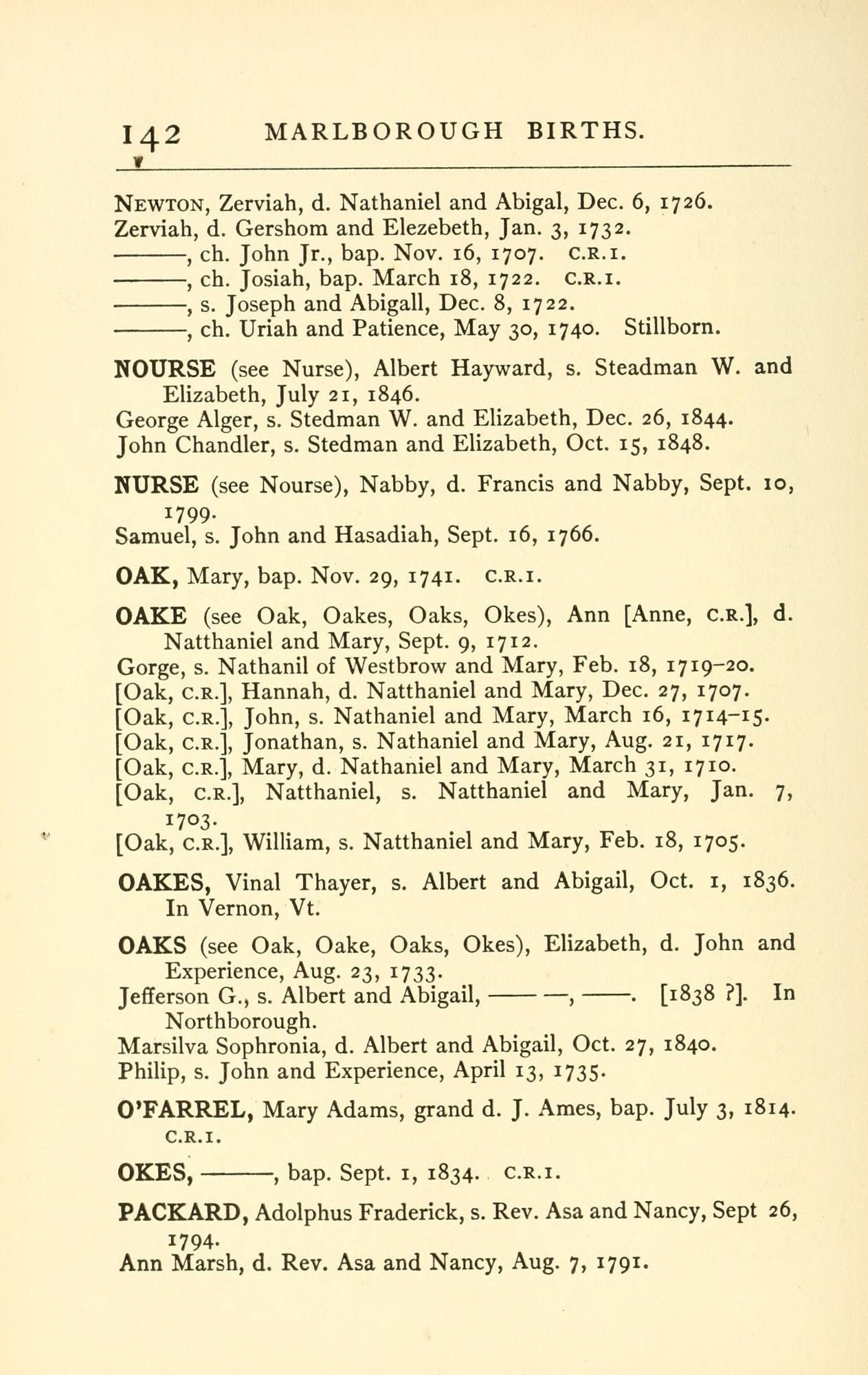
Source: Internet Archive (public-domain scan); vitalrecordsofma00marl.
How it is shown: Complete page as scanned; no crop, no retouch.
Keep in mind: A printed transcription of the town's record, not the manuscript.
Image details
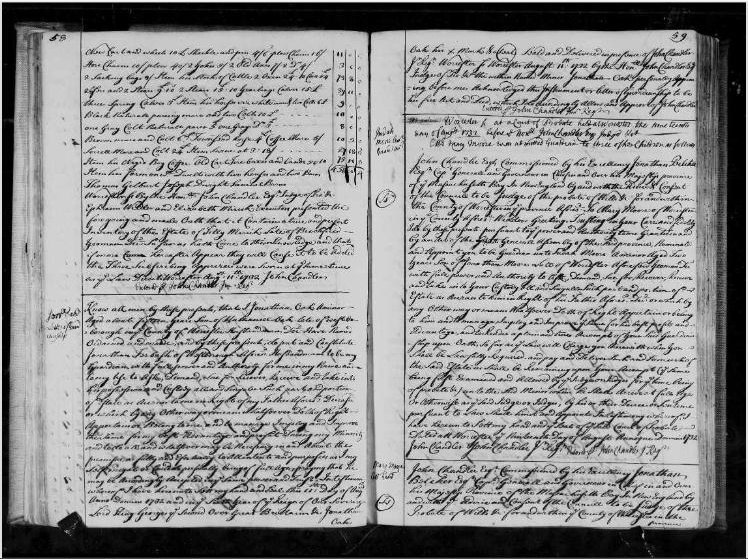
Source: FamilySearch, Worcester. Probate Records 1731-1770, image 48.
How it is shown: Cropped to the two-page document image: the FamilySearch viewer's menus, account name and machine-transcript panel are removed; no retouch of the document, no search highlight. The saved original screenshot stays private.
Keep in mind: A viewer capture of the spread, not an original file. FamilySearch's own machine transcript (which reads 1782) was not relied on. Ties the boy Jonathan to Nathaniel's estate in 1732; it does not tie him to the later Jonathan of Harvard and Canaan (that rests on the 1906 register). Further parties tagged on 4 Oct 2026: Nathaniel Oak(e) (first record 1686; died 1720/21) (the father named on the page: 'son of Nathaniel Oak late of Westborough' (Likely)). Re-released 4 Oct 2026 as a crop of the document image only, replacing the full viewer screenshot.
Image details
Marlborough's vital records enter a Mary Oak baptized November 29, 1741, on the same page as the eight children of the immigrant Nathaniel and Mary (Holloway) Oak. She is not that couple's daughter Mary, born in 1710, and the record names no parents. The 1906 register gives Jonathan's eldest daughter, Mary, a birth at "Marlboro (or Bolton) July 16, 1741," which would fit this baptism, though neither source names the other. The register also says Jonathan married first Rebecca Barnard of Stow and lived at Bolton and Stow in the 1740s; no town record of either has been found. The first Stow record that names him is the entry of his intention to marry Elizabeth Wheeler on January 19, 1748/9.
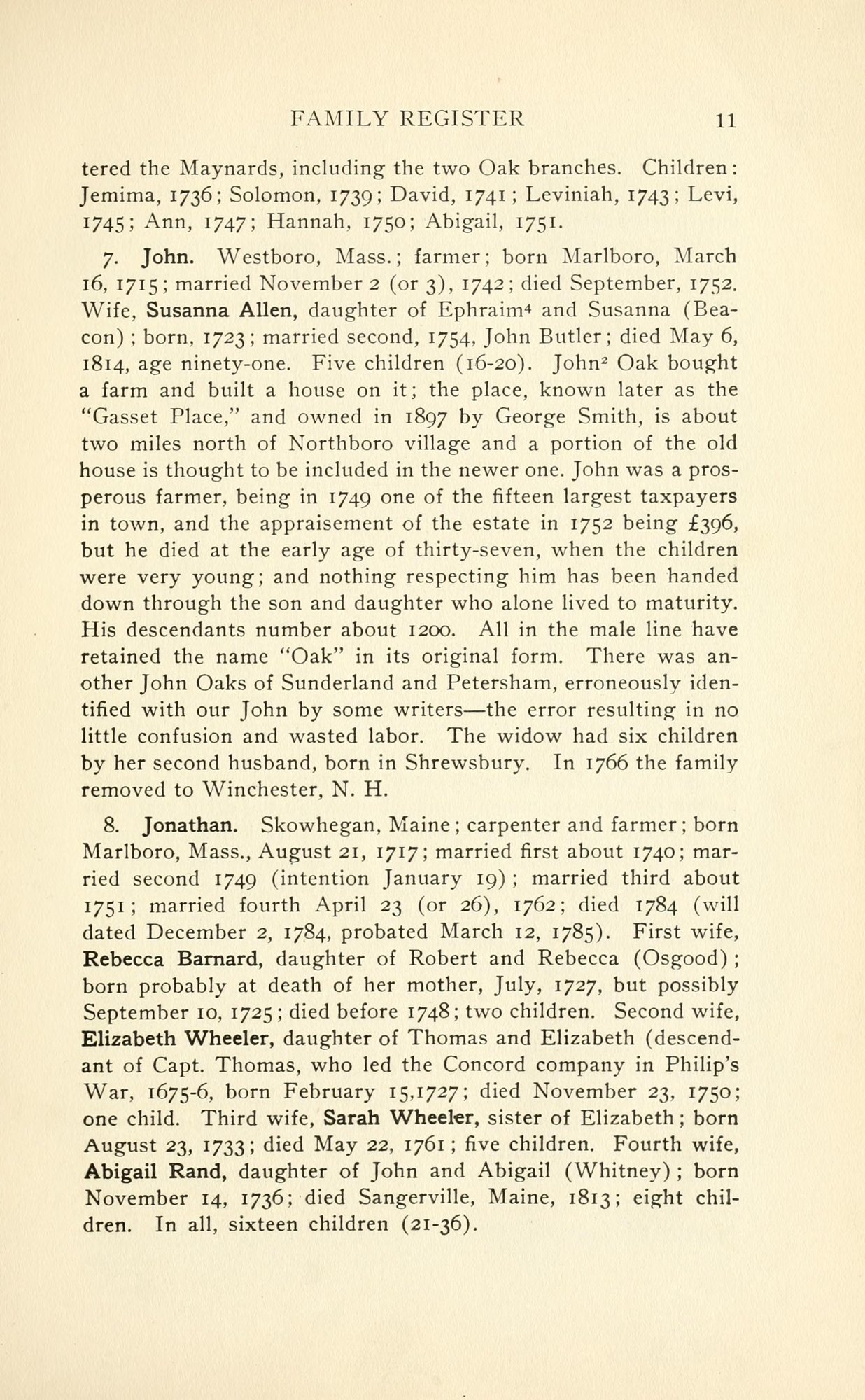
Source: Internet Archive (public-domain scan); oakoaksoakesfami00oakh.
How it is shown: Complete page as scanned; no crop, no retouch.
Keep in mind: A printed book, not an original record.
Image details
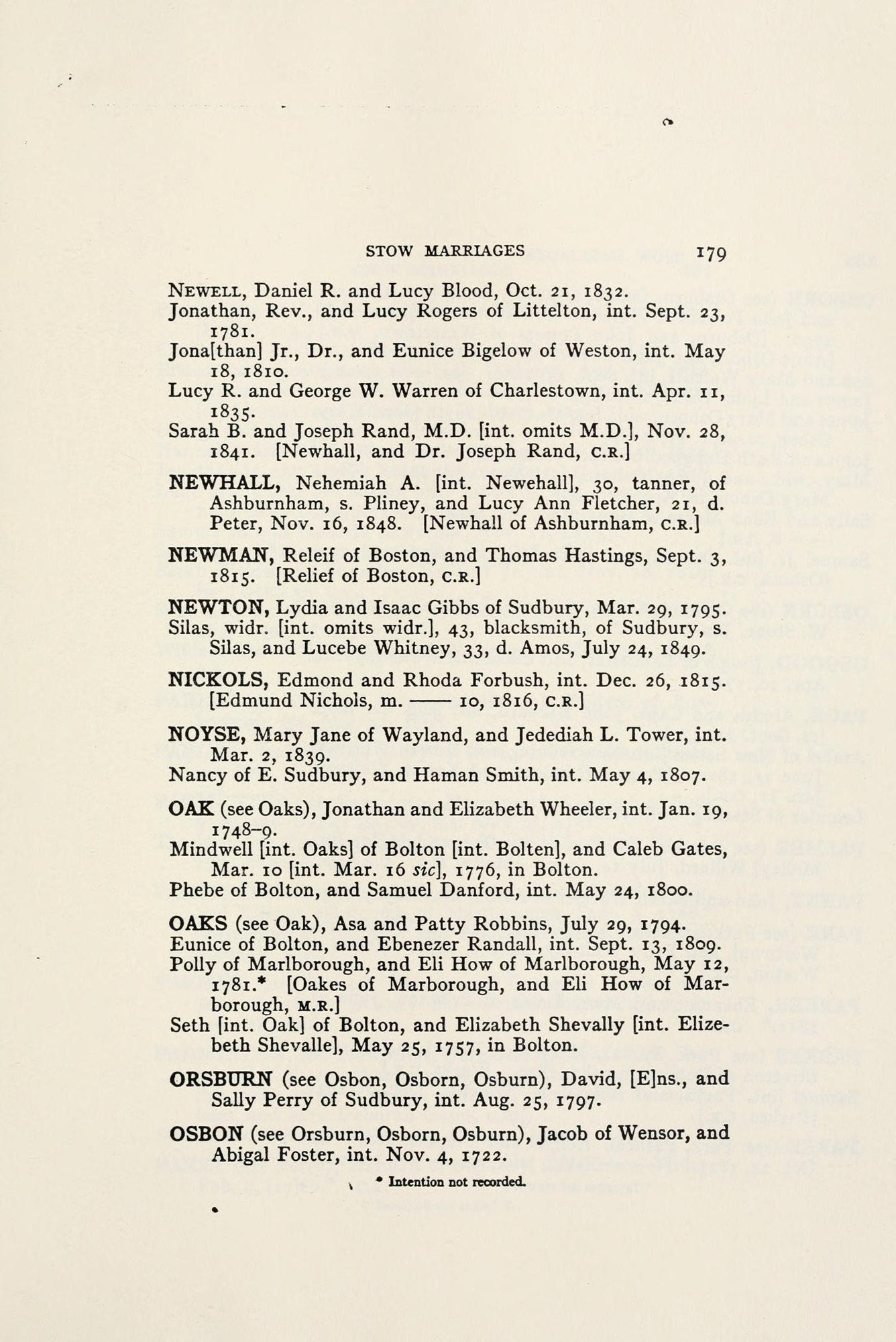
Source: Internet Archive (public-domain scan); vitalrecordsofst00stow.
How it is shown: Complete page as scanned; no crop, no retouch, no search highlight.
Keep in mind: Confirmed. An intention only: no residence, marriage date or parentage is printed. Whether this Jonathan is Jonathan b. 1717 of Marlborough (the tree's chain: Westborough guardianship 1732, Stow 1748/9, Harvard 1749-1771, Canaan) is Unconfirmed; the chain is inference from names and dates.
Image details
From 1749 the Oaks family is in Harvard's records. A child of Jonathan's died there on November 11, 1749. His wife Elizabeth died on November 23, 1750, aged 23 years and 9 months, and their daughter Elizabeth was baptized two days later. A daughter Sarah, "d. of Jonathan and Sarah," is recorded in 1752, and Sarah, wife of Jonathan, died on May 22, 1761, aged 28. On April 26, 1762 he married Abigail Rand. Harvard's records then name Levi and Lois in 1763, Melea in 1768, Solomon and Sybil in 1769, and "Abel, s. of Capt. ---" on August 11, 1771.
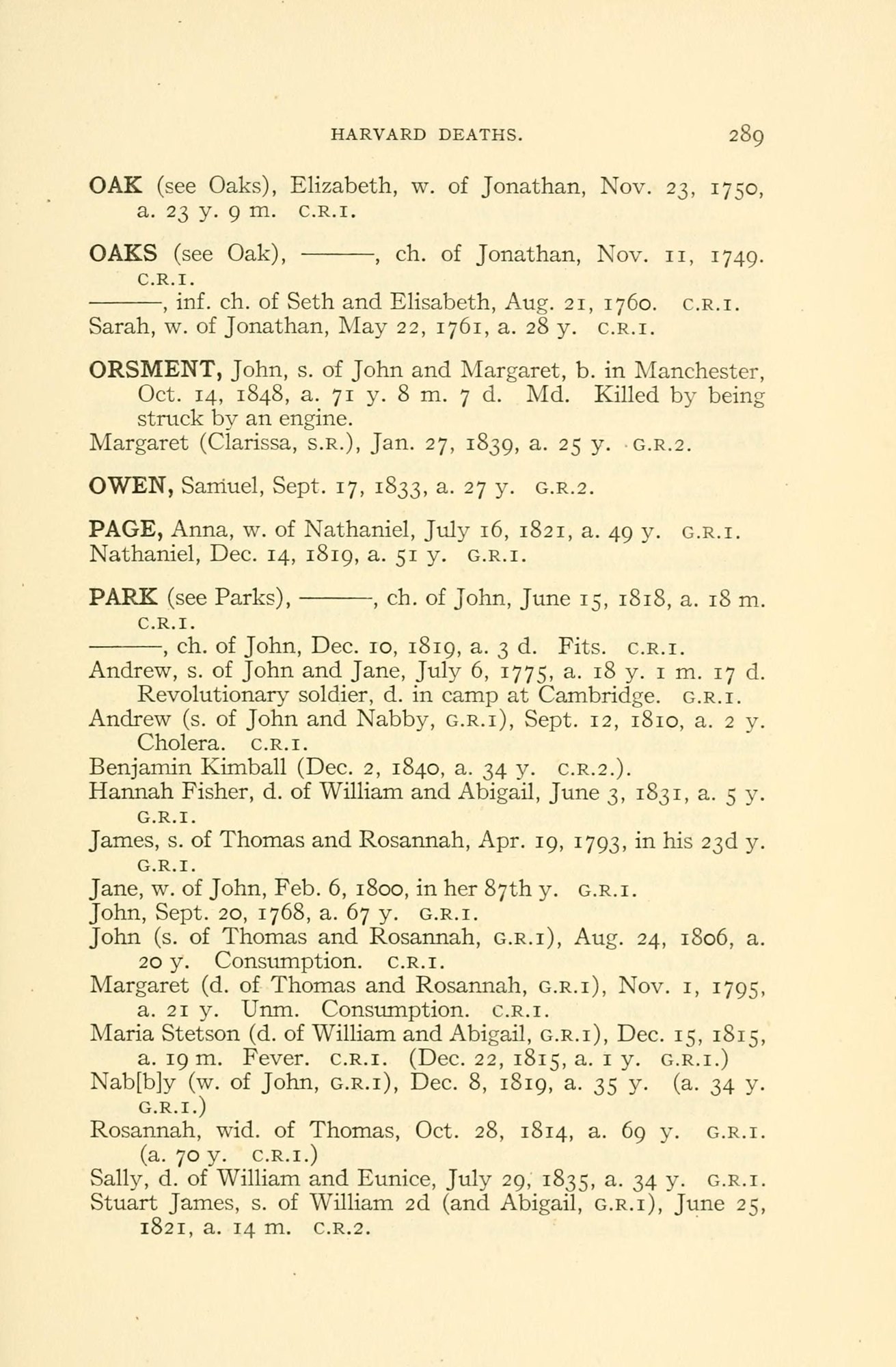
Source: Internet Archive (public-domain scan); vitalrecordsofha00harv.
How it is shown: Complete page as scanned; no crop, no retouch.
Keep in mind: A printed transcription of the town's record, not the manuscript.
Image details
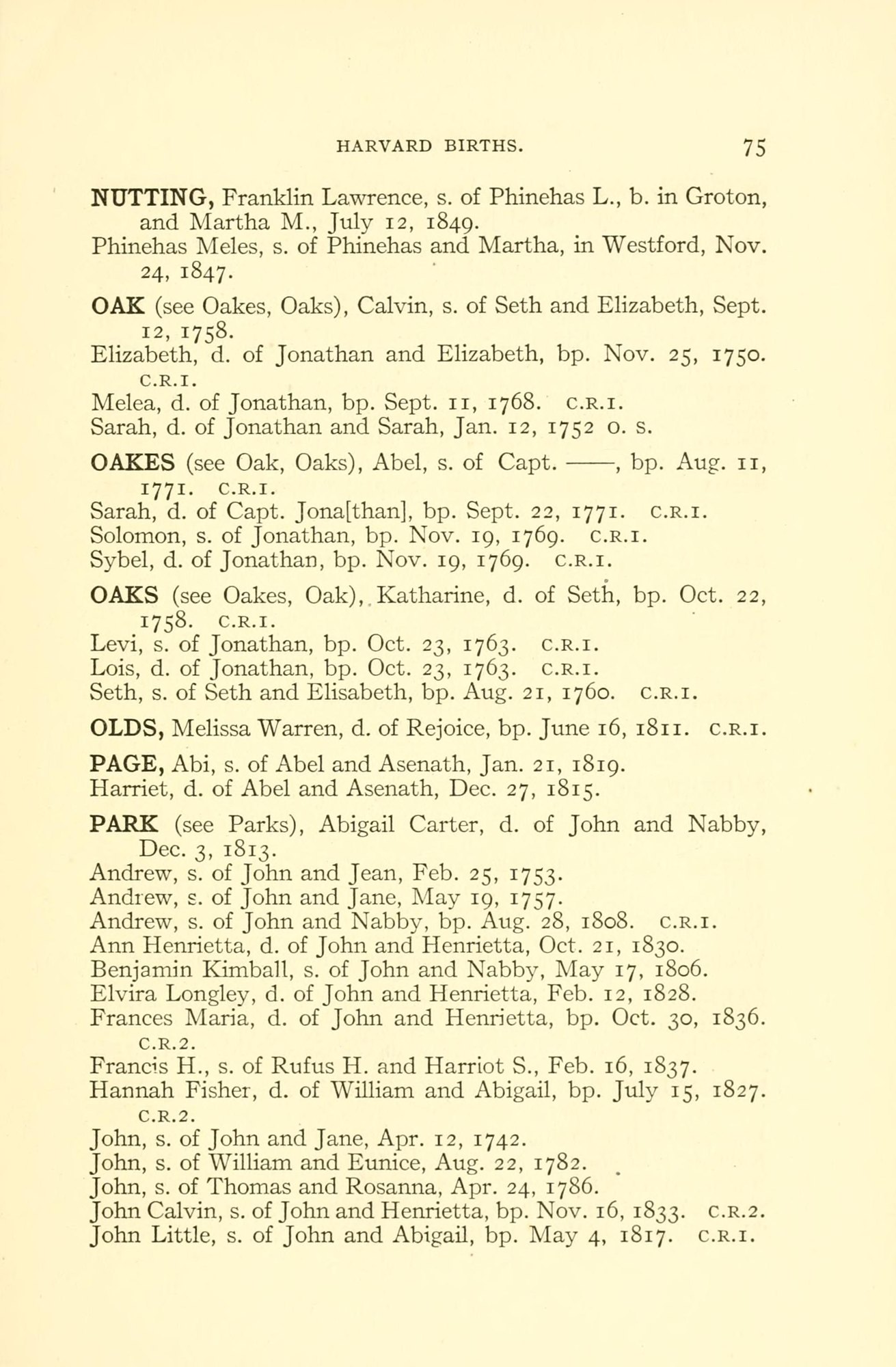
Source: Internet Archive (public-domain scan); vitalrecordsofha00harv.
How it is shown: Complete page as scanned; no crop, no retouch.
Keep in mind: A printed transcription of the town's record, not the manuscript.
Image details
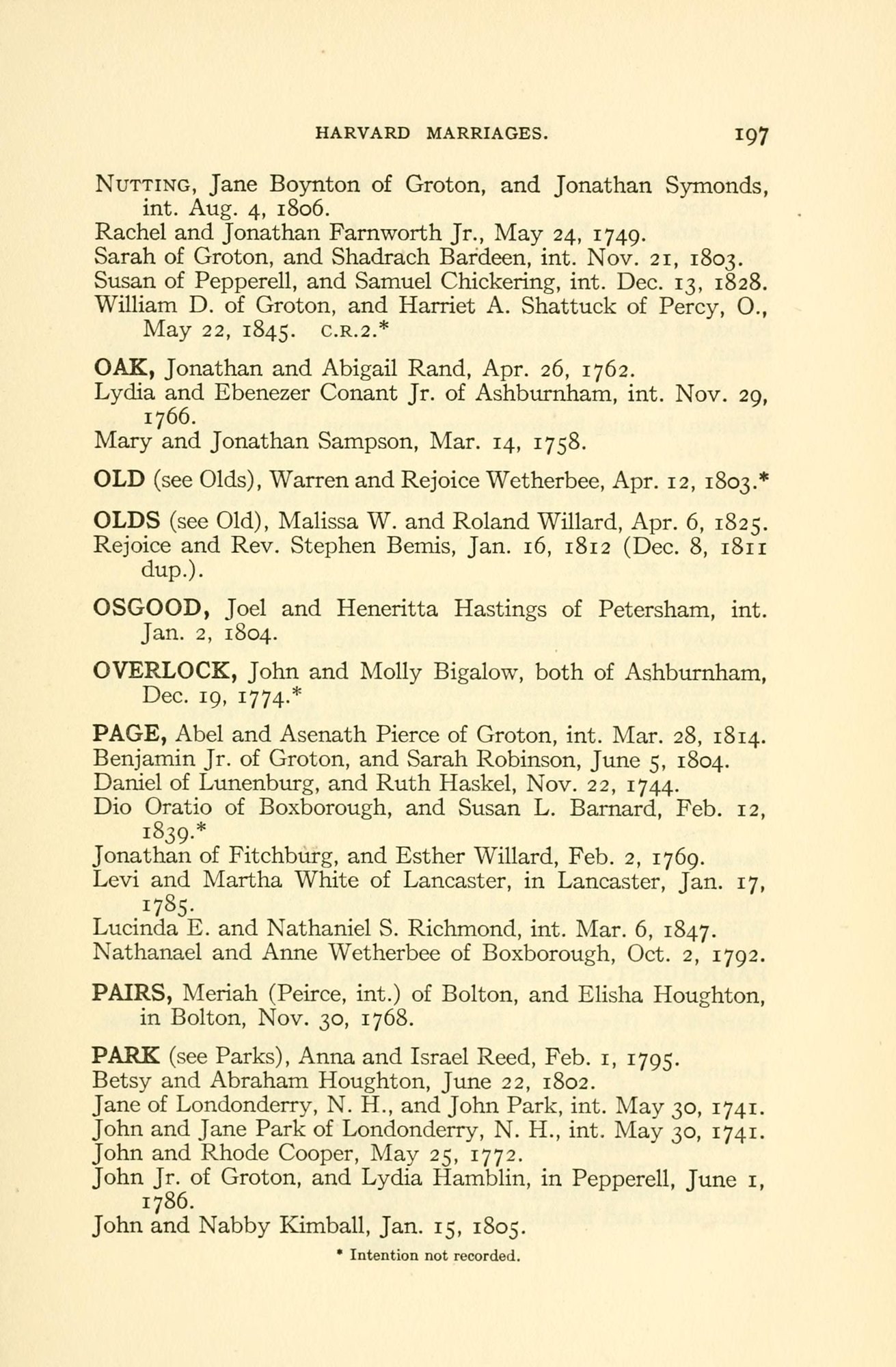
Source: Internet Archive (public-domain scan); vitalrecordsofha00harv.
How it is shown: Complete page as scanned; no crop, no retouch.
Keep in mind: A printed transcription of the town's record, not the manuscript.
Image details
That title appears earlier. When Harvard reseated its meeting-house in 1766, the committee's report put "Capt, Jonathan Oak" in the third seat below. No commission, muster roll or company has been found for him. The register's "captain of the training band" is its inference; a trainband was the town's militia company. He was a carpenter by trade, and the will mentions his carpenter's tools. The register says that after Stow he bought "for £1600 a farm of 112 acres on Bare Hill (or Oak Hill as it was also called from the large trees there growing) in Harvard," and built a house "largely from materials taken from other buildings torn down by him in the practice of his craft—which was still standing in good repair in 1896, owned by Andrew McNeff." In 1771, it says, he sold the Harvard property for £440 and obtained from the Kennebec Purchase Company a grant of land in Canaan (register, page 12).
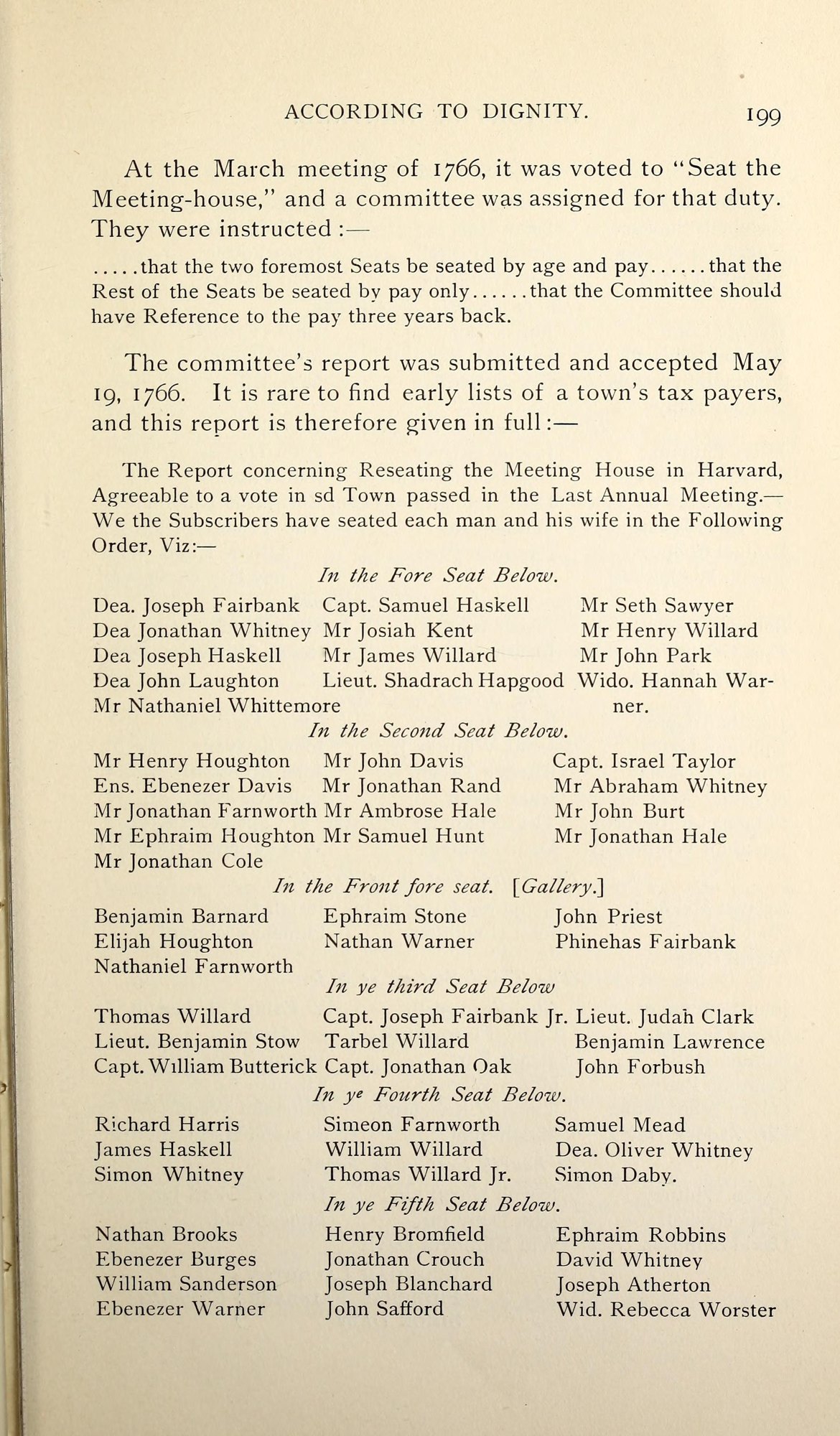
Source: Internet Archive (public-domain scan); historyoftownofh1732nour.
How it is shown: Complete page as scanned; no crop, no retouch, no search highlight.
Keep in mind: Confirmed. The seating reflects tax standing, not age; no other Oak name is on the page. Identification with Jonathan Oak b. 1717 of Marlborough rests on the Oak register (1906) and the tree's chain (Westborough, Stow, Harvard, Canaan), not on this page (Unconfirmed).
Image details
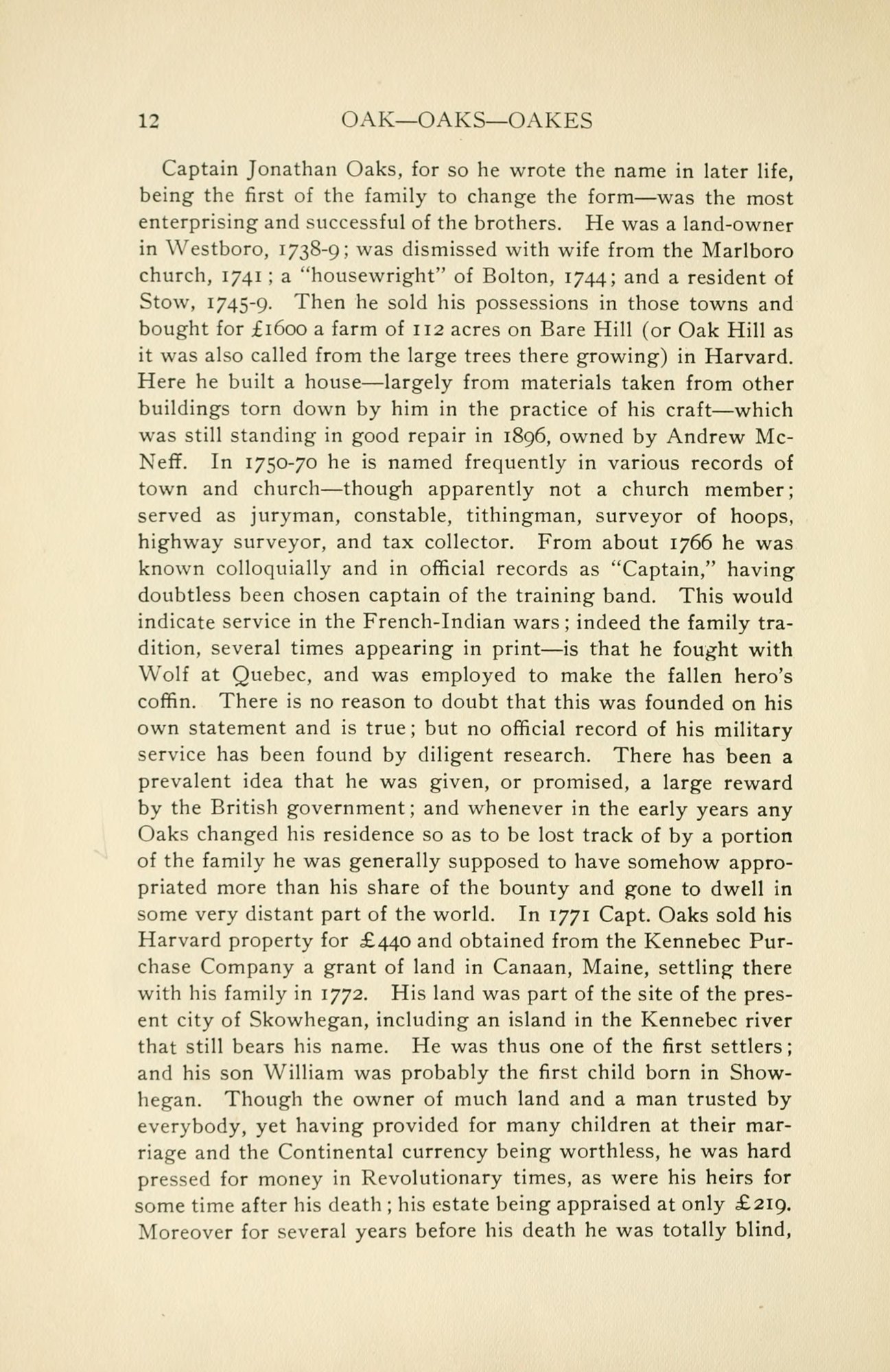
Source: Internet Archive (public-domain scan); oakoaksoakesfami00oakh.
How it is shown: Complete page as supplied; no crop, no retouch, no search highlight.
Keep in mind: Family tradition, as the family compilation prints it; the book itself adds that no official record of his military service has been found. Not independent proof. Label: Unconfirmed.
Image details
Canaan, 1772
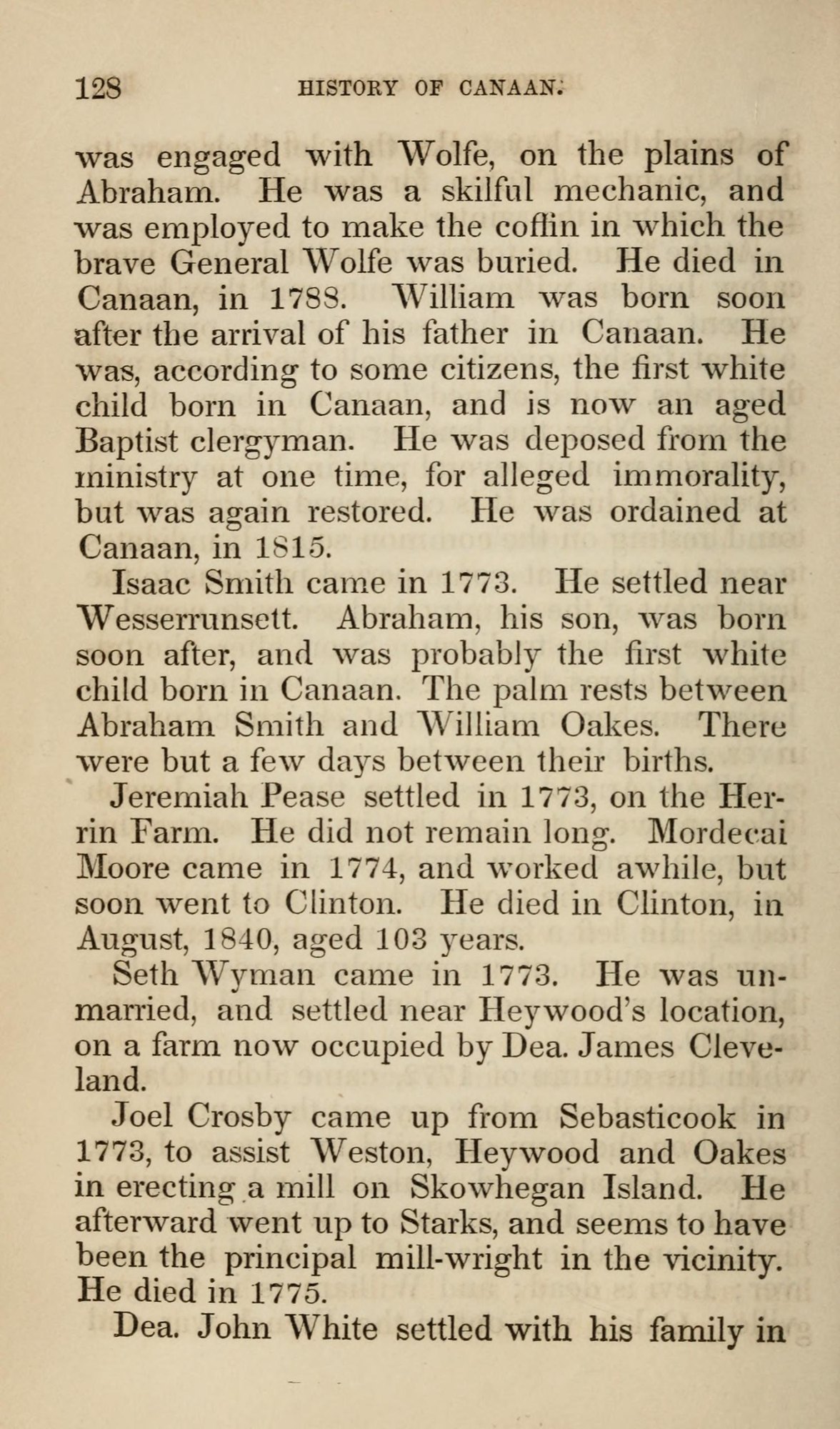
In the autumn of 1772, according to Hanson's History of Canaan (1849), "came John Oakes, with several sons, to 'spy out the land.'" He settled on a farm opposite Great Island, and "Oakes Island was given to him by the Heywoods and Westons." Hanson calls him "a skilful mechanic," and says Joel Crosby came in 1773 "to assist Weston, Heywood and Oakes in erecting a mill on Skowhegan Island." Hanson calls him John, but this is probably Jonathan. The will's places and neighbors point to him: the Heywoods and Westons appear in its probate, and the sons Hanson names, Solomon, Abel, Levi and William, are four of the will's sons, three of them baptized at Harvard as Jonathan's children (Levi in 1763, Solomon in 1769, Abel in 1771). Hanson gives his death as 1788, and says he had served at Quebec with Wolfe and made Wolfe's coffin. The will shows the name and the death date are wrong, and no record supports the Wolfe story. Hanson says William, Jonathan's youngest, was born soon after the family arrived and was, "according to some citizens," the first white child born there, and that he was ordained a Baptist minister at Canaan in 1815; no record of either has been found.
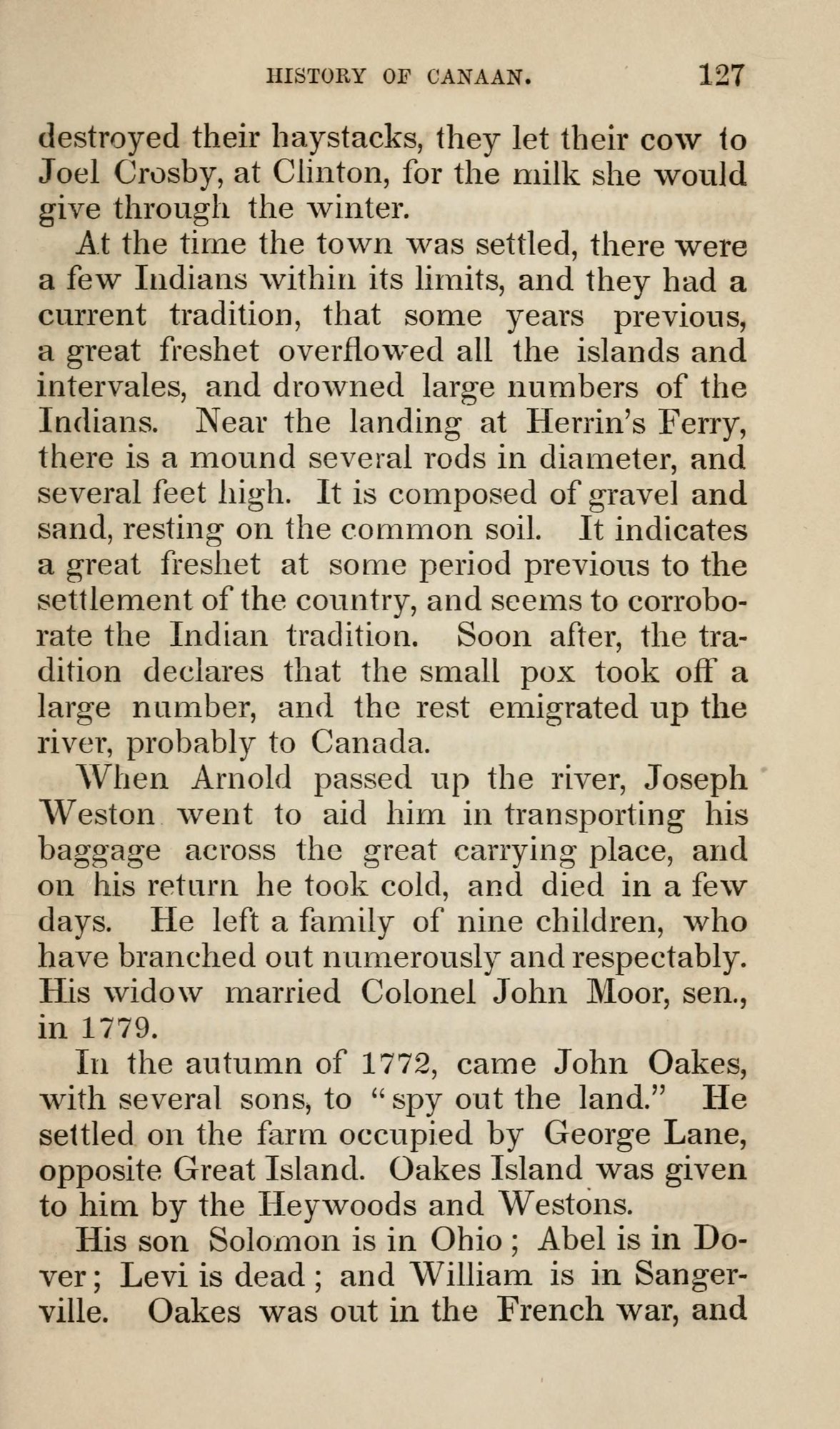
Source: Internet Archive (public-domain scan); historyofoldtown00hans.
How it is shown: Complete page as scanned; no crop, no retouch.
Keep in mind: A printed book, not an original record.
Image details
Source: Internet Archive (public-domain scan); historyofoldtown00hans.
How it is shown: Complete page as scanned; no crop, no retouch.
Keep in mind: A printed book, not an original record.
Image details
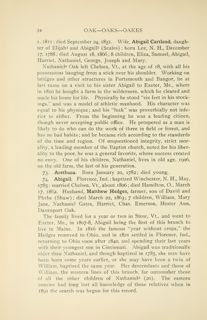
The register remembers his last years as hard ones. Though "the owner of much land and a man trusted by everybody," having provided for many children at their marriages, and "the Continental currency being worthless, he was hard pressed for money in Revolutionary times," and "for several years before his death he was totally blind, and perhaps never saw his youngest child." It records two family beliefs: that "he had by his four wives twenty-four children," which it calls "of doubtful accuracy," and "a prevalent idea that he was given, or promised, a large reward by the British government," so that any Oaks who moved away and lost touch "was generally supposed to have somehow appropriated more than his share of the bounty and gone to dwell in some very distant part of the world" (pages 12-13).
The children
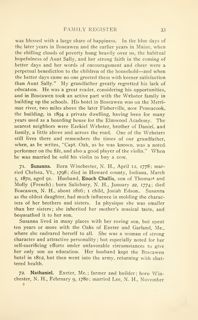
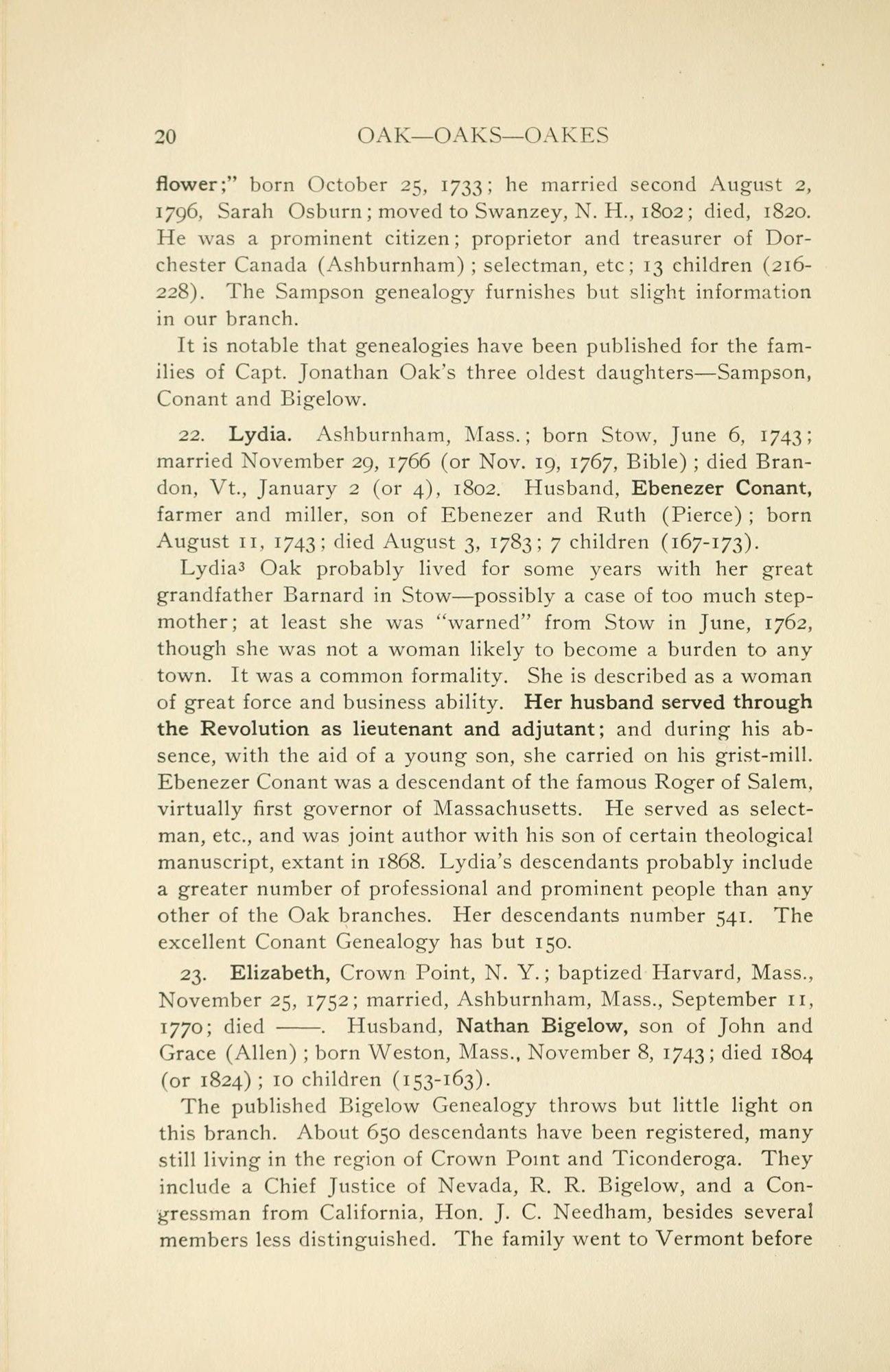
The will's sixteen children are Mary, Lydda, Elizabeth, Sarah, Rebeckah, Lois, Mille, Sibbel and Lucy, and Jonathan, John, Daniel, Levi, Solomon, Abel and William. Three married daughters lived in Massachusetts and beyond. Mary married Jonathan Sampson at Harvard on March 14, 1758. Lydia and Ebenezer Conant Jr. published their intention on November 29, 1766, in both Harvard and Ashburnham. Elizabeth married Nathan Bigelow at Ashburnham on September 11, 1770, and the Bigelow genealogy takes them to Crown Point, New York. The marriages are on record. That the brides were Jonathan's daughters is probable, from their names and the Conant note. Conant was a lieutenant in the Ashburnham company that marched when the Lexington alarm came in April 1775.
The register adds two memories of these daughters. Mary Sampson, who died on September 13, 1794, "died at a funeral in church and was carried home on the bier provided for the occasion." Lydia Conant was "a woman of great force and business ability"; her husband "served through the Revolution as lieutenant and adjutant; and during his absence, with the aid of a young son, she carried on his grist-mill" (pages 19-20). Lydia, it says, "probably lived for some years with her great grandfather Barnard in Stow," and was "warned" from Stow in June 1762, "though she was not a woman likely to become a burden to any town. It was a common formality." Elizabeth and Nathan Bigelow "went to Vermont before 1784 and to New York before 1787" (pp. 20-21). Of a younger daughter, Millie, who married Sherebiah Lambert and lived at Skowhegan, it says: "Millie was a famous midwife in her day, presiding, it is said, at fifteen hundred births for a fee of one dollar each. Also a woman of some nerve, since on one occasion she rescued a pet calf from a bear that had seized it" (page 23). His youngest daughter, Lucy, born at Canaan in 1776, married David Douty at Topsham in 1797 and lived at Sangerville (p. 24); her son was Col. Calvin Sanger Douty of the First Maine Cavalry, killed at Aldie in 1863.
Of the sons, Levi "died in 'Aroostook,' Me., while on a visit to his son"; Solomon held "minor town offices in Canaan to 1790," and "His home seems to have been on the island part of the Skowhegan farm, where most of his children were born"; Abel's wife, Betsy Hamlin, "was of the family of Hon. Hannibal Hamlin"; and of the preacher, Elder William, "A paralytic shock affected his mind in the last years" (pp. 23-24). The 1790 census lists Solomon, Levi and a John Okes as heads of households at Canaan, two years after the date Hanson gives for the father's death. The younger children went north: "In 1806-8 several of them settled in Sangerville, Piscataquis county."
Source: Internet Archive (public-domain scan); oakoaksoakesfami00oakh.
How it is shown: Complete page as scanned; no crop, no retouch.
Keep in mind: A printed book, not an original record.
Image details
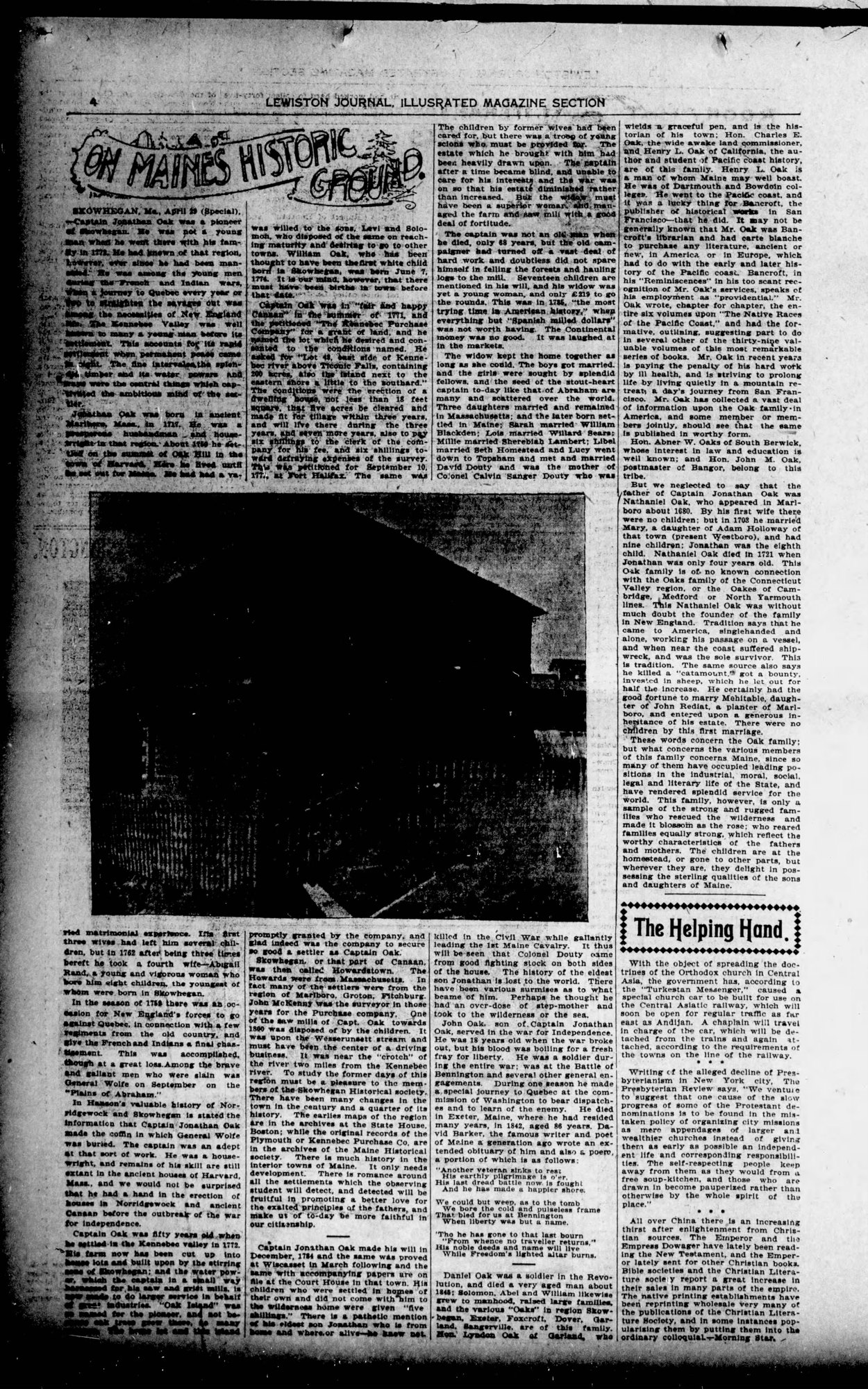
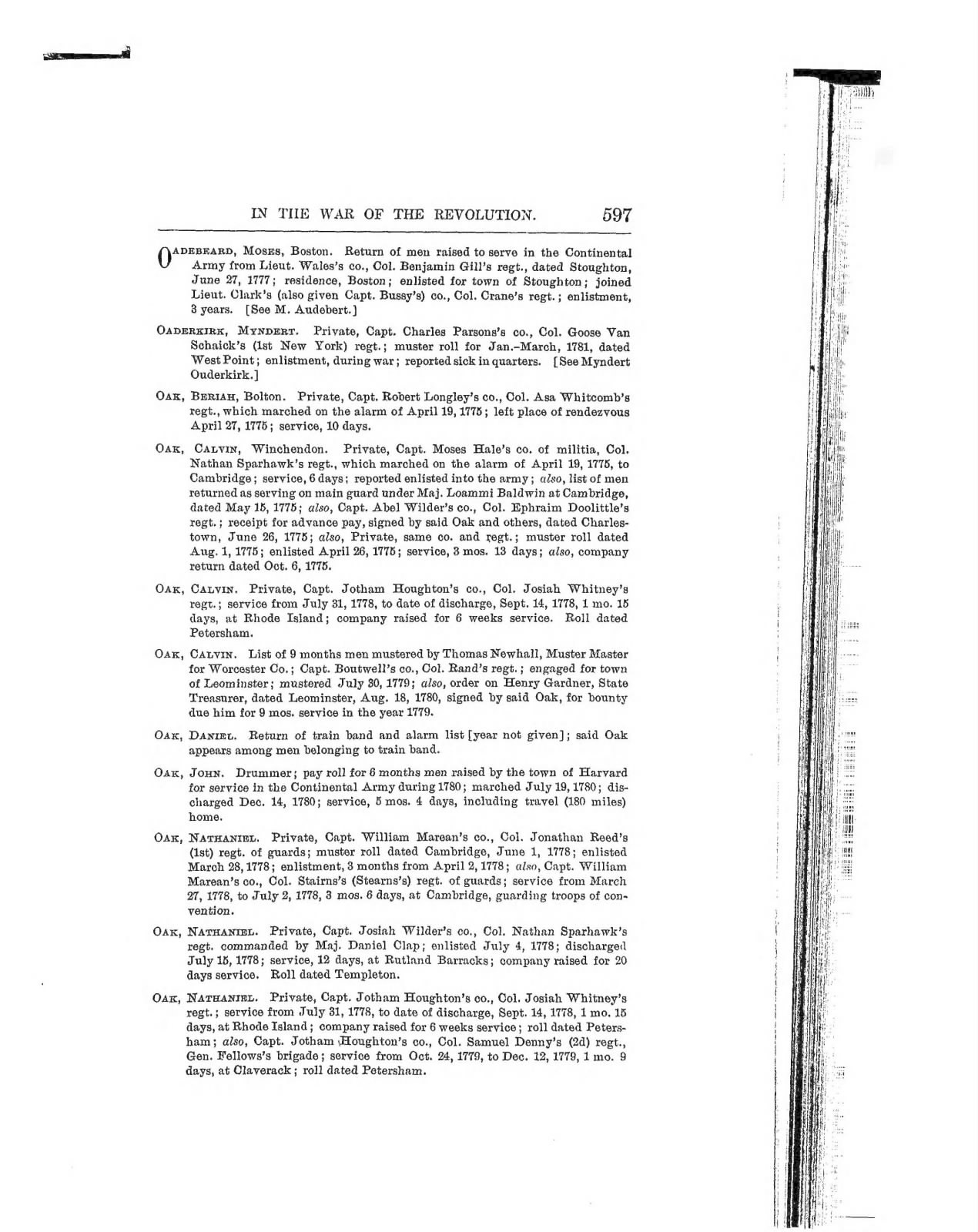
Two sons may appear in Revolutionary records. A John Oaks of Exeter, Maine, is listed as a pensioner aged 84 in 1840. The 1899 Lewiston Journal says the Captain's son John died at Exeter in 1842 aged 86, so the pensioner is probably that son, born about 1755 or 1756. His pension file gives a Harvard residence at enlistment only on his widow's word, and lists service as a private in three enlistments. A John Oaks of Harvard was a drummer among the six-months men raised in 1780, but the pension file does not mention that service, so he may or may not be the same man. A Daniel Oaks appears in rolls of 1777, 1780 (Westborough) and 1781 (Bolton), possibly as many as three different men, and any of them could be the Captain's son Daniel. The register's Daniel, a cordwainer of Wiscasset, married first "at Marlboro, September 9, 1783," Morning Blin Flagg, and Marlborough's records enter "Daniel and Morning Blin Flagg, Sept. 9, 1783" (Vital Records of Marlborough, p. 293); the register also gives his age as "19 years old in 1780," the age on the 1780 Westborough roll.
The eldest son, Jonathan, born about 1754, has no birth record at Harvard or Stow, and the will puts him alive, and away, in December 1784. The register knows little more of him, except that Lydia's son John Conant "also remembered him as visiting his sister Lydia in Ashburnham about 1773-80." Conant's note recalls frequent visits during his childhood from three of his mother's brothers, John, Jonathan and Daniel. The register adds an unverified claim: "He doubtless disappeared in Revolutionary times, and was never heard of" (p. 21).
Source: Newspapers.com, full-page original download.
How it is shown: Complete image as saved; no crop, no retouch, no search highlight.
Keep in mind: Original page; see the Lewiston Journal page for the transcription of the Nathaniel paragraph.
Image details
Source: Commonwealth of Massachusetts, Soldiers and Sailors of the Revolutionary War, vol. XI, via Fold3.
How it is shown: Complete typeset page; no crop, no retouch, no search highlight.
Keep in mind: Nathaniel of Bolton appears here and continues on p. 598. Unconfirmed that the Nathaniel of Bolton entries are the Nathaniel Oak born 1751: they fit the pension file's Capt. Benjamin Hastings company at Bolton in 1775, but the printed abstracts name no parents or later residence (Likely at best).
Image details
The next generation scattered from the Kennebec to Illinois, the California gold fields, Boston, Charleston and New Brunswick; the register's account of them is on Captain Jonathan's grandchildren.
The note that mentions him
The family's cabin-boy tradition survives in a typed copy of John Conant's account at American Ancestors. It names Captain Jonathan Oaks as the cabin-boy's son, "a carpenter by trade," who "lost three wives in Stow, married a fourth and removed to the Kenebeck country." The records support his work as a carpenter and his move to the Kennebec, and document three of the four reported marriages. They differ on Stow: Jonathan's second and third wives died at Harvard, in 1750 and 1761. The wife the note may mean, the first, has left no town record. The story of Nathaniel Oake's arrival is on Nathaniel Oak and the cabin-boy story.
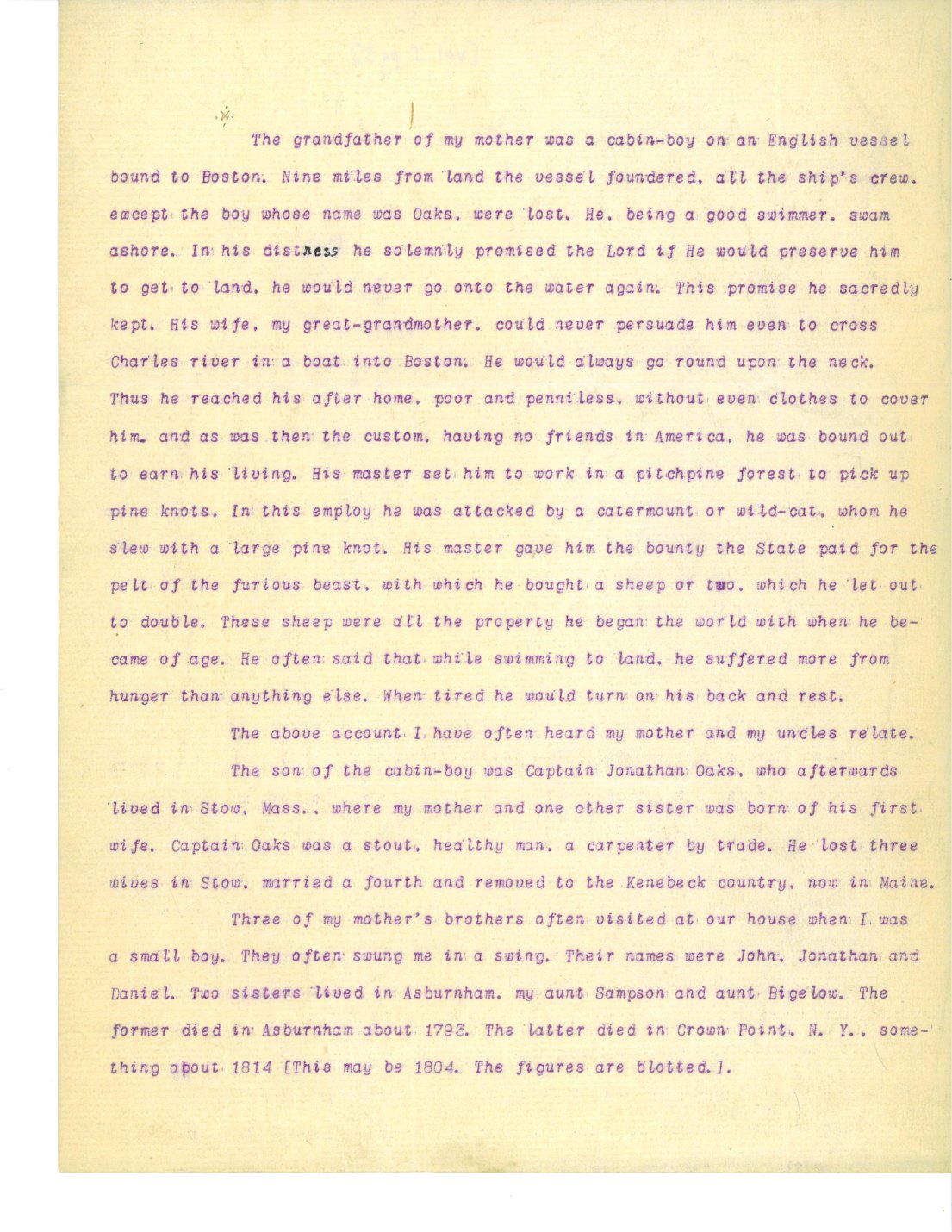
Source: Copy supplied by American Ancestors (NEHGS), Mss 865, Box 9, folder 2
How it is shown: Complete page as supplied; no crop, no retouch.
Keep in mind: A typed copy made by someone other than John Conant, who wrote the note; who typed it and when is not known. Family tradition.
Image details
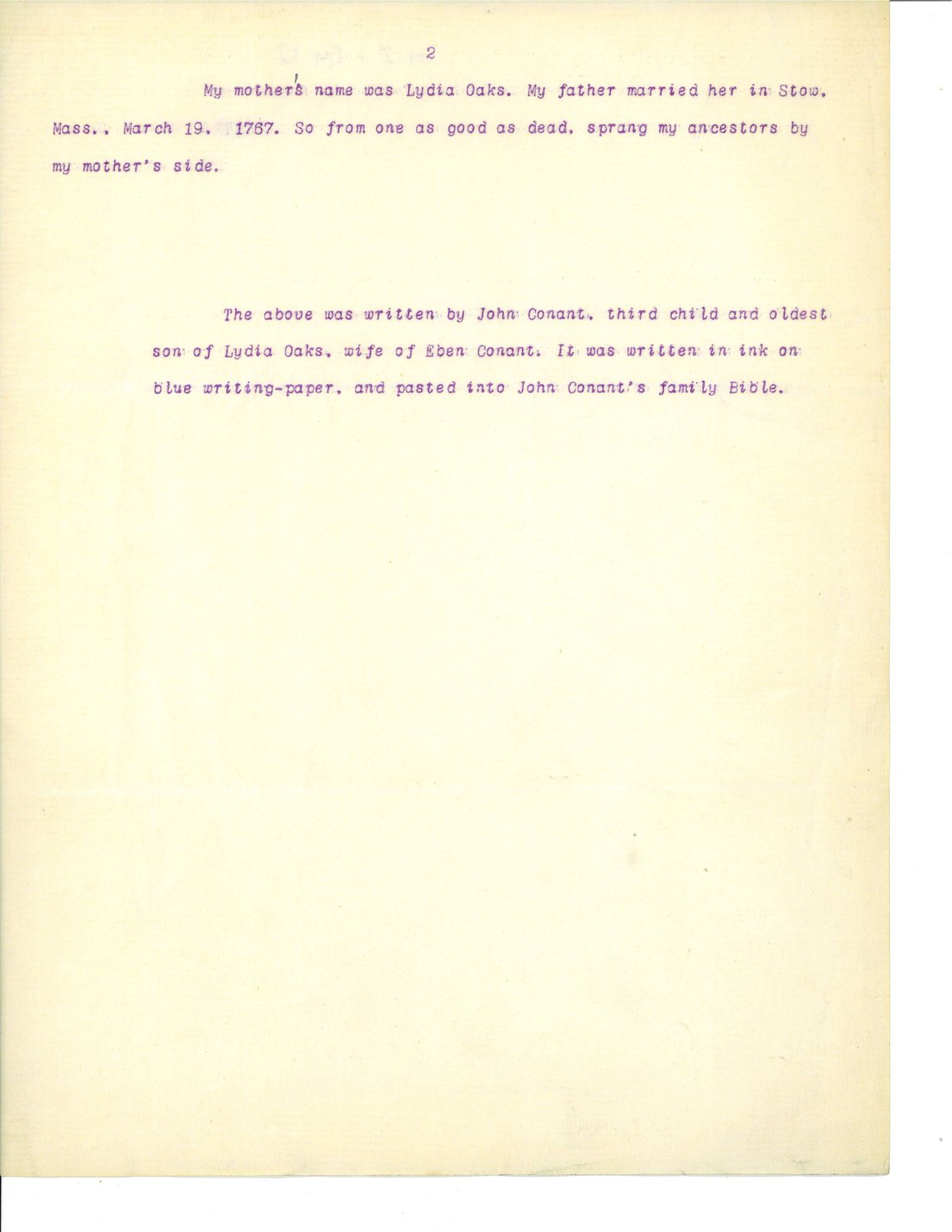
Source: Copy supplied by American Ancestors (NEHGS), Mss 865, Box 9, folder 2
How it is shown: Complete page as supplied; no crop, no retouch. Rotated upright from the sideways scan; nothing else changed.
Keep in mind: A typed copy made by someone other than John Conant, who wrote the note; who typed it and when is not known. Family tradition.
Image details
What we're still looking for
His death can be placed only between December 2, 1784 and March 12, 1785, and no burial place has been found. No record names his wife at Canaan; the register says Abigail Rand died at Sangerville in 1813. We have seen only the printed copy of his will, not the Wiscasset original.
Sources
- Will of Jonathan Oaks of Canaan, December 2, 1784, proved March 12, 1785, with the inventory of March 15, 1785: Lincoln County probate records, vol. III, pp. 121-122 and 235, as printed in Patterson, Probate Records of Lincoln County, Maine (1895), pp. 149-151.
- Vital Records of Marlborough (birth of Jonathan, August 21, 1717; baptism of Mary, November 29, 1741); Worcester County probate records, vol. 1, pp. 58-59 (guardian, August 11, 1732).
- Vital Records of Stow, p. 179; Vital Records of Harvard (deaths, p. 289; baptisms, p. 75; marriages, pp. 149, 197, 204 and 209); Vital Records of Ashburnham.
- Henry S. Nourse, The History of the Town of Harvard (1894): the committee report on reseating the meeting-house, accepted May 19, 1766.
- John Wesley Hanson, History of the Old Towns of Norridgewock and Canaan (Boston, 1849), pp. 127-128, 371.
- 1790 federal census, Lincoln County, Maine, Canaan, p. 35.
- Massachusetts Soldiers and Sailors of the Revolutionary War, vol. 11 (John and Daniel Oaks) and vol. 3 (Ebenezer Conant).
- Lewiston Journal, April 29, 1899 (death of John Oaks at Exeter in 1842; this passage read only at screen resolution).
- H. L. Oak, Oak-Oaks-Oakes: Family Register (1906), pp. 12-13, 19-24. Public domain; read the whole book: PDF, from the Internet Archive. American Ancestors, Mss 865, box 9, typed copy of a note by John Conant.
The full account of Jonathan's father is on Nathaniel Oak and the cabin-boy story, and the searches made for the family are summarized on the research log.