American Acorns
William Oake and the fire at Shrewsbury
On the night of August 7-8, 1723, a fire destroyed the new house of Captain John Keyes at Shrewsbury, Massachusetts. Five people died in it: two carpenter's apprentices, one of them an eighteen-year-old named William Oakes, and three of the captain's sons. Two later town histories record the same death for William, a son of Nathaniel Oak of Westborough, which makes the apprentice probably Nathaniel's son.
The night of August 7-8, 1723, at Captain Keyes's new house
The Boston News-Letter of Thursday, August 15, 1723 printed "an exact Account of the awfull Burning of Capt. John Keyes House, with Five Persons in it, at Shrewsbury, in the Night between the 7th and 8th of this Instant." It was taken, the paper says, "from a Letter of the Reverend Mr. Breck of Marlborough, and from the Mouth of Mr. Ebenezar Bragg of the same, formerly of Ipswich," the only person in the house to escape.
The newspaper describes Captain Keyes building a new house nine or ten feet from his old one. It was almost finished, and Bragg, the carpenter, was working on it with "his Brother Abiel of 17 Years of Age, and William Oakes of 18, his Apprentices." The captain, his wife and four daughters slept in the old house. The three carpenters and the captain's three sons, Solomon, 20, John, 13, and Stephen, 6, slept in the new one.
On Wednesday night, the account says, they took more than ordinary care of the fire. One of them had remarked that he "wd'nt have the House Burnt for 100 Pound," and they raked away the chips lying near it, waited until the rest were almost burnt out, and went to bed, all six together in three beds in one of the chambers, at about ten o'clock, "very Chearly and Merry."
In Bragg's account, he woke about midnight with a sense that the house was on fire. He got up, saw nothing, heard no voice, and could hardly breathe for the smoke. After striking his forehead against the chimney he thought of the window and found it. He held on for a minute, reaching out in hope of finding someone to help the others, until the smoke and fire drove him out, and he jumped head first through the small window. Captain Keyes, awakened in the old house, was coming around the new one and met him; then flame burst out of the windows and the house "was quickly all a light Fire." No noise was heard from the other five. The old house burned too, but the family in it was saved.
The remains stayed among the fallen timbers until toward evening, when they were gathered and buried together in one coffin. The paper closes with three verses of scripture on the shortness and uncertainty of life.
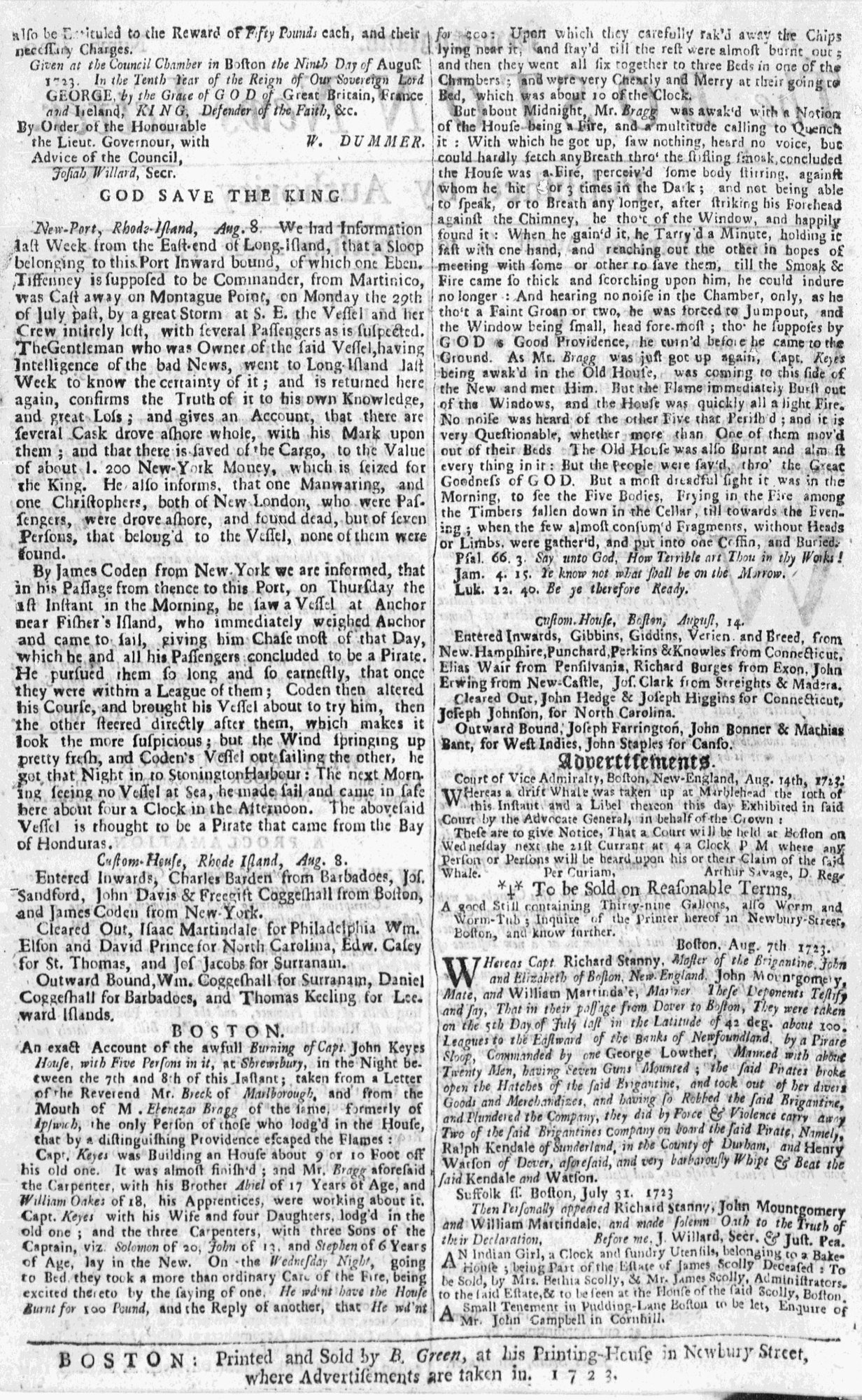
Source: Native Bound Unbound / FromThePage (image of a 1723 newspaper, public domain).
How it is shown: Complete page image; no crop, no retouch, no search highlight.
Keep in mind: Confirmed on the page image: 'William Oakes of 18' and 'his Apprentices'. Two digits are worn ('for ?00', 'hit ? Or 3 times'); neither affects names or ages. The newspaper does not give William's parents: the identification as the son of Nathaniel and Mary Oak(e), b. Marlborough 18 Feb 1705, is the Ebenezer Parkman Project editor's note (Likely). The surnames Bragg (for Abiel) and Keyes (for the three boys) are inferred from the text and the Parkman footnote, not printed.
Image details
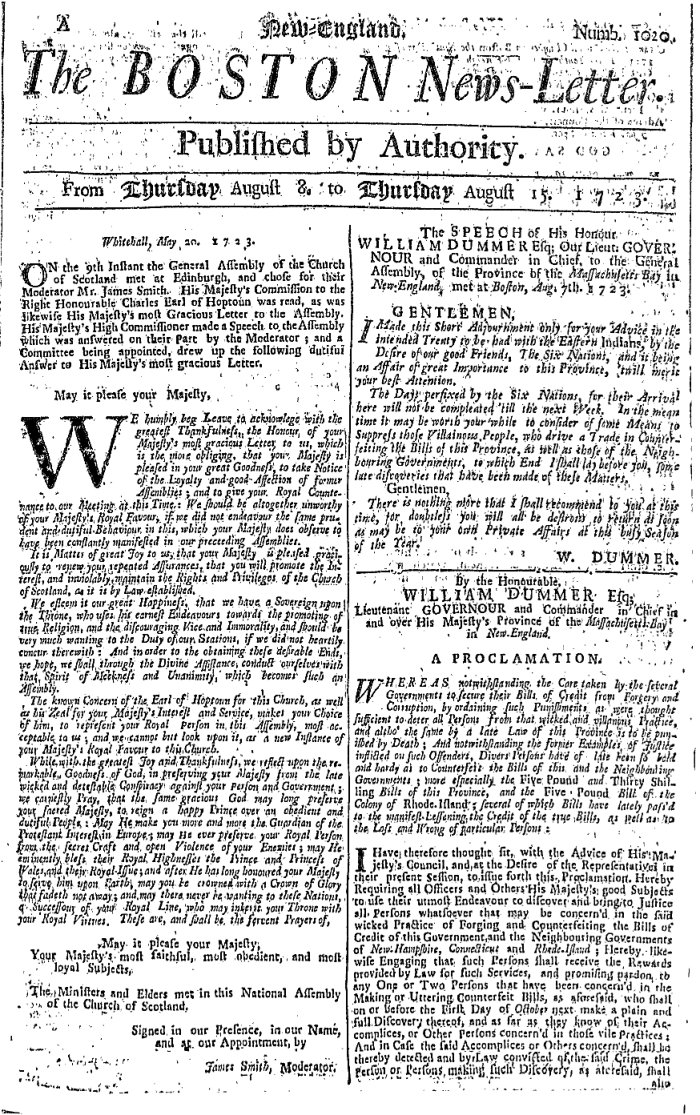
Source: The Boston News-Letter, Boston, 15 August 1723; America's Historical Newspapers (Readex), via AmericanAncestors.org.
How it is shown: Complete page as supplied; no crop, no retouch, no search highlight. A cleaner original than the FromThePage copy already held.
Keep in mind: What the page says: Confirmed. The paper prints the fire at Capt. Keyes's new house on the night between 7 and 8 August; the five who died were Abiel Bragg (17), 'William Oakes of 18' (an apprentice), and Capt. Keyes's sons Solomon (20), John (13) and Stephen (6); the carpenter Ebenezer Bragg escaped by the window. The spelling in print is Oakes. Whether this is our William: Likely at best, not Confirmed. That this William Oakes is the tree's William Oak (1705-1723), son of Nathaniel Oak and Mary Holloway, rests on name, age 18 and the Marlborough-Shrewsbury area; the page gives no parentage or home town for him. The two pages were saved from the owner's Readex (America's Historical Newspapers) access on 4 October 2026. The same printed account was also checked separately on an earlier copy (the FromThePage scan), independently of this Readex capture, and both readings confirm issue 1020 (8 to 15 August 1723) and the complete Keyes passage with its continuation. The carpenter's forename is printed 'Ebenezar'.
Image details
What the other accounts say
The Rev. Ebenezer Parkman, minister at Westborough, heard of it the next day. His diary for August 9, 1723 reads: "Here I had the Information by a Dispensation of Providence in the Burning of the House of Captain Keys of Shrewsbury with 3 of his Sons and Two workmen finishing the house in it." He names no victims; the modern editors' footnote names Abiel Bragg and William Oakes as the carpenter's apprentices.
The American Weekly Mercury of Philadelphia (August 15-22, 1723, with a Boston dateline of August 12) reports that on "Wednesday night the seventh of August" the house of "Capt. John Kies of Shrewsbury took Fire and was burnt, with three of his Sons and two other Men," and that "the Shavings took Fire in the Night when they were a Bed." It says the master workman "was one Brege of Ipswich, who escaped by Jumping out of a Window," and that he "had two Apprentices burnt." It gives no victims' names or ages, and its explanation of the cause differs from the News-Letter's account of the careful raking of the chips.
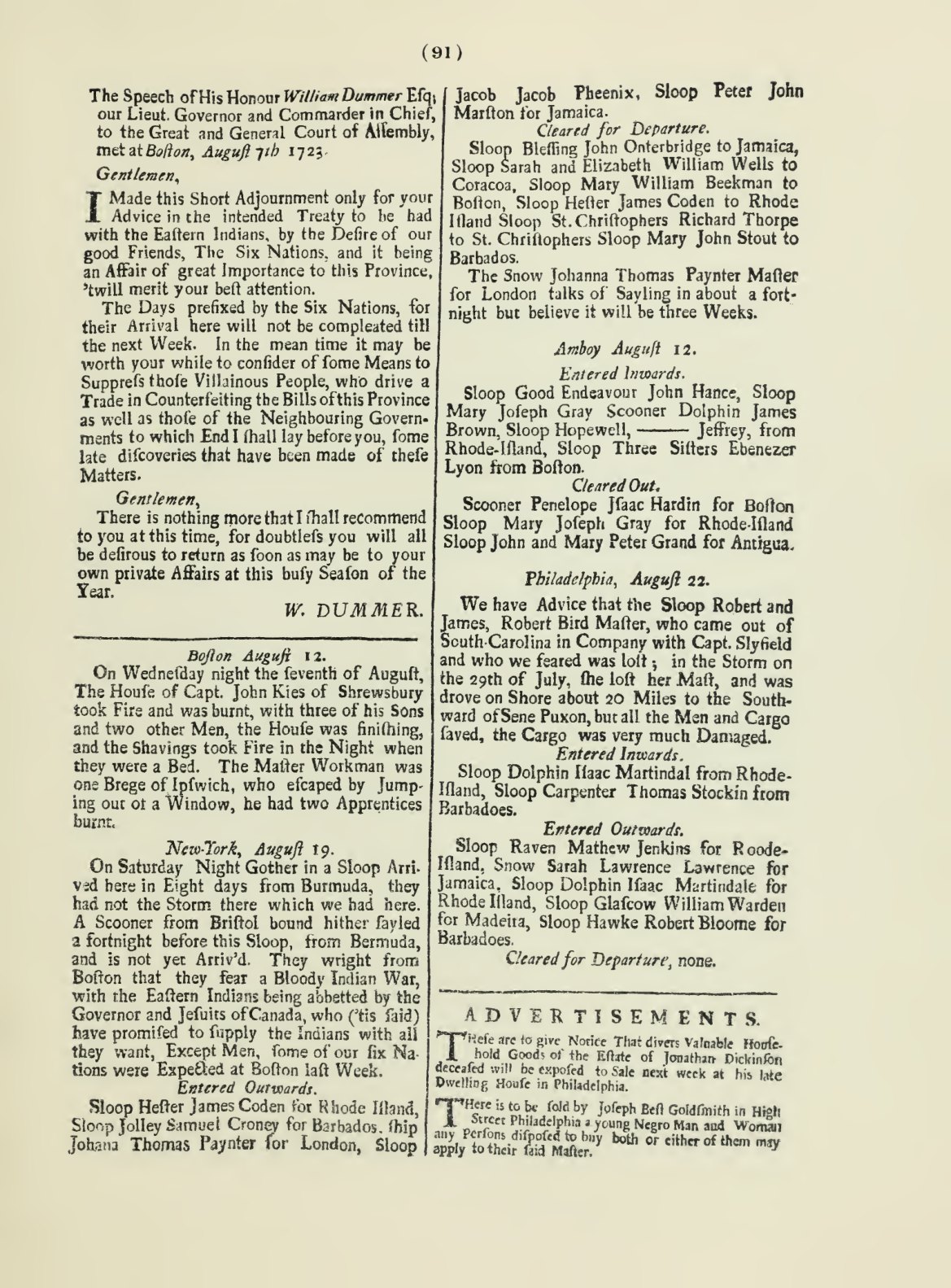
Source: Internet Archive (public-domain scan); americanweeklyme04brad.
How it is shown: Complete page, 110-dpi render from the Internet Archive PDF; no crop, no retouch, no search highlight.
Keep in mind: Confirmed on the page image. The paragraph does not name William Oakes: it is the Philadelphia paper's report of the same fire (Boston dateline 12 Aug 1723) and counts the two apprentices among 'two other Men'. It attributes the fire to shavings; the Boston News-Letter gives no cause. 'Kies' and 'Brege' are as printed. The 'Brege' paragraph is the only part of the page relied on.
Image details
The same item is also held as a scan of the issue's pages 3 and 4 from America's Historical Newspapers, dated August 22, 1723. It shows only what the paragraph above says: the fire and two unnamed apprentices. Page 4 carries an unrelated advertisement for a runaway servant that mentions a Shrewsbury, almost certainly the one in New Jersey. The Mercury corroborates the fire, not William's identity, since it prints no name.
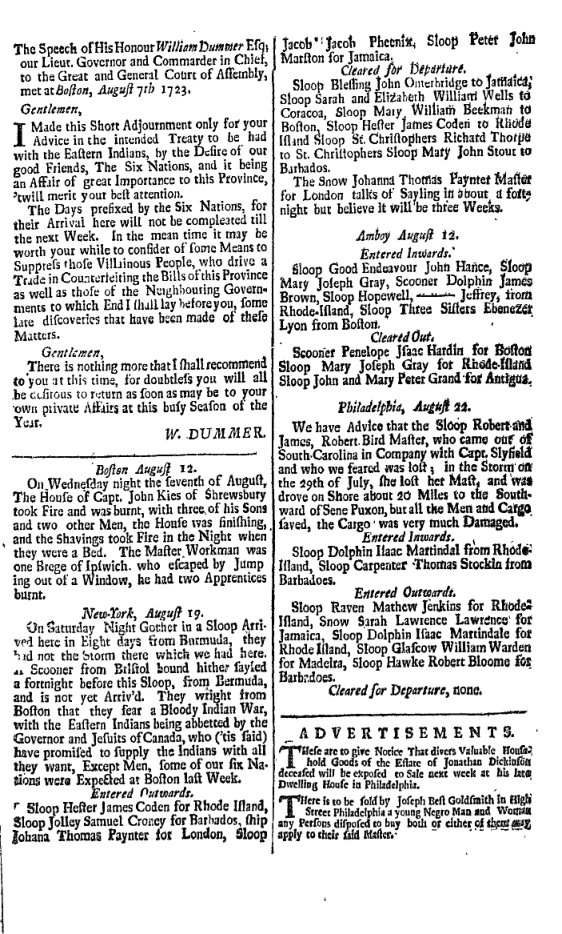
Source: The American Weekly Mercury, Philadelphia, 22 August 1723; America's Historical Newspapers (Readex), via AmericanAncestors.org
How it is shown: Complete page as supplied; no crop, no retouch, no search highlight.
Keep in mind: What the page says: Confirmed. The p. 3 item condenses the fire ('Boston August 12'), names Capt. John Kies of Shrewsbury and the master workman 'Brege of Ipswich', and says 'he had two Apprentices burnt'; it does not name them and has no Oak or Oakes text. The p. 4 advertisement for a runaway servant mentions a Shrewsbury that is almost certainly the New Jersey town and has no connection to the Oak family. IDENTITY: not applicable to a name, because none is printed. William Oak (1705-1723) is tagged only as the apprentice whose death the Boston News-Letter of 15 Aug 1723 reports (Likely at best, not Confirmed); this page corroborates the fire, not his identity.
Image details
The one death record found for the fire is in Marlborough's vital records: "BRAGG, Abial, Aug. 8, 1723." No record of William's death or burial has been found.
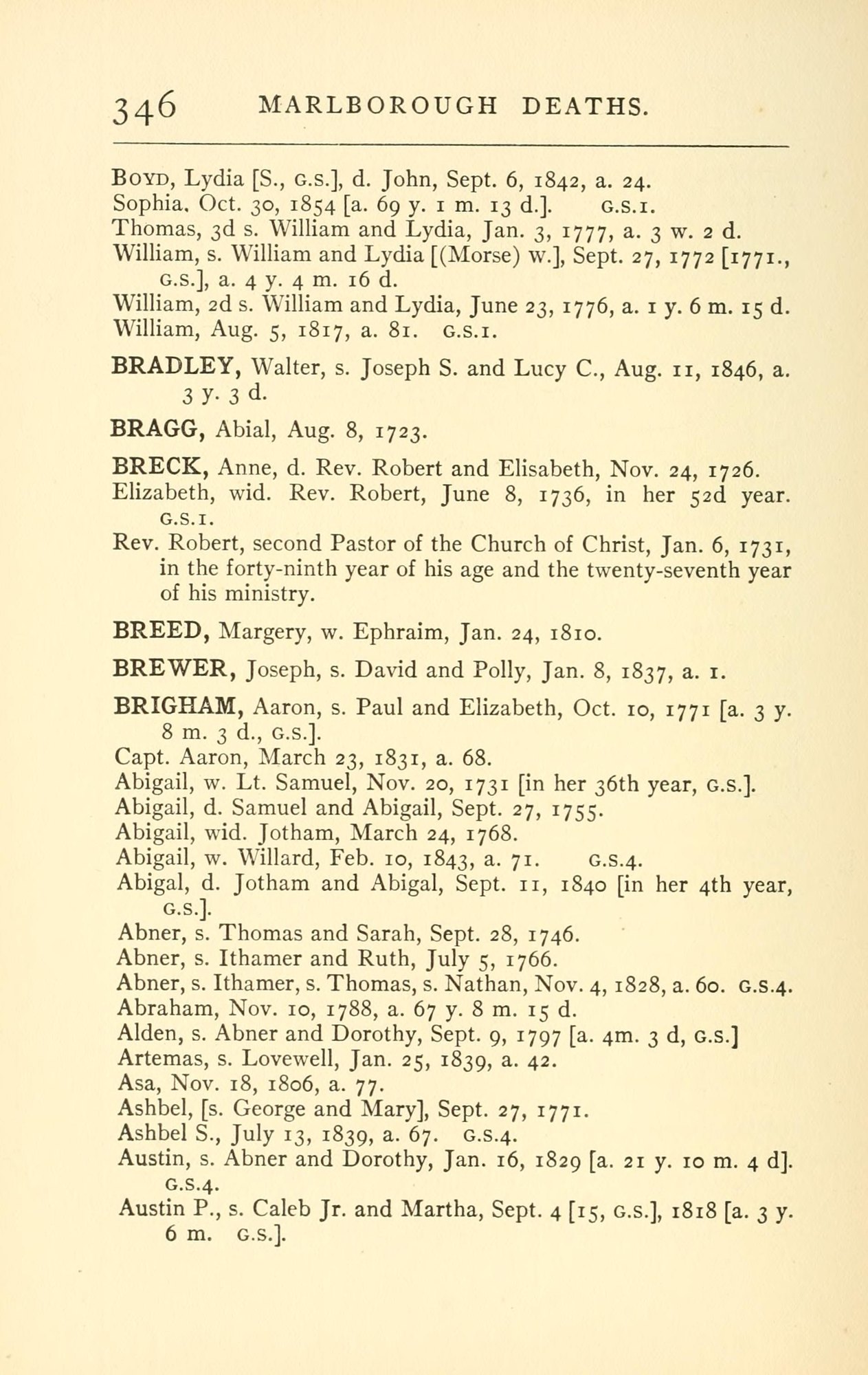
Source: Internet Archive (public-domain scan); vitalrecordsofma00marl.
How it is shown: Complete page as scanned; no crop, no retouch, no search highlight.
Keep in mind: Confirmed. The entry gives no age, parents, place or cause and does not mention the fire; the date is the day the fire's victims died (Boston News-Letter) and Marlborough is the Braggs' home town in the newspaper, so it is read as Abiel Bragg's death (inference). It does not name William Oakes.
Image details
Ebenezer Bragg, the carpenter
The carpenter was probably Ebenezer Bragg, born at Ipswich on November 13, 1699, who married Zeruiah Brigham at Marlborough on March 16, 1724, later lived at Shrewsbury and died there on September 4, 1766, "in his 67th year." He would have been 23 at the fire. The identification rests on converging details (the name, "formerly of Ipswich," Marlborough residence, the carpenter's trade, the age) and on two printed family books, the 1906 Oak register and a 1907 genealogy, that state it without a source. His will, made on November 28, 1760, with a codicil of August 27, 1766 and allowed on October 27, 1766 (Worcester probate case 6928), names his wife Sarah as executrix and the children John, Nathaniel, Timothy, Zurviah, Sarah, Martha, Ebenezer, Abiel, Moses, Elisabeth (wife of Silas Gates) and Mary (wife of George Brigham), and two grandchildren, Thomas and Samuel Briant, the children of his late daughter Lydia; it also mentions his late son Benjamin. He signed the codicil with his mark, and Artemas Ward witnessed both. No indenture or other record of his apprentices has been found.
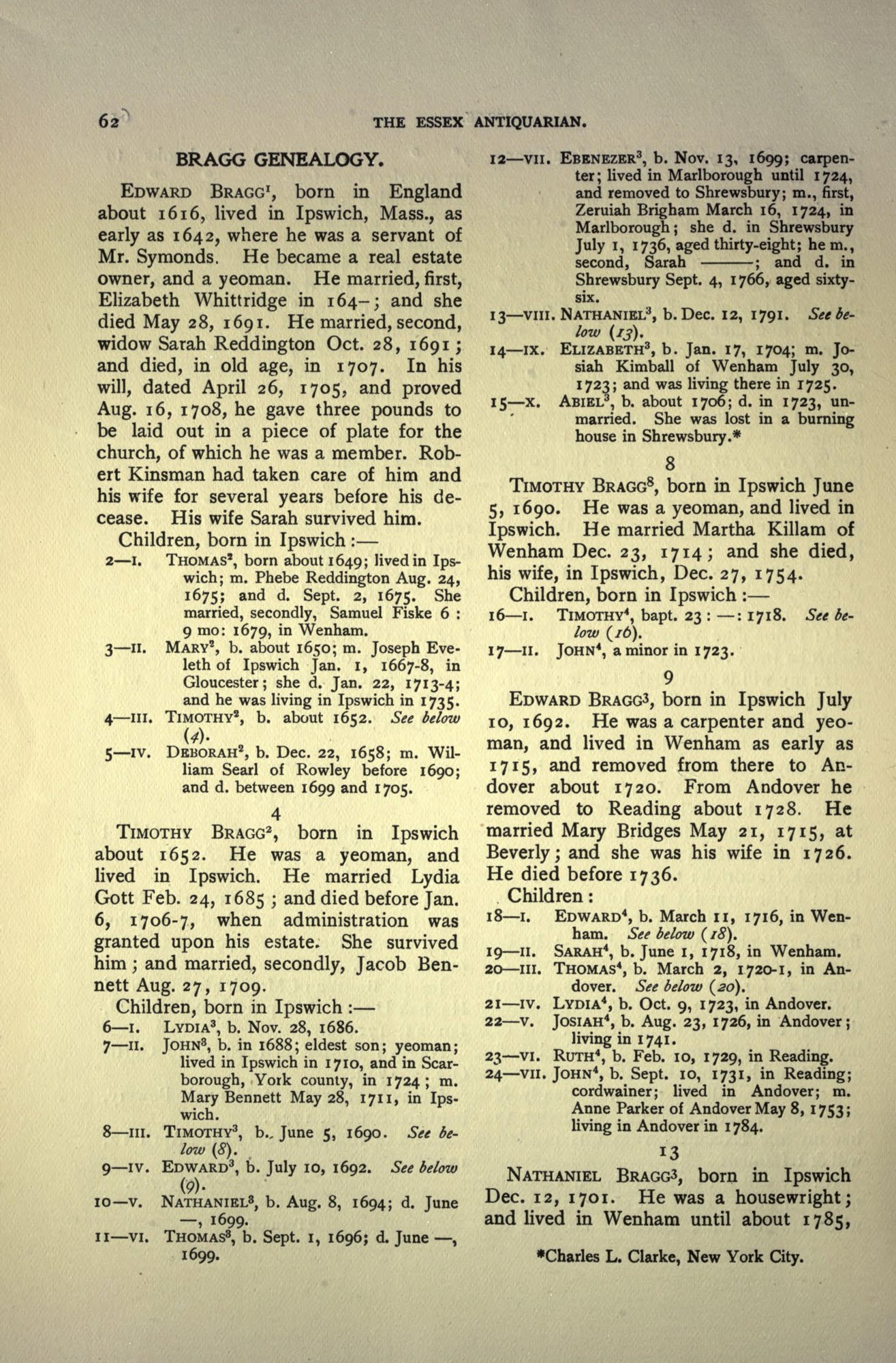
Source: Internet Archive (public-domain scan); essexantiquarian11perluoft.
How it is shown: Complete page as scanned; no crop, no retouch, no search highlight.
Keep in mind: Confirmed. The page does not name William Oakes: it records the carpenter's family and the death of his brother Abiel in the 1723 Shrewsbury fire in which William died. It cites no source for the fire (a footnote credits a contributor, Charles L. Clarke, New York City), calls Abiel 'She' (an evident error), and Abiel's 'about 1706' is derived from the newspaper's 'of 17 Years' (not an Ipswich birth record).
Image details
William Oake in his father's probate file
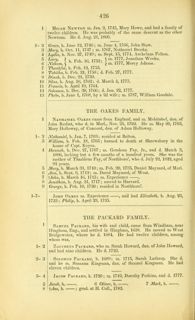
Nathaniel Oak died at Westborough about February 17, 1720/21 (the day is hard to read in the inventory). In early February 1721/2 Jonathan Forbush of Sutton took guardianship of eight of his children: Mary, Anne, John, Jonathan, George, Nathaniel, William and Hannah. Marlborough's vital records enter "William, s. Natthaniel and Mary, Feb. 18, 1705," which made him sixteen when the guardian was named. Charles Hudson's History of Marlborough gives the same birth date and adds, under Nathaniel's children, "William, b. Feb. 18, 1705; burned to death at Shrewsbury in the house of Capt. Keyes."
An earlier printed account ties the death to Nathaniel's family. Joseph Allen's history of Northborough, printed in the Worcester Magazine in 1826 (vol. 2, p. 152), says in a footnote that Nathaniel Oaks and his second wife, Mary, daughter of Adam Holloway, had eight children, one of whom, William, was "burned to death at Shrewsbury in the house of Capt. Keyes." This was probably the apprentice named in the 1723 News-Letter, but the footnote is a printed account of 1826, not a contemporary record, and gives no source.
The 1906 Oak family register tells the same story under Nathaniel's children. It gives William's birth as February 18, 1706, the day and month of Marlborough's entry but a year later, and says he "died unmarried August 8, 1723." He "was at work as carpenter's apprentice, with five other workmen, on a new house for Capt. John Keyes in Shrewsbury," and "only one man (Ebenezer Bragg) saved his life"; it adds that "An account of the disaster by Rev. Mr. Breck was published in the Boston Letter" (register, page 10). The register counts six workmen, but the News-Letter's five dead were two apprentices and three of the captain's sons, and the register gives no source.
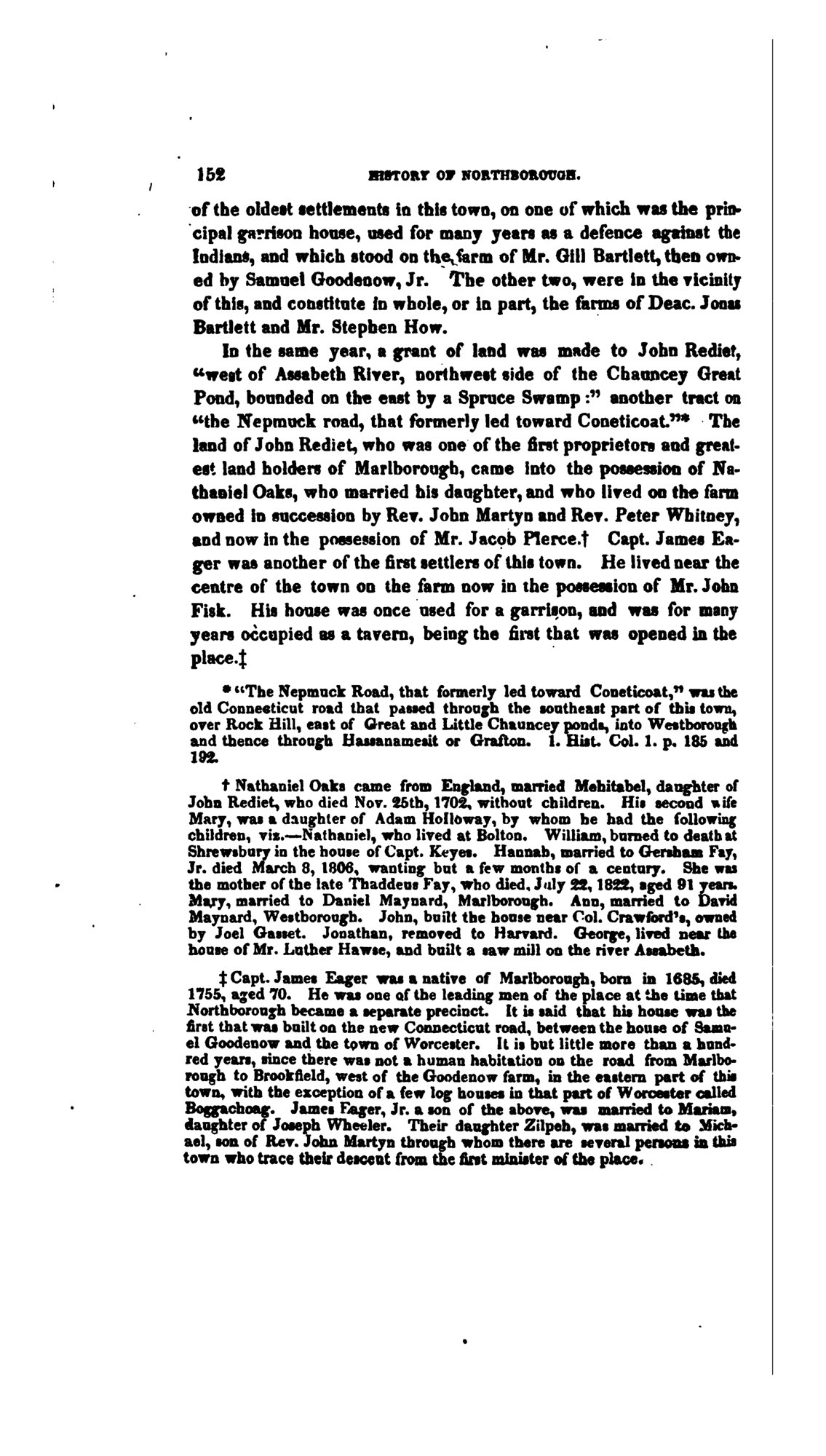
Source: The Worcester Magazine and Historical Journal, vol. 2, Worcester, 1826; Internet Archive (public domain).
How it is shown: Complete page as supplied; no crop, no retouch, no search highlight.
Keep in mind: What the page says: Confirmed. The footnote says Nathaniel Oaks came from England; married Mehitabel, daughter of John Rediet, who died 25 Nov 1702 without children; his second wife Mary was a daughter of Adam Holloway; the children were Nathaniel (of Bolton), William (burned at Shrewsbury in Capt. Keyes's house), Hannah (m. Gershom Fay Jr., d. 8 Mar 1806), Mary (m. Daniel Maynard, Marlborough), Ann (m. David Maynard, Westborough), John, Jonathan (removed to Harvard) and George. The text says nothing of a shipwreck, a cabin boy or a catamount; it is a printed account of 1826, not a contemporary record. Whether these are our people: the page names Nathaniel Oaks of Marlborough, his two wives and his children, and the tree holds the same parents and the same eight children with the same spouses (Likely for each child, since the tie to Nathaniel rests on this 1826 account). That the 'William' of the footnote is the William Oakes aged 18 named in the Boston News-Letter of 15 Aug 1723 is Likely, not Confirmed: the footnote is a later secondary account. Not tagged: John Rediet and the other people named on the page.
Image details
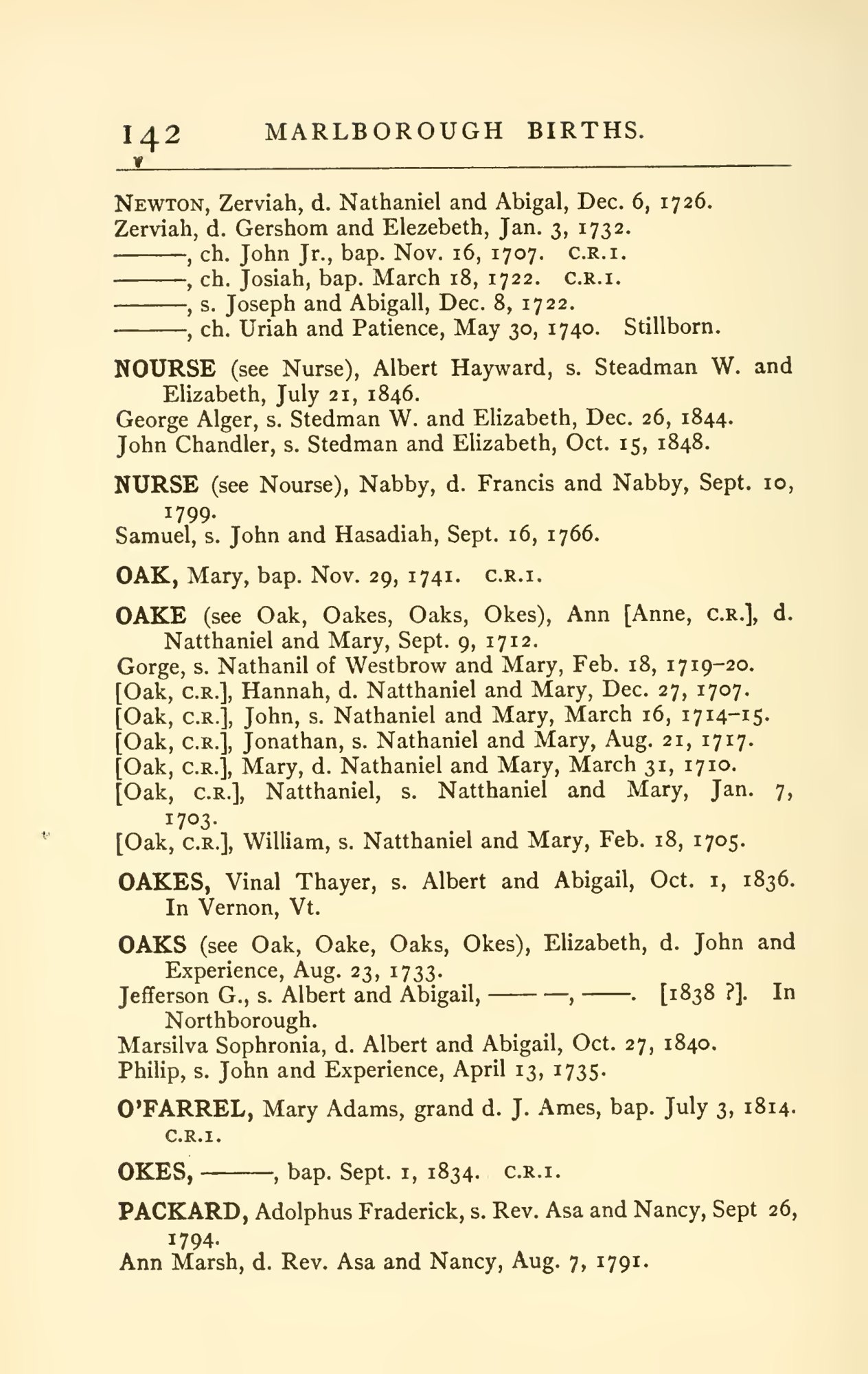
Source: Vital Records of Marlborough (NEHGS, 1908); Internet Archive (public domain)
How it is shown: Complete page as supplied; no crop, no retouch, no search highlight.
Keep in mind: What the page says: Confirmed from the page image, with the dates as printed: Ann, d. Natthaniel and Mary, Sept. 9, 1712; Gorge, s. Nathanil of Westbrow and Mary, Feb. 18, 1719-20; Hannah, Dec. 27, 1707; John, March 16, 1714-15; Jonathan, Aug. 21, 1717; Mary, March 31, 1710; Natthaniel, Jan. 7, 1703 (the year is printed 1703); William, Feb. 18, 1705; most with the note that the church record spells the name Oak. The same page prints 'OAK, Mary, bap. Nov. 29, 1741,' a different, later Mary, and later Oakes and Oaks families (Albert and Abigail; John and Experience) that are not Nathaniel's line. Whether these are our people: Likely, not Confirmed. The eight names, their birth order and the parents' names 'Natthaniel and Mary' match exactly the eight children the 1826 Worcester Magazine footnote gives to Nathaniel Oaks and Mary Holloway, and the tree holds the same eight; the page names no surname for Mary, and the tie to the tree's Nathaniel Oak(e) and Mary (Holloway) Oak rests on that match and the Marlborough place. William (b. 18 Feb 1705) is Likely the William Oakes of 18 who died in the 1723 Shrewsbury fire, by age alone. The 1741 baptism is not tagged. A caution on the date: Natthaniel's 7 Jan 1703 falls in the old-style January-to-March window, where a year written plainly as 1703 is often meant as 1703/4 in today's reckoning; the page does not say which the clerk meant. The parents' own Concord marriage, dated "March ye 2d 1703," carries the same ambiguity and is not independently resolved either (see the Nathaniel Oake story). This is a caution about reading the date, not a claim that one reading is correct.
Image details
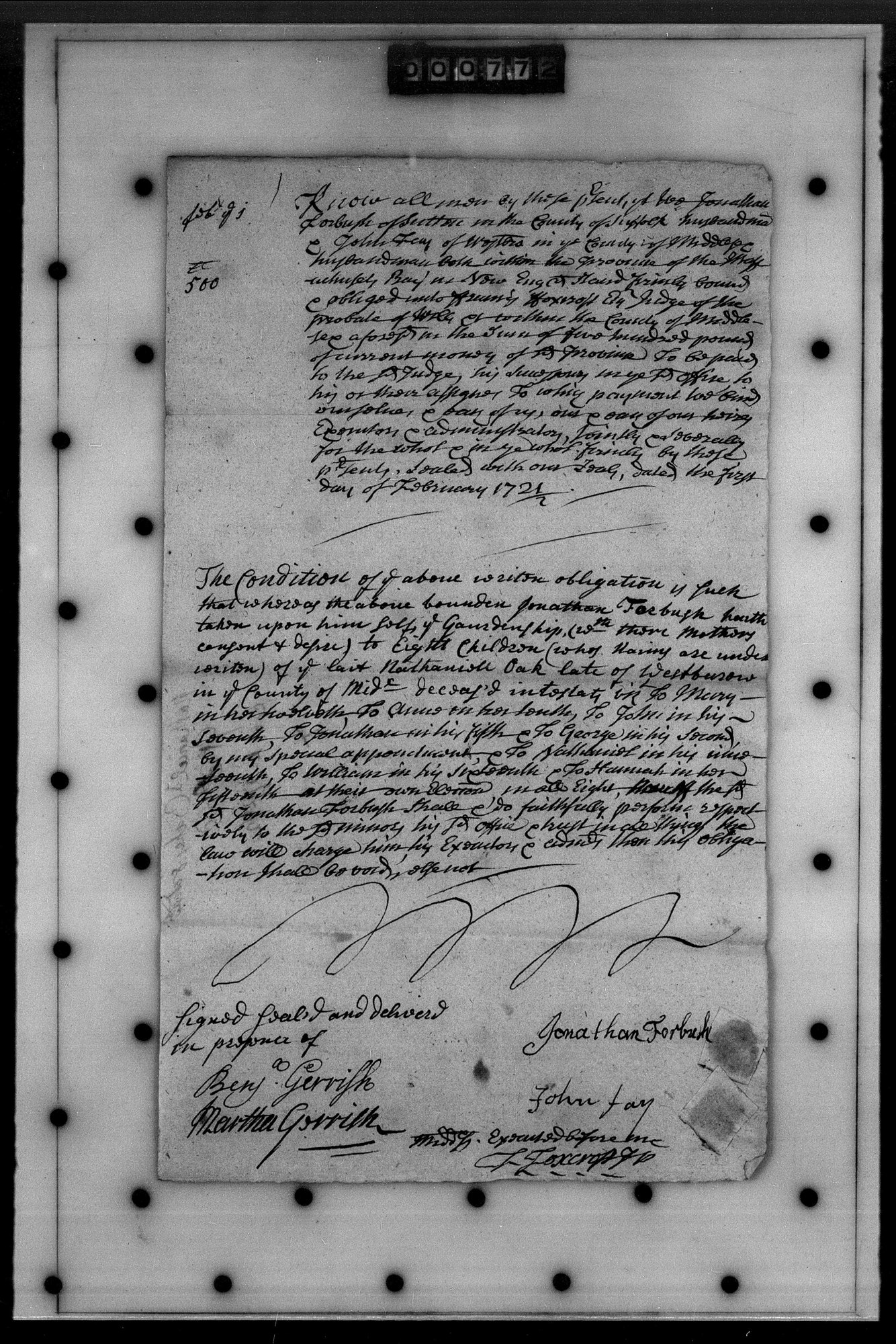
Source: FamilySearch, Probate records 1648-1924 (Middlesex County, Massachusetts), film 007553698, image 774.
How it is shown: Complete frame (original, unaltered); no crop, no retouch, no search highlight.
Keep in mind: Transcribed (frames 766-782); a first reading was made. Confirmed: the eight children and the ordinals for John (seventh), Jonathan (fifth) and George (second). Likely: Anne (tenth) and Hannah (fifteenth). Not reliably read: the ages for Mary, Nathaniel and William. Date and sum Likely. Tagging the eight to the tree's persons rests on the names and the 1906 register order (Likely).
Image details
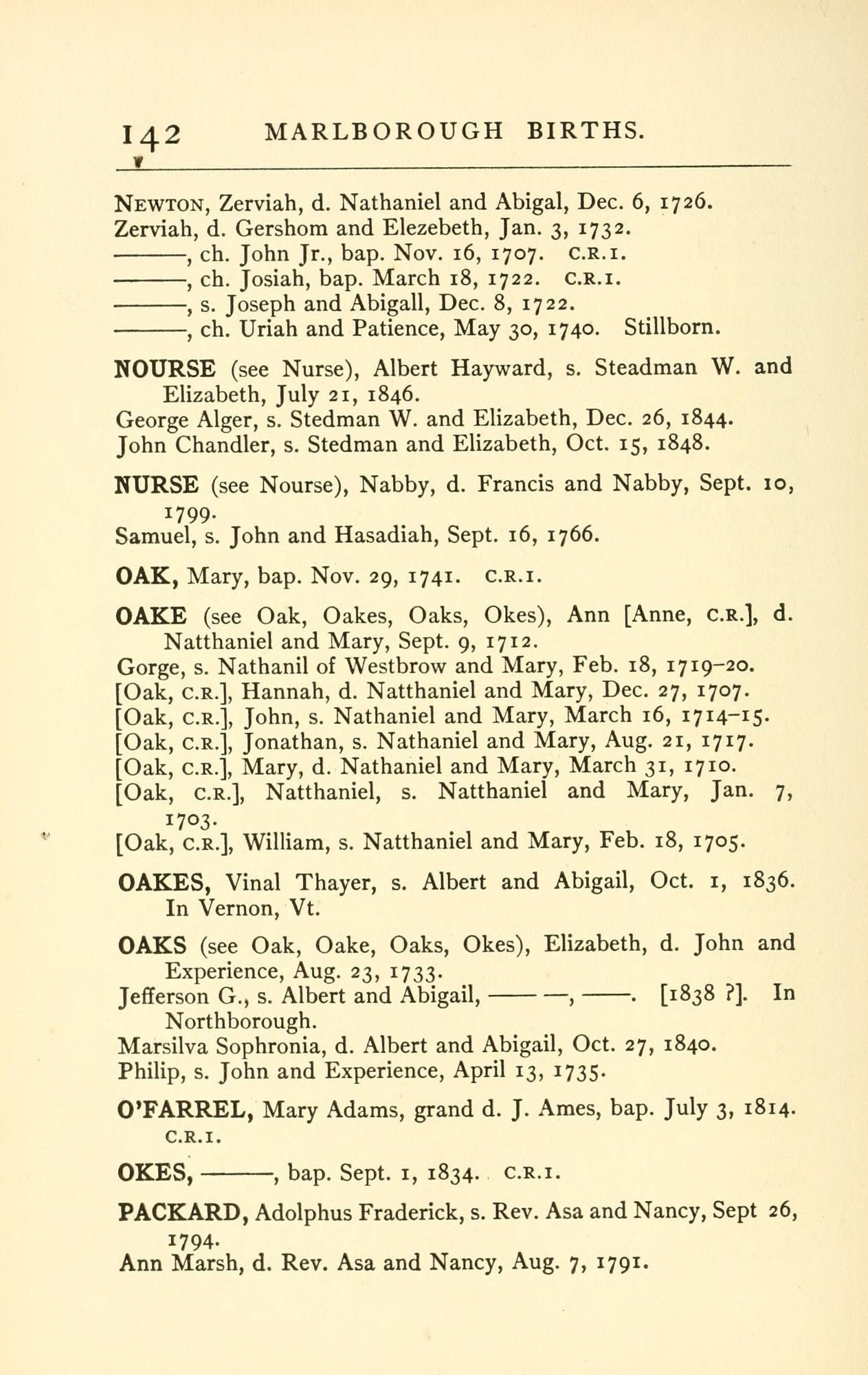
Source: Internet Archive (public-domain scan); vitalrecordsofma00marl.
How it is shown: Complete page as scanned; no crop, no retouch.
Keep in mind: A printed transcription of the town's record, not the manuscript.
Image details
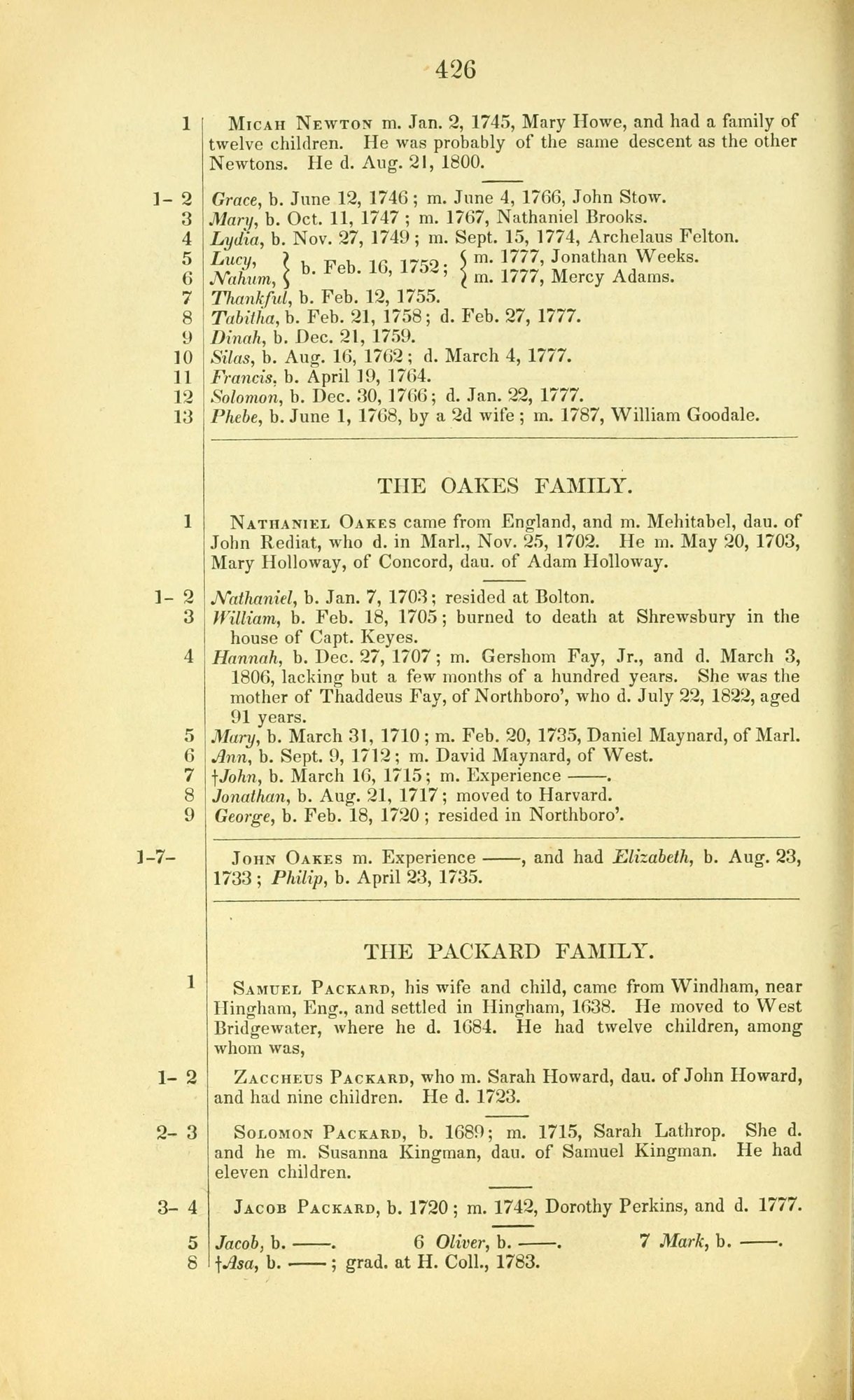
Source: Internet Archive (public-domain scan); historyoftownofm00huds.
How it is shown: Complete page as scanned; no crop, no retouch.
Keep in mind: A printed book, not an original record.
Image details
Whose son was William Oakes?
The newspaper does not say whose son William Oakes was. What links him to Nathaniel's son is Allen's 1826 footnote, Hudson's entry and the matching age: a boy born in February 1705 was eighteen in August 1723, or seventeen if the clerk's year was Old Style, which fits the paper's "18" within the slack its other ages show. The page image of the issue itself, Peter Whitney's History of the County of Worcester (1793) and the Parkman Project's transcription all read 18. Andrew Ward's 1847 history of Shrewsbury gives "William Oakes, 16" in a footnote, but his own 1826 text reads "Oaks, of 18," so the 16 is unsourced. The transcription's heading calls William "the son of Natthaniel and Mary Oak[e]," but that note is modern and gives no source. He is not among the heirs in 1729, which fits his death in 1723. A different William Oake, baptized at Westborough on April 21, 1728, was a son of another Nathaniel and cannot be this William.
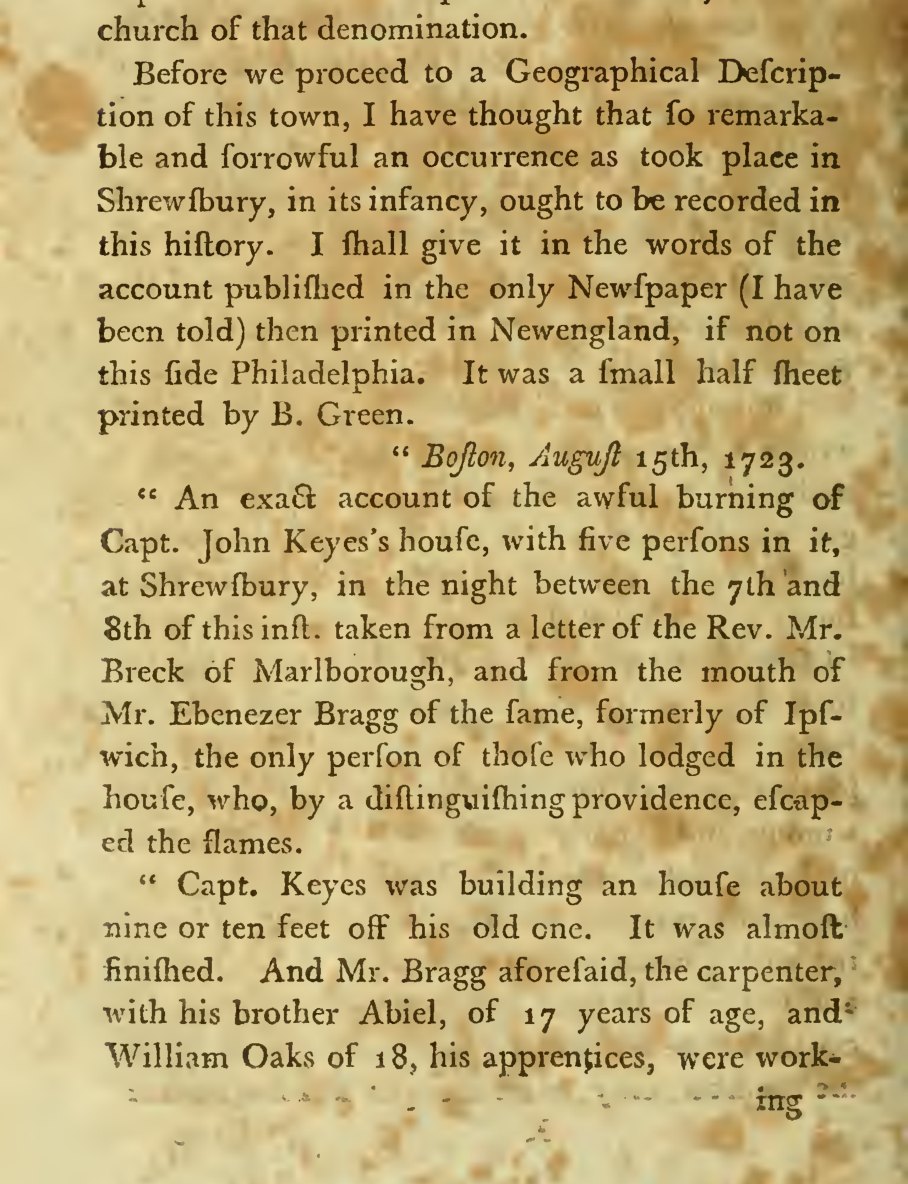
Source: Internet Archive (public-domain scan); historyofcountyo00whit.
How it is shown: CROP of the page image (the upper part of the printed page, down to the line ending 'were work-'); the full-page image is not held in the folder; no retouch, no search highlight.
Keep in mind: Confirmed. Whitney says he is quoting the Boston paper of 15 Aug 1723. Whitney prints the surname Oaks; Ward (1847) prints 'William Oakes, 16'. Whitney's 'only Newspaper' is wrong (the Gazette and the Courant also ran). The identification of the apprentice as the son of Nathaniel Oak(e), b. 18 Feb 1705, is Hudson's (1862, p. 426) and is Likely, not proven.
Image details
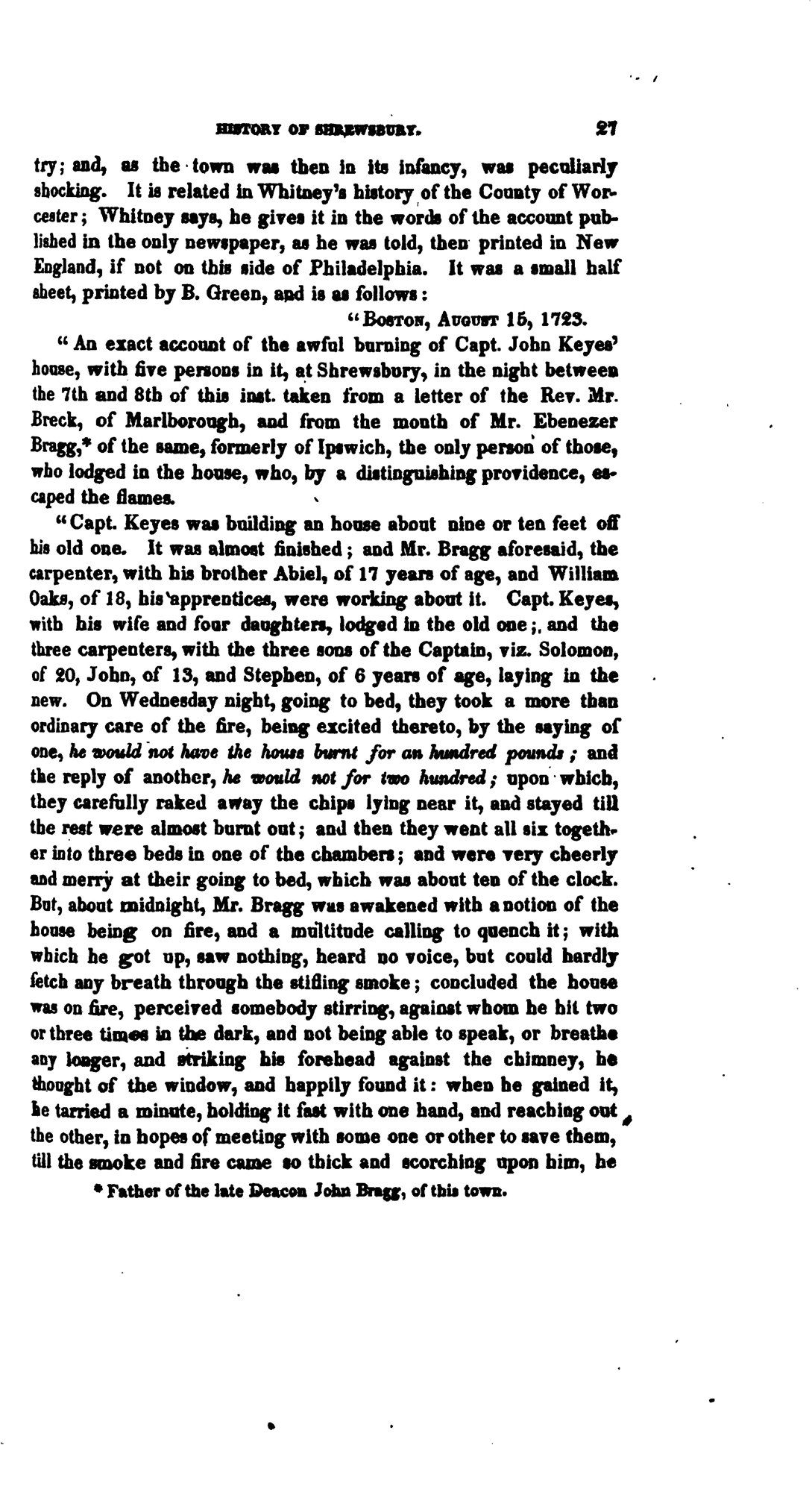
Source: Internet Archive (public-domain scan); worcestermagazi00unkngoog.
How it is shown: Complete page image; no crop, no retouch, no search highlight.
Keep in mind: Confirmed on the page image: 'of 18'. A second Internet Archive copy (Allen County copy) is so faint that its text comes out as 'of 10'; that is a scanning artifact, not the print. The footnote on this page calls Ebenezer Bragg father of the late Deacon John Bragg. The text is Ward's quotation of Whitney, not an independent reading of the 1723 paper.
Image details
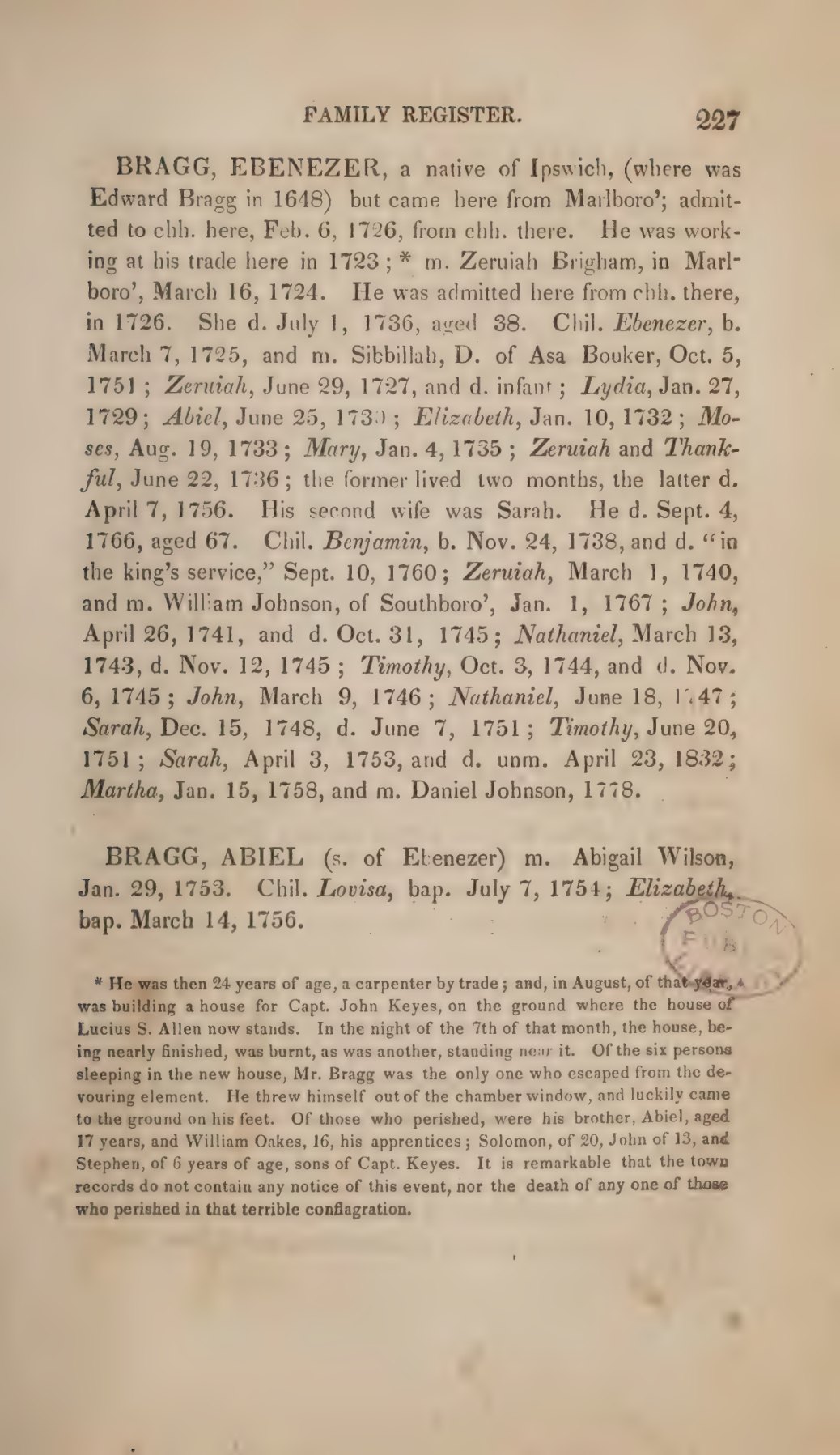
Source: Internet Archive (public-domain scan); historyoftownofs00ward_2.
How it is shown: Complete page, rendered from the Internet Archive PDF (BPL copy); no crop, no retouch, no search highlight; the library stamp is on the original.
Keep in mind: Confirmed on the page images of three copies (BPL, NYPL, LoC): 'William Oakes, 16'. Ward's own 1826 text and Whitney give 18; Ward 1847 does not say where 16 comes from, so 16 is an unsourced variant. The footnote says 'the night of the 7th'. The page carries a library ownership stamp. The identification of the apprentice as Nathaniel Oak(e)'s son William is Hudson's (1862, p. 426), Likely.
Image details
An indenture or court entry naming William's parent or guardian under Ebenezer Bragg could settle the identification; none has been found.
Sources
- Boston News-Letter, No. 1020, August 15, 1723, p. [2], page image, Native Bound Unbound (FromThePage). fromthepage.com/nativeboundunbound/native-bound-unbound-english-language-documents/boston-news-letter/display/35900941
- The same issue and page, a clean Readex scan: image on this site, offered alongside the FromThePage copy above.
- Ebenezer Parkman Project, transcription of the Boston News-Letter, August 15, 1723, p. [2]. www.ebenezerparkman.org/wp-content/uploads/2021/12/Fire-John-Keyess-House-Shrewsbury-Aug.-7-8-1723-transcription.pdf
- American Weekly Mercury, No. 192, August 15-22, 1723, p. [3] (Boston dateline August 12), facsimile in the Mercury volume at archive.org (americanweeklyme04brad); and the issue of August 22, 1723, pp. 3-4, America's Historical Newspapers (Readex), via AmericanAncestors.org.
- Ebenezer Parkman, diary, August 9, 1723, with the editors' footnote. www.colonialsociety.org/documents/ebenezer-parkman-world-diary-1723
- Peter Whitney, The History of the County of Worcester (1793), quoting the Boston News-Letter, as transcribed by the Shrewsbury Historical Society. www.shrewsburyhistoricalsociety.org/shrewsbury-1793
- Charles Hudson, History of the Town of Marlborough (1862), p. 426. archive.org/details/historyoftownofm00huds
- Middlesex County, Mass., probate papers, cases 16185 and 16186 (1721-1722): the guardian's bond, film 007553698, frame 774.
- Joseph Allen, "History of Northborough," Worcester Magazine and Historical Journal, vol. 2 (1826), p. 152 (footnote on Nathaniel Oaks and his children). archive.org/details/worcestermagazi00unkngoog/page/n159/mode/1up
- Andrew H. Ward, History of the Town of Shrewsbury (1847), p. 227, and his 1826 text, p. 27.
- Vital Records of Marlborough, Massachusetts, to the End of the Year 1849: William's birth, 18 February 1705; pp. 227, 346.
- Vital Records of Ipswich, vol. I, pp. 44-45; Vital Records of Shrewsbury, pp. 131, 245.
- Colonial Society of Massachusetts, Check-List of the Boston News-Letter: issue of 15 August 1723, No. 1020.
The full account of Nathaniel is on Nathaniel Oak and the cabin-boy story, and the searches made for him are summarized on its research log.