American Acorns
Politics and religion on the Oak line
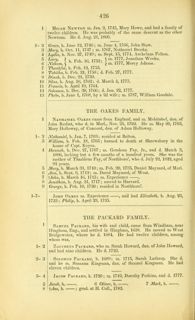
For three centuries the Oaks served their towns as surveyors, constables, clerks and legislators, and the records tie them to Congregational, Methodist, Baptist and Shaker congregations; one became a Mormon elder. The immigrant, Nathaniel Oak(e), was taxed under the Andros government in 1688 and appears on Marlborough's March 1691/2 garrison list. Hudson's printed list puts "Nathaniel Oakes" in Samuel Goodnow's garrison in an assignment Hudson dates 1711 (Likely). The 1906 family register and a 1903 sketch credited to its compiler, Henry L. Oak, both say that in 1707 he fought in that garrison's battle with Native Americans, but neither cites a roll, and Hudson's account of the fight mentions only one man and does not name him, so his part in the fight is unconfirmed. A church named at a baptism or a wedding shows where the ceremony was held, not what a person believed; each affiliation below says which kind of record it comes from.
Town offices, three centuries
The immigrant's son Nathaniel Oake Jr. was chosen surveyor of highways at Westborough in 1732/3 and 1735/6, and had a town rate abated in 1733. The two records probably concern the same man.
Jonathan Oak, probably the immigrant's son born in 1717, sat in the third seat of Harvard's 1766 meeting-house reseating under the title "Capt." (Confirmed as recorded). The 1906 family register adds that he served as juryman, constable, tithingman and tax collector at Harvard from 1750 to 1770; those offices rest on the register alone (Likely). No commission for his rank has been found. His life is on Captain Jonathan Oaks.
In 1794 the town of Chelsea, Vermont, voted Nathaniel Oak nineteen and a half bushels of wheat for building its pound, stocks and sign-post, and the vote itself confirms it. The town's centennial history recalls him as its "acting sexton," a later recollection (Likely). His son Benjamin Hastings Oak appears on Chelsea's printed lists as town clerk in 1807 and as the town's representative to the Vermont legislature in 1810, and the printed entries confirm both. The family register says he served as clerk until 1812 (Likely). Their fuller stories are on Nathaniel Oak of Chelsea, Vermont and Benjamin Hastings Oak, which also covers Benjamin's years as a Garland selectman and treasurer.
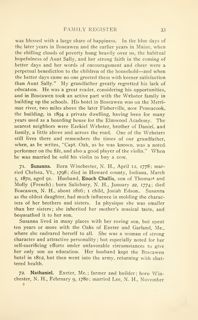
Benjamin's son Lyndon Oak of Garland, Maine, held elected office in the Maine House. Garland's printed town history records his election on the ninth trial, February 26, 1844, on the Liberty party ticket, and a second term won in 1845 on the "Anti-Slavery" ticket. The same history names him as a Republican candidate for the State Senate in 1856, without saying whether he won that race. The town's printed returns are the source for these elections (Likely). The same history and an 1886 public document list him as a trustee of Maine State College from at least 1875 and as president of its board of trustees by 1885/86, and those two printed lists confirm it.
A family sketch adds that he served in the legislature "at different times from 1843 until 1867," though the town returns put his first election in 1844 and his last in 1868. The sketch also says he ran an independent protest candidacy for Congress in 1876 and declined a Republican nomination for Governor in 1880. His obituary in the Bangor Daily Commercial (February 19, 1902, as transcribed by the Lyndon Oak Memorial Library) tells the governorship story with the year 1879: party leaders "with Mr. Blaine at their head" offered him the nomination, which "promised to be a very expensive honor," and it went to Daniel F. Davis. The same obituary says he was elected to the state Senate in 1856, "in the following year" after his 1855 defeat, and that in 1869, elected to the House after refusing to pledge his vote in advance, he "threw the one deciding vote" that sent Hannibal Hamlin to the United States Senate.
The obituary quotes an unnamed Bangor politician: "no man, not even making an exception in favor of the late James G. Blaine, was the power behind the appointment and election of more men to office than Mr. Oak." He was a trustee of the college at Orono from 1867 to 1888, its board's president for the last six of those years, and for six years a trustee of the insane hospital at Augusta. These come from the sketch, the obituary and a biographical sketch reprinted from the Bangor Whig and Courier in his lifetime (shown on his story); the legislative journals have not been checked. The Maine State Library's digital collections and period Bangor and Kennebec newspapers may settle them. His full story is on Lyndon Oak of Garland.
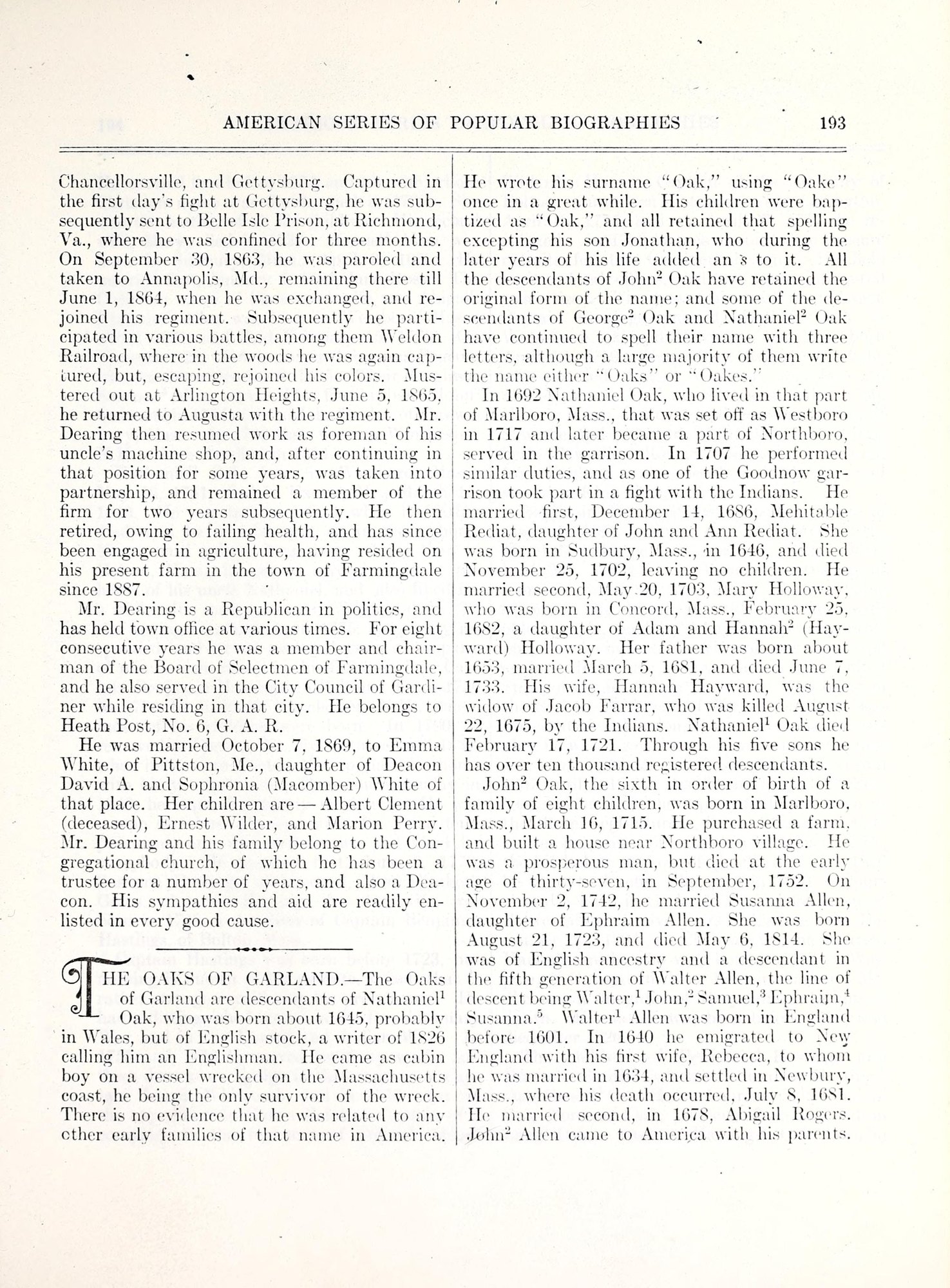
Source: Internet Archive (public-domain scan); biographicalsket00newe.
How it is shown: Complete page as supplied; no crop, no retouch, no search highlight.
Keep in mind: Written by Henry L. Oak, the compiler of the 1906 register: one witness, not two (Main's review, 2 Oct 2026). Family-written text; several dates in it are wrong (see the review). Unconfirmed where only this text says it.
Image details
His brother Lorenzo Oak appears in the same town's returns as treasurer and town clerk through the 1840s and 1850s, and the 1903 family sketch sums up his service: "Town Clerk in Garland six years, on School Committee five years, Selectman and Town Treasurer twenty-two years, Assistant Assessor of Internal Revenue four years, and Representative to the Legislature in 1873" (p. 197). The town returns give him more years as clerk than the sketch does. Their youngest brother, Edson, "filled many offices in the town of Garland, including that of Representative to the Legislature" (p. 198).
The next generation of the Garland family went into public office too, by the same sketch (pp. 196-199). Lyndon's son John Marshall Oak was appointed postmaster of Bangor by President McKinley on October 1, 1898, reappointed by President Roosevelt in 1903, and in 1896 was president of the Eastern Maine Republican Club. Edson's son Charles Edson Oak was appointed Land Agent and Forest Commissioner of Maine in 1892, "and later Fish and Game Commissioner," until 1901. Edson's son-in-law, Capt. Joseph A. Clark, had been a member of the legislature and "United States pension agent in 1889-93."
Captain Jonathan's line had its officeholders as well. The 1906 register describes Col. William Oakes of Sangerville as "colonel of militia, holding town, county and state offices" (p. 44), and his cousin Col. Calvin Sanger Douty as "Deputy Sheriff and twice Sheriff of Piscataquis county" (p. 53); Seth Oak's son-in-law Capt. Samuel Wiswell of Townshend, Vermont, "held town offices, and was lieutenant of militia" (p. 29). Their families are on Captain Jonathan's grandchildren.
Revolutionary-era politics: committees, a court-martial, and old men's words
Captain Benjamin Hastings of Bolton, whom a 1903 sketch of the Oak family names as the father of the Susanna Hastings who married Nathaniel Oak Jr. in 1773 (Unconfirmed), commanded Bolton's minute company at the Lexington alarm in 1775, as the Bolton company roll confirms. Lemuel Wood's journal of the 1759 Crown Point expedition records a captain named Hastens dismissed "with Disgrace" for refusing to work without pay, and Nourse's Military Annals of Lancaster associates that officer with Benjamin Hastings of Bolton. Both printed statements are confirmed, but the identification, and whether the 1759 captain and the 1775 one are the same man, rest on name and town only (Likely). His full record is on Benjamin Hastings of Bolton.
John Oaks of Exeter, Maine, swore in 1818 that he was "now reduced & need[s] the assistance of my country for support," after three Revolutionary enlistments beginning in 1776, as his declaration confirms; a pension of $8 a month followed. An 1899 newspaper feature and the family register separately say he served at Bennington and carried dispatches to Quebec "at the commission of Washington." His pension file names no battle at all, so those stories are family tradition, and the events themselves are unconfirmed. His story, including the proof problems his widow Abigail faced, is on John Oaks of Exeter, Maine.
Two men who married into the family took up committee work during the Revolution. Ebenezer Conant Jr., an ensign in 1774 and lieutenant on Ashburnham's April 19, 1775 roll, served nine months' Continental duty in 1779, as his printed service record confirms; a secondary town history names him to Ashburnham's committee of correspondence (Likely). Jonathan Sampson Sr., husband of Mary Oak, served on Dorchester Canada's committee of correspondence in the mid-1770s and was later a selectman and proprietors' treasurer there, by the same town history (Likely).
Anti-slavery politics and a family divided by the Civil War
Lyndon Oak's first election, won on the Liberty party ticket against the major parties, is the family's clearest documented tie to organized anti-slavery politics. In the town history he wrote, he recalls telling constituents who asked when slavery would end that it would be "a long period of waiting" but "sure to come" (Likely). His nephew Henry Lebbeus Oak, the son of Lyndon's brother Lebbeus and the 1906 register's compiler, wrote of himself, in an autobiography his brother printed, that "from being a Republican he has become essentially a 'Mugwump,'" the label for Republicans who broke with their party in 1884 (Likely).
The generation that followed fought on both sides. Joseph Oliver Evans, great-grandfather of Ivan Oak, served in the Union's 3rd Maine Infantry from 1861 to a disability discharge in 1862, and his record confirms it. Joseph M. York is probably the man of that name in the 30th Maine, mustered in 1863. Jeremiah Holloway's record names Company C of the 43rd Mississippi Infantry, part of the Vicksburg garrison, with a parole dated July 1863 (Likely). The 1906 register's preface says the family was fairly represented "on both sides in the War of 1861-5" and that in politics and religion "they have never been extreme partisans or fanatics." That generalization is unconfirmed, and the only Confederate case is itself likely, not certain.
Church covenant and discipline in colonial Massachusetts
The family's documented church life begins in dispute. Hudson's history of Marlborough lists "Nathaniel Oakes" among those who "sustained Mr. Emerson" when the town argued over settling a minister, and the 1906 register separately says he signed the 1702 call to Rev. John Emerson. The printed list is confirmed; his tie to the town church is inferred from it, not from a membership record. Adam Holloway, father of the immigrant's wife, Mary, is listed on the opposing side of the same dispute.
Mary Holloway's church life is unusually well documented. The Westborough church ledger records that she and her second husband, probably Thomas Rice Jr., "confessed their Sin of fornication" and were restored to communion in 1727, with children baptized the same year. Later entries have her present at a 1744 wedding and nursing in the minister's household in 1736 and 1749. The transcribed church ledger and Parkman's diary confirm all of it. Her story is on Mary Holloway.
Her son Nathaniel Oake Jr. and his first wife, Tabitha Rice, both appear in the same Westborough ledger: Tabitha admitted to communion in November 1727, Nathaniel "ownd ye Covt" in April 1728, with their two sons' baptisms entered in 1728 and 1733, all confirmed by the ledger. Nathaniel's second wife, Kezia Maynard, whom he married in 1736, had her transfer to Bolton's church recorded in 1749, after their five children's baptisms were entered between 1737 and 1743, again confirmed by the ledger. Their fuller story is on Nathaniel Oake Jr. and Kezia of Bolton.
For a few years Nathaniel Jr.'s house was also a meeting-house of sorts. About 1741 Westborough's north-side families began holding their own services "in the house of Mr. Nathaniel Oake," and on April 3, 1743, Parkman, after "much hesitation and consultation," baptized seven people there. The north side became a separate precinct in October 1744 (DeForest and Bates, The History of Westborough, 1891, pp. 109-112).
Jonathan Oaks of Harvard, probably a brother of this Nathaniel Jr., has his children's baptisms at Harvard entered from the 1740s to the 1770s, all confirmed. The 1906 register separately claims he was "dismissed with wife from the Marlboro church" in 1741 and was "apparently not a church member" afterward. That claim is not in the Marlborough church pages read so far, and it is unconfirmed.
Methodist and Baptist leadership on the frontier
Nathaniel Oak of Chelsea, Vermont, died at Exeter, Maine, in 1840, by Hale's account "while happily praising God in a love feast," a Methodist gathering, after walking to the meeting house and collapsing. A contemporary newspaper notice confirms the walk and the sudden death but does not name the gathering. The 1906 register's further claim that he was "an active Methodist" who also let his hotel hall be used for Congregational meetings rests on the register alone (Likely).
John Oaks of Exeter isn't established as this Nathaniel's son; he's a candidate son of Captain Jonathan Oaks instead. The register calls him "a zealous Baptist" whose barn often hosted meetings. That description and the parentage both come from the register alone (Likely). A wedding guest's deposition in his widow's pension file confirms only that a Rev. Ezekiel Emerson performed his 1783 wedding, without stating a denomination.
Captain Jonathan's son William, the Baptist elder William Oakes of Sangerville, was "ordained as a preacher in 1815; deposed in 1821; and reinstated in 1826," per the register; he is a different man from Col. William Oakes of Sangerville (p. 44). A separate 1849 printed history of Canaan and Norridgewock confirms an 1815 Canaan ordination and a later deposal from the ministry without naming the denomination. Read together, the two printed accounts make the identification likely, not certain.
The register gives two more preachers and churchmen in Maine. Nathaniel Oak of Exeter, Captain Nathaniel's son, was "a leading member of the Baptist church" (p. 34). John Ames Oaks of Garland, "farmer and Methodist preacher," was "a good-natured, hard-working man, who preached and traded horses at intervals" (pp. 43-44). Henry, the compiler, remembered John Ames Oaks treating him to maple syrup as a boy, though "the two families lived in Garland for half a century, neither knowing of any relationship between Oaks and Oak."
Samuel Oak and his wife, Lucinda Allen, anchor the clearest Baptist record on the line. Their 1847 marriage return names Bloomfield's First Baptist pastor as the officiant, and Samuel's 1900 funeral was conducted by that church's pastor, as the marriage return and his funeral notice confirm.
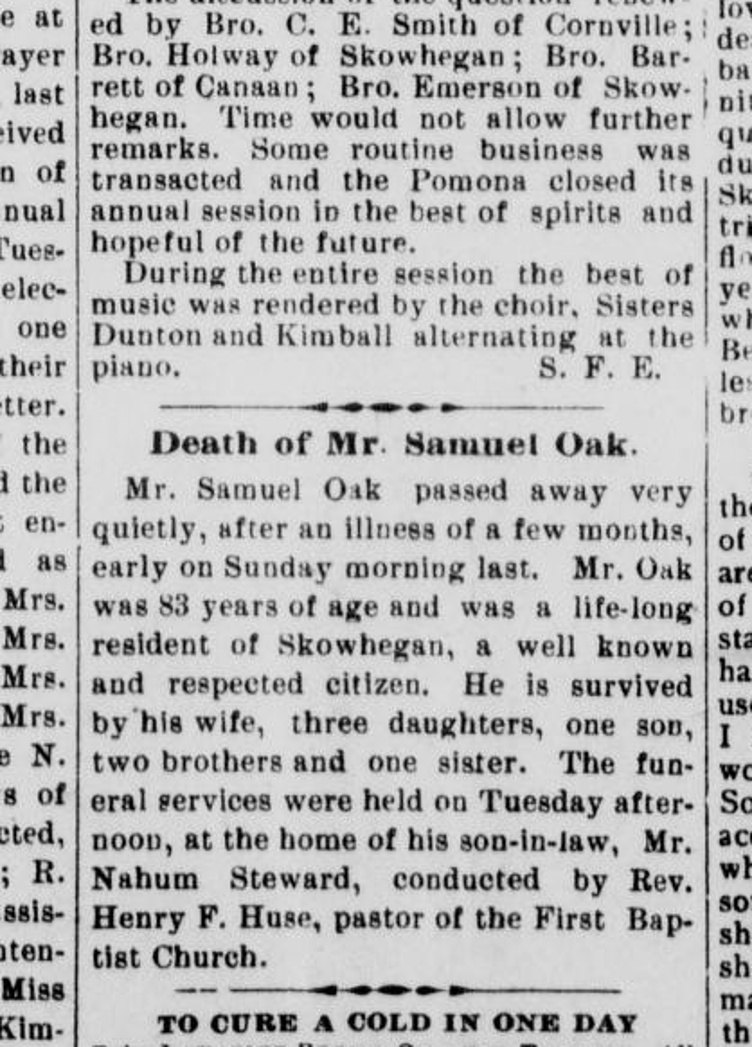
Source: Library of Congress, Chronicling America (public-domain newspaper page).
How it is shown: Complete image as supplied; no crop, no retouch, no search highlight.
Image details
The church's 1903 historical sketch says Lucinda had "joined in January 1838," and a 1912 birthday report calls her the congregation's oldest member; these are two separately dated accounts (Likely). Lucinda's story is on Lucinda. John Conant, the source of the family's cabin-boy Bible note, "united with the Baptist church" at eighteen in Ashburnham and served nearly forty years "as clerk and deacon" at Brandon, Vermont, as his 1856 obituary confirms.
The register adds church leadership across the family, all of it from the register alone. Beriah Oakes Jr. of Wendell, Massachusetts, Beriah's youngest son, "was a prominent Methodist, building at great sacrifice the First Methodist church in Wendell" (p. 31). Captain Nathaniel's son William, who left Chelsea in 1803-4 and settled in Indiana in 1815, was "an active Methodist, the meetings being long held in his home" (p. 35). Oliver Sampson of Ashburnham, Captain Jonathan's grandson through his daughter Mary, was "a prominent Methodist" (p. 59). Lydia (Oak) Conant's children went several ways: her son Calvin, a mechanic and physician, was "Clerk of Baptist church"; her son Eben of Geneva, Illinois, was "a prominent Unitarian"; and her daughter Sarah married Jonathan Merriam of Brandon, "a hatter by trade; Capt. of Militia; selectman, and Baptist deacon" (p. 51). In New York, William Oak's son Abraham of Bridgewater "held various town offices, especially in connection with the schools; and was an influential member of the Congregational church from 1804" (p. 28).
Dissent and variety
Not every record points toward conventional church membership. Henry Lebbeus Oak, the register's compiler, described himself in the same autobiography as "a thorough Agnostic, yet in sympathy with any religious belief that helps men to be better" (Likely). The cabin-boy's vow, in the Bible note the 1906 register prints, was a private promise never to go on the water again if God preserved him, a promise rather than a church affiliation (Family tradition).
Two later descendants are said, by the register alone, to have belonged to Shaker communities in Massachusetts and New York. The register calls one of those accounts a tradition; the other is a register statement (Likely). A third Shaker connection came by marriage: the register says Abel Shattuck, husband of Sylvanus Oak's daughter Lydia, "lived 10 years with the Shakers of New Lebanon, N. Y., a clothier by trade, and much employed in public affairs of Coleraine" (p. 46).
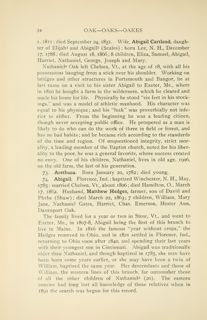
A register entry names another descendant, Hannah Oak's son King Follett, who "became a Mormon Elder" in 1831 and moved to Illinois by 1839. The Joseph Smith Papers' biography of King Follett names him "Son of John Follett and Hannah Oak (Oake) Alexander," so he is the King Follett for whom Joseph Smith preached the King Follett Discourse at Nauvoo in April 1844. The register says he "shared the presecution [sic] of the saints, being in jail in Richmond and Columbia, Mo., April to October, 1839, on a charge of robbery, but was acquitted on trial," and that he was "killed by a bucket of rocks falling upon him in a well" in 1844 (p. 55). His story is on King Follett.
What we're still looking for
Masonic membership is named but not documented by lodge records. The register calls William Oaks of Orland "high in Masonry," and the 1903 sketch names lodges for three of Lyndon's and Edson's sons: John Marshall Oak in St. John's Commandery, K. T., of Bangor and the Scottish Rite, thirty-second degree; Charles Edson Oak as Master of the Blue Lodge and High Priest of the chapter at Caribou; and Joseph Prescott Oak as Eminent Commander of De Molay Commandery, K. T. Church registers for Marlborough (1686-1741), Harvard (1749-1771) and several Maine and Vermont towns are known to exist but have not been fully read. The family's military service, including the Hastings, Seth Oak and Nathaniel Oak of Chelsea cases, is on Oak-line military service.
Sources
- H. L. Oak, Oak-Oaks-Oakes: Family Register (1906). Public domain; read the whole book: PDF, from the Internet Archive.
- Charles Hudson, History of the Town of Marlborough (1862), p. 426 and the printed list of those sustaining Rev. Emerson. archive.org/details/historyoftownofm00huds
- Lyndon Oak, History of Garland, Maine (Dover, Maine, 1912), pp. 279-280, 285-286, 296-307.
- "The Oaks of Garland" (unsigned; credited to Henry L. Oak in the 1912 History of Garland), in Biographical Sketches of Representative Citizens of the State of Maine (Boston, 1903), pp. 193-199.
- Catalogue of the Officers and Students of the Maine State College, 1875-6; Maine Public Documents, 1886, vol. 2, no. 7.
- Westborough Church Records (Colonial Society of Massachusetts transcription); Ebenezer Parkman's diary.
- Hale, Chelsea Centennial (1884), pp. 45-47.
- Vermont Chronicle (Windsor), July 22, 1856, p. 3 (John Conant's obituary).
- John Hanson, History of the Old Towns of Norridgewock and Canaan (1849), p. 371.
- Somerset Reporter (Skowhegan), October 29, 1903, p. 7 (church sketch, Lucinda's joining date); "Death of Mr. Samuel Oak," Somerset Reporter, January 11, 1900, p. 8; Independent-Reporter, October 3, 1912, p. 1 (Lucinda's 92nd-birthday report, oldest-member claim).
Fuller accounts are on Benjamin Hastings of Bolton, Captain Jonathan Oaks, Nathaniel Oak of Chelsea, Vermont, John Oaks of Exeter, Maine, Mary Holloway, Nathaniel Oake Jr. and Kezia of Bolton, Lucinda and the research log.